




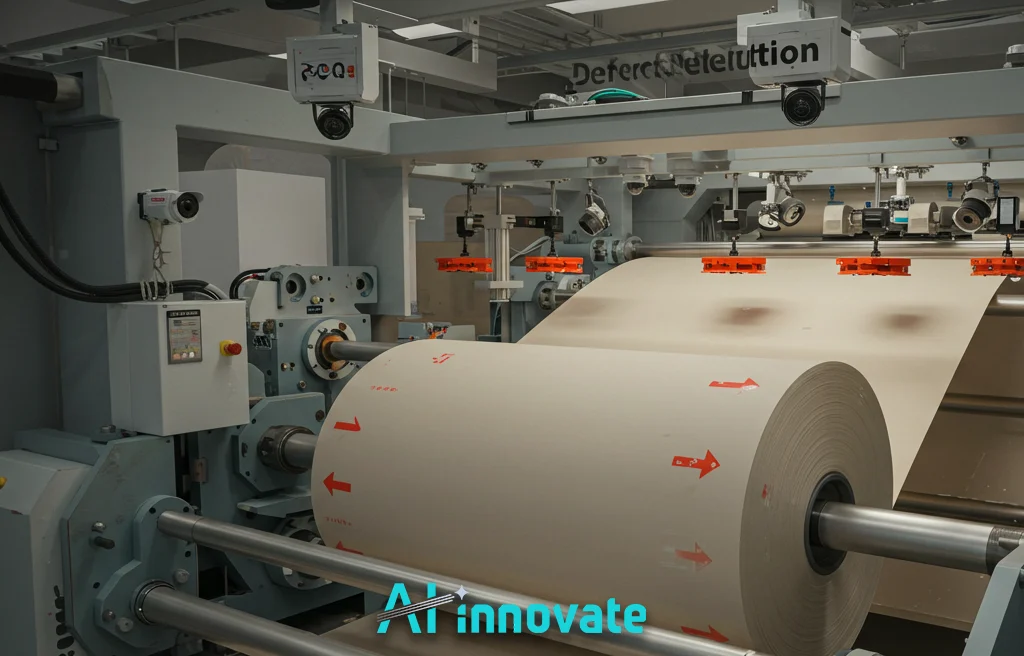
Paper manufacturing is a continuous, high-speed process in which small imperfections can quickly affect large volumes of output. Variations in fiber distribution, moisture levels, coating quality, or machine alignment can lead to defects that compromise the paper’s strength, appearance, and usability.
Traditional inspection methods often rely on manual sampling or basic camera systems, which may miss subtle flaws or detect issues too late. As customer expectations for consistency and sustainability increase, these limitations become more problematic. Artificial intelligence (AI) and machine vision are now transforming how paper producers monitor quality. AI systems analyze surface patterns and process data in real time to help detect defects earlier and with greater accuracy.
This article will explain how modern defect detection works in paper manufacturing, why it is important for productivity and cost control, and how intelligent inspection systems support reliable, high-quality production.

The Velocity Imperative in Web Inspection
The core challenge in paper quality assurance is not merely finding defects, but doing so on a continuous web of material often exceeding 10 meters in width, moving at incredible speeds. Human inspection is physically impossible, and traditional sampling methods are reactive, identifying problems only after significant waste has already occurred.
This operational velocity introduces several critical challenges that legacy systems simply cannot address, demanding a fundamental shift in inspection methodology. Consider these primary obstacles:
- High-Speed Blur and Data Volume: At production speeds, conventional cameras capture motion blur, while the sheer volume of visual data overwhelms standard processing units.
- Micro-Level Defect Sizes: Flaws such as pinholes, fine streaks, or spots can be as small as a few micrometers (µm), rendering them invisible to the naked eye.
- 24/7 Operational Demands: Production lines run continuously, requiring an inspection solution that is tireless, consistent, and operates without interruption or fatigue.
- Inherent Human Inconsistency: Subjectivity, fatigue, and variations in skill lead to inconsistent quality judgments between different inspectors or even the same inspector across shifts.
Read Also : Web Inspection System – Intelligent Quality Control
Microsecond Precision with Line-Scan Imaging
To overcome the challenges of speed and scale, the industry has turned to advanced machine vision for defect detection, specifically leveraging line-scan camera technology. Unlike area-scan cameras that capture a single rectangular frame at a time, line-scan cameras capture a single row of pixels at an extremely high frame rate.
As the paper web moves beneath the camera, these individual lines are stitched together in real-time by powerful processing software, creating a seamless, high-resolution digital reconstruction of the entire paper surface without distortion or gaps.
This is the cornerstone of effective modern Defect Detection for Paper Manufacturing. To appreciate its effectiveness, it’s helpful to understand the core operational principle behind this technology.
- High-Frequency Capture: The camera captures thousands of individual lines of image data per second, perfectly synchronized with the speed of the production line.
- Continuous Image Reconstruction: A dedicated image processor immediately assembles these lines into a complete, continuous image of the paper roll.
- Real-Time Algorithmic Analysis: Sophisticated algorithms, often powered by deep learning, analyze the reconstructed image in real-time to identify any deviation from pre-defined quality standards.
Quantifying Gains Beyond Defect Removal
The implementation of automated inspection systems delivers tangible returns that extend far beyond simply identifying flaws. These systems provide a clear, measurable impact on operational efficiency, material costs, and overall profitability.
The financial and operational gains are not abstract; they are documented across numerous industrial applications, providing a compelling business case for adoption. The data below, gathered from various industry reports, illustrates the quantifiable improvements our clients can expect when implementing advanced Defect Detection for Paper Manufacturing.
| Metric | Reported Improvement |
| Reduction in Web Breaks | Up to 50% |
| Annual Cost Savings | Approx. €500,000 |
| Decrease in Product Returns | 36% |
| Improvement in Overall Quality | 25% |
| Reduction in Energy Consumption | 17.3% |
| Increase in Production Efficiency | Up to 24.8% |
These figures demonstrate that a robust inspection system functions less as a cost center and more as a powerful driver of profitability and sustainability.
From Anomaly Detection to Defect Taxonomy
The evolution of intelligent inspection has graduated from simple go/no-go logic to a far more sophisticated diagnostic capability. A modern system’s true value is not merely in flagging an anomaly but in its ability to classify it with high precision, which is central to a modern Defect Detection for Paper Manufacturing strategy.
Beyond a Binary Pass/Fail
A simple “accept/reject” signal is operationally insufficient because it offers no insight for corrective action. Operations managers need to know not just that a defect occurred, but precisely what it is. This is the critical shift from basic anomaly detection to building a comprehensive defect taxonomy—a structured classification system that functions as a real-time diagnostic tool for your entire production line.
Achieving High-Fidelity Classification
By employing advanced deep learning architectures, such as hybrid models combining Convolutional Neural Networks with Support Vector Machines (CNN-SVM), these systems can achieve classification accuracy rates as high as 97.5% across diverse defect types.
This level of precision transforms the quality control system into a source of live, actionable intelligence. A recurring pattern of a specific defect can be traced back to its root cause, enabling a shift from reactive fixes to proactive process optimization.
Building a Practical Defect Library
This detailed classification forms a rich diagnostic library, allowing the system to distinguish between critical flaws with nuanced differences. Here are a few examples:
- Substrate Perforations: Distinguishing between clean pinholes versus fibrous tears, which may indicate different mechanical stressors on the paper web.
- Contaminant Analysis: Identifying the nature of a spot, such as differentiating an oil stain (indicative of a machinery leak) from organic debris like an insect.
- Formation Flaws: Classifying structural imperfections, from subtle coating non-uniformities and streaks to more severe wrinkles and folds that compromise integrity.
- Edge and Trim Defects: Monitoring for issues like edge cracks or delamination that are critical for downstream converting processes.
Accelerating Vision Systems via Emulation
For the technical developers and R&D specialists tasked with creating and refining these sophisticated vision systems, the development lifecycle presents its own set of challenges. Prototyping and testing new models often hinge on the availability of specific, expensive industrial camera hardware.
This reliance can create significant bottlenecks, slowing down innovation and increasing project costs due to hardware procurement, setup, and maintenance. This is a critical friction point in the deployment of better Defect Detection for Paper Manufacturing.
To address this, we developed AI2Cam, our powerful camera emulation software. This tool decouples software development from physical hardware constraints. AI2Cam allows engineers to simulate a wide range of industrial cameras and imaging conditions directly on their computer.
They can test their algorithms against various resolutions, lighting scenarios, and defect types in a virtual environment, drastically accelerating prototyping cycles. This accelerates innovation, reduces capital expenditure on testing hardware, and fosters remote collaboration between development teams.

Architecting Your Intelligent Quality Framework
The insights and technologies discussed here are not disparate components; they are the building blocks of a comprehensive, intelligent quality framework. At AI-innovate, our role is to help you architect and implement this framework.
For industrial leaders, our AI2Eye system provides the robust, real-time inspection capabilities needed to drive down waste and boost efficiency on the factory floor. For technical teams, our AI2Cam software provides the agility and flexibility to develop and deploy next-generation vision solutions faster than ever before.
This dual approach ensures that both your operational and developmental needs are met within a single, cohesive strategy. If you are ready to move beyond reactive quality control and architect a proactive, data-driven framework for excellence, our team of specialists is prepared to design a bespoke solution tailored to your unique production environment.
Conclusion
In the context of paper manufacturing, defect detection has evolved into a critical component of efficient and sustainable production. Manufacturers can gain deeper insight into surface quality and process stability by combining high-resolution imaging with machine learning. These systems allow for quicker responses to quality issues, improved yield, and more consistent product standards. As production demands increase, intelligent inspection becomes essential for maintaining competitiveness.
From what I’ve seen working with industrial vision systems, the biggest advantage of AI in paper inspection is control. When operators understand defect patterns in real time, they can stabilize processes and prevent recurring problems. As technologies advance, AI-driven web inspection will be more integrated with process optimization, supporting smarter, more resilient paper production operations.
Note: Some graphics and visuals in this post were produced using AI-generated content.