




Electronic components need to meet strict quality standards as the smallest defects can lead to performance problems or costly rework later in production. In electronics manufacturing, inspection is required to be both fast and accurate, especially when printed circuit boards and other components move quickly through the line. Traditional inspection methods are still in use, but they may struggle when facing small, varied, or difficult to spot defects.
Deep learning provides inspection systems with a more intelligent way to analyse images, identify defects and enhance consistency. It can help manufacturers to detect visible issues on circuit boards and identify missing or damaged components, supporting quality control in production environments where speed is of the essence.
In this blog, we’ll look at common PCB defects, the main deep learning approaches used for detection, the recommended model choices for practical projects, and the typical workflow for deploying these systems.
Improve Electronic Component Inspection , with Deep Learning
Detect micro-defects, reduce false positives, and automate inspection workflows using AI-powered deep learning vision systems.

Understanding Common PCB Defects
Printed circuit boards can face many different types of defects, and these problems can appear at different stages of manufacturing. Some defects affect the surface, some involve the components themselves, and others are related to circuit quality or assembly.
Because these defects vary so much in appearance and severity, deep learning can be useful for improving how they are detected.
Common PCB defects include:
- Surface defects, such as scratches, contamination, stains, or other visible issues on the board.
- Component defects involve damaged, missing, wrong, or misplaced parts.
- Circuit defects include shorts, opens, missing holes, or broken traces.
- Assembly errors, involving incorrect placement, rotation, alignment, or soldering problems.
This Topic might also interest you :
Different Deep Learning Approaches for Electronics Inspection
The type of defect detection problem determines which deep learning model is used. Some are better suited to simple pass-fail decisions, while others are more effective at locating or outlining the exact area of the defect.

Classification Models
Classification models are used when the goal is to decide whether an image or image crop is defective or non-defective. Instead of locating the exact defect, the model simply predicts the class. These models are useful when the inspection task is simple and the main goal is to separate good parts from bad parts.
Typical classification models include:
- ResNet
- EfficientNet
- MobileNet
- Custom CNNs
Object Detection Models
Object detection models are used when the defect must be located with a bounding box. This is one of the most common approaches in practical production settings because it helps the system not only detect the problem, but also show where it is.
YOLO-family models are especially popular because they offer a strong balance between speed and accuracy. This is of great importance in manufacturing environments where inspections need to happen in real time.
Common examples include:
- YOLOv7-tiny variants
- YOLOv8
- YOLOv9
- YOLOv11-based PCB detectors
- Lightweight PCB-specific YOLO adaptations
These models are often used for detecting missing, misplaced, rotated, wrong, or visibly damaged components.
This Topic might also interest you :
Segmentation Models
Segmentation models are used when the exact defect shape or solder-region boundary matters. Instead of drawing a box around the defect, the model outlines the defect area at the pixel level.
These methods are useful for detailed inspection tasks, especially when more precise information is needed about the size or shape of the defect. Mask R-CNN has been studied for PCB defects such as missing holes and shorts.
Common segmentation models include:
- Mask R-CNN
- U-Net
- DeepLab
- Segment Anything-style pipelines
Anomaly Detection Models
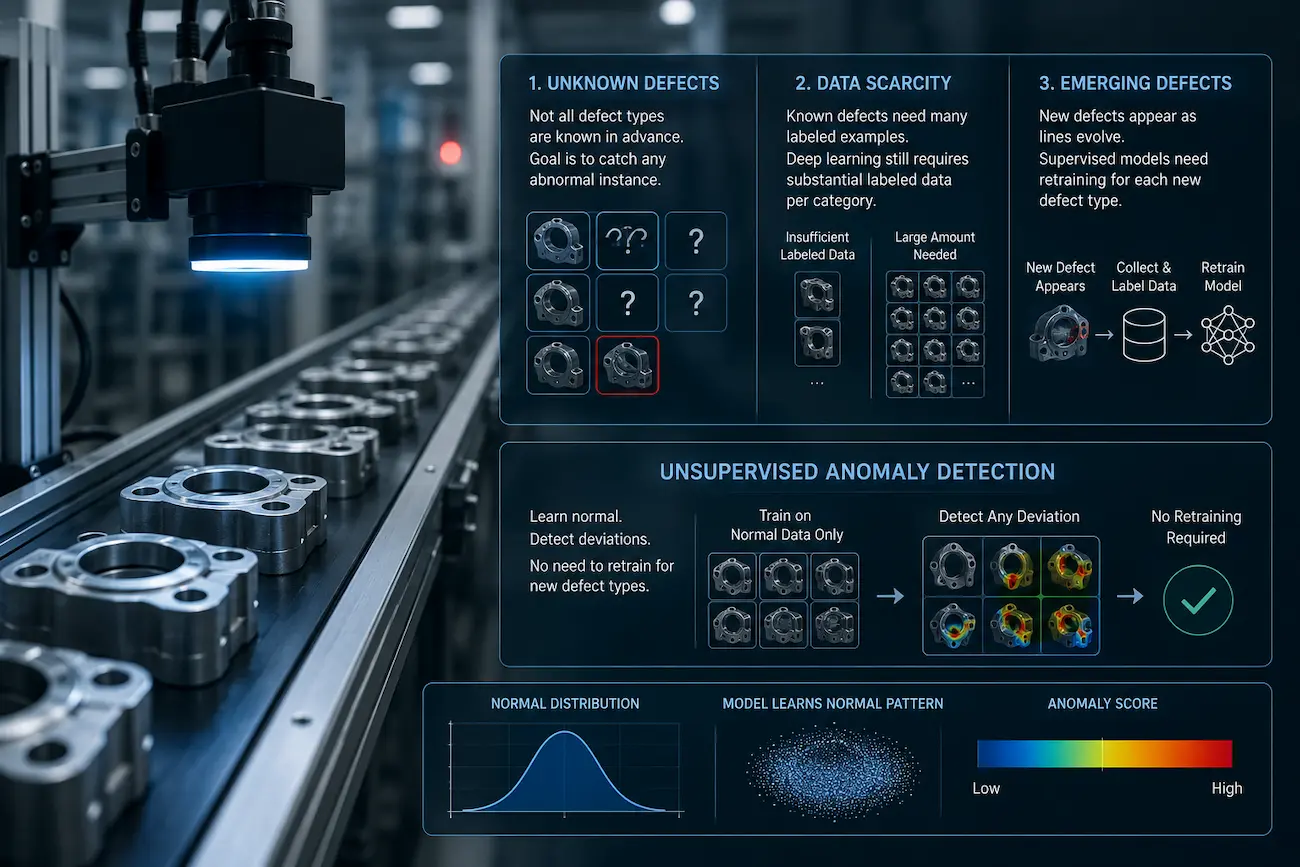
Anomaly detection models are useful when defective samples are rare. In many electronics manufacturing environments, there may be many examples of normal boards but very few examples of actual failures.
These models learn what a normal board or component looks like and then flag anything that doesn’t match that. This approach can be very valuable when collecting enough defective examples for training is difficult.
Common anomaly detection approaches include:
- Autoencoders
- PaDiM
- PatchCore
- Student-teacher models
- Reconstruction-based methods
Which Deep Learning Model Should You Use?
The best model for a practical production project depends on the inspection goal and the type of training data available.
For identifying missing, misplaced, incorrect, rotated or damaged components, a YOLOv8 or YOLOv11-style object detection model is a good choice. These models often perform well in real production lines because they balance speed and detection performance effectively.
However, if the defect boundary is more important, such as in solder-area inspection, Mask R-CNN or U-Net may be a better option. These models provide more detailed localisation and are useful when exact shape or area measurement is important.
If there are many normal samples but very few defective ones, PatchCore or PaDiM can be a practical choice. These anomaly detection models help manufacturers to identify unusual patterns without the need for large numbers of defective examples.
In simple terms:
- Use YOLO-style models for visible component-level defects
- Use Mask R-CNN or U-Net when precise defect boundaries matter
- Use PatchCore or PaDiM when defective samples are limited
How the Inspection Process Usually Works
Deep learning-based electronic component inspection usually follows a clear workflow from image capture to real-time deployment.
Image Acquisition
The first step is image acquisition. This usually involves industrial cameras, controlled lighting, and fixed board positioning so that the captured images are consistent.
In some cases, manufacturers may also use multi-angle imaging or X-ray imaging, especially when inspecting solder-joint defects or internal issues that are harder to see from the surface.
Data Preparation
Next comes data preparation. Manufacturers collect images of both normal and defective components and label them according to the task. Depending on the model type, labels may include:
- Bounding boxes
- Segmentation masks
- Image-level class labels
Good data preparation is important since model quality depends heavily on the quality and variety of provided training examples.
Model Training
The next step is model training. In many projects, teams start with a pretrained model such as YOLO, EfficientNet, ResNet, or Mask R-CNN and then fine-tune it using their own inspection data. This reduces time needed for training and usually improves performance compared to training from scratch.
Evaluation
Once trained, the model must be evaluated carefully before deployment. Common evaluation metrics include:
- Precision
- Recall
- F1-score
- mAP
- False reject rate
- False accept rate
In manufacturing, low false negatives are especially important because missed defects may reach customers and create larger quality problems later.
Deployment
After evaluation, the model is prepared for deployment on the production line. This often means exporting it into a format that supports fast real-time inference. Common deployment formats include:
- ONNX
- TensorRT
- OpenVINO
- Edge-device formats
Turn Deep Learning for Electronics Inspection into Measurable Quality Gains
Deep learning only creates value in electronic component inspection when it is deployed with the right imaging setup, data strategy, and real-time inference capability. Moving from manual checks and traditional inspection methods to reliable production-line performance requires robust vision pipelines, scalable edge processing, and models that can detect small, varied defects accurately at manufacturing speed.
At AI-innovate, we help electronics manufacturers bridge the gap between deep learning theory and shop-floor execution by providing:
- Intelligent visual inspection with AIxEye, enabling real-time detection of PCB surface defects, missing or damaged components, assembly errors, and other visible quality issues across high-speed electronics production lines
- Edge AI infrastructure with AIxCore (powered by NVIDIA Jetson Orin AGX) for fast image processing, on-site inference, and multi-camera inspection directly where production decisions need to happen
- Synthetic data capabilities through AIxCam, helping teams strengthen inspection models when defective samples are limited, defect variation is high, or rare failure cases are difficult to capture in sufficient volume
Whether you’re improving inspection for a single electronics line or scaling deep learning across multiple PCB and component quality workflows, the key is combining reliable image capture, explainable AI models, and industrial-grade deployment built for real manufacturing environments.
Conclusion
Deep learning is becoming an important tool for detecting defects in electronic components. Deep learning models can support a wide range of inspection tasks, from identifying surface defects and assembly errors to locating missing components and diagnosing circuit issues. When used as part of an efficient workflow that encompasses everything from image acquisition and labelling to training, evaluation, and deployment, these systems can become a valuable asset in the quality control of electronics manufacturing.
As production lines continue to speed up and become more automated, we believe deep learning is likely to play an even bigger role in helping manufacturers improve quality and reduce defects.
FAQ
What hardware is required for deployment?
Industrial deployment usually requires GPU-based systems (like NVIDIA Jetson for edge devices or standard high-performance GPUs for servers) to maintain low latency. For example, compact models like the LDLFModel are designed specifically to run in under 13 ms on standard industrial hardware.
How much data do I need?
Deep learning models typically require thousands of annotated images to generalize well. Modern datasets for robust training, such as DsPCBSD+, contain over 10,000 annotated images covering various defect categories.
Can deep learning detect defects traditional AOI misses?
Yes. Deep learning excels at identifying “soft” defects that rule-based systems struggle with, such as:
- Tilted or shifted components.
- Component polarity issues (reversed orientation).
- Complex solder defects like bridges or voids that vary significantly in visual appearance
Sources
Ai-Innovate uses only high-quality sources, including peer-reviewed studies, to support the facts within our articles.
- arXiv. (2025). Automated Defect Detection for Mass-Produced Electronic Components Based on YOLO Object Detection Models — A research paper on using YOLO-based deep learning models and data augmentation to improve automated defect detection for high-volume electronic components. Retrieved from https://arxiv.org/html/2510.01914v1
- Journal of Intelligent Manufacturing / Springer Nature. (2025). Deep Learning Model for Automated Visual Inspection of Electronic Boards — An academic study focused on deep learning-based visual inspection for electronic boards, with relevance to automated optical inspection and production-line quality control. Retrieved from https://link.springer.com/article/10.1007/s10845-025-02748-5
- Results in Engineering / ScienceDirect. (2025). Deep Learning-Enhanced Defects Detection for Printed Circuit Boards — A research article on real-time PCB defect inspection using computer vision and deep learning, including crack and scratch detection under different lighting conditions. Retrieved from https://www.sciencedirect.com/science/article/pii/S2590123025001550
- Opsio. (2025). Deep Learning for Electronic Component Defect Detection — A practical industry guide covering deep learning architectures, training strategies, and deployment considerations for defect detection in electronics manufacturing. Retrieved from https://opsiocloud.com/blogs/deep-learning-for-electronic-component-defect-detection/
- Machine Learning and Knowledge Extraction (MDPI). (2026). Deep Learning Algorithms for Defect Detection on Electronic Boards: A Review — A review article examining deep learning approaches for defect detection on electronic boards, with emphasis on automated and rapid inspection in electronics manufacturing. Retrieved from https://www.mdpi.com/2504-4990/8/1/5