




A single unnoticed flaw in a leather surface can change how a product feels, performs, and is perceived by the customer. In industries where craftsmanship and consistency define brand value, even minor defects can lead to costly rework and lost trust. Traditional leather inspection methods often rely on manual checks, subjective judgment, and delayed feedback, making it difficult to maintain uniform quality at scale.
As production volumes grow and customization increases, these limitations become more visible. Manufacturers are now turning to AI-powered inspection systems to bring greater accuracy and reliability into the process. In this article, you will explore how modern leather defect inspection works, the challenges it addresses, and how intelligent vision technologies help manufacturers achieve consistent, high-quality results across different materials and applications.

A Quick Comparison Between Manual and Intelligent Inspection
Leather is far from a uniform industrial material. As a natural product, it has inherent variations in texture, color, and density. This organic complexity poses a significant technical challenge for automated inspection. Even experienced human inspectors achieve variable accuracy, typically between 70% and 85%, affected by fatigue, lighting, and other environmental factors.
The table below contrasts the limitations of manual processes with the capabilities of an intelligent inspection system.
| Feature | Manual Inspection Challenges | Intelligent System Capabilities |
| Consistency | Subject to human error, fatigue, and cognitive bias | Unwavering, 24/7 operational consistency |
| Accuracy | 70-85% accuracy under ideal conditions | Potentially exceeds 99% accuracy |
| Speed | Limited by human visual and cognitive processing speed | Can inspect hundreds of images per second |
| Objectivity | Dependent on individual interpretation and training | Standardized, metric-based defect classification |
| Lighting | Highly sensitive to changes in ambient light | Optimized and controlled lighting environments |
Decoding Defects with Deep Learning
To overcome the challenges of material subtlety, modern inspection systems rely on sophisticated deep learning models. These algorithms are trained to perceive and classify imperfections with a level of granularity far beyond human capability.
Understanding these core technologies is key to appreciating their power in a production environment. The following are a few of the foundational models driving this technological shift.
Convolutional Neural Networks (CNNs)
CNNs are the bedrock of modern image analysis. These networks are specifically designed to process pixel data by applying a series of filters that can identify hierarchical patterns. In the context of leather inspection, a CNN can learn to recognize basic features like edges and textures in its initial layers, gradually building up to identify complex defects such as scratches, holes, and insect bites in its deeper layers.
You Only Look Once (YOLO)
YOLO is an object detection algorithm prized for its incredible speed and efficiency. Unlike traditional models that scan an image multiple times, YOLO processes the entire image in a single pass. This makes it ideal for real-time applications on a fast-moving production line, where it can rapidly identify and draw bounding boxes around multiple defect locations simultaneously. The implementation of a system based on Leather Defect Inspection ensures the highest quality.
Semantic Segmentation
For the most demanding applications, semantic segmentation models offer an unparalleled level of detail. Instead of simply placing a box around a defect, these models classify every single pixel in the image. This allows the system to not only detect a flaw but also to map its exact shape, size, and boundaries. This granular data is invaluable for advanced grading and automated cutting systems that need to optimize the usable area of a hide.

Engineering the Automated Inspection Cell
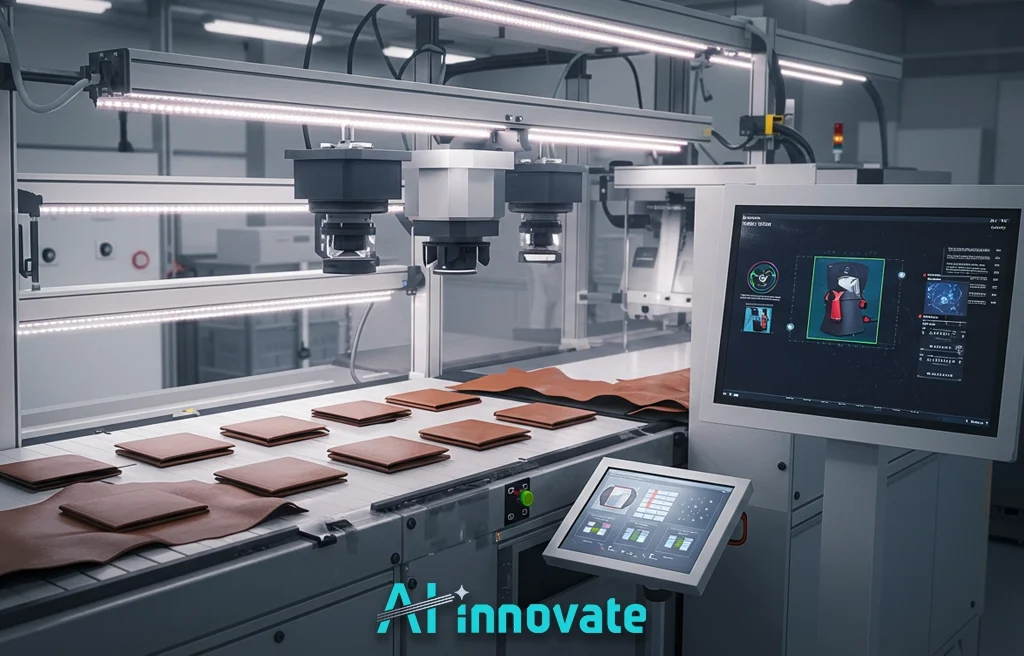
Translating algorithmic precision into a robust industrial solution requires thoughtful engineering of the physical inspection environment. A typical automated inspection cell is more than just a camera and a computer; it is an integrated system designed to create optimal conditions for data capture.
This involves using specialized hardware like high-resolution line scan cameras, which build a seamless, distortion-free image of an entire hide as it moves along a conveyor. To counteract the natural wrinkles and folds of the material, systems often incorporate flattening rollers to present a uniform surface to the camera.
Building and deploying such a system follows a clear, structured path. Let us outline the essential steps to bring this technology to your factory floor:
- Hardware Configuration: The process begins with selecting the right industrial camera, lens, and lighting setup to ensure high-contrast, high-resolution images that make defects clearly visible.
- Data Acquisition and Preparation: One of the most compelling advantages of modern systems is their ability to train on relatively small datasets. Some models can achieve high accuracy with as few as 100 images of acceptable products and just 20 images of defective ones.
- Model Training and Validation: This is where a tool like our AI2Cam becomes invaluable. By emulating the chosen camera and lighting conditions, your development team can train, test, and fine-tune the inspection model in a virtual environment, drastically reducing the time and cost associated with physical prototyping. A robust Leather Defect Inspection process can be simulated to optimize its parameters.
- Deployment and Integration: Once the model is validated, it is deployed onto the edge computing device within the inspection cell, where it begins analyzing the product flow in real time and integrating with your factory’s Manufacturing Execution System (MES).
Read Also: Defect Detection in Manufacturing – AI-Powered Quality
Architecting Your Inspection Engine
You now have a clear blueprint of what it takes to elevate your quality control from a subjective, manual process to a data-driven, automated system. The next step is to translate this knowledge into a competitive advantage.
This is not about simply buying a product; it is about architecting an inspection engine tailored to your unique operational needs and technical goals.
At AI-innovate, we provide the specialized tools to build that engine. For industrial leaders focused on immediate ROI and seamless integration, our AI2Eye system offers a turnkey solution that delivers proven efficiency gains and waste reduction.
For your technical teams, AI2Cam provides the ultimate sandbox for innovation, empowering them to simulate, prototype, and perfect vision systems faster than ever before. Contact our experts to design a solution that transforms your production line.
Conclusion
Leather defect inspection has evolved from a manual, experience-based practice into a data-driven quality control process supported by artificial intelligence. By using machine vision and real-time analysis, manufacturers can detect surface imperfections earlier, improve material utilization, and maintain consistent standards across production batches. These systems not only enhance inspection accuracy but also support better planning and resource management.
From my experience working with industrial vision and quality systems, the most valuable shift is not just automation, but confidence. When manufacturers trust their inspection data, they can make faster decisions and invest in long-term improvement. As AI inspection technologies continue to mature, I believe they will become an essential foundation for high-quality leather manufacturing and sustainable production practices.
Note: Some graphics and visuals in this post were produced using AI-generated content.