




Other material surfaces either have a defect or they don’t. Ceramic is different, because every piece carries a glaze that introduces its own class of defects on top of whatever the body brought out of the kiln.You’re not inspecting one material, but two, and they interact.
That complexity is why ceramic defect detection has stayed manual. Rule-based machine vision doesn’t handle a matte white tile and a high-gloss printed tile on the same line. Human inspectors adapt. Rules don’t. We’ve worked with ceramic manufacturers on both sides of that problem. The shift isn’t primarily about speed but rather what becomes reliably detectable.
This guide covers how ceramic defects form, why lighting and training data are the hard problems, and what AI inspection can actually deliver on a production line.
What Is Ceramic Defect Detection?
Ceramic defect detection is the process of identifying and classifying surface flaws on ceramic products before they leave the production line. It applies across floor and wall tile, sanitaryware, tableware, and technical ceramics. In every case, the goal is the same: catch flaws that would cause a reject, a return, or a field failure, without pulling conforming pieces off the line.
What makes ceramic different from most other inspected materials is the two-layer structure of the final product. The ceramic body carries body-origin defects formed during pressing, drying, or firing. The glaze layer, applied on top, carries its own set of defects introduced during glazing and firing.
What Types of Defects Do Ceramic Surfaces Actually Carry?
Ceramic surface defects split cleanly into two groups by origin: defects that come from the body and survive to the surface, and defects that are created in the glaze layer itself during application or firing.
Body-origin defects
These begin in the clay or forming process and show up at the surface after firing. Cracks are the most common: they form during rapid drying or uneven shrinkage, run through the body structure, and can be hairline-thin or clearly open. Pressing flaws, such as lamination lines or density variations, can also propagate to the surface. Body cracks are generally structural rejections, not just cosmetic ones, because they create stress concentration points that shorten service life.
Glaze-origin defects
These form in the glaze layer during application or kiln firing and are the harder inspection problem. Color contamination, spots, and glaze blobs round out the category.
The inspection challenge with glaze defects is that they’re often visually subtle, highly dependent on lighting angle, and easy to confuse with intentional surface texture, especially on printed or decorative glazes.
| Defect Type | Origin | Visual Signature | Inspection Challenge |
|---|---|---|---|
| Color Contamination | Kiln atmosphere or material impurity | Unexpected color shifts or patches | Difficult to distinguish from intentional glaze variation |
| Spot / Blob Defect | Excess glaze accumulation | Raised dots or irregular glaze clusters | Easily confused with decorative surface texture |
| Glaze Runs | Over-melting during firing | Vertical or diagonal flow marks | Subtle on glossy surfaces, depends heavily on lighting |
| Pinholes | Gas release during firing | Microscopic holes in glaze surface | Hard to detect without angled illumination |
| Surface Clouding | Improper cooling cycle | Hazy or foggy glaze appearance | Low contrast makes detection inconsistent |
Why Is Lighting the Hardest Part of Ceramic Surface Inspection?
Lighting is the hardest part of ceramic inspection because ceramic surfaces span a wider reflectivity range than almost any other inspected material, from flat matte finishes that absorb light to high-gloss glazes that mirror the camera, often within the same product range or even the same line.
The same defect looks completely different depending on the finish beneath it. On a matte surface, a pinhole creates a small shadow under raking light and becomes detectable. On a gloss surface, that same raking light produces specular reflections that wash the shadow out entirely.
Advanced ceramic inspection systems solve this with multi-angle illumination rigs that fire in sequence:
- Low-angle illumination catches surface height variation, blisters, and edge defects
- Intermediate-angle illumination reveals cracks and linear features
- High-angle illumination captures color anomalies and contamination
Together they build a composite image that extracts defect signatures no single lighting angle would reveal.
For AI-based systems, this has a downstream consequence in training data. A model trained under one illumination setup won’t generalize to a different lighting configuration on the same product. Lighting design and model training have to be co-developed, not treated as separate steps.
What Can AI Actually Do for Ceramic Defect Detection?
AI improves ceramic defect detection by learning to separate real defects from acceptable glaze variation on complex backgrounds, the specific task that rule-based vision systems can’t handle reliably on textured or printed surfaces.
What AI delivers on a ceramic line in practice:
Consistent classification across glaze types
A well-trained model handles matte, satin, and gloss finishes without being reconfigured for each product changeover.
Detection of defects that fatigue hides
Pinholes and early-stage crazing are the exact defect types that human inspectors miss at the end of a long shift. They’re also the types AI catches most reliably once the imaging setup is right.
Classification, not just detection
The system outputs defect type and location, which informs the grading decision. A pinhole on food-contact tableware is a hard reject. The same size anomaly on a floor tile may be a downgrade. The model can be configured to apply different rules to different defect classes.
Speed
Single-stage object detectors such as YOLO variants process frames at production line rates without needing GPU clusters, especially when inference runs on edge hardware co-located with the line.
This is one of the clearest cases for AI for material defect identification across any substrate: the combination of high natural variation and surface complexity is exactly the problem learning-based methods are designed for, and it’s exactly the problem that makes rule-based approaches fail on ceramic.
Where Does an AI Inspection System Fit on a Ceramic Production Line?
The inspection system fits between the end of the kiln cooling conveyor and the sorting or palletizing station, after every defect that can form has formed, and before any downstream handling that would complicate the grading decision.
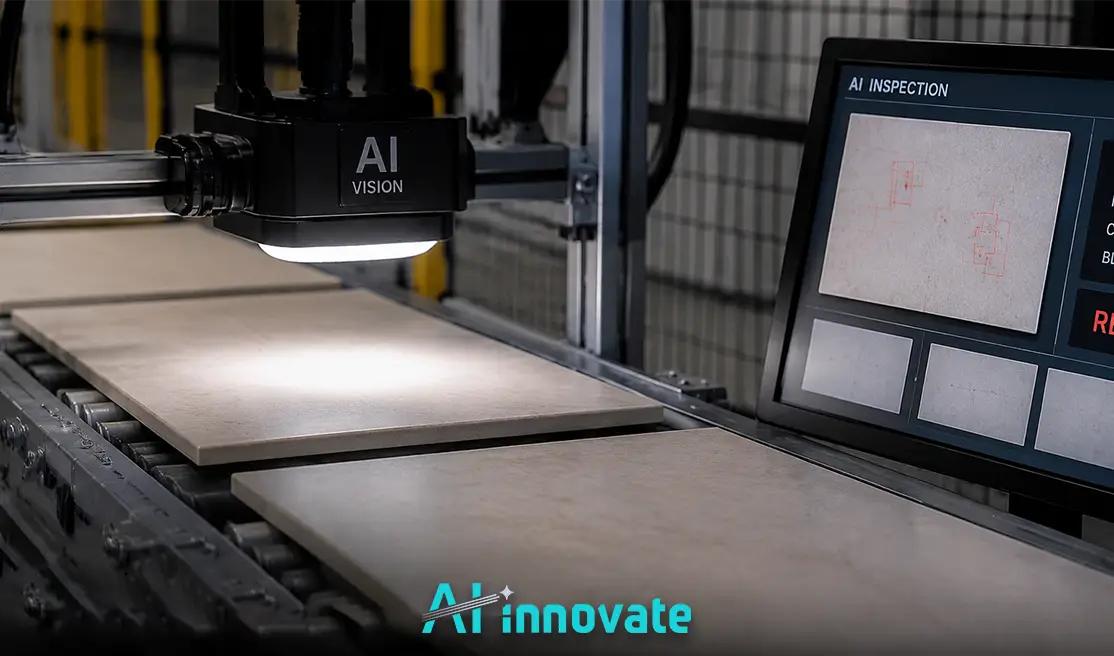
For flat tile, this is a single-station setup: camera array above the conveyor, controlled illumination enclosure, AI inference on edge hardware, output signal to the sorting gate. For sanitaryware and three-dimensional tableware, the geometry requires either multiple camera angles or a turntable system that presents different faces of the piece to the camera in sequence.
A machine vision system for defect detection on a ceramic line typically has four components working together:
- Imaging station: industrial cameras matched to the resolution needed for the smallest target defect, with illumination designed for the specific glaze finish in production.
- Edge compute: on-site inference hardware that runs the AI model at line speed without cloud dependency. For ceramic lines where network connectivity is unreliable, on-premise processing isn’t optional.
- Decision logic: rules that map defect type, size, and location to a grading outcome. The same physical defect gets classified differently depending on where it falls on the piece and what the end application is.
- Feedback loop: a process for routing borderline cases to human review and using confirmed calls to improve the model over time. This is what turns a static deployment into a system that gets better as it runs.
How AI-innovate Supports Ceramic Defect Detection
We work with ceramic manufacturers to deploy inspection systems that are tuned to their actual product range, not built on generic ceramic data and handed over. The line-specific work is where most AI inspection projects succeed or fail, and it’s what we focus on from the first scoping conversation.
The products we deploy for ceramic surface inspection:
- AIxEye handles real-time defect detection and process optimization on the line, classifying cracks, pinholes, blisters, crazing, crawling, and color anomalies across tile, sanitaryware, and tableware at production speed.
- AIxCore is the industrial AI edge computer that runs inference on-site, powered by NVIDIA Jetson Orin AGX. For ceramic lines where the imaging enclosure sits in a dusty, high-temperature environment, edge deployment is the only architecture that’s both reliable and latency-free.
- AIxCam provides simulation tools for camera configuration and synthetic training data generation, which is directly relevant to ceramic’s class imbalance and glaze variability problems. Rare defects on complex glaze backgrounds can be generated at volume before they appear enough times on the live line to train from.
- AIxAm detects surface and geometry defects on three-dimensional ceramic pieces by analyzing multi-view images and depth data in real time, covering warping, edge chipping, and dimensional deviation in addition to surface flaws.
The starting point is always the same: your glaze types, your defect mix, your line speed, and your acceptable quality level. The surface defect detection setup follows from those constraints, not the other way around.
Book a demo and we’ll scope a ceramic inspection setup around your specific product range, from illumination design through model tuning and edge deployment. Reach us at Info@ai-innovate.com or +1 (514) 813-1809.
Final Thoughts
Ceramic is a two-layer inspection problem, and most inspection failures come from treating it as one. The body and the glaze each carry their own defect classes, they interact during firing, and the glaze’s reflectivity determines whether a defect is even visible to the camera or the inspector standing in front of it. Any inspection system that doesn’t start from that reality will underperform on the defects that matter most.
The manufacturers who get ceramic defect detection right build the imaging and the model together, with illumination designed for their specific glazes and training data that covers their actual defect mix including the rare classes. That combination, reliable imaging, line-specific training, and edge inference that keeps up with production, is what turns ceramic inspection from a bottleneck into a controllable quality gate.
Frequently Asked Questions
Sources
Ai-Innovate uses only high-quality sources, including peer-reviewed studies, to support the facts within our articles.
- Sun et al. (2025). Ceramic tableware surface defect detection based on deep learning. Engineering Applications of Artificial Intelligence, 141. https://www.sciencedirect.com/science/article/abs/pii/S0952197624018815
- Zhou et al. (2025). Research progress in deep learning for ceramics surface defect detection. Measurement, 242. https://www.sciencedirect.com/science/article/abs/pii/S0263224124018414
- Cumbajin et al. (2024). A Real-Time Automated Defect Detection System for Ceramic Pieces Manufacturing. Sensors, 24(1), 232. https://doi.org/10.3390/s24010232
- Glaze and Body Defects in Industrial Ceramics. ResearchGate (2025). https://www.researchgate.net/publication/397796955_Glaze_and_Body_Defects_in_Industrial_Ceramics
- US Patent 11,226,295 – Ceramic body defect inspecting apparatus and defect inspecting method. https://image-ppubs.uspto.gov/dirsearch-public/print/downloadPdf/11226295
- Glaze Surface Defects: Causes and Prevention Controls. Setec SRL (2022). https://www.setec-srl.com/wp-content/uploads/2024/04/2022-00003.pdf