





A finished oak panel can be worth ten times what the same board was as rough lumber. A missed crack or a misjudged knot can wipe that value out in a single cut. Wood is unforgiving that way: it carries enormous variability, the line between a feature and a flaw is hard to see, and every grading decision ripples through downstream yield, cost, and customer trust. That’s why wood defect detection has stayed labor-intensive long after other industries automated their inspection.
This guide covers the defects that drive most rejects on a wood line, how they’re being caught today, where AI is changing the economics of wood surface inspection, and what to look for if you’re ready to move past manual grading.
Transform Wood Inspection with AI-Powered Defect Detection
Move beyond manual grading and rule-based machine vision. Learn how machine vision for defect detection and deep learning improve accuracy, speed, and consistency in industrial wood inspection systems.
What Is Wood Defect Detection?
Wood defect detection is the process of identifying flaws on wood surfaces, such as knots, cracks, and resin pockets, before the piece moves further down the production line. It applies across sawmills, plywood and panel production, flooring, furniture manufacturing, and structural lumber, anywhere the surface quality of wood determines the value of the finished product.
The challenge with wood, more than with most materials, is that natural features and real defects can look very similar. A live knot might be acceptable in one product and rejectable in another. Grain variation is normal but can be mistaken for a flaw. Getting the call right consistently is what separates good wood inspection from a steady stream of false rejects and customer escapes.

What Are the Most Common Wood Surface Defects?
The most common wood surface defects are knots, cracks, resin pockets, wormholes, and discoloration. Public industrial datasets used to train modern detection models typically label ten or more distinct defect classes, but most production lines focus on the handful that drive the majority of rejects.
Live and Dead Knots
A live knot is firmly attached to surrounding wood and sometimes cosmetically acceptable, while a dead knot is loose or detached from the wood around it. Dead knots are usually the higher-priority defect because they can fall out and create holes, but both need to be located accurately to decide whether to cut around them.
Resin Pockets and Pitch
Resin pockets are cavities filled with sap or pitch. They affect appearance and can interfere with finishing and gluing, which makes them a recurring issue in furniture and flooring lines.
Wormholes and Insect Damage
Wormholes are small voids left by insect activity. They’re cosmetic in low-grade products but reject-grade in higher-value finishes, so accurate classification matters more than detection alone.
Discoloration and Stain
Blue stain, mineral streaks, and other discoloration usually don’t affect strength but reduce visual grade in finish-critical applications. They’re some of the hardest defects to call reliably because they shade gradually into normal grain variation.
Missing Knots, Marrow, and Quartzity
These are less common but show up in detailed defect taxonomies. Missing knots are holes where a knot has fallen out, marrow refers to pith at the center of the tree, and quartzity describes mineral-rich abnormalities. They’re worth knowing about if you’re building a model that needs to handle the full range a real sawmill produces.
How Is Wood Surface Inspection Done in 2026?
Wood surface inspection is done through a combination of manual visual checks, traditional machine vision systems, and increasingly, AI-based vision systems trained on wood-specific defect data. Each approach handles different parts of the problem.
| Approach | Best At | Limitation |
|---|---|---|
| Manual Visual Inspection | Subjective judgment on wood grade and finish quality | Slow, inconsistent across shifts, fatigue-prone |
| Traditional Machine Vision | High-speed detection of clear, consistent defects | Struggles with natural variation and subtle wood defects |
| AI / Deep Learning Vision | Detecting subtle and irregular defects across varied grain patterns | Requires quality training data and ongoing model tuning |
Most production lines today still rely on human inspectors for final grading, with traditional vision handling speed-critical checks. The shift toward AI is driven by the same problem that’s hard for both: telling a real defect apart from a natural feature when the two look almost identical.
How Does AI Improve Wood Defect Detection?
AI improves wood defect detection by learning to distinguish defects from natural grain variation, something rule-based vision systems struggle with on a material as varied as wood. Convolutional neural networks (CNNs) and modern object detection models like YOLO can be trained on thousands of annotated wood defect images and then classify defects in real time as boards move down the line.
Published research shows real performance on real wood lines. Deep learning approaches have reached defect classification accuracy above 99% on solid wood panels, with detection times near one second per piece including preprocessing. Single-stage object detection models such as YOLO variants and two-stage models like Faster R-CNN both perform strongly across knots, cracks, and resin defects, with the choice between them depending on the speed and accuracy tradeoff a specific line needs.
The practical advantages on a wood line look like this:
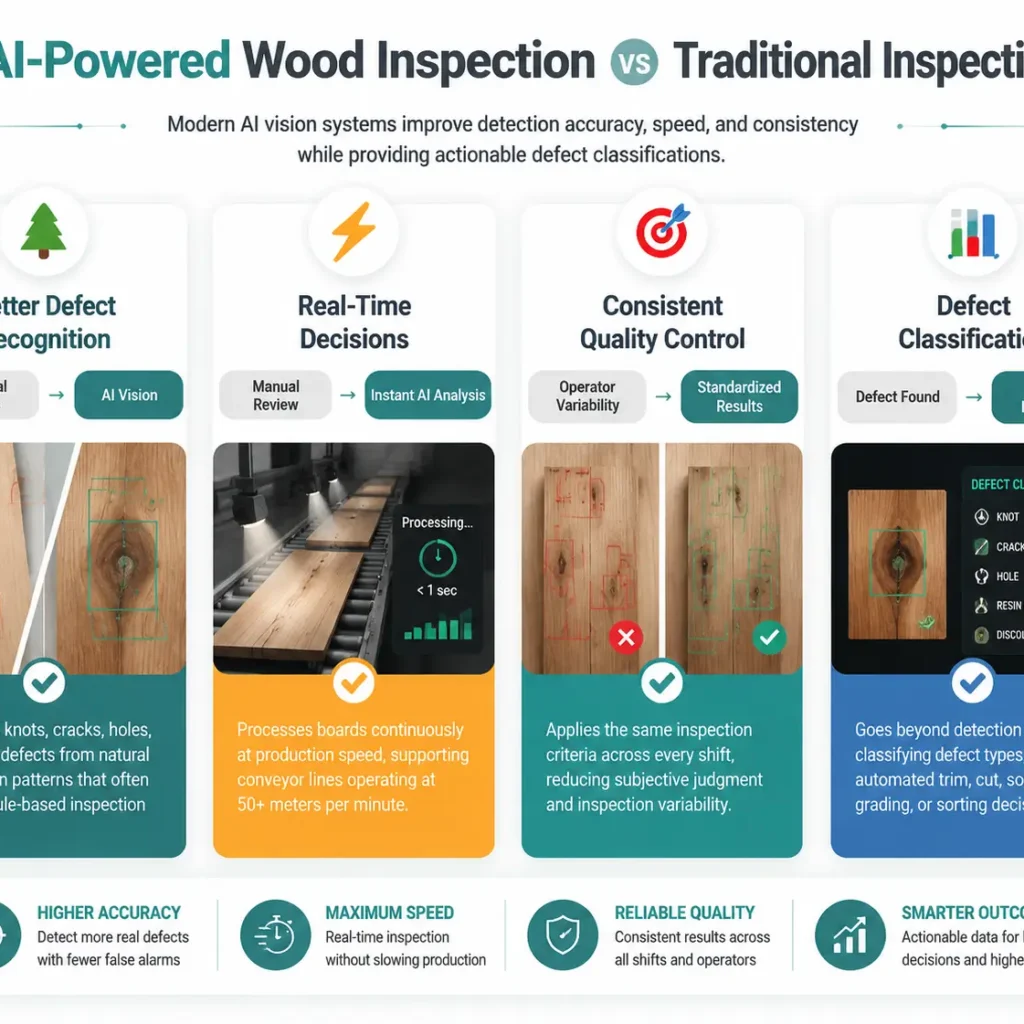
This is one of the strongest cases for AI for material defect identification, because the underlying problem (high natural variation plus rare-but-serious defects) is exactly what learning-based methods are built to solve.
Where Does AI Fit on a Wood Production Line?
AI fits best as the inspection layer between raw scanning and downstream cutting or grading decisions. Cameras capture each board, the AI model classifies and locates defects, and the line uses that data to decide what happens next.
A typical setup looks like this:
Industrial Cameras
Capture high-resolution images of every board under controlled lighting conditions.
Machine Vision for Defect Detection
Detects, locates, and classifies wood defects such as knots, cracks, splits, holes, and grain anomalies in real time.
Decision Logic
Uses defect type and location to determine trimming, cutting, grading, downgrade, or rejection actions.
Continuous Learning
Flagged samples improve future model performance, detection accuracy, and overall inspection consistency.
Defects that go beyond surface flaws, such as hidden voids or internal density variations, may still need X-ray inspection. But for everything visible on the surface, an AI vision system delivers far higher throughput and consistency than manual grading.
What Are the Challenges of AI-Based Wood Inspection?
The main challenges are training data quality, separating defects from acceptable variation, and adapting to different wood species. Wood is highly variable, and a model trained on one species or grade can underperform on another without retraining.
Specific issues to plan for:
- Annotated training data needs to cover the species, grade, and defect mix your line actually produces.
- Lighting consistency matters more than usual on wood because grain and color can dramatically change appearance.
- Class imbalance is common: live knots are everywhere, marrow and missing knots are rare. Models need careful handling so rare defects aren’t missed.
- Threshold tuning decides whether borderline cases (a small live knot, light discoloration) are flagged or passed.
These are solvable with the right data pipeline and tuning process, but they’re worth knowing about before committing to a system. The strongest results come from surface defect detection setups that treat the model as part of a workflow, not as a finished product on day one.
How AI-innovate Supports Wood Surface Inspection
We help wood manufacturers bring AI inspection onto the line in a way that matches their real material, not a generic demo. The goal is reliable defect calls on your actual wood, at your actual line speed.
At AI-innovate, we support wood defect detection with:
- AIxEye for real-time defect detection and process optimization, identifying knots, cracks, resin pockets, discoloration, and other surface flaws across wood production lines
- AIxCore, an industrial AI edge computer powered by NVIDIA Jetson Orin AGX, delivering real-time image processing and reliable on-site machine vision for inspection workflows
- AIxCam, advanced simulation tools for camera testing and synthetic data generation, helping you build out training datasets for rare defects like missing knots or marrow that are hard to capture in volume
- AIxAM, which detects surface and geometry defects on 3D objects, including cracks, deformation, and assembly misalignment, by analyzing multi-view images and depth data in real time
Whether you’re upgrading inspection on a single panel line or scaling wood quality control across multiple facilities, the foundation is the same: reliable visual data, explainable AI, and industrial-grade deployment. Book a demo and we’ll help you scope it around your species, defects, and throughput.
Final Thoughts
Wood is one of the harder materials to inspect well, because the same features that give it value, grain, color, and natural character, are also what make defects hard to call consistently. The strongest setups don’t try to remove that variability. They use AI to learn it, so the system can separate a live knot from a dead one and a real crack from harmless grain.
Pair that with high-speed cameras, good lighting, and a feedback loop, and inspection becomes a reliable part of the line rather than a bottleneck. Manufacturers who get this right see fewer escapes, more usable yield from each board, and steadier grading across every shift.
Sources
Ai-Innovate uses only high-quality sources, including peer-reviewed studies, to support the facts within our articles.
- Shah, H., Saarela, E., Korkeakangas, T., & Pitkäaho, T. (2026). A comprehensive review of automatic defect detection in wooden surface inspection. Applied Computing and Intelligence. Review of single-stage and two-stage deep learning models for wood defect detection and the move beyond manual and X-ray methods. https://www.aimspress.com/article/doi/10.3934/aci.2026001
- Detecting Defects on Solid Wood Panels Based on an Improved SSD Algorithm. PMC / NIH. Sets out the production-line accuracy and speed requirements (above 95% on live knots, dead knots, and cracks at 50 m/min). https://www.ncbi.nlm.nih.gov/pmc/articles/PMC7570981/
- FDD-YOLO: A Novel Detection Model for Detecting Surface Defects in Wood. MDPI Forests (2025). Defines the multi-class wood defect taxonomy used in modern detection datasets, including live knot, dead knot, knot-with-crack, knot-missing, crack, marrow, and resin. https://doi.org/10.3390/f16020308
- Bilateral Defect Cutting Strategy for Sawn Timber Based on Artificial Intelligence Defect Detection Model. PMC / NIH. Demonstrates a YOLO-based framework for locating and classifying live knots, dead knots, cracks, and insect holes in sawn timber. https://pmc.ncbi.nlm.nih.gov/articles/PMC11510799/
- Zenodo (2021). Supporting data for deep learning and machine vision based approaches for automated wood defect detection. Open dataset with over 43,000 labeled wood surface defects across ten classes. https://zenodo.org/record/4694695.
Frequently Asked Questions About AI Wood Defect Detection
Common questions manufacturers ask when evaluating AI-powered wood inspection systems and machine vision technology.
Yes. Trained on labeled wood images, AI models can classify a knot as live, dead, knot-with-crack, or missing and determine whether it should be treated as a defect according to your grading rules. This type of judgment is one of the key advantages AI has over traditional rule-based vision systems.
Usually yes, at least partially. A model trained primarily on pine may not perform as accurately on oak, maple, or beech because grain patterns, color, and defect appearance vary significantly between species. Retraining with species-specific data is typically much faster than building a model from scratch.
Modern AI inspection systems are designed for industrial production environments. Research demonstrates defect classification in approximately one second per panel, while advanced object detection models can operate at conveyor speeds exceeding 50 meters per minute.
The required dataset size depends on the variety of defects and natural grain variations present in your production line. Public datasets containing 20,000 to 40,000 labeled wood defect images provide a useful starting point, but the highest-performing models are typically trained with examples collected directly from the target manufacturing environment.
Not from surface images alone. AI vision systems excel at identifying visible defects such as knots, cracks, resin pockets, and discoloration. Detecting internal defects like hidden voids, density variations, or internal cracks generally requires technologies such as X-ray or ultrasound inspection, often combined with AI-based classification.
Wood exhibits significant natural variation in grain, color, and texture. Traditional machine vision relies on predefined rules that can struggle with this variability. AI learns from real examples and can distinguish between acceptable wood characteristics and genuine defects, reducing both false rejects and missed defects.
Costs vary based on line speed, camera requirements, lighting configuration, integration complexity, and AI model deployment. Most manufacturers justify the investment through reduced manual grading labor, lower scrap rates, improved quality consistency, and better downstream product value.