Within every modern factory, a silent conversation unfolds through dense streams of sensor data. Temperature readings, vibration signatures, torque curves, and pressure trends move through the system at high frequency, documenting the health and stability of your operation with remarkable precision. Small deviations in these signals can reveal critical moments in the production story. They may hint at quality defects forming, components drifting out of tolerance, or machines entering the earliest stages of failure.
Yet many organizations still rely on manual inspection or static threshold systems to catch these events. Thresholds cannot adapt to new production conditions. Manual monitoring cannot keep up with the speed of modern manufacturing. Both approaches often miss anomalies, trigger false alarms, and provide no explanation for why something went wrong.
This is where AI-driven time series anomaly detection reshapes the landscape. By combining unsupervised learning, diffusion-based reconstruction, and explainable AI techniques, manufacturers gain real-time insights with a level of clarity that legacy systems cannot achieve.
In this article, you will learn how explainable AI for time series works, why it matters, and how our products like
AI2Eye and
AIxcore streamline deployment, reduce downtime, and support confident, data-driven decision-making.
What Is Explainable AI for Time Series Anomaly Detection?
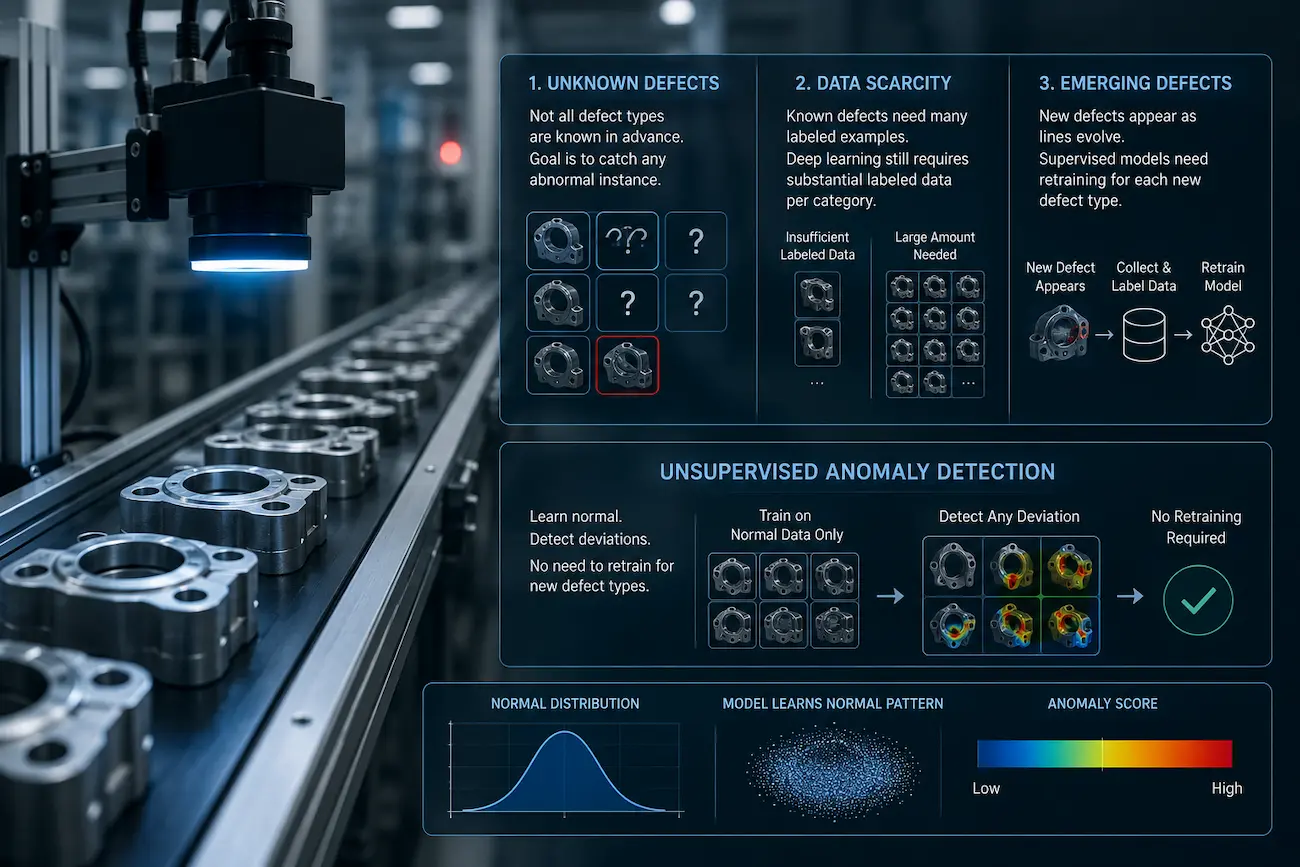
Time series anomaly detection is the process of identifying unusual behavior in continuous, multivariate sensor data. Instead of relying on predefined rules, AI models learn the normal behavior of a system directly from data. When new signals deviate from this learned baseline, the system flags an anomaly.
Explainable AI enhances this process by revealing why the model issued an alert. It identifies which sensor changed, when it changed, and how strongly that shift contributed to the anomaly score. This transforms detection into diagnosis, giving operators the context they need to act quickly and confidently.
Time series anomaly detection matters because modern production relies on fast, accurate, continuous monitoring. A single undetected deviation can lead to scrap, equipment damage, or unplanned downtime. Explainability brings trust and transparency to AI, aligning insights with real-world engineering intuition.
How AI-Powered Time Series Anomaly Detection Works
AI-driven anomaly detection replaces rigid rules with adaptive learning. The workflow unfolds through six practical stages.
Data Capture
Sensors collect high-frequency multivariate signals such as temperature, acceleration, force, pressure, and flow. These signals describe complex interactions across the production line.
Data Preprocessing
Signals are normalized, windowed, and filtered to remove noise. Time alignment ensures every variable corresponds to the same moment in the process.
Model Training
Unsupervised learning focuses on normal operation. Models like
DiffAD learn the statistical behavior, patterns, rhythms, and variations inherent in healthy production.
Detection and Classification
During inference, the model reconstructs each new window of data. If the reconstruction is difficult or inaccurate, the system assigns a high anomaly score.
Automated Response
The system notifies operators, marks the anomaly in dashboards, or triggers logic in the MES or PLC layer. Users receive alerts in real time.
Continuous Improvement
The model evolves with new data. Operators add feedback, and systems refine their understanding of what normal looks like as machines age or product mixes change.
This cycle provides fast, reliable anomaly identification without manual tuning or predefined fault catalogs.
Applications Across Industries
Explainable AI for time series anomaly detection applies to any setting where signals describe machine or process behavior. Common applications include:
Fabric and Textile Manufacturing
Detecting loom vibration changes, tension shifts, or thermal inconsistencies that lead to fabric defects.
Metal Surface Processing
Monitoring thermal cycles, speed variations, and cooling behavior to identify scratches, oxidation, or cooling defects like aluminum “Frost.”
| Sensor |
Description |
| Tundish Metal Temp |
Molten metal temperature before casting |
| Strip Speed_mpm |
Line speed in meters per minute |
| Quench Exit Temp |
Temperature after the quenching stage |
| High Temp IR_Slab |
IR measured surface temperature of the slab |
Read Also: Metal Defect Detection
Electronics Assembly
Tracking torque, placement vibration, current draw, and temperature to catch early signs of solder defects or misalignment.
Automotive and Aerospace Components
Analyzing multivariate sensor streams from machining, forming, or composite curing processes to detect subtle deviations before they translate into safety risks.
Across all industries, the core benefits are the same: early warning, clear explanations, and precise insights that reduce downtime and improve quality.
Technologies and Models Behind Explainable Time Series Detection
Modern AI solutions combine several core technologies to deliver accurate and explainable results.
Deep Learning for Sensor Patterns
Models such as 1D convolutional networks, autoencoders, or diffusion models learn complex temporal relationships across many variables.
Diffusion-Based Reconstruction (DiffAD)
By learning to denoise corrupted normal signals, diffusion models become highly sensitive to deviations that do not fit expected patterns.
Explainable AI (Grad CAM Adapted for Time Series)
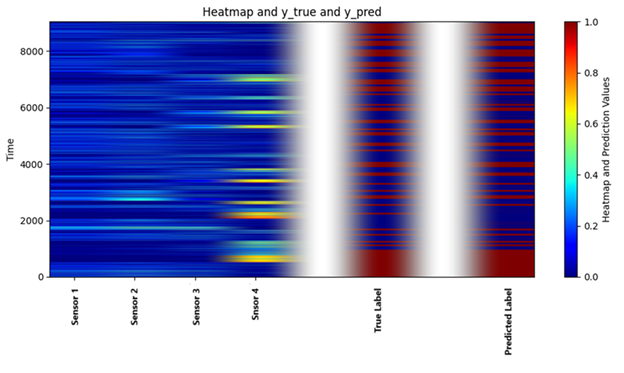
Grad CAM highlights which time points and sensor channels contributed most to an anomaly, turning a black-box alert into a clear narrative.
IIoT Integration
Edge devices and data acquisition systems stream synchronized sensor data for real-time analysis.
Automation and Robotics
Detected anomalies feed into automated workflows, enabling predictive maintenance and adaptive control.
Together, these technologies turn raw signals into transparent operational insight.
Benefits and Challenges
Key Advantages
- Achieves continuous, high-speed monitoring
- Increases anomaly detection accuracy across complex multivariate systems
- Reduces scrap, rework, and unplanned downtime
- Provides explainability that supports fast troubleshooting
- Enables predictive, data-driven quality control
- Adapts to new fault types without needing labeled data
Challenges
- Requires high-quality, synchronized sensor streams
- Integration with legacy equipment can take planning
- Initial configuration and data collection require expertise
- Model retraining is needed as systems evolve
- Explanations can reflect correlations rather than direct causation
With careful deployment and strong domain understanding, the advantages significantly outweigh the challenges.

How to Get Started with Explainable Time Series Anomaly Detection
Getting started involves several structured steps that blend data preparation with
AI-innovate’s specialized tools.
Define Your Monitoring Goals
Identify failure modes,
defect detection types, or process deviations you want to detect.
Collect Sensor Data
Gather normal operational data across all relevant sensors. Time alignment is essential.
Deploy AI2Eye for Real-Time Monitoring
AI2Eye applies DiffAD and time series Grad CAM on the production line, providing anomaly detection and clear, actionable explanations.
Monitor and Refine
Adjust thresholds, review Grad CAM outputs, and incorporate operator feedback to enhance long-term accuracy and ROI.
Explore how AI2Eye and AI2Cam can help your manufacturing team achieve defect-free, data-driven production.
Conclusion
Explainable AI for time series anomaly detection is transforming how manufacturers understand their operations. By learning normal behavior in an unsupervised way and diagnosing deviations with transparent explanations, AI becomes a trusted partner on the production floor.
From my experience developing AI systems for industrial environments, the real value lies not in detecting more anomalies but in revealing their meaning. When operators know what happened, when it happened, and why it matters, every alert becomes a starting point for improvement rather than a source of noise.
Note: Some graphics and visuals in this post were produced using AI-generated content.