




A bottle that ships with an under-fill invites a regulatory complaint. One with an over-fill quietly gives away product on every single unit. A crooked cap lets the drink go flat before it reaches a shelf, and a mislabeled batch can get an entire pallet rejected by a retailer. None of these defects are dramatic on their own, but on a line moving over a thousand bottles a minute, they compound fast, and a single publicized contamination or labeling failure can damage a brand for years. The average food or beverage product recall runs around ten million dollars in direct cost alone.
The core problem is scale. A human inspector sampling one bottle in a hundred was never going to catch a half-centimeter fill discrepancy or a label sitting two millimeters out of position, not because the inspector lacks skill, but because the math does not work at that speed. AI vision solves this by inspecting every single bottle rather than a sample, applying the same standard to bottle number one and bottle number ten thousand.
This guide covers what AI vision actually checks on a bottling line, why bottles are a genuinely difficult inspection target, and how the technology fits into a real production environment.
Why Bottle Inspection Is Uniquely Difficult
Bottling lines are one of the harder environments in machine vision, for reasons that have nothing to do with the AI itself. Glass and aluminum containers throw specular reflections that confuse simple threshold-based vision systems, turning a harmless glare into a false reject. Carbonated beverages foam and bubble, which can fool basic level sensors into misreading where the true liquid line actually sits.
Add in a wet, fast-moving, high-throughput line running dozens of different SKUs, each with its own label, color, and container shape, and the inspection challenge compounds quickly. Deep learning models handle this variability by learning what a correct bottle looks like across all of it, rather than relying on rigid thresholds that break the moment conditions shift even slightly.
What AI Vision Checks on Every Bottle
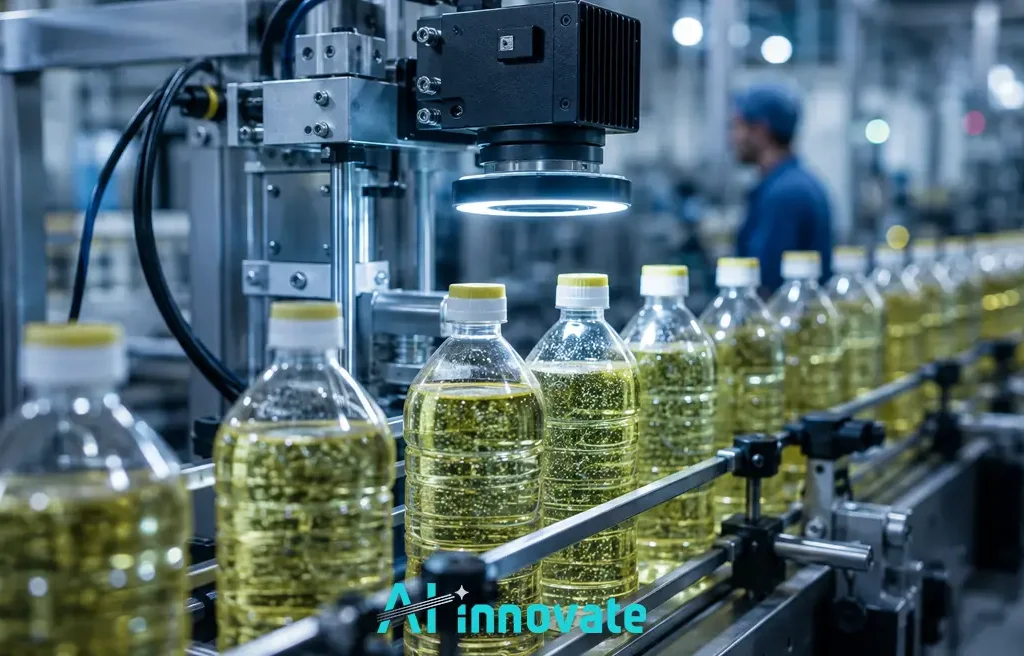
A single bottle passing through an inspection station gets checked across several defect categories in one pass, since the failures that actually trigger recalls and rejected pallets are spread across all of them, not concentrated in one.
- Fill level. Verifying liquid sits within a tolerance band between a minimum and maximum line, read accurately even through foam, bubbles, or tinted and opaque containers.
- Caps and closures. Missing caps, crooked or “cocked” seating, cross-threading, broken tamper bands, and damaged closures that risk leaks or spoilage.
- Labels. Missing, misaligned, skewed, wrinkled, or torn labels, verified for presence, correct position, and proper adhesion.
- Codes and OCR. Date codes, lot numbers, and barcodes checked for both presence and readability using optical character recognition.
- Container integrity. Cracked, chipped, scratched, or deformed glass and PET caught before filling, since these defects cause leaks and safety hazards downstream.
- Contamination. Foreign objects and floating debris in the contents identified before sealing, the defect class most directly tied to brand-damaging recalls.
The Fill-Level Challenge: Under-Fill, Over-Fill, and the Tolerance Band
Fill-level inspection is a genuinely two-sided problem, and it is worth understanding why both sides matter. Under-fill shorts the customer and invites regulatory scrutiny. Over-fill gives away real product on every single bottle, a cost that scales silently across an entire production run without ever showing up as a single dramatic loss. The target is a tight tolerance band between a defined minimum and maximum, and AI vision verifies that every container sits inside that band, reading the true liquid level even when foam or an opaque container would defeat a simpler sensor.
Materials and Formats: Glass, PET, and Cans
Bottling lines rarely run a single material, and each format brings its own inspection considerations. Glass and PET plastic bottles need surface and fill checks alongside cap and label verification, while cans introduce their own seam and print-quality requirements. Products like wine, beer, and soft drinks also carry natural visual variability between batches, which is precisely where AI-driven vision has an advantage over older rule-based systems: it learns to recognize complex patterns and genuine defects while tolerating the normal aesthetic variation a rigid rule-based system would flag as a false reject.
This same principle underlies broader AI quality control solutions for plastic manufacturing, where distinguishing acceptable material variation from an actual defect is the central technical challenge.
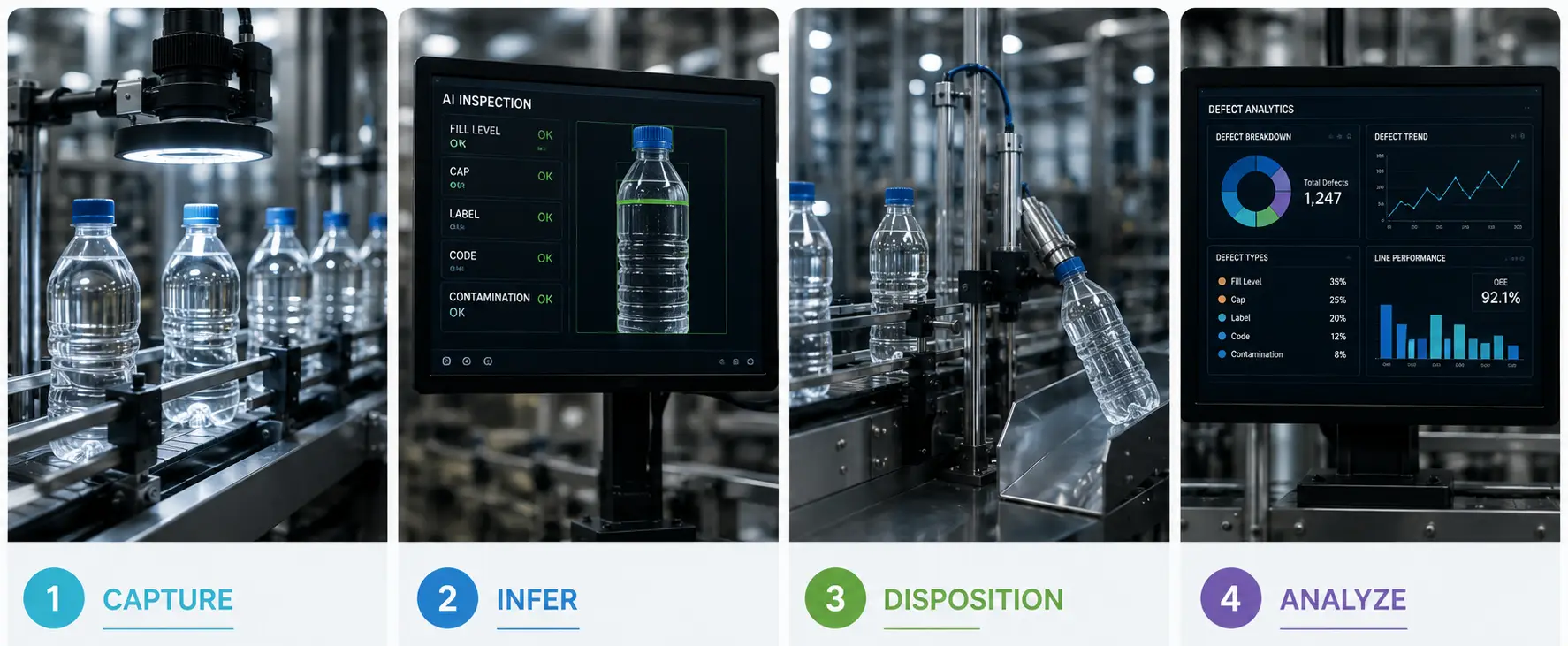
How Bottle Inspection Fits Into the Production Line
- Capture. Line-rate cameras and lighting purpose-built for wet, reflective, high-speed environments image every container as it passes.
- Infer. GPU-accelerated AI analyzes fill level, cap, label, code, and contents together, typically completing analysis in well under 100 milliseconds per container.
- Disposition. In-spec bottles continue down the line; flagged defects are rejected automatically at full line speed, without slowing production.
- Analyze. Every detected defect is categorized and logged, feeding root-cause analysis and longer-term process improvement rather than disappearing the moment the bottle is rejected.
Why Manual and Rule-Based Inspection Fall Short
Manual sampling checks a fraction of what actually ships, which means the defect that reaches a customer is frequently the one nobody happened to look at. Traditional rule-based machine vision improves on that but still struggles with the specific conditions a bottling line creates: glare off glass and aluminum reads as a defect it is not, foam defeats simple level sensors, and every new SKU on a multi-product line forces reprogramming and downtime.
This is the same underlying gap explored in applications of AI in quality control: the difference is not just detection accuracy but the ability to tell real defects apart from ordinary product variation, at full line speed, without constant manual recalibration.
Bottle Quality Control Across Beverage Industries
The same core inspection categories apply whether a line is running still water, carbonated soda, wine, beer, or spirits, but the specific tolerance and risk profile shifts by category. Regulatory scrutiny is tightest around fill-level accuracy and labeling compliance, since both are directly tied to consumer protection rules. Contamination detection carries the highest brand risk, since a single publicized incident can affect sales far beyond the batch actually involved.
Understanding the ROI of automated visual inspection in this context usually comes down to weighing the cost of the system against giveaway recovered from tighter fill control, scrap reduction from earlier defect catches, and the avoided cost of a single recall, which alone can outweigh a full inspection deployment.
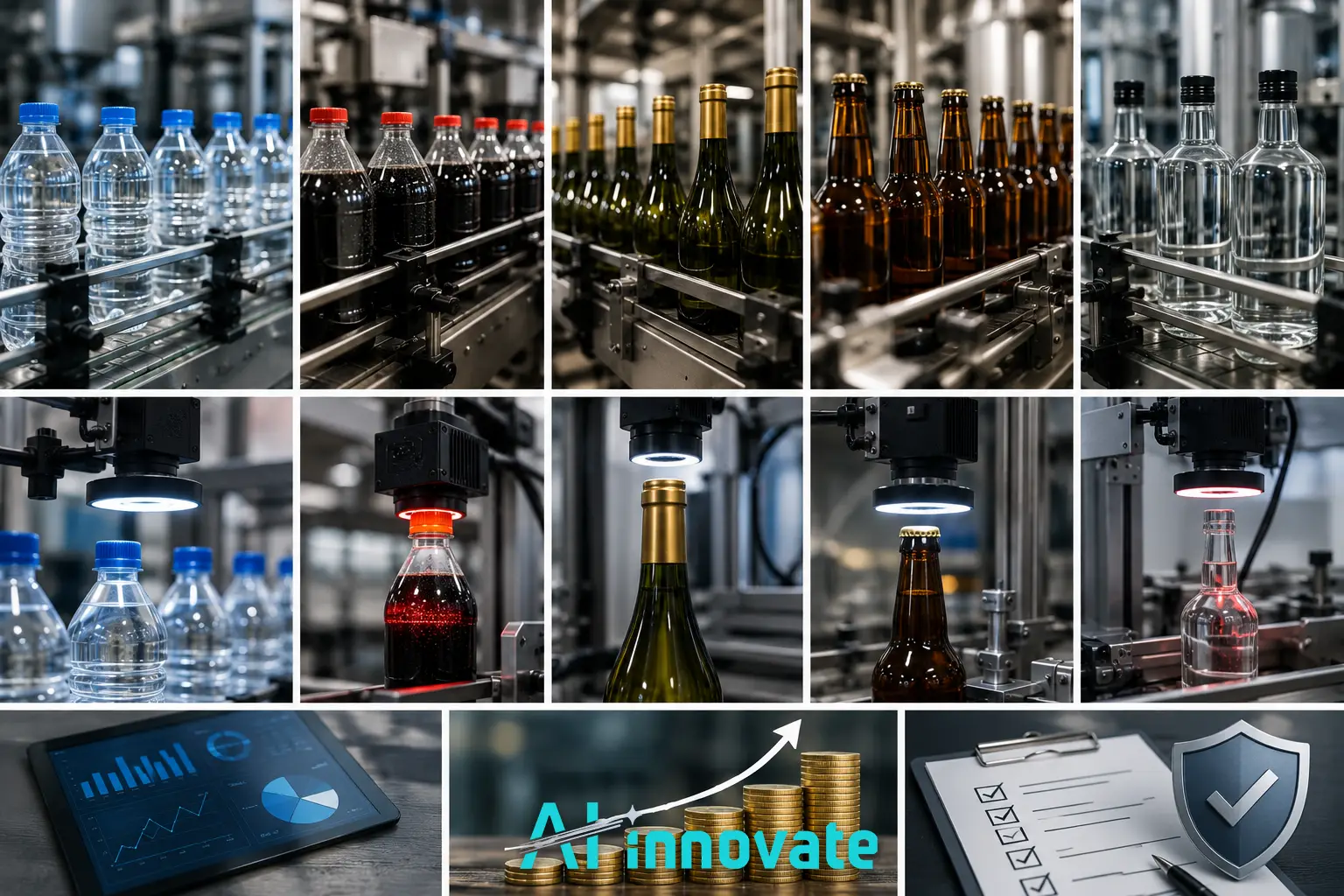
How AI-innovate Supports AI Bottle Inspection
Bottle inspection is one of the most challenging applications for AI vision. High production speeds, reflective bottle surfaces, foam, multiple container formats, and changing SKUs all make consistent inspection difficult. An effective system must accurately inspect every bottle without slowing the production line.
AI-innovate addresses these challenges with an integrated AI vision platform built for high-speed beverage manufacturing.
- AIxEye performs real-time inspection of every bottle, verifying fill levels, cap placement, label alignment, printed codes, container integrity, and contamination in a single inspection. As production changes between bottle sizes, label designs, or product SKUs, the system adapts with minimal reconfiguration.
- AIxCam enhances inspection accuracy by generating synthetic training data for rare defects that are difficult to capture in real production, helping AI models recognize uncommon issues with greater confidence.
- AIxCore provides high-performance edge AI computing, processing inspection data directly on the production line to deliver real-time decisions without cloud latency, even on high-speed bottling systems.
Together, AIxEye, AIxCam, and AIxCore enable continuous 100% bottle inspection, helping beverage manufacturers improve product quality, reduce waste, minimize false rejects, and detect critical defects before products reach the market.
Final Thoughts
Bottle quality control with AI replaces sampling-based manual checks with full-coverage inspection that catches fill-level errors, cap and label defects, container damage, and contamination on every single bottle, at the speed modern bottling lines actually run.
The real value shows up less in any single caught defect and more in the compounding effect of full coverage: less giveaway from over-fill, fewer recalls from contamination that would have otherwise shipped, and a consistent standard applied to bottle one and bottle one million alike. For an industry where the cost of a single bad batch can run into the millions, that shift from sampling to full inspection is not a marginal improvement. It is the difference between hoping a defect gets caught and knowing it will be.
Confused About Where to Start with AI?
Our specialists help you identify the right AI approach based on your process, data, and goals.
Frequently Asked Questions
What does AI vision actually check on a bottling line?
AI vision typically checks fill level, cap and closure integrity, label presence and placement, date and batch codes, container defects like cracks or chips, and contamination, all in a single pass as each bottle moves through the inspection station.
Can AI vision read fill level accurately through foam and carbonation?
Yes. This is one of the specific advantages deep learning models have over simple level sensors, which are often fooled by foam and bubbles in carbonated beverages. Trained models learn to identify the true liquid level despite the foam head or an opaque or tinted container.
Does AI vision slow down high-speed bottling lines?
No, when properly implemented. Cameras and lighting are specified for the line’s actual speed, and GPU-accelerated inference typically completes analysis and disposition in well under 100 milliseconds per bottle, fast enough to inspect well over a thousand bottles per minute without becoming a bottleneck.
How does AI vision handle a line that runs many different SKUs?
Deep learning models handle changeovers between different labels, colors, and container sizes without requiring the reprogramming that rule-based vision systems typically demand for each new format, which is one of the more practical advantages on multi-product bottling lines.
What is the biggest cost risk that bottle inspection helps avoid?
Product recalls carry the largest single financial risk, with the average food or beverage recall running around ten million dollars in direct cost. Contamination and labeling failures are the defect categories most often behind a recall, which is why they receive particular attention in inspection design.
Is AI vision better than rule-based machine vision for bottles?
Is AI vision better than rule-based machine vision for bottles?
For the specific conditions bottling lines create, glare off reflective materials, foam, and normal product variation across batches, deep learning generally outperforms rule-based systems, which tend to generate false rejects when conditions shift even slightly outside their programmed thresholds.
Sources
Ai-Innovate uses only high-quality sources, including peer-reviewed studies, to support the facts within our articles.
- ImageVision.ai. (2026). Bottle Inspection with Vision AI. Retrieved August 2026, from https://imagevision.ai/bottle-inspection-with-vision-ai/
- BCN Vision Group. (2026). Artificial Vision & AI for the Bottling Industry. Retrieved August 2026, from https://bcnvisiongroup.com/en/p11/machine-vision-bottling-industry
- iFactory AI. (2026). AI Vision Beverage Fill Level & Bottle Inspection. Retrieved August 2026, from https://ifactoryapp.com/ai-vision-camera/ai-vision-beverage-fill-level-monitoring
- iFactory AI. (2026). AI Vision Glass Bottle Container Inspection. Retrieved August 2026, from https://ifactoryapp.com/ai-vision-camera/ai-vision-glass-bottle-container-inspection
- Opsio. (2026). Bottle Defect Detection with Vision AI. Retrieved August 2026, from https://opsiocloud.com/knowledge-base/bottle-defect-detection-with-vision-ai/
- Overview AI. (2026). AI Beverage Can & Bottle Inspection. Retrieved August 2026, from https://www.overview.ai/blog/ai-beverage-can-bottle-inspection/
- International Journal of Innovative Science and Research Technology (IJISRT). (2025). AI-Based Bottle Inspection System. Retrieved August 2026, from https://www.ijisrt.com/assets/upload/files/IJISRT25MAR1796.pdf
- Robovision. (2026). AI-Enhanced Bottle Inspection System. Retrieved August 2026, from https://robovision.ai/ucp-ai-enhanced-bottle-inspection