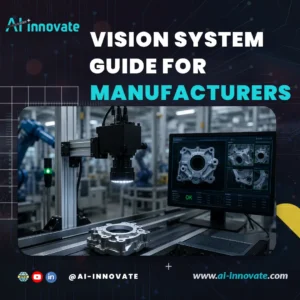





No matter how advanced the manufacturing process, variation is inevitable. If not detected early, small inconsistencies in materials, machine settings, or environmental conditions can gradually lead to visible defects. Traditionally, quality control has relied on manual inspection and rule-based systems, which struggle to keep pace with modern production speeds.
These methods often miss subtle patterns that signal emerging problems. Machine learning offers a more adaptive approach, learning directly from production data and visual inputs. Rather than following fixed instructions, intelligent models recognize complex defect patterns and improve over time.
This article explains how machine learning is applied to defect detection, its importance for operational reliability, and how manufacturers use data-driven inspection systems to improve accuracy, reduce waste, and strengthen product consistency.

A Taxonomy of Detection Algorithms
Not all detection methodologies are created equal; the optimal algorithmic choice is intrinsically tied to the nature of the available data and the specific manufacturing context. For a technical team embarking on this journey, understanding these distinctions is paramount. To provide clarity, we can categorize the most prominent approaches in use today.
Supervised Learning Models
This is the most common approach, where the model is trained on a large dataset of pre-categorized images, explicitly labeled as “defective” or “non-defective.” The algorithm learns to associate specific visual features with these labels.
- Convolutional Neural Networks (CNNs): These are the workhorses of image-based analysis. Their architecture is exceptionally effective at automatically and hierarchically extracting relevant features from images, making them ideal for identifying complex defect patterns.
Unsupervised Anomaly Detection
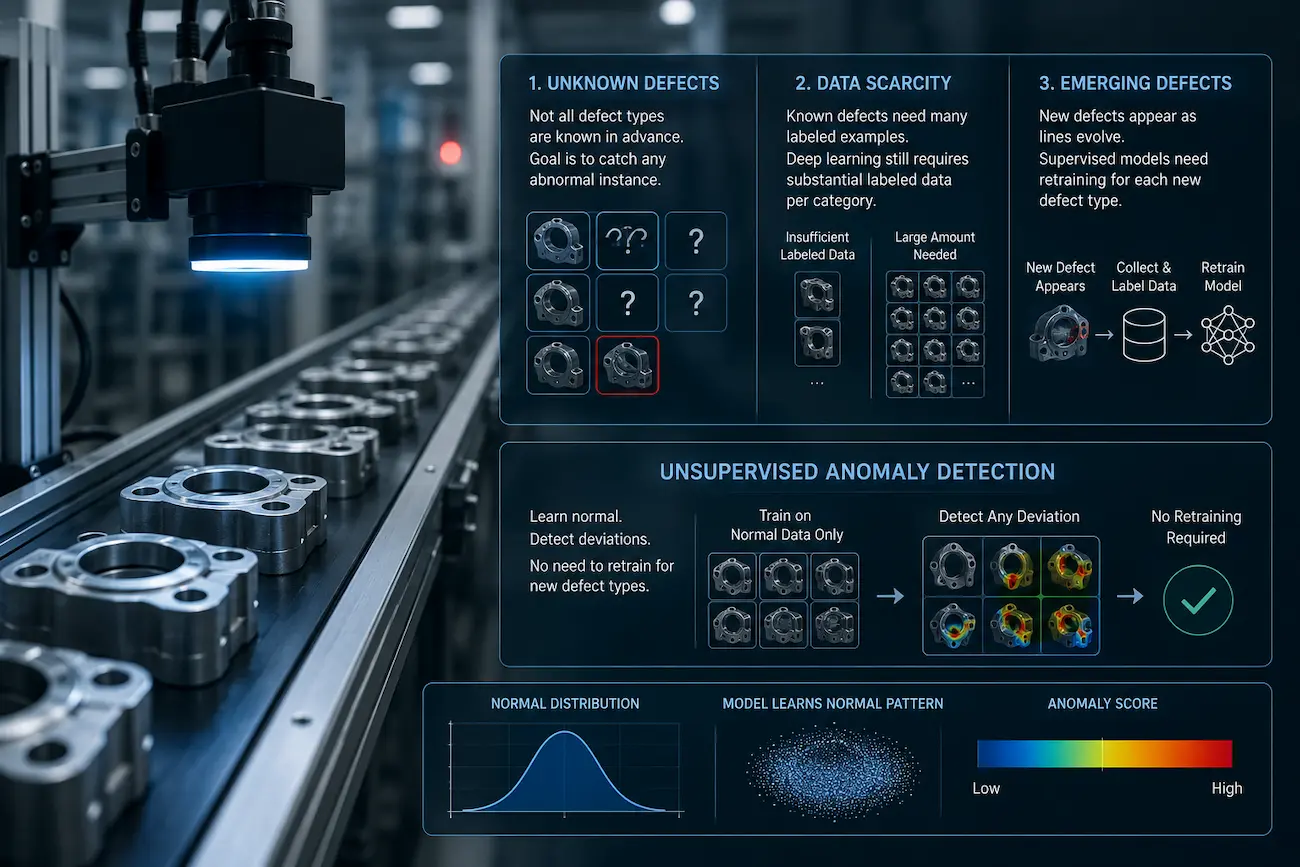
In many real-world scenarios, collecting a large volume of “defective” samples is impractical. Unsupervised methods address this by training a model exclusively on images of “normal” or “perfect” products.
- Autoencoders and Variational Autoencoders (VAEs): These models learn to reconstruct a “normal” input image. When presented with a defective product, the reconstruction error will be high, flagging it as an anomaly without ever having seen a labeled defect example.
Some applications may also leverage classical models like k-Nearest Neighbors (kNN) for defect detection in specialized areas, such as analyzing vibration data to find faults in rotating machinery.
Read Also: Defect Detection in Manufacturing – AI-Powered Quality
Implementation Hurdles and Data Dependencies
Our commitment to providing practical solutions means presenting a clear and realistic view of the implementation process. While powerful, deploying an effective AI-based inspection system is not a simple “plug-and-play” exercise.
It requires careful planning and a deep understanding of the underlying dependencies. Based on broad industry experience, two primary considerations consistently emerge as the most critical factors for success.
- Data Acquisition & Labeling: Supervised models are data-hungry. Their accuracy is directly proportional to the volume and quality of the labeled data they are trained on. Acquiring and meticulously labeling thousands of images representing every possible defect class is often the most resource-intensive phase of a project.
- High Computational Requirements: Processing high-resolution images in real-time to keep pace with production lines demands significant computational power. This necessitates investment in appropriate hardware (like GPUs) and optimized software to ensure the system can make decisions without creating a bottleneck.
- Model Generalization: The system must be robust enough to perform accurately on new data it hasn’t seen before. A model that only performs well on its training set but fails on slightly different production batches is of little practical use. This requires careful validation and testing.
Frontiers in Advanced Anomaly Recognition
The field of Defect Detection Using Machine Learning is continuously evolving. Looking ahead, several key trends are set to address current challenges and unlock new capabilities. One of the most promising areas is Transfer Learning, which involves taking a model that has been pre-trained on a massive dataset (like millions of general internet images) and fine-tuning it on a smaller, specific dataset of industrial parts.
This drastically reduces the data requirements and training time. Another frontier is the application of Reinforcement Learning, where an agent can learn to not just identify a defect but also to control a camera or sensor to actively search for the most likely points of failure, creating a dynamic and intelligent inspection process.
Furthermore, the integration of Hyperspectral Cameras is pushing the boundaries of what is detectable. These sensors capture data from across the electromagnetic spectrum, enabling the identification of defects based on chemical composition or moisture content—flaws that are entirely invisible to the human eye or standard cameras.
Read Also: Anomaly Detection in Manufacturing – Process Insights
From Prototyping to Production with Applied AI
Understanding the technology is the first step; applying it effectively is the next. We bridge the gap from theory to a fully functional production system.
Accelerate Innovation with AI2Cam
Our camera emulation tool, AI2Cam, empowers developers to build and test their machine vision applications without physical hardware. This accelerates development by:
- Enabling rapid prototyping
- Reducing hardware costs
- Providing testing flexibility
Optimize Quality with AI2Eye
Our end-to-end system, AI2Eye, deploys directly onto the factory floor to deliver real-time quality control. This system is engineered to:
- Minimize product waste
- Boost operational efficiency
- Guarantee superior product quality
Conclusion
Machine learning is redefining how manufacturers approach quality control by enabling defect detection. By transforming raw production data into intelligent inspection systems, organizations gain earlier visibility into quality risks and more consistent evaluations. These capabilities reduce rework, improve throughput, and support more reliable operations. As these models continue to learn and improve, defect detection becomes more precise and scalable across diverse production environments.
Based on my experience with data-driven inspection technologies, the most significant change is the increased confidence in decision-making. When teams trust their inspection results, they can focus on process improvement rather than constant troubleshooting. Looking ahead, machine learning will remain a foundational tool for building resilient, high-quality manufacturing systems.