




In 2025, FDA food recalls involving foreign material contamination rose 93 percent compared to the same period in 2024. Most of those failures were detectable before they shipped. The gap between what manual inspection catches and what regulators, retailers, and customers expect isn’t a training problem. It’s a physics problem: human eyes cannot sustain the speed, consistency, and defect sensitivity that high-volume food lines require across a full shift.
This guide covers the defects that drive the most recalls on food lines, how AI quality control in the food industry handles contamination, packaging, and fill monitoring, and what a realistic deployment looks like.
What Are the Most Common Quality Defects in Food Manufacturing?
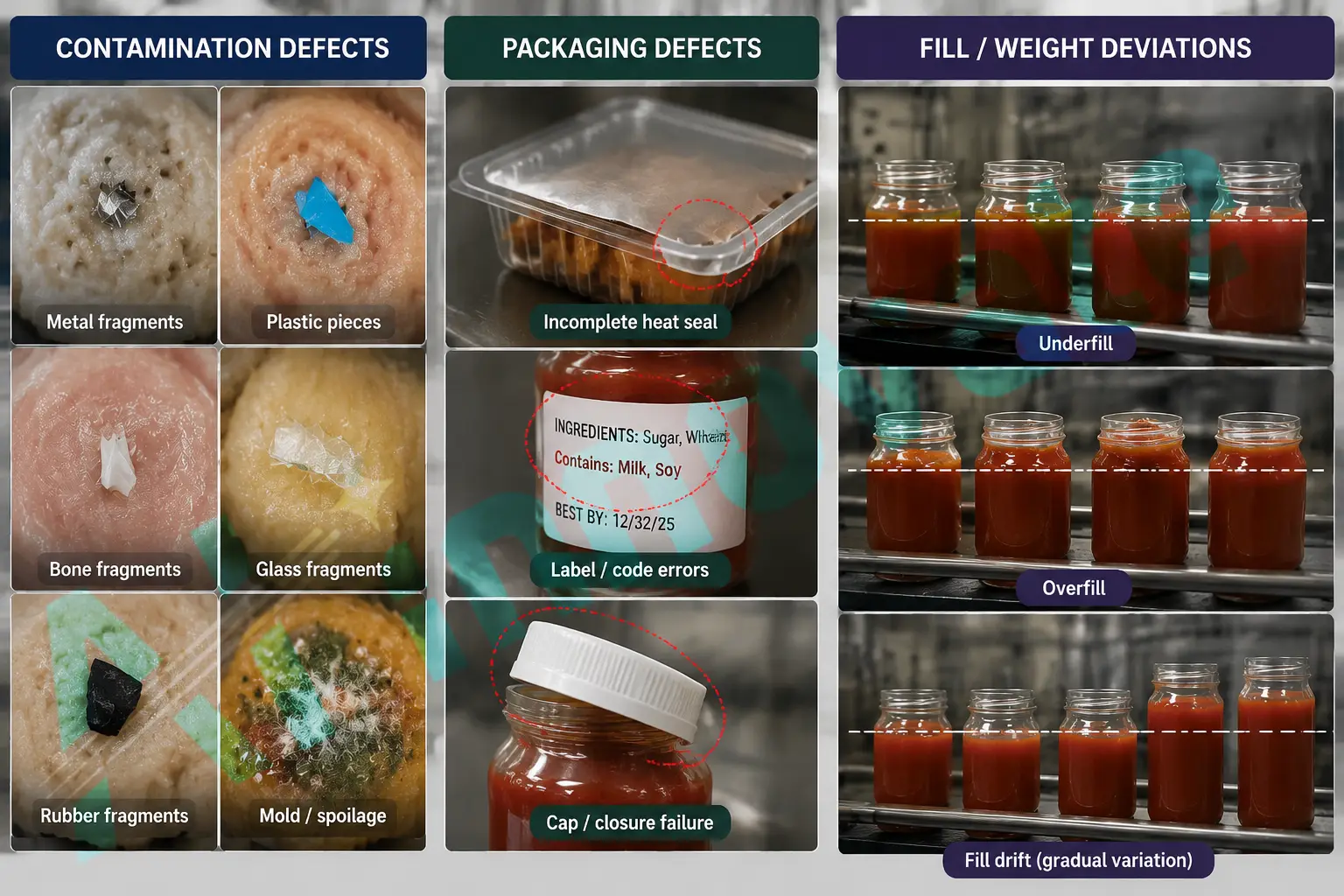
The most common quality defects in food manufacturing fall into three categories: contamination, packaging failures, and fill or weight deviations. Each carries different regulatory consequences and requires a different detection approach.
Contamination defects include:
- Metal fragments from equipment wear
- Plastic pieces from packaging materials
- Bone fragments in meat and poultry
- Glass from broken containers or lighting
- Rubber from gaskets and belts
- Mold, spoilage, and biological contamination
These are the defects that trigger recalls and require imaging that can see into or through the product, not just across the surface.
Packaging defects are a leading cause of food recalls by frequency:
- Incomplete heat seals allow air and moisture ingress
- Label errors including missing allergen declarations and illegible date codes account for the majority of allergen-related recalls
- Cap and closure failures compromise tamper evidence and seal integrity
Fill and weight deviations present three distinct cost problems:
- Underfill is a net weight violation under FDA, CFIA, and most international weights and measures regulations
- Overfill is invisible to the customer but accumulates into significant margin loss on high-volume lines
- Fill drift that moves gradually out of tolerance is the hardest to catch manually because no individual unit looks obviously wrong until it is already out of spec
What Does AI Quality Control Actually Cover in Food Manufacturing?
AI quality control in the food industry covers inline inspection of food products and packaging at production line speed, using trained machine learning models to classify defects that rule-based vision systems and manual inspection miss. The scope includes:
- Foreign object and contamination detection
- Packaging integrity verification
- Fill level and weight monitoring
- Label and code compliance
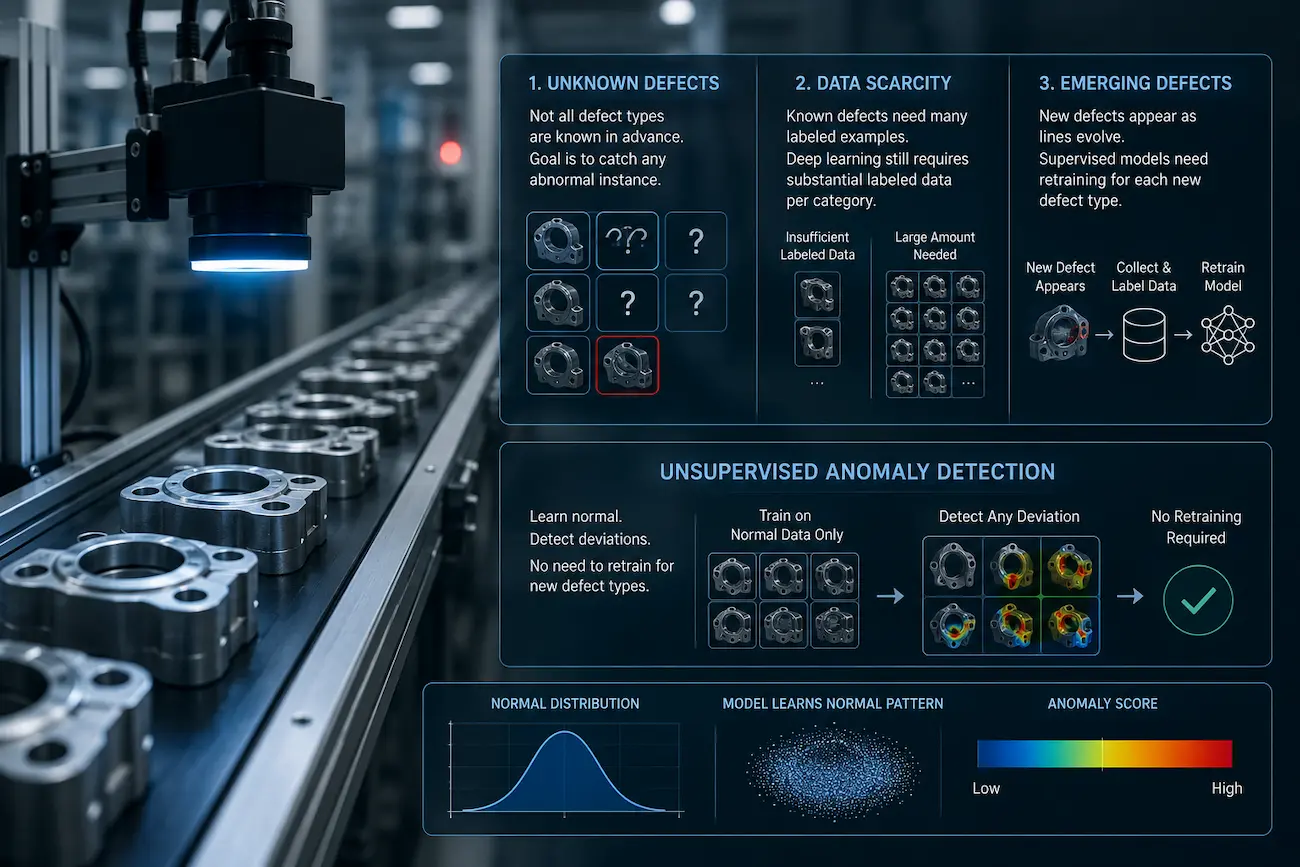
The key distinction from traditional inspection is that AI models learn from labeled examples rather than fixed rules. That matters because food lines run multiple SKUs, packaging varies, and the defects that carry the most consequence are exactly the ones that defeat fixed brightness thresholds: a small plastic fragment in a textured product background, a micro-seal failure on a clear tray.
This learning-based approach is what separates AI-driven quality control from the rule-based systems that came before it. The AI in food safety and quality control market reached $2.7 billion in 2024 and is projected to reach $13.7 billion by 2030 at a 30.9 percent compound annual growth rate, driven by the cost of what gets missed, not technology enthusiasm.
How Does AI Detect Foreign Objects and Contaminants?
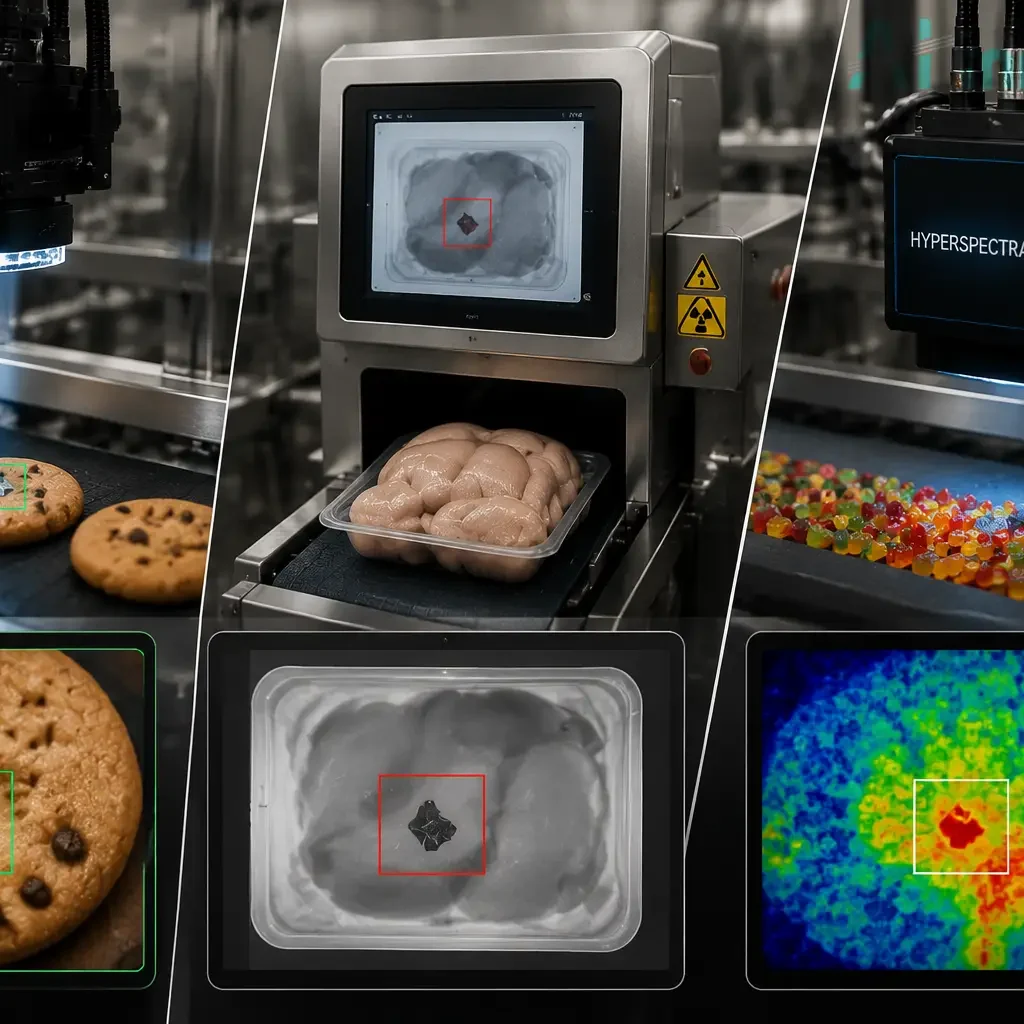
AI detects foreign objects by combining imaging modalities with deep learning models that classify each frame against known contaminant signatures, rather than relying on density thresholds that product variation defeats. Three methods cover the contaminant risk profile most food lines carry:
Vision-based AI inspection
a form of automated visual inspection, uses high-resolution cameras to detect surface contaminants, discoloration, mold, and visible foreign objects on exposed product. CNNs trained on labeled contaminant images classify defects in real time as product moves down the conveyor.
X-ray AI classification
it detects dense objects inside packaged product, including metal, bone, glass, and some plastics. Dual-energy X-ray absorptiometry has demonstrated 95% overall accuracy and 97% accuracy on clean product identification in published research. AI reduces the false positives from natural density variation that threshold-based X-ray generates on irregular products like poultry and fresh produce.
Hyperspectral imaging
Hyperspectral imaging with AI extends detection to non-metallic contaminants including certain plastics and rubber that X-ray misses, at higher cost and complexity. Most common on high-value or high-risk product lines.
On the food lines we work with, the practical advantage over traditional inspection is classification, not just detection. The system identifies what type of contaminant was found, where, and at what confidence level, which informs both the reject decision and the root cause investigation.
How Does AI Handle Food Packaging Inspection at Line Speed?
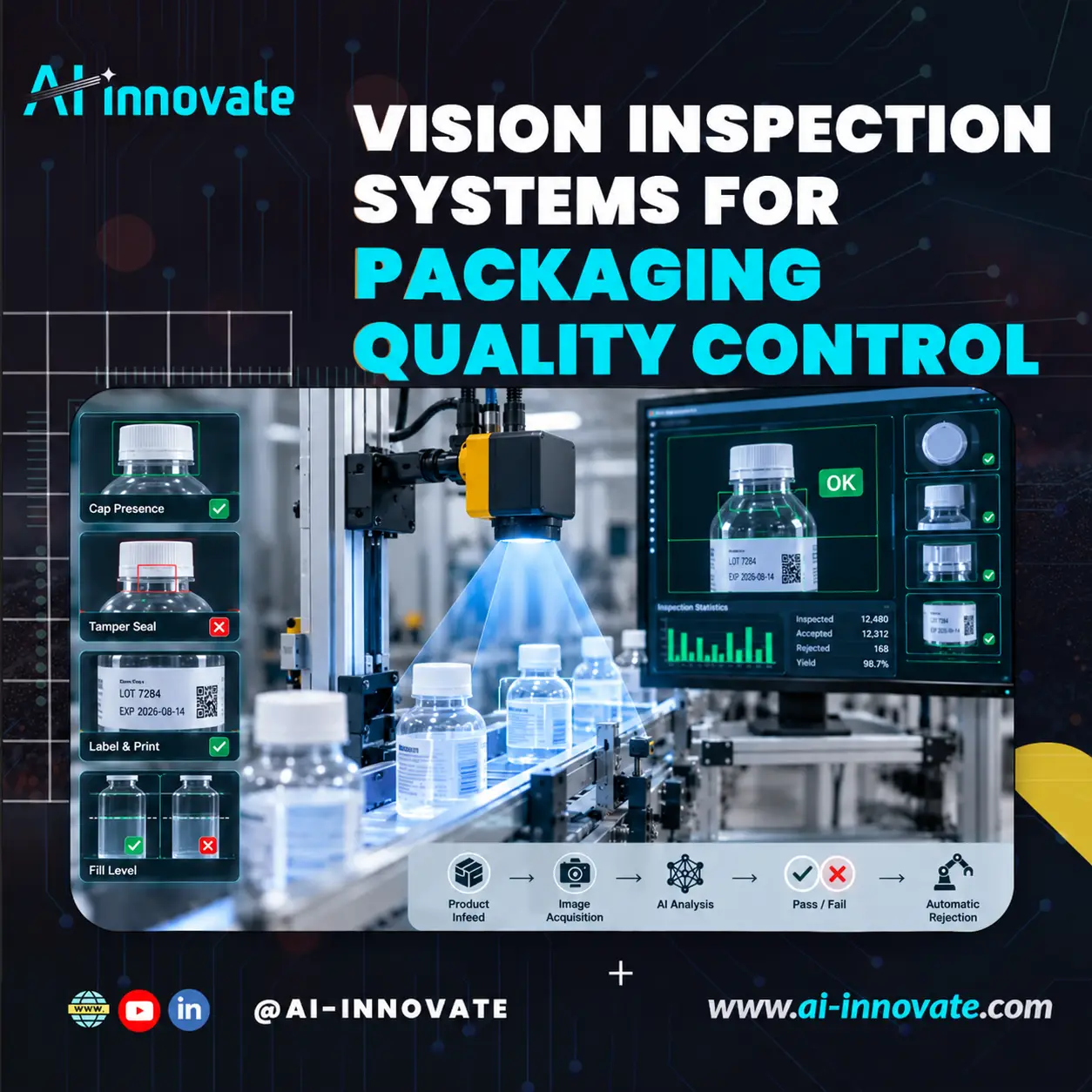
AI handles packaging inspection by classifying seal integrity, label accuracy, date code legibility, cap closure, and packaging condition simultaneously at full conveyor speed, without adding cycle time. This kind of real-time defect analysis runs inline, so it keeps pace with the line rather than bottlenecking it. The two core inspection tasks:
Seal integrity inspection
it detects incomplete heat seals, micro-leaks, wrinkles in the seal zone, and contamination inside the seal area that prevents a proper bond. Research on food tray sealing using deep learning demonstrates reliable faulty seal classification directly from image data, without handcrafted feature engineering, including subtle partial seals that threshold-based vision misses.
A 2025 review in the Journal of Food Science reported CNN, RNN, and SVM implementations achieving average accuracies above 94% with F1-scores near 0.9 for spoilage and contamination classification.
Label and code verification
it uses optical character recognition combined with AI-based matching to confirm correct label application, allergen declarations, date codes, lot numbers, and barcode readability. This matters because undeclared allergens have remained the leading cause of US food recalls, behind 101 FDA recalls in 2024 alone. At production line speeds, human label verification is not feasible. AI verification running inline is.
How Does AI Monitor Fill Levels and Product Weight?
AI monitors fill levels by measuring visible fill height, head space, or product volume in each container against the declared specification, flagging deviations before the container is sealed. It works alongside checkweighers rather than replacing them: vision-based fill monitoring provides upstream early warning, the checkweigher confirms net weight compliance.
The AI model learns what correct fill looks like across natural variation in product density and container positioning, which makes it more reliable than a fixed height threshold on products that settle or shift. Three fill problems cost money differently on a food line:
- Underfill at or below net weight compliance tolerance is a regulatory violation and a direct recall risk if it reaches the market at scale
- Overfill above target is invisible to the customer but compounds into significant margin loss across millions of units
- Fill drift that starts within tolerance and moves out over a shift is the hardest to catch manually because no individual unit triggers a clear rejection until the line is already out of spec
What Regulatory and Traceability Requirements Does AI Inspection Help Meet?
AI inspection helps food manufacturers meet documentation and traceability requirements by generating automatic inspection records for every unit, rather than relying on manual sampling logs. The requirements it directly supports:
- FSMA Preventive Controls (21 CFR Part 117) requires CCP monitoring records with evidence that controls are operating as intended. AI generates automatic logs with image evidence, defect classification, timestamps, and lot codes per unit.
- FSMA 204 Traceability Rule requires Key Data Elements and Critical Tracking Events producible within 24 hours of an FDA request. AI inspection records tied to lot codes and timestamps satisfy this directly.
- GFSI standards (BRC, SQF, FSSC 22000) require documented monitoring evidence, corrective action records, and trend data. AI inspection data feeds these requirements and reduces audit preparation time.
- Retailer quality mandates increasingly require 100% inline inspection coverage rather than statistical sampling on high-risk categories. AI inspection is the only practical way to meet that requirement at production speed.
The traceability point matters most when something goes wrong. Regulators and retailers ask not just whether product passed inspection, but whether you can demonstrate what was inspected, when, at what parameters, and what the system found. AI inspection generates that record per unit automatically. A manual log filled out at shift end does not.
What Data and Infrastructure Does AI Food Inspection Actually Require?
AI food inspection requires cameras matched to your smallest target defect, illumination designed for your packaging material, on-site edge compute for line-speed inference, and training data covering your actual product and defect mix. The key components:
- Camera resolution and placement must be specified for the smallest defect that matters on your line. A two-millimeter plastic fragment requires higher resolution than a fill level check.
- Illumination design varies by packaging type: backlighting for fill level on transparent containers, raking light for surface contaminants on matte packaging, diffuse illumination for high-gloss films that generate specular reflections.
- Edge compute eliminates the cloud latency incompatible with inline rejection and keeps FSMA documentation data on-site where it belongs.
- Training data must reflect your product range and defect mix. Synthetic data generation covers rare contaminant types that don’t appear frequently enough on the live line to build a representative training set from production data alone.
- PLC integration connects the inspection system to the line’s reject mechanism and feeds inspection data into your MES or quality management system for traceability and trend reporting.
How Does AI Food Inspection Compare to Traditional Machine Vision and Manual Grading?
The core difference is adaptability. Manual grading adapts to new products but degrades with fatigue. Traditional machine vision is consistent but fails when product or packaging changes. AI is both consistent and adaptive across SKUs, shifts, and packaging formats.
The documentation column is where the practical gap is widest. Manual inspection tells you how many rejects were pulled. AI inspection tells you which unit, which defect type, which lot, and at what time, while there is still time to intervene upstream.
| Factor | Manual Inspection | Traditional Machine Vision | AI-Based Inspection |
|---|---|---|---|
| Foreign object detection | Misses small or low-contrast items; fatigue-dependent | Detects metallic objects; misses plastic, bone, glass | Detects metallic and non-metallic contaminants across product types |
| Packaging defect detection | Subjective; misses micro-seals and faint label errors | Handles simple seal checks; fails on variable packaging | Classifies seal, label, date code, and cap defects simultaneously |
| Fill level monitoring | Slow; impractical at volume | Consistent on uniform containers; fails on variable fills | Accurate across container shapes at line speed |
| Consistency across shifts | Degrades over shift length | Consistent but rigid; breaks on SKU changeover | Consistent at hour one and hour eight |
| Regulatory documentation | Manual shift-end logs | Basic pass/fail logging | Automatic per-unit classification, image capture, lot traceability |
How AI-innovate Supports Quality Control in the Food Industry
We deploy AI inspection systems built around your actual product range and defect mix. A model trained on another manufacturer’s line underperforms on yours because the product appearance, packaging materials, and defect signatures are different. The products we deploy for food quality control:
- AIxEye handles real-time defect detection and process optimization, classifying foreign object contamination, packaging defects, fill level variation, and label errors at full conveyor speed.
- AIxCore is the industrial AI edge computer powered by NVIDIA Jetson Orin AGX, running inference on-site for millisecond-latency rejection and on-premise FSMA documentation.
- AIxCam provides synthetic data generation for rare contaminant types, uncommon packaging defects, and new SKUs before they appear at volume on the live line.
- AIxAM detects surface and geometry defects on three-dimensional food products and containers using multi-view images and depth data, covering deformation, missing closures, and structural packaging failures.
Book a demo and we will scope a food inspection setup around your product range, packaging formats, and compliance requirements. Reach us at Info@ai-innovate.com or +1 (514) 813-1809.
Final Thoughts
Food inspection is three distinct problems that each need a different detection method. Contamination requires imaging that sees into the product. Packaging defects require vision precise enough to catch a micro-seal failure at line speed. Fill monitoring requires measurement consistent enough to hold net weight compliance across a full shift. Manual inspection handles none of these reliably at volume. Traditional machine vision handles each one until the product or packaging changes.
AI inspection handles all three by learning what acceptable looks like across your product’s natural variation, rather than enforcing fixed rules that variation defeats. The manufacturers getting the best results treat it as the data foundation their quality process runs on, not a replacement for it.
Frequently Asked Questions
Can AI vision systems detect non-metallic foreign objects like plastic and bone?
Yes, but the imaging method determines what is detectable. Camera-based AI detects surface contamination and visible foreign objects. X-ray AI detects dense objects inside packaged product including metal, bone, glass, and some plastics. Hyperspectral imaging extends detection to plastics, rubber, and biological material that X-ray misses. The right combination depends on your contaminant risk profile.
How does AI inspection handle multiple SKUs on the same line?
Each SKU requires its own model configuration because acceptable appearance differs by product and packaging. Modern AI inspection platforms switch models at SKU changeover without manual reprogramming. Setup time for a new SKU is significantly lower than reprogramming a traditional machine vision system.
Does AI inspection generate records that satisfy FSMA documentation requirements?
Yes. AI inspection generates per-unit records including image evidence, defect classification, timestamp, and lot code automatically. These satisfy CCP monitoring documentation under FSMA Preventive Controls, Key Data Elements under the FSMA 204 Traceability Rule, and BRC and SQF audit evidence requirements.
How accurate is AI fill level inspection compared to checkweighers?
They measure different things and work best together. A checkweigher measures actual weight. AI vision measures fill level and flags deviations before the container is sealed. For net weight compliance, checkweighers remain the primary control. AI fill monitoring provides the upstream warning that prevents systematic underfill from reaching the checkweigher in the first place.
What is the typical deployment timeline for AI food inspection?
A single-line deployment covering one inspection type typically runs four to eight weeks from scope to production, including camera installation, model training, and PLC integration. The data collection phase is usually the critical path item.
Can AI inspection catch labeling errors like wrong allergen declarations?
Yes. Label verification AI uses OCR combined with a trained verification model to confirm correct label application, allergen declarations, date codes, and lot numbers. This is the inspection step that prevents the labeling errors behind the majority of allergen-related recalls.
Does AI replace manual inspection entirely on a food line?
In most deployments, AI handles high-speed inline inspection while human quality staff focus on exception review, root cause investigation, and process decisions. AI catches what fatigue causes humans to miss. Humans interpret what the data means and decide what to change upstream.
What happens when AI inspection flags a false positive?
False positive rates are controlled through confidence threshold tuning during commissioning. Most deployments route borderline calls to a secondary human review station rather than direct rejection. False positive data feeds back into model improvement over time.
Sources
Ai-Innovate uses only high-quality sources, including peer-reviewed studies, to support the facts within our articles.
- BCC Research. AI in Food Safety and Quality Control Market, 2024. Market valued at $2.7 billion in 2024, projected to reach $13.7 billion by 2030 at a CAGR of 30.9%. https://blog.bccresearch.com/how-ai-is-transforming-food-safety-quality-control-in-2026
- Merieux NutriSciences / Food Engineering Magazine (2026). 93% increase in FDA food recalls driven by foreign material contamination in January-April 2025 versus the same period in 2024. https://www.foodengineeringmag.com/articles/103647-number-of-food-recalls-up-bad-or-good
- Andriiashen, V., van Liere, R., van Leeuwen, T., & Batenburg, K. J. (2021). Unsupervised Foreign Object Detection Based on Dual-Energy Absorptiometry in the Food Industry. Journal of Imaging, 7(7), 104. https://www.ncbi.nlm.nih.gov/pmc/articles/PMC8321356/
- Madhu, P., et al. (2025). AI-Driven Food Packaging Systems: A New Frontier in Intelligent Food Safety and Shelf-Life Management. Journal of Food Science. https://ift.onlinelibrary.wiley.com/doi/10.1111/1750-3841.70716
- Benouis, M., et al. (2021). Food Tray Sealing Fault Detection in Multi-Spectral Images Using Data Fusion and Deep Learning Techniques. Journal of Imaging, 7(9), 186. https://www.ncbi.nlm.nih.gov/pmc/articles/PMC8470697/
- Machine Learning for Quality Control in the Food Industry: A Review. PMC (2025). https://pmc.ncbi.nlm.nih.gov/articles/PMC12523314/
- FDA. Background on the Food Safety Modernization Act (FSMA). https://www.fda.gov/food/food-safety-modernization-act-fsma/background-fda-food-safety-modernization-act-fsma