




A scratch invisible to the naked eye can shatter a windshield under stress. Glass is everywhere in high-stakes manufacturing, yet it remains one of the hardest materials to inspect reliably. Its transparency, reflectivity, and sensitivity to lighting angle mean that the same defect can appear obvious from one position and invisible from another, which is why glass quality control has historically depended on slow, subjective manual checks.
This guide covers what glass defect detection actually involves, the specific flaws that matter most, why glass is uniquely difficult to inspect, how AI changes the equation, and where it delivers the most value.
What Is Glass Defect Detection?
Glass defect detection is the process of identifying surface, internal, and structural flaws in glass products before they reach downstream assembly or the end customer. It applies across flat glass sheets, bottles and containers, automotive glazing, display panels, lenses, and specialty optics.
The core challenge is that glass behaves optically in ways most materials don’t. It transmits, reflects, and refracts light simultaneously, which means cameras and human eyes alike can struggle to separate a real defect from a normal optical effect. That’s what makes glass inspection a distinct problem.
What Are the Most Common Glass Defects?
The most common glass defects fall into three categories: surface defects, internal defects, and structural defects. Each has different causes, different visual signatures, and different consequences if missed.
Surface Scratches and Chips
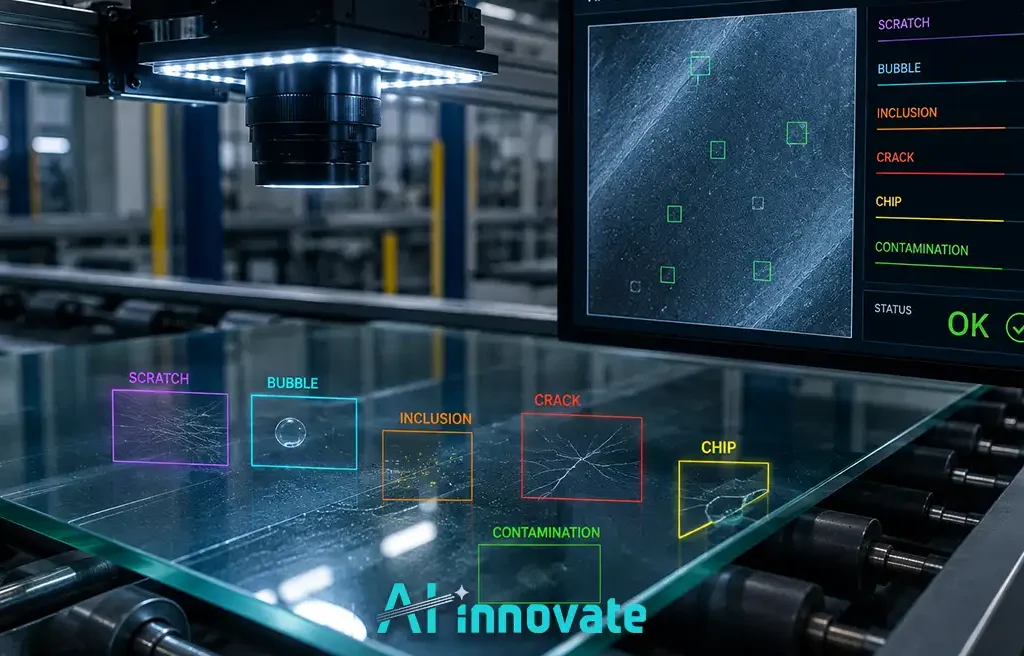
Scratches are the most frequent glass defect, caused by mechanical contact or friction during handling, transport, or processing. Shallow scratches can be nearly invisible under standard lighting, which makes them easy to miss manually. Chips and shells typically appear on edges from impact during handling and are easier to spot but critical to reject.
Internal Bubbles and Inclusions
Bubbles (also called seeds) and inclusions are foreign particles or gas pockets trapped inside the glass during melting. They originate from batch impurities or furnace wear. These defects reduce glass strength and, in tempered glass, can cause spontaneous breakage, which is why they’re treated as serious safety risks in automotive and architectural applications.
Coating Defects and Pinholes
Coated glass products (low-E architectural glass, anti-reflective lenses, display panels) can develop voids, pinholes, or uneven coverage during the coating process. These appear as tiny exposed spots that compromise performance and are especially hard to detect on transparent substrates.
Cracks and Stress Fractures
Cracks can form during thermal processing, handling, or from internal stress concentrations. In container glass, split-finish cracks are nearly invisible but compromise the seal integrity of the bottle or jar.
Contamination
Dust, grease, water spots, and other contaminants can become embedded or trapped in the glass structure. They’re cosmetically unacceptable in most applications and can interfere with downstream coating or bonding processes.
Heat-Treating Defects
Improper tempering or cooling can cause bows, ripples, or warping across the glass surface. These structural defects affect both performance and appearance and are distinct from surface flaws because they involve the geometry of the piece itself.
Why Is Glass Inspection Harder Than Other Materials?
Glass inspection is harder because the material’s transparency and reflectivity create optical effects that confuse both human inspectors and traditional machine vision systems. On an opaque material like metal or wood, machine vision for defect detection sees surface features directly. On glass, it sees through the surface, reflects off it, and refracts through it, all at once.
The specific challenges include:
- Transparency means defects and background blend together, making contrast-based detection unreliable.
- Reflectivity creates glints, highlights, and mirror effects that can look like defects or mask real ones.
- Angle dependency means the same scratch can be visible at one lighting angle and invisible at another.
- Variable glass types (tempered, laminated, curved, coated) each behave differently under the same lighting.
- Subtle defects like shallow scratches, micro-bubbles, and coating pinholes sit at or below the threshold of what rule-based vision reliably catches.
Manual inspection adds its own problems on top of these. Fatigue, subjectivity, and slow throughput make it nearly impossible to scale for high-volume glass production. An experienced inspector might catch most defects in a small batch, but consistency drops sharply over a full shift of looking through transparent material under changing light.
What Methods Does AI Use to Detect Glass Defects?
AI detects glass defects by training deep learning models to recognize flaws across multiple lighting conditions and glass types, learning to separate real defects from the optical noise that confuses rule-based systems.
The most common approaches in industrial glass inspection are:
- Convolutional neural networks (CNNs) such as ResNet, EfficientNet, and MobileNet for defect classification, identifying whether a region contains a scratch, bubble, inclusion, or other flaw.
- Object detection models like YOLO variants and Faster R-CNN for locating and classifying defects simultaneously, drawing bounding boxes around each flaw with a defect-type label.
- Instance segmentation models like Mask R-CNN for pixel-level defect mapping, which is especially useful for scratches on transparent surfaces where the defect boundary matters.
- Synthetic data generation using diffusion models to create artificial defect images when real defective samples are scarce, addressing the class imbalance problem that plagues glass inspection datasets.
These are the core architectures behind modern AI for material defect identification, and each one trades off speed against precision depending on what the line needs.
Recent research using improved ResNet-50 architectures has achieved 97.2% detection accuracy for glass defects with a false detection rate below 0.5%, processing at 25 frames per second at production-line edge speed.
This performance holds across multiple glass types and defect categories, from flat float glass to curved automotive panes. The consistency of these results across recent research (2021-2025) demonstrates that AI has reached a reliable threshold where accuracy and speed both exceed what manual inspection can sustain over a full production shift.
On the lines we work with, the practical difference is that AI holds its accuracy across lighting variation, glass curvature, and shift changes, all the conditions where manual and rule-based inspection break down.
Where Are Glass Defects Most Critical?
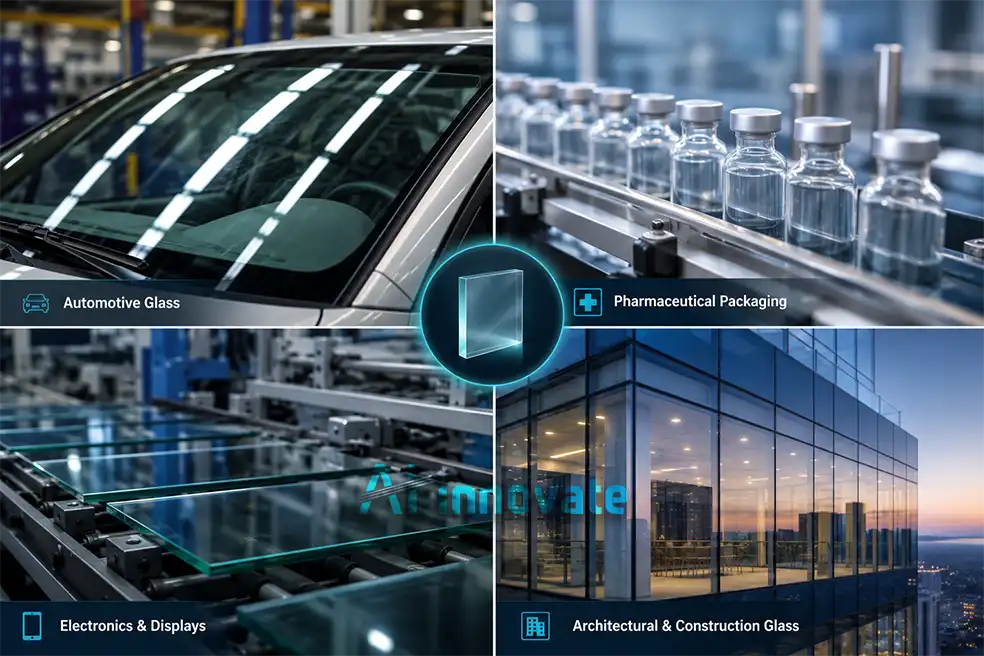
Glass defects are most critical in industries where a missed flaw creates a safety risk, a regulatory violation, or a high-cost field failure. Four industries stand out.
Automotive Glass
Windshields, side windows, mirrors, and lighting covers all require defect-free glass. An inclusion or stress fracture in a windshield is a direct safety hazard. Automotive glass inspection demands high-speed inline detection with zero tolerance for critical defects like inclusions and cracks.
Pharmaceutical Packaging
Glass vials, bottles, ampoules, and syringes must be free of cracks, chips, and particulate contamination. A defect that compromises the seal or introduces contamination into a drug product can trigger a recall. Pharma glass inspection operates under strict regulatory standards where traceability and documentation matter as much as detection itself.
Electronics and Displays
Smartphone screens, tablet panels, camera lenses, and optical components all require flawless glass surfaces. Even a micro-scratch on a display cover glass is a reject. The combination of high volume, small defect size, and tight tolerances makes this one of the most demanding glass inspection applications.
Architectural and Construction Glass
Float glass, tempered panels, and coated architectural glass are inspected for scratches, coating defects, and heat-treating distortion. Tolerances are generally wider than automotive or electronics, but the sheer size of the panels (often several meters) makes full-surface coverage a throughput challenge that manual inspection can’t scale for.
What Changes When You Switch to AI Glass Inspection?
The biggest change is consistency. AI removes the angle dependency, fatigue, and subjectivity that limit manual and rule-based inspection on glass.
| Factor | Manual Inspection | Traditional Machine Vision | AI-Based Inspection |
|---|---|---|---|
| 🔍 Handles Transparency & Reflections | Partially, depends on inspector skill | Poorly, prone to false calls | Well, learns to filter optical noise |
| 🎯 Defect Consistency | Varies by operator and shift | Consistent but rigid | Consistent and adaptive |
| ⚡ Throughput | Slow, limits line speed | Fast but limited by rules | Fast and flexible |
| 🔬 Subtle Defect Detection | Unreliable at speed | Misses low-contrast flaws | Catches micro-defects reliably |
| 🔄 Adaptability to New Products | Immediate but subjective | Requires reprogramming | Requires retraining with new data |
| 📊 Data & Traceability | Manual documentation | Basic logging | Automatic classification, logging, and trend analysis |
Beyond consistency, AI inspection gives glass manufacturers something manual checks can’t: data. Every defect is classified by type, size, and location automatically, which feeds into trend analysis, process control, and quality audits. That visibility is what turns inspection from a pass/fail gate into a tool for continuous improvement, the kind of real-time surface defect detection that drives yield gains over time.
How AI-innovate Supports Glass Defect Detection
We help glass manufacturers deploy AI inspection systems built around their specific glass types, defects, and production requirements, not generic datasets.
- AIxEye performs real-time defect detection on the line, identifying scratches, chips, bubbles, inclusions, coating defects, contamination, and cracks across flat glass, automotive glazing, pharmaceutical containers, and display panels.
- AIxCore is our NVIDIA Jetson Orin AGX-powered edge AI computer, delivering low-latency inspection and real-time processing directly on-site.
- AIxCam provides camera simulation and synthetic data generation, helping train models for rare defects such as inclusions, stress fractures, and coating failures.
- AIxAM analyzes multi-view images and depth data to detect surface and geometry defects on curved glass, containers, and other 3D glass products.
Every deployment starts with your glass type, defect profile, line speed, and quality requirements. From there, we design the inspection system around your production environment.
Book a demo and we’ll scope a glass inspection solution tailored to your products, defects, and throughput goals. Reach us at Info@ai-innovate.com or +1 (514) 813-1809.
Final Thoughts
Glass earns its reputation as one of the hardest materials to inspect. Transparency, reflectivity, and angle-dependent visibility make it a problem that manual checks and rule-based vision both struggle to solve consistently. AI changes the equation by learning to see through the optical noise, holding accuracy across shifts, and catching the subtle flaws that drive the costliest escapes.
The manufacturers getting the best results pair AI with the right lighting, cameras, and data pipeline for their specific glass type. They treat the model as part of a workflow, not a finished product on day one, and they use the inspection data to improve their process, not just reject bad parts.
Frequently Asked Questions
Can AI detect defects inside glass, not just on the surface?
AI can detect internal defects like bubbles and inclusions when the imaging setup is designed for it, typically using backlighting or transmitted light to make internal flaws visible. Surface-only lighting will miss subsurface defects regardless of how good the AI model is.
How does AI handle the reflections and glare that confuse cameras on glass?
AI models trained on glass learn to distinguish between optical artifacts (glints, refractions, transparency effects) and real defects. This is one of the main advantages over rule-based vision, which tends to either over-flag reflections as defects or miss real flaws hidden behind them.
Does an AI system need to be retrained for different glass types?
Usually yes. A model trained on flat float glass will underperform on curved automotive glass or coated display panels because the optical behavior changes. Retraining on the new glass type is far less work than building a model from scratch, but it’s a step that shouldn’t be skipped.
How fast can AI inspect glass on a production line?
Modern object detection models run fast enough for inline inspection at full production speed. The exact throughput depends on resolution, camera setup, and glass size, but deep learning models routinely process frames in milliseconds, which keeps up with high-speed glass lines.
What's the biggest challenge with AI glass inspection?
Data scarcity for rare defects. Common flaws like scratches are easy to collect, but critical defects like inclusions or stress fractures are rare by nature. Synthetic data generation helps close this gap by creating artificial training examples of uncommon defects.
Can AI tell the difference between a cosmetic flaw and a structural defect?
Yes, if the model is trained with that distinction. A well-labeled dataset that separates cosmetic-only flaws (light surface marks) from structural risks (inclusions, cracks) lets the model classify severity, not just presence, which supports smarter accept/reject decisions.
Is AI glass inspection only for large manufacturers?
No. The technology scales down to single-line deployments. The key factor isn’t production volume but whether your defect cost and quality requirements justify the investment, which is often the case even for smaller operations producing safety-critical or high-value glass products.
Sources
Ai-Innovate uses only high-quality sources, including peer-reviewed studies, to support the facts within our articles.
- Research on the Application of Computer Vision and Deep Learning in Green Building Material Quality Inspection. Proceedings of the 2025 International Conference on Artificial Intelligence and Smart Manufacturing. Demonstrates improved ResNet-50 architecture achieving 97.2% detection accuracy on glass defects with false detection rate below 0.5% at 25 fps edge processing speed on a 120,000-image dataset. https://dl.acm.org/doi/10.1145/3756423.3756435
- Enhancing Glass Defect Detection with Diffusion Models: Addressing Imbalanced Datasets in Manufacturing Quality Control. arXiv (2025). Addresses class imbalance in glass defect datasets and proposes Denoising Diffusion Probabilistic Models (DDPMs) for synthetic data generation of rare defects. https://arxiv.org/pdf/2505.03134
- A lightweight and robust detection network for diverse glass surface defects via scale- and shape-aware feature extraction. Engineering Applications of Artificial Intelligence (2026). Comprehensive review of recent glass defect detection methods (2022-2024), noting advances in attention mechanisms and multi-scale feature extraction for handling variable defect sizes and shapes. https://www.sciencedirect.com/science/article/abs/pii/S0952197625006402
- Optimizing Defect Detection on Glossy and Curved Surfaces Using Deep Learning and Advanced Imaging Systems. Sensors (2025). Addresses defect detection on reflective and curved glass surfaces using ResNet-50 and VGG-16 architectures, directly tackling the transparency and reflectivity challenges. https://www.ncbi.nlm.nih.gov/pmc/articles/PMC12031545/
- Context-Enhanced Network with Spatial-Aware Graph for Smartphone Screen Defect Detection. Sensors (2024). Demonstrates deep learning methods for detecting defects in high-precision glass screens using attention mechanisms and graph reasoning. https://www.ncbi.nlm.nih.gov/pmc/articles/PMC11175082/
- Cognex. Glass Inspection: AI-Powered Glass Quality Control. Industry reference on the challenges of transparency, reflectivity, and variable lighting in glass inspection, and how AI addresses them. https://www.cognex.com/en/applications/automated-defect-detection/material-quality-inspection/glass-defect-detection
- Sari, F. (2022). Deep Learning Application in Detecting Glass Defects with Color Space Conversion and Adaptive Histogram Equalization. International Information and Engineering Technology Association. Demonstrates YOLO-V3 achieving above 97% precision/recall on glass jar scratch and bubble defects with color-space preprocessing methods. https://www.iieta.org/download/file/fid/73685
- Image-based surface scratch detection on architectural glass panels using deep learning approach (2021). ScienceDirect. Demonstrates Mask R-CNN achieving 96.5% mAP for pixel-level scratch detection on transparent glass surfaces. https://www.sciencedirect.com/science/article/abs/pii/S0950061821004773