






Surface Defect Detection

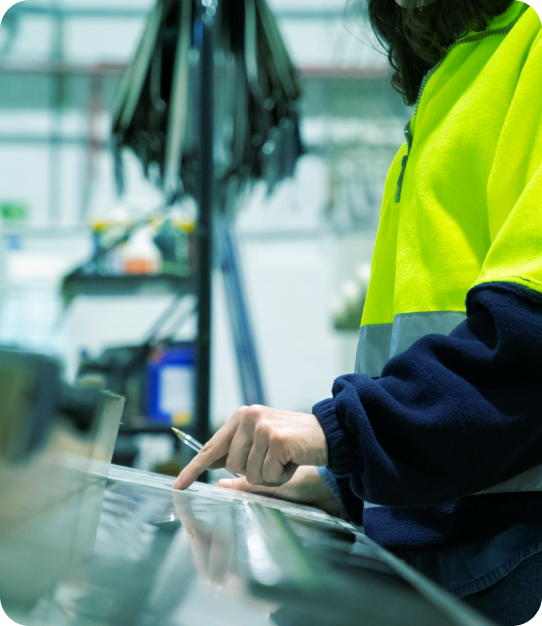
Your production line deserves inspections that keep up. We deliver real-time surface defect detection across metals, textiles, polymers, and paper,without the tuning, guessing, or manual checking that older systems require. Fewer defects, less downtime, and a more predictable process from day one.

When Manual Inspection
Isn't Enough

Manufacturers today need to be completely sure that faulty products will never reach customers. With production speeds increasing and quality standards getting stricter, you need inspection methods that are always accurate. 

Old inspection methods aren’t enough. AI brings the precision and speed your production line requires.

Why AI Innovate for surface Defect detection

Accurate Detection with AI

Accurate Detection with AI

We bring advanced AI and machine-vision to manufacturing, turning raw data into reliable, automated defect detection.

Real-Time Defect Monitoring

Real-Time Defect Monitoring

AIxEye provides instant defect recognition, works across different materials, and fits easily into existing production lines.

Better Output, Less Waste

Better Output, Less Waste

Boost productivity, reduce scrap, and improve consistency, AIxEye delivers insights that help operations run smoother.

Smart Inspection, Customized to Your Line

Tailored for your production line, our AI-powered systems deliver accurate surface defect detection across metals, fabrics, polymers, and paper.


Metal Inspection

Our metal inspection system delivers stable, high-accuracy detection even on reflective surfaces, helping manufacturers reduce defects, maintain consistent product quality, and keep production running smoothly without manual rechecks or constant parameter tuning.

Application :

Processes Covered:

Textile Inspection

Our textile inspection system ensures consistent fabric quality by detecting holes, stains, loose threads, and pattern issues in real time. Manufacturers minimize waste, avoid rework, and maintain reliable output across woven and nonwoven materials.

Processes Covered:

Application :

Polymer Inspection

Our polymer inspection solution delivers precise detection of bubbles, streaks, voids, and thickness variations, even on transparent films. It supports high-speed production and helps manufacturers maintain stable quality with fewer rejects and manual adjustments.

Processes Covered:

Application :

Paper (Matboard) Inspection

Our paper inspection system identifies wrinkles, pinholes, spots, and coating defects at high line speeds, ensuring consistent paper quality while reducing production errors, scrap rates, and costly manual checks.

Processes Covered:

Application :

See AI Surface Defect Detection in Action

Discover how AI-innovate’s surface defect detection solution performs in real manufacturing environments. This short demonstration shows how our AI-powered machine vision system detects scratches, cracks, dents, coating defects, and other surface imperfections in real time. Watch how automated inspection improves product quality, reduces scrap and rework, and helps manufacturers maintain consistent production without slowing the line.

How Our AI Eye Detects Defects in Real Time

A simple breakdown of how our AI captures, analyzes, and identifies defects across any surface in real time.

Capture

High-resolution cameras collect continuous surface

Detect

Our AI models analyze each frame instantly, identifying scratches

Notify

Operators receive immediate alerts with defect location

Improve

Trends, reports, and analytics highlight recurring problems

92680-1.png

For Manufacturers, We Build Custom
AI Visual Inspection Systems for Quality Control

Materials Compatible with AI Surface Defect Detection

AI surface defect detection systems are designed to inspect a wide variety of industrial materials, each with unique surface properties, reflectivity, textures, and manufacturing challenges. Using AI-powered machine vision, high-resolution industrial cameras, and optimized lighting, inspection parameters can be customized to reliably detect scratches, cracks, dents, contamination, coating defects, discoloration, and other surface imperfections across different production environments.

This flexibility enables manufacturers to deploy a single inspection platform across multiple product lines while maintaining consistent quality standards and production efficiency.

Our AI inspection solutions are commonly used for:

  • Metals: Steel, stainless steel, aluminum, copper, brass, and cast metal components.
  • Plastics and Composites: Injection-molded parts, composite materials, carbon fiber, and engineered polymers.
  • Glass and Ceramics: Glass panels, ceramic components, tiles, and precision-engineered surfaces.
  • Rubber and Elastomers: Industrial seals, tires, molded rubber parts, and flexible components.
  • Coated and Finished Products: Painted parts, powder-coated surfaces, anodized metals, and protective coatings.
  • Textiles and Fabrics: Woven fabrics, nonwoven materials, technical textiles, and finished textile products.

What types of surface defects can AI detect?

AI-powered surface defect detection systems can identify a wide range of visible surface imperfections that affect product quality, appearance, and manufacturing performance. Using high-resolution industrial cameras, advanced lighting, and machine learning algorithms, the system analyzes every product in real time to detect defects that may be difficult to identify consistently through manual inspection.

Inspection models are trained for specific materials, products, and production conditions, allowing manufacturers to achieve reliable defect detection while maintaining high production speeds.

AI surface inspection systems can detect defects such as:

  • Structural Defects: Cracks, fractures, holes, chips, dents, pits, and edge damage.
  • Surface Imperfections: Scratches, scuff marks, abrasions, wrinkles, and deformation.
  • Coating and Finish Defects: Paint defects, coating inconsistencies, blistering, peeling, bubbles, and orange peel.
  • Material Defects: Corrosion, rust, oxidation, porosity, inclusions, and surface contamination.
  • Visual Quality Issues: Discoloration, stains, burn marks, texture variations, missing material, and dimensional surface irregularities.

What Our Customer Say?

Do you have any questions?

We have answered all your questions

AI-powered surface defect detection uses computer vision and machine learning to automatically identify scratches, cracks, dents, coating issues, stains, and texture irregularities during manufacturing. These systems inspect products in real time using industrial cameras and deep learning models to improve quality control accuracy and consistency.

AI inspection systems capture high-resolution images of products as they move through production lines. Machine learning algorithms then analyze surface patterns, compare them against trained defect data, and instantly classify defects such as scratches, cracks, discoloration, or surface contamination.

AI surface inspection systems can detect:

  • Scratches and dents
  • Cracks and fractures
  • Paint and coating defects
  • Surface contamination
  • Corrosion and oxidation
  • Texture inconsistencies
  • Color variations
  • Material deformation
  • Microscopic surface flaws


Advanced deep learning models can identify subtle defects that are difficult for manual inspectors to detect consistently.

AI inspection systems provide faster and more consistent defect detection than manual inspection. Unlike human inspectors, AI systems do not experience fatigue or subjective judgment variations, allowing manufacturers to maintain stable quality standards across high-speed production environments.

Rule-based inspection systems rely on predefined parameters and often struggle with complex or changing defect patterns. AI-based surface defect detection uses deep learning models that learn from production data, allowing the system to adapt, reduce false positives, and detect more complex surface abnormalities.

AI-powered surface inspection is widely used in:

  • Automotive manufacturing
  • Electronics and semiconductor production
  • Steel and metal processing
  • Textile manufacturing
  • Packaging and printing
  • Aerospace manufacturing
  • Pharmaceutical production
  • Food and beverage industries

These industries require high inspection accuracy and real-time quality monitoring.

Yes. High-resolution industrial cameras combined with deep learning algorithms allow AI systems to identify micro-cracks, tiny scratches, coating inconsistencies, and other microscopic surface defects that are often invisible to the human eye.

Yes. AI-powered inspection systems analyze products instantly during manufacturing, enabling real-time defect detection and immediate removal of defective products before they continue through the production process

Yes. Modern AI-powered inspection systems are designed for inline manufacturing environments and can inspect every product moving through a production line in real time. High-speed industrial cameras, edge AI processing, and optimized machine vision algorithms allow manufacturers to maintain production throughput while performing 100% automated inspection.

Yes. AI-powered surface defect detection systems combined with high-resolution industrial cameras can identify microscopic scratches, cracks, pits, coating defects, and surface contamination that are difficult or impossible to detect consistently through manual inspection. Detection capability depends on factors such as camera resolution, lighting configuration, defect size, and material characteristics.

Just let us know what you need. We'll figure out the solution.

Complete the form below and our team will aim to be in touch within 1 business day.

Mask group

Request a Demo

"*" indicates required fields

Full Name*
Would you like to stay up-to-date with the news about Ai Innovate projects, offers and clients' success stories?
Shopping Basket