




In pharmaceutical manufacturing, a missed defect isn’t a customer complaint. It’s a patient safety risk, a regulatory citation, and potentially a recall. Visible particulates alone have historically accounted for roughly a fifth of sterile injectable recalls.¹ Yet much of the industry still relies on manual visual inspection, where detection rates vary by inspector, by shift, and by hour of the day. Regulators have noticed: EU GMP Annex 1 and the USP visual inspection chapters have raised the bar on what counts as adequate inspection and adequate proof that it happened.
This guide covers how pharmaceutical quality inspection AI handles vials, tablets, container closure integrity, and packaging, how it maps to the regulations that govern sterile and solid-dose manufacturing, and where it fits against manual and legacy automated systems.
What Is AI-Based Pharmaceutical Quality Inspection?
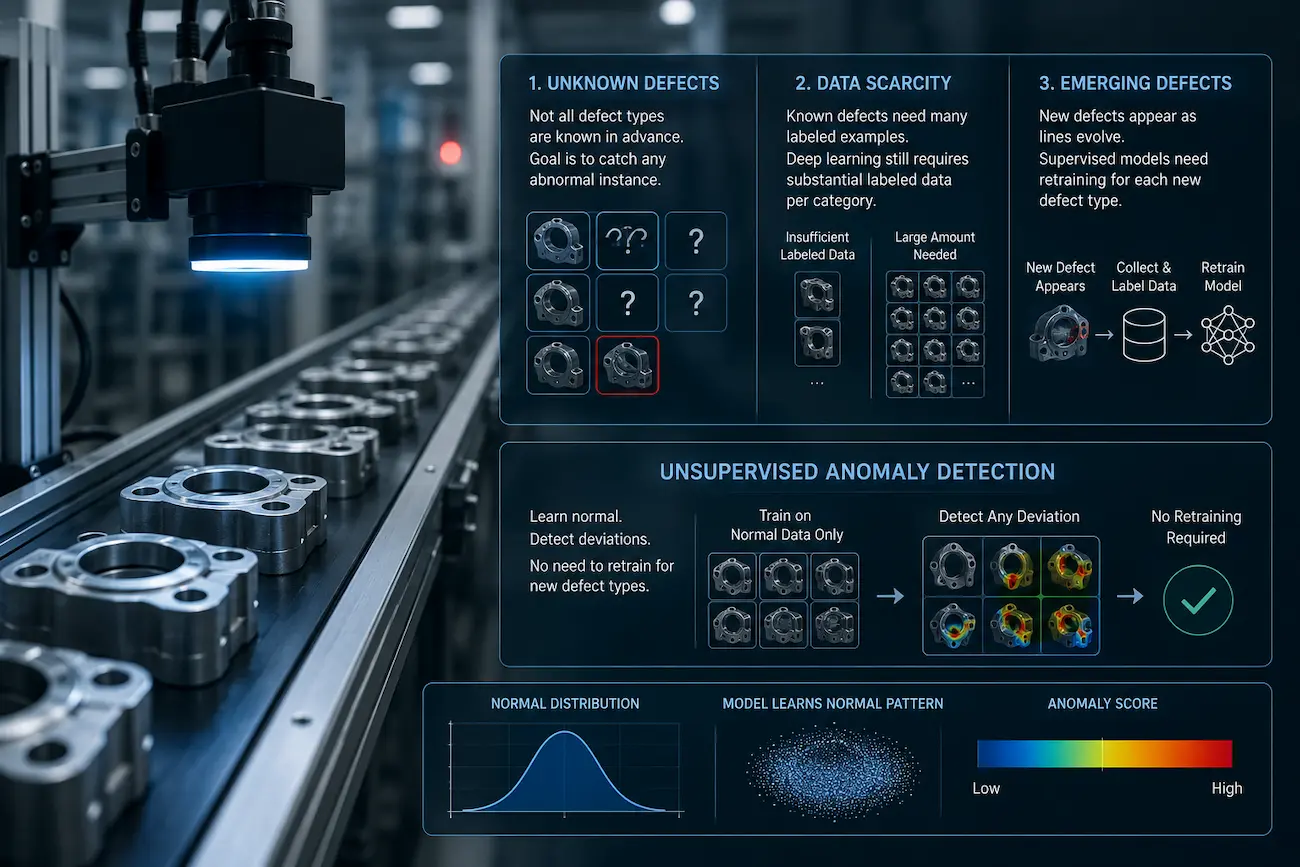
AI-based pharmaceutical quality inspection uses trained machine learning models to detect and classify defects on drug products and packaging at production speed, with every inspection recorded for regulatory traceability. Unlike rule-based vision systems that compare each unit against a fixed template, AI models learn from labeled examples, which lets them handle the natural variation in fill, glass, and product appearance that defeats threshold-based inspection.
The regulated context is what makes pharma different from other industries. It isn’t enough to catch the defect. You have to prove what was inspected, against what criteria, with what result, and be able to produce that record on demand. That dual requirement, detection plus documentation, is the through-line of everything below, and it’s why AI for quality assurance is increasingly part of how manufacturers approach inspection.
What Are the Most Common Defects in Pharmaceutical Manufacturing?
The most common pharmaceutical defects fall into four groups: particulates and product defects, container and closure defects, solid-dose defects, and packaging or labeling errors. Each carries a distinct patient-safety and regulatory consequence, which is why defect detection in manufacturing in pharma is treated differently from cosmetic industries.
Particulate and product defects include:
- Visible particles in injectables, from glass, fiber, metal, or product aggregates
- Cloudiness or discoloration in solutions
- Melt or collapsed cake in lyophilized (freeze-dried) product
- Gross over- or under-fill
Container and closure defects include:
- Cracks or chips in vials and ampoules
- Missing, raised, or misseated stoppers
- Crimp and seal failures on the closure
Solid-dose defects include:
- Chips, cracks, capping, and lamination on tablets
- Color and coating variation
- Dents, holes, or fill errors in capsules
Packaging and labeling errors include:
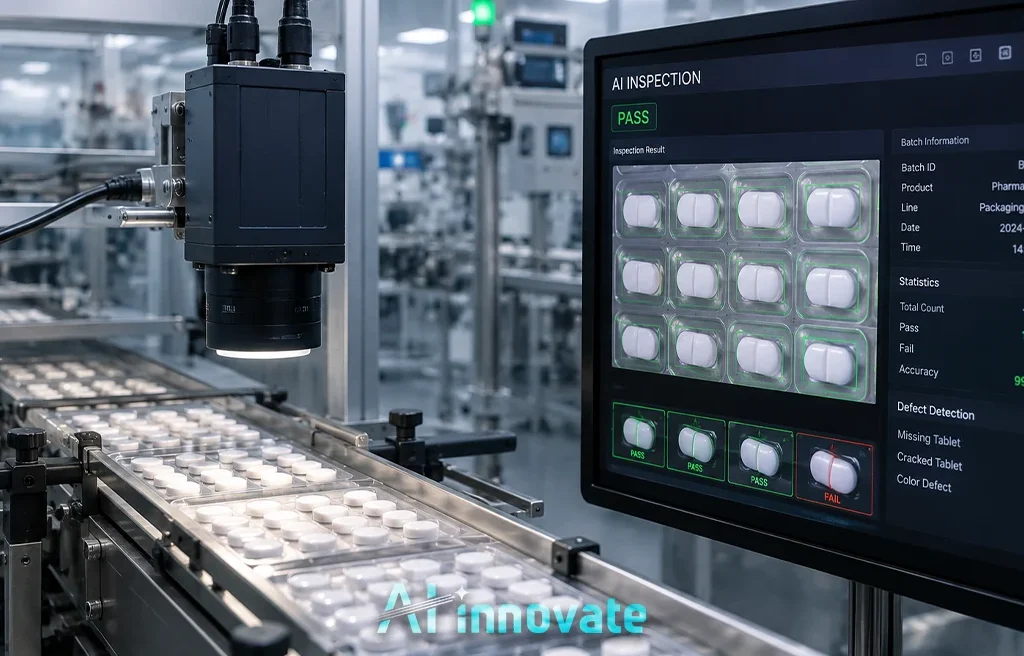
- Missing tablets or capsules in blister cavities
- Wrong, missing, or illegible labels
- Incorrect or unreadable lot numbers and expiry dates
How Does AI Handle Vial and Injectable Visual Inspection?
AI handles vial and injectable inspection by imaging each unit from multiple angles and classifying particulates, fill level, container, and closure defects in real time. This is the highest-stakes inspection in pharma, because injectables go directly into the bloodstream and visible particulates are a direct patient risk.
Pharma visual inspection of injectables is governed by a 100% inspection expectation, and AI strengthens it in two ways: sensitivity and consistency. Deep learning models trained on labeled defect images detect small particles and subtle container cracks more reliably than a human inspector can sustain across a full shift, and they apply the same detection threshold to the first vial and the ten-thousandth, removing the inspector-to-inspector and hour-to-hour variation that regulators scrutinize.
On an injectable line, vial inspection AI typically checks:
- Visible particulates in the solution (glass, fiber, metal, aggregates)
- Fill level against the declared volume
- Container defects such as cracks and chips in vials and ampoules
- Closure defects such as missing, raised, or misseated stoppers
The role here is not to remove the qualified human entirely but to apply a consistent first pass at line speed and route borderline units for review.
How Does AI Inspect Tablets and Solid Dose Forms?
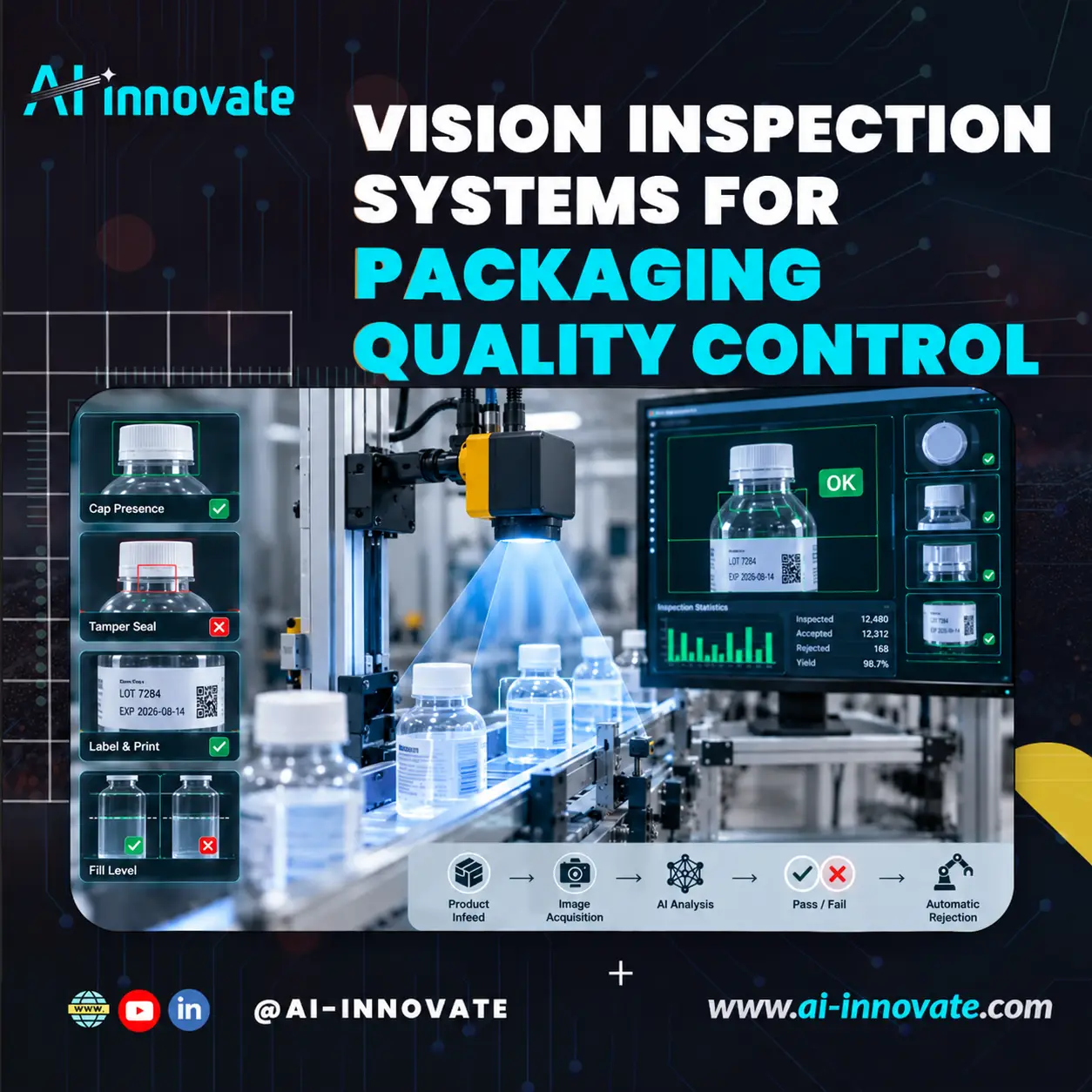
AI inspects tablets and capsules by classifying surface, shape, and color defects on every unit as it moves through the line, catching flaws that sampling-based checks miss. Solid-dose lines run at very high speeds, which makes 100% manual inspection impractical and statistical sampling the traditional fallback.
Because the model learns acceptable appearance from labeled examples, it tolerates the normal batch-to-batch variation in color and texture that causes rule-based systems to over-reject, while still flagging genuine defects. Tablet inspection with AI typically covers:
- Chips, cracks, capping, and lamination
- Spots, color variation, and coating defects
- Capsule dents, holes, and fill consistency
- Broken or fragmented units
The practical payoff is full-batch coverage instead of a sampled subset, which both improves quality and produces a per-unit inspection record.
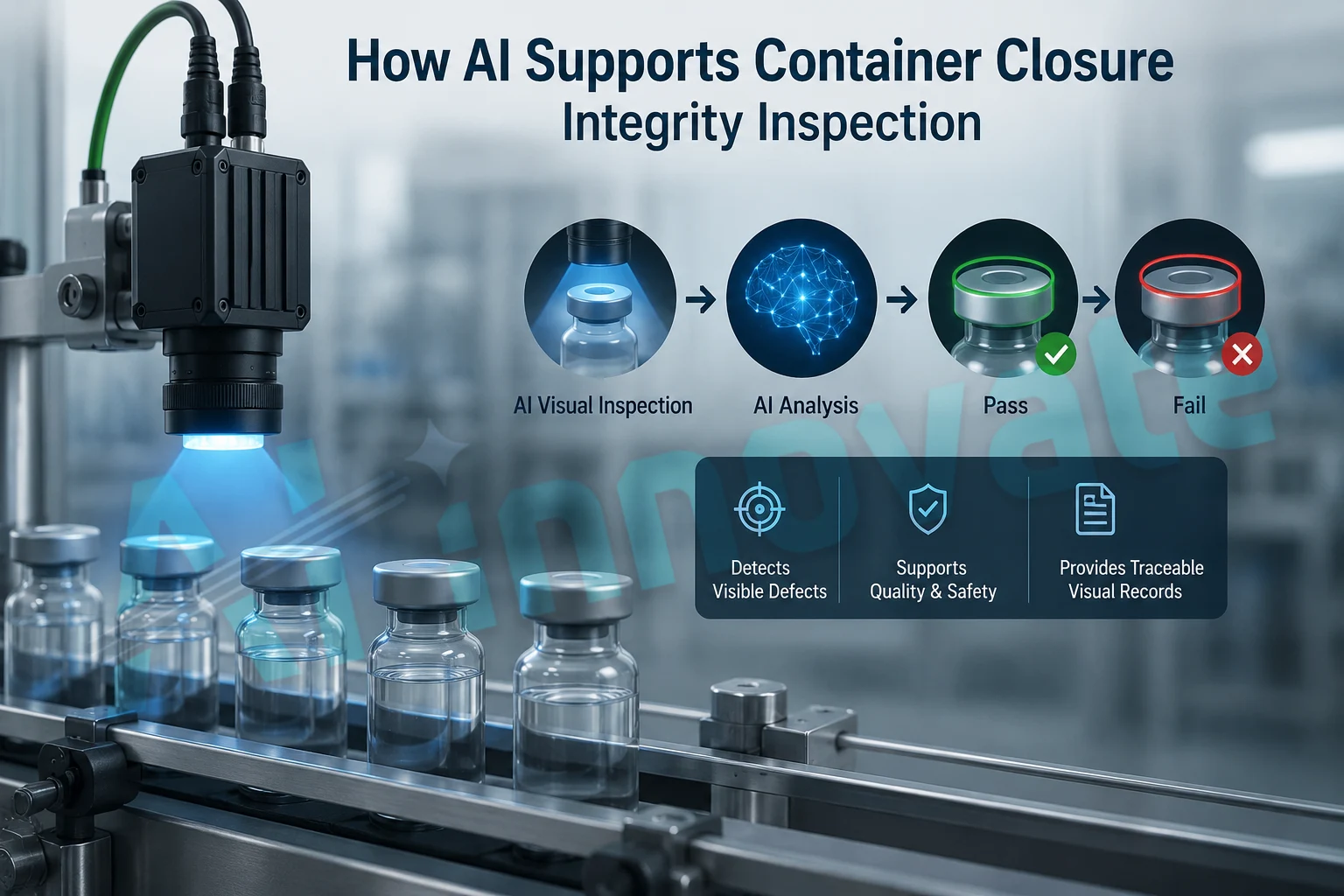
How Does AI Support Container Closure Integrity Inspection?
AI supports container closure integrity (CCI) by visually detecting the closure and seal defects that signal a potential breach, complementing the physical leak tests that confirm integrity. CCI matters because a compromised seal lets microorganisms in, defeating the sterility the whole process exists to protect.
It’s important to be precise about the division of labor here:
- AI vision inspects what’s visible: missing or raised stoppers, crimp defects, cracks, and seal-area problems, caught at line speed.
- Physical methods confirm an actual leak: helium leak testing, vacuum decay, and dye ingress, which USP <1207> describes as the validated approaches to CCI.²
AI’s role is to catch the visible closure defects upstream, reducing the number of suspect units and feeding a documented visual record into the overall CCI strategy that Annex 1 and 21 CFR Part 211 require.
How Does AI Support Pharmaceutical Packaging Compliance?
AI supports pharma packaging compliance by verifying label accuracy, lot and expiry legibility, blister completeness, and serialization data on every pack at line speed. Packaging and labeling errors are a leading cause of pharmaceutical recalls, and many are detectable before the product ever leaves the line.
Combining optical character recognition with trained verification models, AI packaging inspection typically confirms:
- The correct label is on the correct product, with accurate dosage and warning information
- Lot numbers and expiry dates are present and readable
- Blister packs are complete, with no missing or broken units
- Serialization and tamper-evidence features are intact
Because each check is logged automatically, pharma packaging compliance shifts from a sampled, manual sign-off to a per-unit verified record, which is exactly what auditors increasingly expect.
How Does AI Inspection Meet Pharmaceutical Regulatory Requirements?
AI inspection meets pharmaceutical regulatory requirements by performing the detection these standards demand and generating the per-unit, audit-ready documentation they require. The regulations below define what “adequate inspection” and “adequate evidence” actually mean.
EU GMP Annex 1 (2022)
The 2022 revision of EU GMP Annex 1 raised expectations for the manufacture of sterile medicinal products, treating visual inspection as part of a documented contamination control strategy rather than a routine end-of-line step.³ It places greater weight on inspector qualification, detection probability, and trending of rejects, all of which AI supports by producing consistent detection and automatic trend data.
USP , , and ICH Q10
USP <790> is the binding chapter (enforceable as a chapter numbered below 1000) that requires injectable products to be essentially free of visible particulates, verified through 100% inspection followed by AQL sampling at an acceptance limit of 0.65.⁵ USP <1790> is the companion guidance chapter, describing the inspection life cycle, methods, and qualification for visual inspection of injections.⁶ ICH Q10 sits above both as the pharmaceutical quality system framework that ties inspection data into continual improvement and management review. AI inspection feeds all three by delivering consistent 100% inspection and the data that supports AQL trending and quality-system review.
Audit Trail and 21 CFR Part 11
21 CFR Part 11 governs electronic records and electronic signatures, requiring secure, time-stamped, tamper-evident audit trails for data that supports GMP decisions. This is where AI inspection has a structural advantage: it generates per-unit records with image evidence, classification, timestamp, and batch linkage automatically, the kind of audit trail that a manual log completed at shift end cannot reproduce.
How Does AI Pharma Inspection Compare to Manual and Legacy AVI Systems?
The core difference is that AI is consistent like an automated system and adaptable like a human, while documenting everything. Manual inspection brings human judgment but degrades with fatigue and varies between inspectors. Legacy automated visual inspection (AVI) is consistent but rigid, prone to over-rejecting on normal product variation because it matches against fixed parameters.
| Factor | Manual Inspection | Legacy AVI Systems | AI-Based Inspection |
|---|---|---|---|
| Detection Consistency | Depends on operator experience and fatigue | Consistent but relies on fixed rules | Consistent, adaptive, and data-driven across every shift |
| Product Variation | Handled through human judgment | Often rejects acceptable variations | Learns normal variation to reduce false rejects |
| Inspection Coverage | Sampling or slower 100% inspection | 100% inspection with predefined criteria | Real-time 100% inspection with AI classification |
| Defect Detection | May miss subtle or inconsistent defects | Limited to programmed defect rules | Detects known and complex visual defects with high accuracy |
| False Reject Rate | Varies between inspectors | Higher when product appearance changes | Lower after AI model optimization |
| Documentation | Manual records and reports | Basic pass/fail logging | Automatic image capture, classification, and traceability |
| Regulatory Readiness | Manual audit preparation | Limited digital records | Time-stamped inspection history supporting compliance |
| Scalability | Requires additional inspectors | Requires rule updates for new products | Scales easily across products and production lines |
| Continuous Improvement | Based on operator training | Requires manual rule programming | Models improve with new production data and feedback |
When we commission a pharmaceutical inspection line, the false-reject rate is usually where legacy AVI hurts most: every false reject on a high-value injectable is investigated and often discarded, so reducing false rejects while holding detection is where AI earns its place. The documentation row is where the regulatory gap is widest, since AI produces the per-unit evidence that manual and many legacy systems simply do not.
How AI-innovate Supports Pharmaceutical Quality Inspection
We deploy AI inspection systems built around your products, your defect library, and your regulatory obligations, not a generic model handed over to underperform on your line. In a regulated environment, the system also has to produce evidence that holds up under audit, which shapes how we scope every deployment.
The products we deploy for pharmaceutical quality inspection:
- AIxEye handles real-time defect detection and process optimization, classifying particulates, fill, container, closure, tablet, and labeling defects at line speed while logging each result.
- AIxCore is the industrial AI edge computer powered by NVIDIA Jetson Orin AGX, running inference on-site for low-latency rejection and keeping inspection records on-premise where data integrity and 21 CFR Part 11 obligations live.
- AIxCam provides simulation tools and synthetic data generation for rare defects, such as uncommon particulate types or container cracks, that don’t appear often enough on a compliant line to train from directly.
- AIxAM detects surface and geometry defects on three-dimensional containers and products using multi-view images and depth data, covering vial deformation, closure seating, and structural packaging defects.
The starting point is always the same: your product types, your defect library, your line speed, and the regulatory standards you report against. Book a demo and we’ll scope an inspection setup around your products and your compliance requirements. Reach us at Info@ai-innovate.com or +1 (514) 813-1809.
Final Thoughts
Pharmaceutical inspection carries a double burden that other industries don’t: you have to catch the defect, and you have to prove you caught it. Manual inspection struggles with the first because detection drifts with fatigue, and with the second because shift-end logs aren’t real per-unit evidence. Legacy automated systems are consistent but over-reject on normal variation and document little.
AI inspection addresses both at once. It applies consistent, adaptive detection across vials, tablets, closures, and packaging, and it generates the time-stamped, per-unit, image-backed records that EU GMP Annex 1, USP, and 21 CFR Part 11 increasingly expect. For manufacturers in a regulated, audited environment, that combination of detection and traceable evidence is where the real value sits.
Frequently Asked Questions
Does AI inspection replace the qualified human inspector required for injectables?
Not entirely. AI applies a consistent 100% first pass at line speed and routes borderline or rejected units for qualified human review. It strengthens the inspection process and its documentation rather than removing the human oversight that regulations expect.
Can AI inspection satisfy 21 CFR Part 11 audit trail requirements?
The inspection data can support Part 11 compliance when the system is validated and configured correctly, generating secure, time-stamped, per-unit records with image evidence and classification. As with any GMP system, the audit trail and access controls must be validated for your environment.
How does AI handle container closure integrity versus a physical leak test?
AI visually detects closure and seal defects such as missing or raised stoppers and crimp failures. It does not replace physical CCI methods like helium leak, vacuum decay, or dye ingress, which remain the validated way to confirm an actual leak. AI catches visible defects upstream and feeds the overall CCI strategy.
Does AI inspection require revalidation when we change products or formats?
A new product or container format generally requires model configuration and validation for that product, but this is typically faster than reprogramming a legacy AVI system. The validation effort is part of normal change control in a GMP environment.
Can AI reduce the false reject rate on injectables?
Yes. Because the model learns acceptable product variation rather than matching a rigid template, it typically lowers false rejects compared with legacy AVI, while maintaining detection. This matters because every false reject on a high-value injectable triggers investigation and potential loss.
How does AI inspection support EU GMP Annex 1 compliance?
It supports the contamination control strategy Annex 1 expects by delivering consistent visual inspection, detection-probability performance, and automatic trending of rejects, along with the documented evidence that the inspection is operating as intended.
What pharmaceutical products can AI inspect?
AI inspection covers injectables in vials, ampoules, and syringes, solid-dose tablets and capsules, and their packaging, including blister packs, labels, and serialization. The model and imaging setup are configured to each product type and its defect library.
Sources
Ai-Innovate uses only high-quality sources, including peer-reviewed studies, to support the facts within our articles.
- FDA / J.G. Shabushnig, Visual Inspection of Injectable Products (2022). Historical data indicating visible particles accounted for roughly 22% of sterile injectable drug recalls. https://www.fda.gov/media/162175/download
- USP General Chapter <1207>, Package Integrity Evaluation, Sterile Products. Describes validated container closure integrity test methods including helium leak, vacuum decay, and dye ingress. https://www.usp.org/
- European Commission, EudraLex Volume 4, EU GMP Annex 1: Manufacture of Sterile Medicinal Products (2022 revision). Establishes the contamination control strategy and raised visual inspection expectations. https://health.ec.europa.eu/document/download/e05af55b-38e9-42bf-8495-194bbf0b9262_en
- US FDA, 21 CFR Part 211, Current Good Manufacturing Practice for Finished Pharmaceuticals, Section 211.94 (container closure systems). https://www.ecfr.gov/current/title-21/chapter-I/subchapter-C/part-211
- USP General Chapter <790>, Visible Particulates in Injections. Requires injections to be essentially free of visible particulates via 100% inspection and AQL sampling at 0.65. https://www.usp.org/
- USP General Chapter <1790>, Visual Inspection of Injections. Guidance on inspection life cycle, methods, and qualification. https://www.gmp-compliance.org/gmp-news/usp-chapter-1790-visual-inspection-of-injections-published
- US FDA, 21 CFR Part 11, Electronic Records; Electronic Signatures. Audit trail and data integrity requirements. https://www.ecfr.gov/current/title-21/chapter-I/subchapter-A/part-11
- ICH, Q10 Pharmaceutical Quality System. https://www.ich.org/page/quality-guidelines