




For decades, quality control has been reactive. A defect appears, an inspector catches it or misses it, and the team fixes it or ships it. The faster the line runs, the harder it gets to catch problems before they become scrap, rework, or a customer complaint. That model’s now shifting: manufacturers are moving from detecting what went wrong to predicting what’ll go wrong, often hours before it happens.
This guide covers what predictive quality analytics is, why the shift is happening now, how it works, and where it delivers measurable value.
What Is Predictive Quality Analytics?
Predictive quality analytics is the use of historical and real-time production data to forecast quality issues before they occur, rather than detecting them afterward.
Quality problems rarely appear from nowhere. They build gradually, and the conditions that cause them leave traces in process data long before a finished defect is visible. Predictive systems find those traces and raise the alarm early enough to act on them.
What Does Reactive Quality Control Actually Cost in Lost Production and Scrap?
The shift is driven by economics: reactive inspection catches problems only after they’ve already consumed time, materials, and energy. The cost of staying reactive is steep:
- Unplanned downtime costs industrial manufacturers an estimated $50 billion a year
- Most of that loss is unplanned, which is exactly what prediction is built to prevent
- Poor maintenance strategies reduce a plant’s overall productive capacity by 5 to 20 percent
Predictive analytics flips this by catching early warning signs and acting before impact. The market reflects the change: manufacturing predictive analytics grew from $1.6 billion in 2024 toward a projected $6.6 billion by 2033. On the lines we work with, the logic’s simple: once you can predict a defect, preventing it is always cheaper than handling it after the fact.
How Does Predictive Quality Analytics Work on a Production Line?
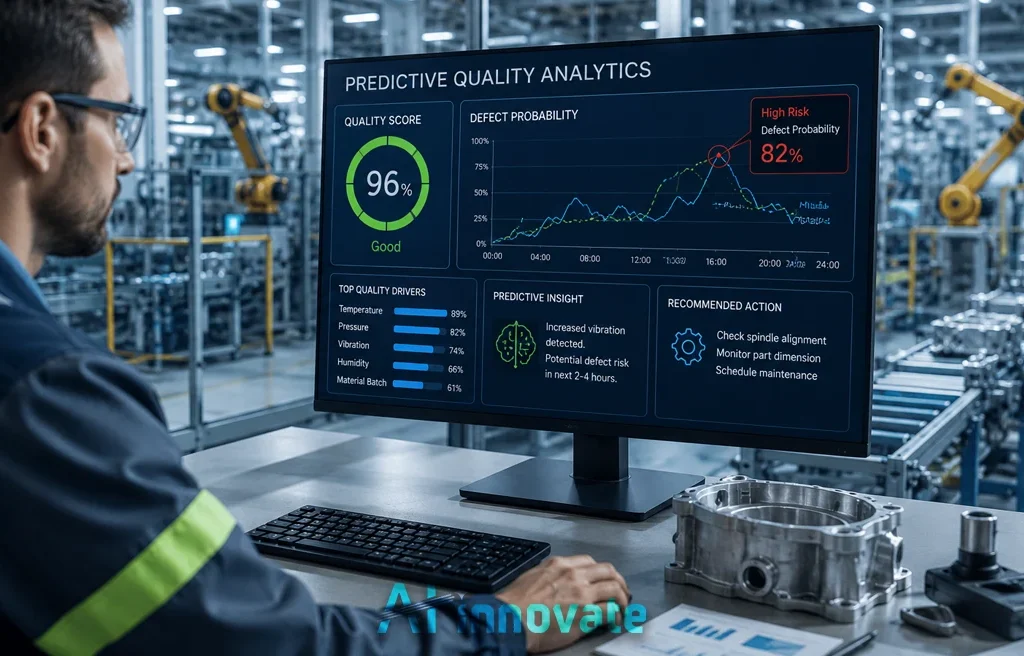
Predictive quality analytics works by training machine learning models on historical production data, then running them against live data to flag risk in real time.
It starts with data collection, where sensors capture process variables like temperature, pressure, vibration, and feed rate, and link them to historical quality records. Those paired records train a model to recognize which conditions preceded which defects. Once it’s trained, the model runs against live production data continuously, and when it detects a known failure pattern forming, it alerts operators before the batch is finished. Every prediction that’s later confirmed or proven wrong becomes new training data, so the AI quality prediction gets more accurate over time.
The key point is that the model works on process data, not finished parts. It can warn operators while there’s still time to adjust and prevent the defect, which reactive inspection can’t do. That’s why strong AI for process monitoring is the foundation any predictive system is built on.
| Factor | Reactive Quality Control | Predictive Quality Analytics |
|---|---|---|
| Timing | Acts after a defect appears. | ✔ Acts before the defect forms by identifying quality risks in real time. |
| Data Used | Finished parts and inspection results. | ✔ Live process data, machine sensors, vision systems, and historical production data. |
| Cost of Issues | Higher due to scrap, rework, warranty claims, and production losses. | ✔ Lower through early intervention and defect prevention at the source. |
| Downtime | Unexpected production interruptions after quality failures occur. | ✔ Maintenance and process adjustments are planned before failures impact production. |
| Continuous Improvement | Focuses on correcting symptoms after defects are found. | ✔ Uses AI-driven root cause analysis and continuous learning to optimize manufacturing processes. |
What Real Benefits Does Predictive Quality Analytics Deliver?
The benefits fall into two categories: preventing escapes and optimizing resources.
Preventing escapes is the headline. A missed defect often becomes a field failure costing many times more than catching it in production, so surfacing risk before a part finishes is where the biggest savings come from. Downtime drops alongside it: McKinsey research indicates that predictive maintenance can reduce unplanned downtime by 30 to 50 percent and extend machine life by 20 to 40 percent.
On the resource side, condition-based servicing replaces fixed maintenance schedules, which McKinsey links to maintenance cost reductions of 10 to 40 percent, while Deloitte research indicates predictive maintenance can increase equipment uptime by 10 to 20 percent and productivity by up to 25 percent. That visibility is what turns machine learning in quality control into a tool for fixing root causes instead of patching symptoms.
Where Does Predictive Quality Analytics Deliver the Most Value by Industry?
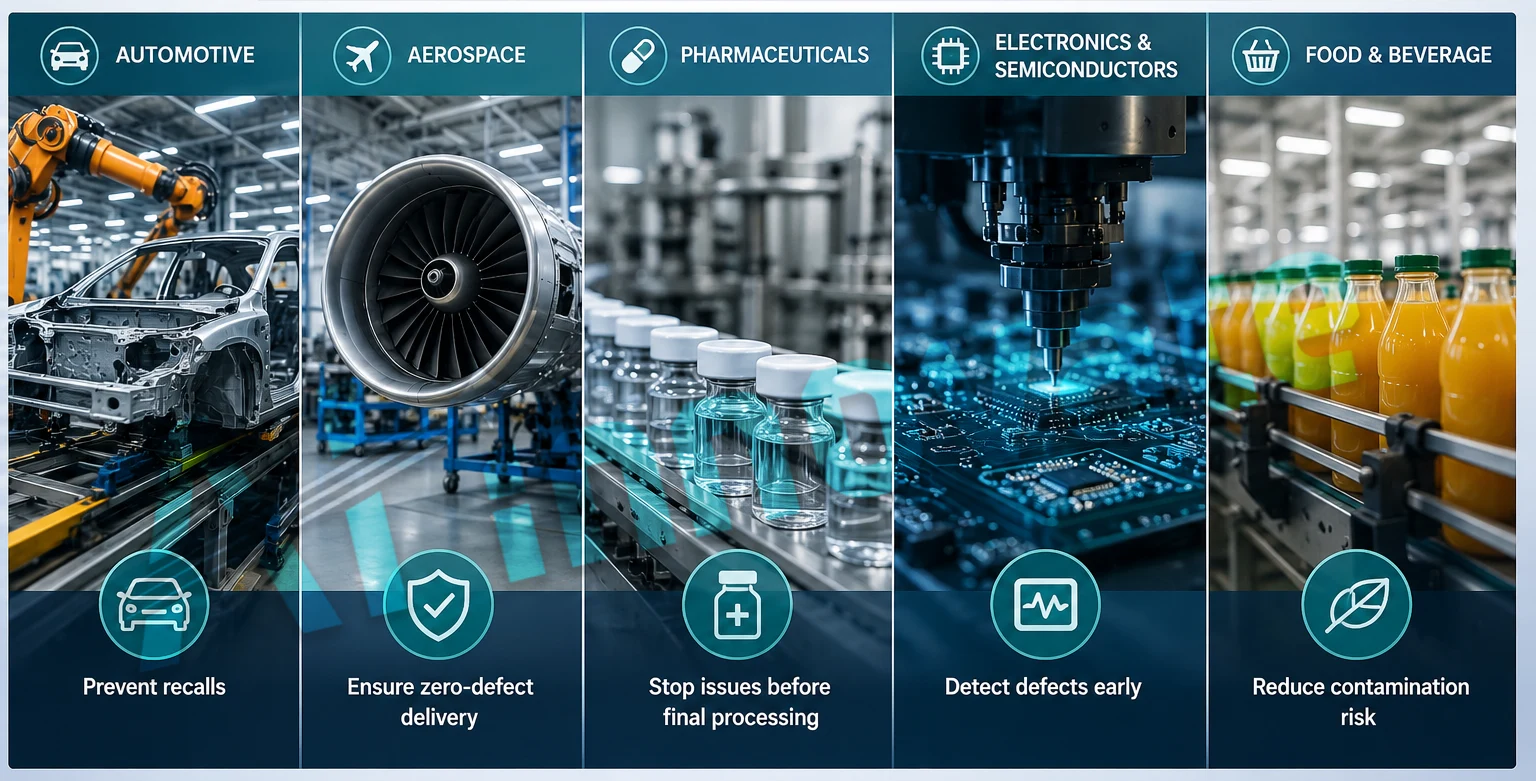
Predictive quality matters most where the cost of failure is high, volume is significant, or tolerances are tight:
- Automotive. Catches paint, weld, or alignment drift hours before finished parts ship, preventing recalls rather than just rework.
- Aerospace. Maintains zero-defect delivery on critical components, where cost per defect is highest.
- Pharmaceuticals. Flags batch risk early enough to halt a run before final processing, recovering most of the material cost.
- Electronics and semiconductors. Identifies wafer or board runs at risk while parameters can still be adjusted.
- Food and beverage. Forecasts shelf-life and contamination risk before shipping.
The common thread is that prediction protects against costs reactive inspection only discovers after they’re already sunk.
What Are the Real Challenges of Implementing Predictive Quality Analytics?
Predictive quality is powerful, but it isn’t plug-and-play. The main challenges are data, false positives, and integration:
- Data quality. Models are only as good as their training data, and many manufacturers find their historical records fragmented or poorly timestamped. Data prep often takes longer than model training.
- False positives. A model that over-flags trains operators to ignore alerts, so tuning toward fewer false alarms is critical for trust.
- Integration. Predictive analytics in production needs real-time feeds from equipment, historians, and quality databases that don’t always communicate.
- Rare failure modes. A defect that appears once every few months is hard to learn from, which is where synthetic data generation increasingly helps.
None of these is a dealbreaker, but each is worth planning for before deployment.
How AI-innovate Supports Predictive Quality Analytics
We work with manufacturers to build predictive systems trained on your actual production patterns, not on generic benchmark data handed over and left to underperform. A model trained on another plant’s line behaves poorly on yours, because your equipment, suppliers, and conditions are different. That line-specific work is where predictive projects succeed or fail.
The components we deploy:
- AIxEye delivers real-time defect detection and process optimization, generating the continuous quality signals that feed and confirm your predictive models.
- AIxCore is the industrial AI edge computer powered by NVIDIA Jetson Orin AGX, running inference on-site so predictions arrive fast enough to act before a batch finishes.
- AIxCam provides simulation tools and synthetic data generation, letting you train on rare failure modes that haven’t occurred often enough on the live line to learn from.
- AIxAM detects surface and geometry anomalies on three-dimensional parts using multi-view images and depth data, adding more quality signals to your models.
The starting point’s always the same: your biggest quality or downtime pain point, your line speed, your available data, and what success looks like in dollars. This is also where solid AI for quality assurance practices and predictive analytics reinforce each other. Book a demo and we’ll scope a focused pilot around it. Reach us at Info@ai-innovate.com or +1 (514) 813-1809.

Final Thoughts
The move from reactive to predictive quality is where manufacturing’s heading. It isn’t about replacing operators but about giving them better information earlier, so they can prevent problems instead of chasing them. The data’s already being generated on your lines. Predictive analytics simply learns from it.
Early movers are already seeing fewer escapes, lower downtime, and higher margins. The technology’s mature enough to work reliably, and the business case is strong enough that predictive quality is shifting from a competitive advantage to a competitive necessity. Start small, prove the value on one problem, and scale from there.
Frequently Asked Questions
How is predictive quality different from just monitoring?
Monitoring tells you what’s happening now. Prediction tells you what’ll happen next if you don’t act. The strongest systems do both.
What data do I need to build a predictive model?
Historical process data (temperatures, pressures, feed rates, line speeds) paired with historical outcomes like which batches had defects or rework. Six to twelve months of this is usually enough for a pilot.
Can I retrofit predictive analytics to my existing line?
Usually yes. If your equipment has sensors or a PLC, the data’s likely already being collected. Where sensors are missing, adding them is often cheaper than replacing equipment.
How long does ROI take?
Focused pilots can show savings in 3 to 6 months. Full rollout typically pays back within 12 to 18 months through downtime reduction and scrap prevention.
What happens when a prediction is wrong?
Every model makes mistakes. The aim is manageable ones: a flagged batch that turns out fine costs some rework, far cheaper than a missed batch that fails in the field.
Does predictive quality replace my current inspection system?
No. It works alongside existing inspection. Your AOI or manual checks catch defects that happen anyway, while predictive alerts flag the batches at risk before they ever reach inspection.
How accurate does the model need to be to be useful?
It doesn’t need to be perfect, just better than reacting after the fact. Even a model that catches most at-risk batches with a manageable false-positive rate delivers real savings, and accuracy climbs as the model sees more of your data.
Sources
Ai-Innovate uses only high-quality sources, including peer-reviewed studies, to support the facts within our articles.
- Deloitte, on unplanned downtime costing industrial manufacturers an estimated $50 billion annually. Deloitte predictive maintenance and smart factory research. https://www2.deloitte.com/us/en/insights/focus/industry-4-0/using-predictive-technologies-for-asset-maintenance.html
- IMARC Group, Manufacturing Predictive Analytics Market Report. Primary source for market size of USD 1,603.98 million in 2024, projected to reach USD 6,617.41 million by 2033 at a CAGR of 16.20%. https://www.imarcgroup.com/manufacturing-predictive-analytics-market
- McKinsey & Company, Manufacturing: Analytics Unleashes Productivity and Profitability. Source for 30 to 50 percent unplanned downtime reduction, 20 to 40 percent machine-life extension, and 10 to 40 percent maintenance cost reduction from predictive maintenance. https://www.mckinsey.com/capabilities/operations/our-insights/manufacturing-analytics-unleashes-productivity-and-profitability
- AI-Powered Predictive Maintenance in Manufacturing. AlphaBOLD (2026), on generative AI for synthetic datasets covering rare failure scenarios. https://www.alphabold.com/ai-powered-predictive-maintenance-in-manufacturing/