





Manufacturing is nearly impossible without visual inspection, so it’s no question that a good visual inspection process is worth investing in. Customer expectations are ever-increasing, regulatory requirements are as tight as ever, and production lines have never been faster. That’s why many manufacturers are taking a closer look at automated visual inspection.
The big question isn’t whether the technology works, but whether the investment makes financial sense. So in this guide, we’ll break the discussion into what automated visual inspection brings, what it costs to implement, and how those costs translate into measurable returns.
Surface Defect Detection Powered by Precise Image Annotation.
Accurate image annotation is the foundation of high-performance defect detection models. Learn how labeled datasets enable AI systems to identify scratches, cracks, and surface irregularities with greater precision, consistency, and scalability in manufacturing environments.

Understanding Surface Defect Detection and the Role of Image Annotation
Surface defect detection is the process of finding flaws on materials or products. These flaws can be tiny scratches, dents, cracks, rust, or uneven paint. Finding them manually can take a long time and is more unreliable and prone to mistakes when compared to AI systems.
This is where image annotation comes to the rescue. Image annotation is the process of labelling or tagging images so that a computer vision model can “learn” to recognize specific patterns. When it comes to spotting surface defects, annotation helps AI models understand what a defect looks like and where it appears on a surface.
The better the notes, the better the AI system can spot defects as they happen. This means less waste, better quality, and faster production.
Annotation Types Explained in Simple Language
Each annotation type allows the AI model to “see” defects differently, and the choice depends on how precise the detection needs to be and the complexity of the surface. There are several ways to annotate images for surface defect detection, and each serves a specific purpose:
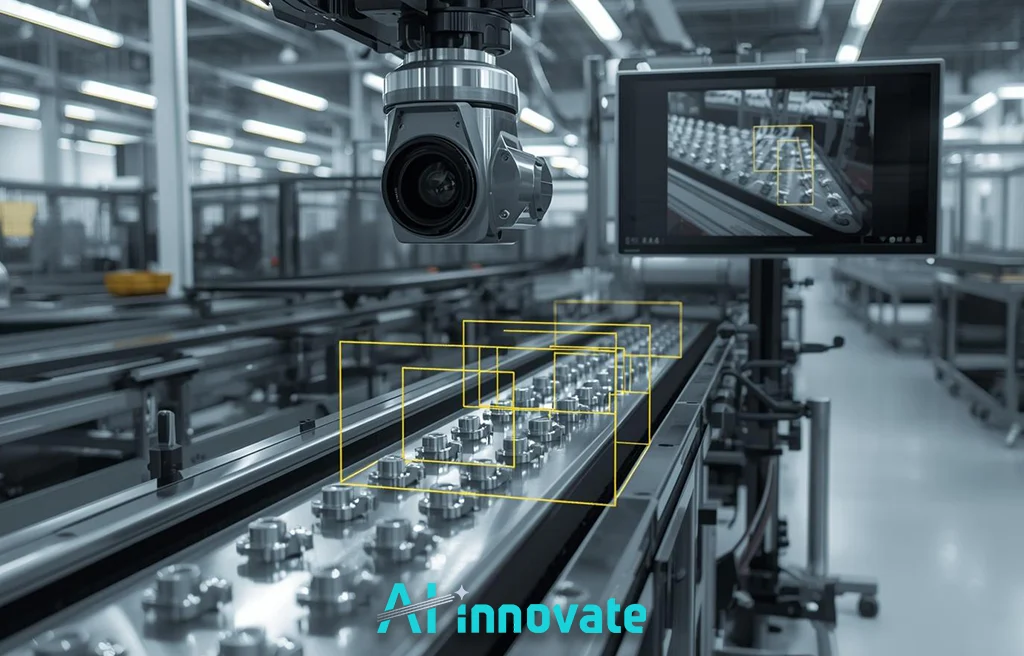
- Bounding Boxes: Drawing rectangles around defects. This is simple and widely used for object detection. It’s used for scratches, dents, missing components, or foreign objects. Best when defects are clearly isolated and roughly rectangular.
- Polygons: Drawing precise shapes around irregular defects. It’s used for cracks, corrosion spots, pits, or surface peeling. Ideal for defects with irregular or complex edges.
- Semantic Segmentation: Label each pixel of the image to classify the type of surface or defect. This is detailed but very accurate. It’s used for coating inconsistencies, paint defects, or areas of discoloration. Good for continuous or widespread surface anomalies.
- Instance Segmentation: Combines object detection and segmentation to distinguish multiple defects of the same type on a single surface. It’s used for multiple scratches, dents, or defects occurring close together where each must be treated individually.
- Key Points or Landmarks: Identifies specific points on defects for measurements or pattern recognition. It’s used for measuring crack lengths, defect center points, or alignment issues in components. Useful for defects where size or position matters.
Step-by-Step Workflow of Image Annotation for Surface Defect Detection
Creating high-quality annotated datasets is crucial for training AI. This is usually how the training process goes:
- Collect Images: Capture high-resolution images of surfaces, including both defective and defect-free samples. Preprocessing can involve adjustments such as resizing, contrast enhancement, or noise reduction.
- Organize and Preprocess: Sort images by type of surface, lighting conditions, or defect type.
- Select Annotation Tool: Choose a software tool suitable for your needs, such as Labelbox, CVAT, or Supervisely.
- Define Annotation Guidelines: Decide which defects to label, annotation type, and labeling conventions for consistency.
- Annotate Images: Mark defects in each image according to the defined guidelines. Accuracy and consistency are key at this stage.
- Quality Check: Review annotated images to ensure they match the guidelines and correct any errors.
- Split Data: Divide annotated images into training, validation, and test sets for machine learning.
- Train AI Model: Feed the annotated images into a computer vision model to teach it to detect defects.
- Evaluate Model Performance: Test the model on unseen images and adjust annotations or model parameters if needed.
- Deploy and Monitor: Implement the trained AI model on production lines and keep monitoring performance for new defect patterns.
Looking beyond the numbers, the value of automated visual inspection becomes clear from the return. The ROI often comes from multiple areas working together rather than a single cost-saving metric.
How AI-innovate Helps with Surface Defect Detection Using Image Annotation
AI-innovate supports manufacturers in deploying AI-powered surface defect detection by providing a complete ecosystem for creating, training, and scaling inspection models. Our products help transform image annotation into actionable quality control insights through:
- Accurate defect detection and classification with AI2Eye, enabling real-time surface inspection for scratches, dents, corrosion, or coating inconsistencies across production lines
- Data generation, labeling, and validation with AI2Cam, reducing the time and cost of building high-quality annotated datasets, and ensuring models perform reliably even on rare or complex defect types
- Industrial edge AI processing through AIxCore, powered by NVIDIA Jetson Orin AGX, providing real-time inference on production lines, integrated robotics support, and robust industrial networking for continuous, high-speed inspection
Whether you’re developing AI models from scratch, validating new defect types, or scaling inspection across multiple production lines, AI-innovate’s tools turn image annotation into measurable improvements in quality, efficiency, and operational reliability.
Conclusion
Image annotation is a crucial step in leveraging AI-based surface defect detection. By carefully labelling defects and adhering to a structured workflow, manufacturers can train computer vision models to detect imperfections more quickly and accurately than humans alone, which improves product quality, reduces waste and increases efficiency on the production line. I believe that well-annotated datasets enable AI systems to learn and adapt continuously, thereby improving the reliability and accuracy of defect detection over time.
Sources
Ai-Innovate uses only high-quality sources, including peer-reviewed studies, to support the facts within our articles.
- Keymakr Blog. (2024). Surface Defect Detection with Computer Vision and Image Annotation. Explains how annotated images are used to train AI systems for detecting defects in industrial settings. Retrieved from https://keymakr.com/blog/surface-defect-detection-with-computer-vision-image-annotation/
- SpringerLink. (2025). Application of Mask R‑CNN and YOLOv8 for PCB Defect Detection. Compares deep learning‑based segmentation and object detection models for industrial defect recognition tasks. Retrieved from https://link.springer.com/article/10.1007/s42452-025-06641-x
- Nature Scientific Reports. (2025). Deep Learning for Metal Surface Defect Detection. Presents a study on applying deep neural networks to classify and detect surface defects. Retrieved from https://www.nature.com/articles/s41598-025-31235-3
- Industrial Engineering Journal (GDUT). (2024). A Review on Surface Defect Detection Based on Deep Intelligent Vision. Reviews various computer vision approaches to surface inspection and defect detection. Retrieved from https://iej.gdut.edu.cn/en/article/doi/10.3969/j.issn.1007-7375.230233
- SpringerLink. (2024). Surface Defect Inspection of Industrial Products with Object Detection Deep Networks. A systematic review of deep learning methods for surface defect detection, with insights into annotation and model training. Retrieved from https://link.springer.com/article/10.1007/s10462-024-10956-3
FAQ
Why is image annotation important in defect detection?
Most manufacturers achieve a full ROI within 12 to 24 months. In high-volume or high-risk sectors like steel or pharmaceuticals, some case studies report much faster paybacks, with one instance showing a 280% ROI in just over 4 months.
How does image annotation help machine learning detect defects?
Annotated images provide ground truth data. Models like CNNs (Convolutional Neural Networks) use this data to learn patterns of defects and distinguish them from normal surfaces during production.
Can image annotation be automated?
Partially. Tools with AI-assisted labeling can suggest annotations based on pre-trained models, but human verification is usually required to ensure accuracy, especially for complex or subtle defects.
How many annotated images are needed for defect detection?
The required number depends on defect complexity and model type. For simple defects, a few hundred images may suffice. For complex or rare defects, thousands of high-quality annotated images are recommended.