




Edge detection, as the name suggests, is one of the basic tools in machine vision used to detect the “edges” of shapes and objects in images. In simple terms, it helps a vision system find where one object ends and another begins. It’s easy to imagine that such a tool is useful in many applications where image clarity, object recognition, and measurement are important.
In classical machine vision, edge detection is usually rule-based and uses filters such as Canny, Sobel, or Laplacian of Gaussian. In AI-based machine vision, edges and object boundaries can also be learned automatically by deep learning models such as convolutional neural networks and segmentation networks. This feature is beneficial when dealing with more unpredictable, complex images.
In this blog, we introduce the main edge detection techniques, the core principles behind edge detection in computer vision, common industrial applications, and the typical implementation process used in machine vision systems.
Enhance Edge Detection in AI Machine Vision, with Intelligence
Improve defect detection accuracy, strengthen visual inspection systems using edge detection techniques in AI-powered machine vision.

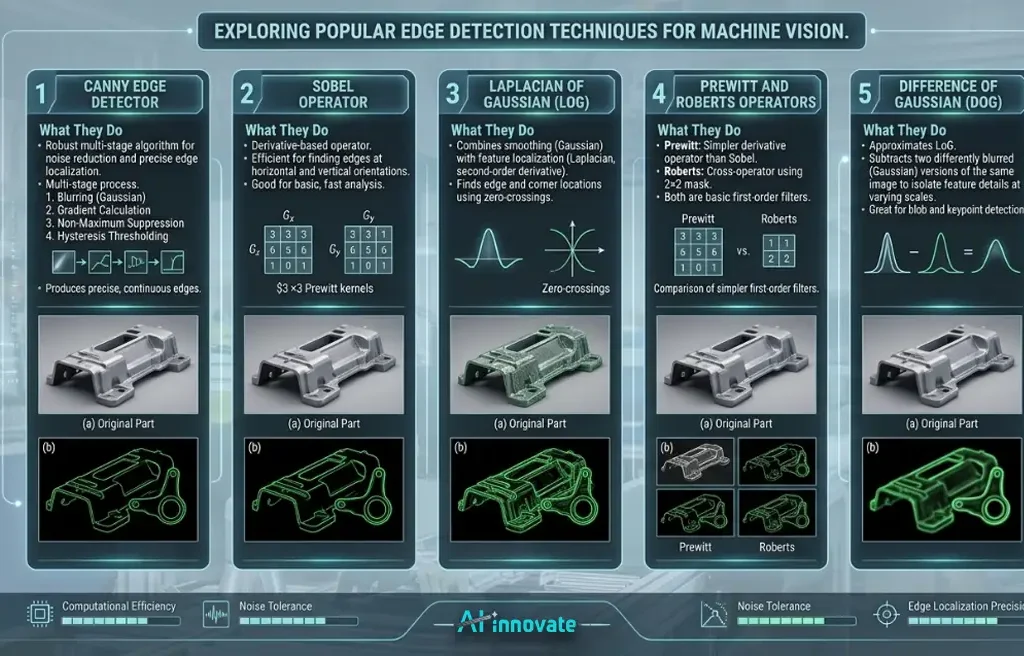
Popular Edge Detection Techniques and What They Do
Edge detection can be done using several different methods, depending on the image quality, the amount of noise, and the type of result needed.
Canny Edge Detector
The Canny edge detector is one of the most widely used edge detection methods. It’s popular because it’s designed to detect clear edges while reducing noise and false detections. It works through several steps, including:
- Smoothing the image
- Calculating gradients
- Suppressing weak responses
- Applying thresholding
Because it produces thin and clean edges, it’s often used in industrial inspection and measurement tasks.
Sobel Operator
The Sobel operator is a simple and commonly used method for detecting intensity changes in horizontal and vertical directions. It works by applying filters that estimate image gradients. This makes it useful for identifying general edge direction and strength. It’s often used when a fast and straightforward edge detection approach is needed.
Laplacian of Gaussian (LoG)
The Laplacian of Gaussian method combines smoothing and edge detection. First, it applies Gaussian filtering to reduce noise. Then it uses the Laplacian operator to detect regions where intensity changes sharply. This method is useful when noise reduction is important before edge detection is performed.
Prewitt and Roberts
Prewitt and Roberts are older gradient-based edge detection operators. They are simpler than Sobel and are often used for basic image processing tasks or educational purposes. While they may not always perform as well in noisy industrial environments, they still help explain the foundations of edge detection.
Difference of Gaussian (DoG)
Difference of Gaussian works by subtracting one blurred version of an image from another blurred version created with a different Gaussian filter size. This highlights areas where intensity changes occur and can help reveal edges. It’s often used when multi-scale edge information is useful or when developers want a simpler approximation of more advanced filtering methods.
How Computer Vision Turns Image Changes Into Boundaries
Even though edge detection methods differ, they usually rely on a few common computer vision principles.
- Noise Reduction: Noise reduction removes unwanted image variation before edge detection begins. Without this step, random noise may be mistaken for real edges. Gaussian blur is one of the most common methods used for this step.
- Gradient Calculation: Gradient calculation identifies sharp changes in pixel intensity. These changes often mean object boundaries, corners, or surface transitions. In this step the system understands where strong visual changes are happening in the image.
- Thresholding: Thresholding decides which detected changes are strong enough to count as real edges. Weak responses may be removed so that the final output is cleaner and more useful. This is important since not every change in intensity indicates a meaningful boundary.
- Edge Thinning and Non-Maximum Suppression: After edges are detected, edge thinning makes the edges narrow and well-defined. Non-maximum suppression is used to remove extra edge responses around the strongest edge location. This makes the final edge map easier to use for later tasks such as contour analysis or dimension measurement.
- Contour Detection: Contour detection transforms edge pixels into more useful object boundaries. Rather than working with individual edge points, the system groups them together to form shapes and outlines. This is particularly useful for measuring parts, detecting object shape and comparing boundaries against expected geometry.
This Topic might also interest you :
Real Industrial Uses of Edge Detection in Machine Vision
Edge detection is widely used in many industries since object boundaries and shape information are important in processes like inspection, automation, and analysis.
Quality Inspection
In quality inspection, edge detection can be used to measure part dimensions, identify defects and missing features, and confirm whether a product matches the expected shape. This is common in manufacturing environments, where accurate pass/fail decisions depend on visual boundaries.
Object Detection
Edge information can support object detection by helping systems to locate parts, define shapes and separate items from the background. Edge-based processing can still play a useful role in preprocessing or feature extraction, even when AI models are used.
Medical Imaging
In medical imaging, edge detection helps identify boundaries between tissues, organs, or abnormal regions. This can support analysis, segmentation, and diagnostic workflows.
Autonomous Vehicles
Autonomous vehicles use edge-related information to understand lane boundaries, road edges and surrounding objects. More advanced systems often combine deep learning with traditional vision principles.
Robotics
In robotics, edge detection enables machines to locate objects, guide movement and measure positions, as well as supporting pick-and-place tasks. Providing clean boundary information can enhance the way robots interact with parts and tools.
OCR and Document Processing
In optical character recognition (OCR) and document processing, edge detection can help to separate text, boxes, forms and printed regions from the background. This improves the analysis of document structure and character recognition.
Agriculture Vision
In agriculture vision, edge detection can support tasks such as plant analysis, identifying crop boundaries, locating fruit and sorting. It enables systems to identify shapes and boundaries in natural scenes.
Common Challenges in Edge Detection for Industrial Inspection
Edge detection plays a critical role in machine vision, but achieving reliable results in real manufacturing environments is often more challenging than in controlled laboratory conditions. Factors such as inconsistent lighting, reflective materials, image noise, product movement, and complex surface textures can reduce edge clarity and increase false detections. Modern AI-powered machine vision systems overcome these challenges by combining advanced image processing, adaptive algorithms, and optimized hardware to deliver accurate, repeatable edge detection across demanding industrial applications.
Variable Lighting
Changes in illumination, shadows, and glare reduce edge contrast and make boundaries difficult to identify consistently.
Adaptive image enhancement and optimized lighting calibration maintain stable edge detection under changing conditions.
Reflective Surfaces
Polished metals, glass, and coated products often produce reflections that generate false or incomplete edges.
Machine vision combines controlled lighting with AI filtering techniques to separate true object edges from reflections.
Image Noise
Electronic sensor noise and environmental interference can create unwanted edge patterns and reduce inspection accuracy.
Advanced preprocessing and machine learning reduce noise while preserving important edge information.
High-Speed Production
Fast-moving products increase the risk of motion blur, making edge localization more difficult.
High-speed industrial cameras and edge AI perform real-time image processing without slowing production.
Complex Surface Textures
Textured materials and irregular patterns can make it difficult to distinguish real defects from normal surface features.
Deep learning models learn the characteristics of acceptable surfaces and improve defect discrimination.
Product Variation
Differences in shape, orientation, or manufacturing tolerances require flexible inspection parameters.
AI-based edge detection automatically adapts to product variations, reducing manual adjustments and improving inspection consistency.
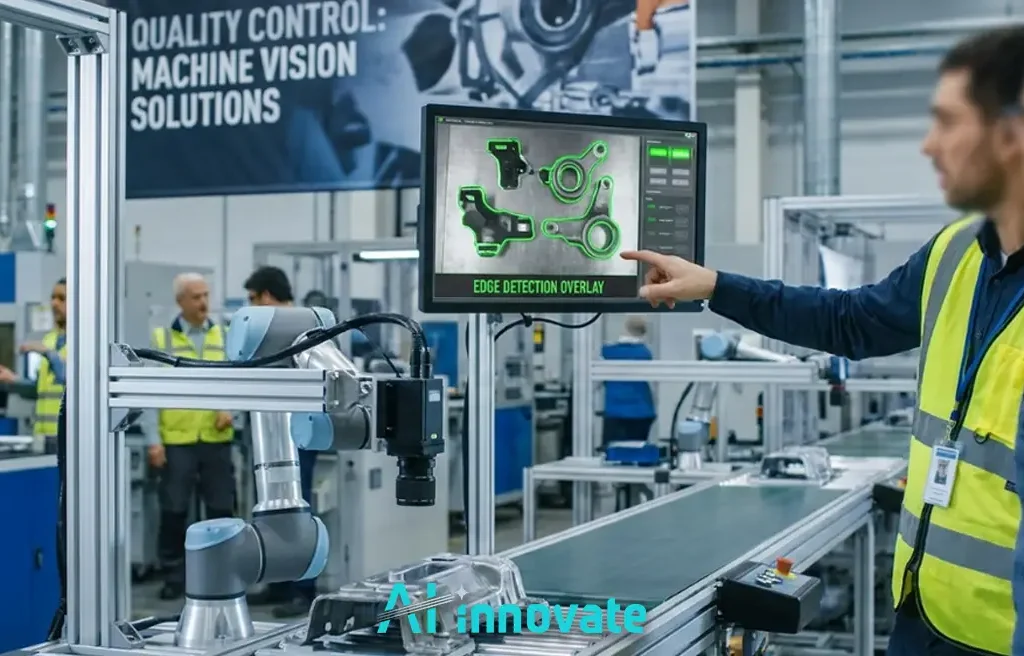
From Image Capture to Pass-Fail: How Edge Detection Is Applied
A typical edge detection workflow in machine vision follows a clear sequence from image capture to decision-making. This is how the classical computer vision approach works step by step:
- Capture Image: The process starts by capturing an image with a camera or imaging system. Good lighting and stable positioning are important because they affect edge quality later.
- Convert to Grayscale: The image is usually converted to grayscale so that the system can focus easily on intensity changes without the added complexity of color.
- Apply Gaussian Blur: A Gaussian blur is applied to reduce image noise and smooth small variations that could create false edges.
- Run Canny Edge Detection: Next, Canny edge detection is often used to find strong boundaries in the image. It’s a common choice because it balances noise handling and edge clarity well.
- Find Contours: Once the edges are found, the system identifies contours. These contours represent object outlines or important shape boundaries.
- Select Largest Contour: In many inspection tasks, the largest contour is selected because it’s often the main object being measured or analyzed.
- Measure Dimensions: The system then uses the contour to measure dimensions such as length, width, diameter, or position.
- Compare Against Tolerance: The measured values are compared against the expected tolerance range defined by the inspection standard.
- Return Pass or Fail: Finally, the system returns a pass or fail result based on whether the object meets the required dimensions or boundary conditions.
Turn Edge Detection in Machine Vision into Measurable Industrial Gains
Edge detection only creates value when it is applied within the right imaging setup, processing pipeline, and deployment strategy. Moving from basic image filtering to reliable industrial performance requires strong image capture, real-time processing, and vision systems that can turn boundaries, contours, and object edges into accurate inspection and measurement decisions.
At AI-innovate, we help manufacturers bridge the gap between machine vision fundamentals and production-floor execution by providing:
- Intelligent visual inspection with AIxEye, enabling accurate detection of edges, contours, shape deviations, missing features, and dimensional issues across quality inspection and automation workflows
- Edge AI infrastructure with AIxCore (powered by NVIDIA Jetson Orin AGX) for fast on-site image processing, real-time boundary analysis, and scalable deployment across machine vision applications
- Synthetic data capabilities through AIxCam, helping teams strengthen vision models when labeled images are limited, visual conditions vary, or edge cases are difficult to capture in real production environments
Whether you’re improving measurement accuracy at a single inspection station or scaling machine vision across multiple lines and use cases, the key is combining reliable image capture, explainable AI models, and industrial-grade deployment built for real manufacturing environments.
Conclusion
Edge detection remains an important part of machine vision, helping systems to identify boundaries, shapes and significant changes in images. Classical methods such as Canny, Sobel, LoG, Prewitt, Roberts and DoG are still widely used, particularly for structured inspection tasks. However, AI-based machine vision systems can now automatically learn edges and object boundaries through deep learning models.
Edge detection helps turn raw images into useful visual information, whether the goal is quality inspection, robotics, medical imaging, OCR, or agricultural vision. We believe with the right technique and workflow, edge detection can support more accurate measurements, better object recognition and more reliable machine vision results.
FAQ
What is the difference between an edge and a boundary?
An edge is a local point or line segment representing a sharp change in pixel intensity. A boundary is a more abstract concept representing the separation between distinct regions or objects in a scene. Edge detection is the tool used to identify these boundaries.
Why do I need to convert images to grayscale first?
Edge detection primarily focuses on intensity discontinuities rather than colour. Converting to grayscale simplifies the image into a single channel of brightness values (0–255), reducing computational complexity and allowing algorithms to focus on light-versus-dark transitions.
What causes "false edges" in machine vision?
False edges are often triggered by image noise, sensor errors, reflections, or sharp shadows that the algorithm mistakes for physical object boundaries. Preprocessing steps like Gaussian blurring are used to smooth out these fluctuations before detection.
How does lighting affect edge detection in machine vision?
Lighting has a significant impact on edge detection accuracy because poor illumination, shadows, glare, and reflections can reduce edge contrast and introduce false edges. Industrial machine vision systems use controlled lighting techniques, such as diffuse, backlight, or dome illumination, to create consistent image quality and improve edge detection performance across different production conditions.
Which edge detection algorithm is best for industrial inspection?
The best edge detection algorithm depends on the application. Canny edge detection is widely used for high-precision inspections because it provides strong noise suppression and accurate edge localization. Sobel and Prewitt operators are commonly used for fast image analysis, while Laplacian-based methods are effective for detecting fine details and subtle surface variations.
Can AI improve traditional edge detection?
Yes. AI enhances traditional edge detection by automatically adapting to changes in lighting, material appearance, and production conditions. Machine learning models can reduce false detections, improve edge classification, and maintain consistent inspection performance without requiring frequent manual parameter adjustments.
What hardware is required for AI edge detection systems?
AI edge detection systems typically include high-resolution industrial cameras, appropriate lenses, controlled lighting, edge computing hardware, image acquisition devices, and AI-enabled machine vision software. The hardware configuration depends on the inspection speed, product size, and defect characteristics.
Sources
Ai-Innovate uses only high-quality sources, including peer-reviewed studies, to support the facts within our articles.
- GeeksforGeeks. (2025). Comprehensive Guide to Edge Detection Algorithms — A practical overview of major edge detection methods, including Sobel, Prewitt, Roberts, Laplacian-based approaches, Canny, and newer machine learning-based techniques. Retrieved from https://www.geeksforgeeks.org/computer-vision/comprehensive-guide-to-edge-detection-algorithms/
- Medium. Edge Detection in Computer Vision: A Comprehensive Guide with Python — A beginner-friendly explainer that walks through core edge detection concepts and shows how to implement them in Python for computer vision workflows. Retrieved from https://medium.com/@global.himani26/edge-detection-in-computer-vision-a-comprehensive-guide-with-python-e1dc846accd9
- Milvus. What Is a Machine Vision Edge Detection Algorithm? — A concise reference on how edge detection works in machine vision systems, including its role in identifying boundaries, contours, and features for inspection tasks. Retrieved from https://milvus.io/ai-quick-reference/what-is-a-machine-vision-edge-detection-algorithm