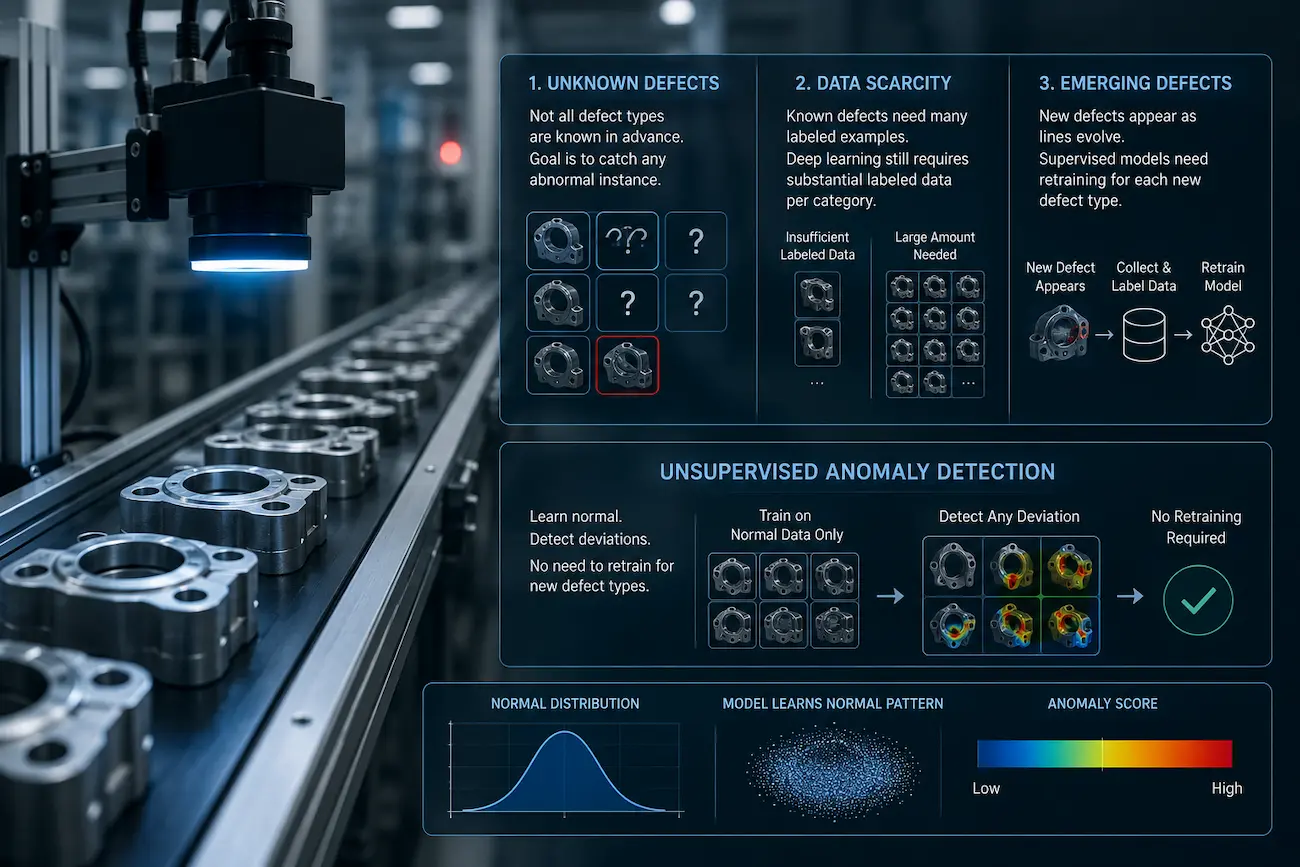





A single bad batch can erode a plant’s margin before the monthly report even lands. Scrap rarely shows up as one dramatic failure. It builds quietly, a fraction of a percent here, a fraction there, until the losses are too large to explain away. Rising material costs and thinner margins mean manufacturers can’t write this off as a normal cost of doing business anymore. AI manufacturing waste reduction gives plants a way to catch problems at the source instead of finding them buried in a spreadsheet weeks later.
This guide breaks down where AI actually reduces waste, what verified data says about the results, and how to build a program that pays for itself.
What Counts as AI Manufacturing Waste Reduction?
AI manufacturing waste reduction means using computer vision, machine learning, and sensor data to catch the root causes of scrap, rework, and overproduction before they turn into losses. Traditional quality control usually catches a defect after it’s already happened, often at final inspection. AI systems watch conditions continuously instead, flagging a process drifting out of spec before it produces a bad part.
Operators and quality teams still make the final call. AI just gives them an earlier, clearer signal than manual checks alone can provide, so a problem gets caught while it’s still cheap to fix. On the factory floor, that shows up in a few concrete areas:
- Defect detection, where machine vision models spot flaws on the line in real time
- Process drift detection AI, where sensors and models catch a machine trending toward scrap before it gets there, often through the kind of continuous AI for process monitoring that manual spot checks miss
- Predictive maintenance, where equipment issues get flagged before they cause quality problems
- Demand forecasting, where better predictions cut overproduction and excess inventory
Why Scrap Costs More Than Most Manufacturers Realize
Scrap benchmarks vary by industry, but a consistent pattern holds across most manufacturing operations. A scrap rate under 1% is considered excellent in most sectors, and a rate under 5% is generally still acceptable. Anything above that usually points to a process, maintenance, or materials problem worth investigating.
| Scrap Rate | What It Signals |
|---|---|
| Below 1% | Excellent process control, typical of high-precision manufacturing |
| 1% to 5% | Acceptable range for most manufacturing operations |
| Above 5% | Likely points to a quality control or maintenance gap |
Leadership teams tend to underestimate scrap costs because of what standard cost tracking leaves out. A 2026 industry analysis of scrap accounting found that plants routinely under-count true scrap costs by 30 to 50 percent, since the material line rarely captures:
- Labor and machine time already spent on the part before it was scrapped
- Rework labor and re-inspection time
- Downtime that follows a scrap event
- Expedited freight or rush orders needed to cover the shortfall
How Scrap Reduction AI Systems Catch Waste Before It Happens
Scrap reduction AI systems work by moving inspection earlier in the production cycle, which is where the real savings happen. A part caught at final inspection has already absorbed its full material and labor cost. A part caught mid-process, or a defect prevented altogether, saves both.
Ford’s experience with automated paint inspection is a well-documented example of the gap between manual and machine-driven checks. The automaker’s manual inspections identified only about half of surface defects, while a camera-based vision system built for that line caught dirt particles smaller than a grain of salt across thousands of images per vehicle. Manual checks simply can’t match that kind of coverage at scale.
On the floor, this typically looks like a layered approach to defect detection in manufacturing:
- Vision systems that catch surface defects, misalignment, or dimensional errors as parts move down the line
- Defect prevention AI systems that flag when a process parameter is trending toward an out-of-spec range, before a bad part gets made
- Root cause tools that connect scrap spikes to a specific machine, shift, or material batch
Tools built for this, like AIxEye, focus specifically on catching scrap-causing flaws in real time instead of waiting for a batch inspection to surface them.
Lean Manufacturing AI Inspection: Pairing Old Discipline With New Data
Lean manufacturing has always been about eliminating waste, whether that’s excess inventory, wasted motion, or defects. AI doesn’t replace lean thinking; it gives it better data to act on. Lean teams once relied on manual audits and periodic reviews to find waste. Lean manufacturing AI inspection surfaces the same patterns continuously, at a scale no manual process can match.
That pairing plays out in a few practical ways:
- Root cause analysis that used to take a team days now runs in the background continuously
- Standard work gets reinforced by real-time alerts when a process deviates from it
- Kaizen events get sharper because the data pointing to the highest-impact waste is already there
Plants with mature lean programs tend to see the fastest results from AI, since the operational discipline and data collection habits needed for machine learning for manufacturing process optimization are already built.
Industrial Waste Reduction AI and the Sustainability Case
Executives increasingly need a sustainability story alongside a cost story, and industrial waste reduction AI delivers both. Less material waste means less raw material extraction, less energy spent reprocessing scrap, and a smaller carbon footprint tied to production.
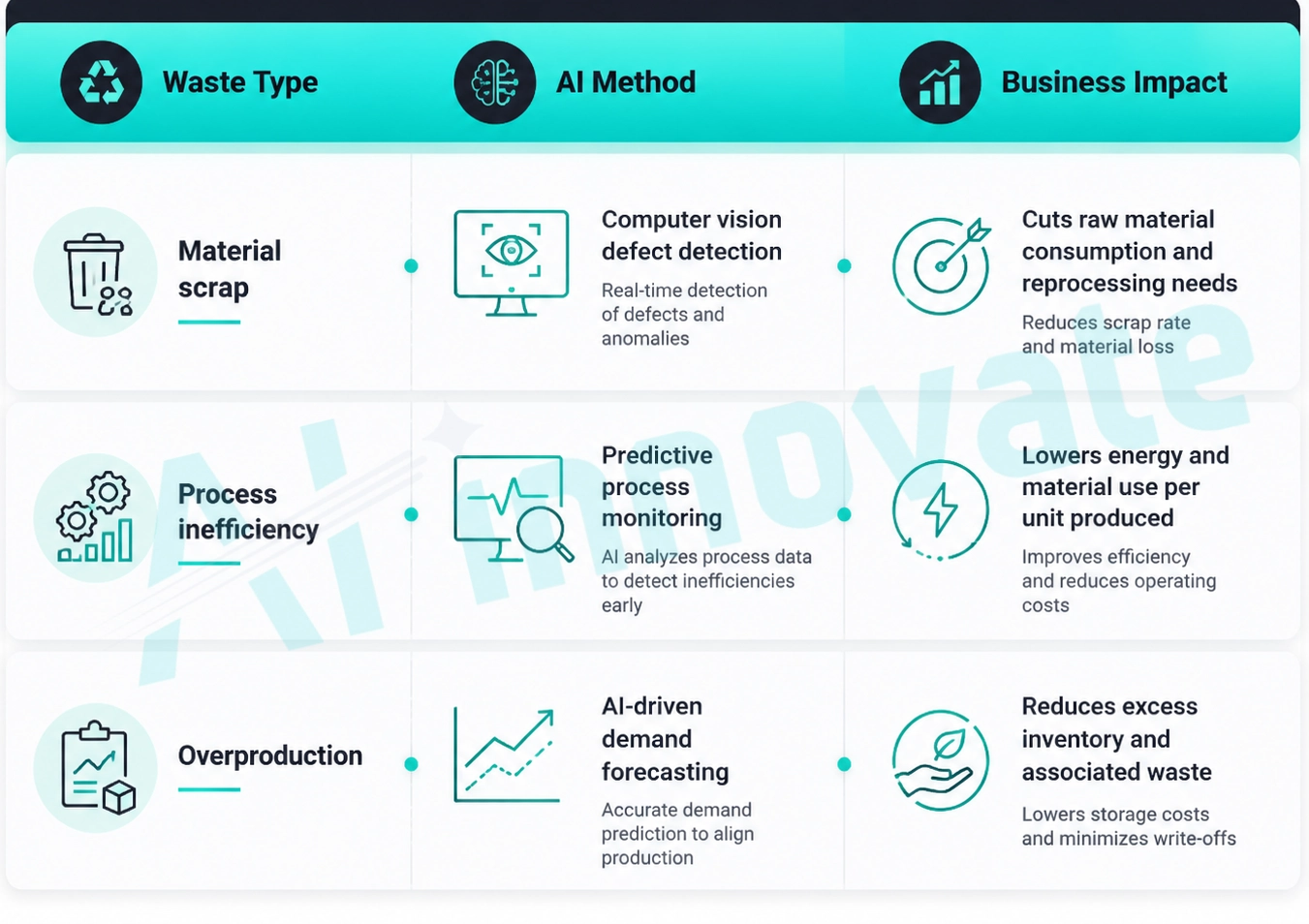
Predictive maintenance plays a role here too. McKinsey’s research on advanced analytics in manufacturing found predictive maintenance programs typically cut machine downtime by 30 to 50 percent and extend machine life by 20 to 40 percent, both of which reduce the waste tied to unplanned breakdowns and emergency part replacement. Every unplanned failure that gets caught early also means fewer emergency parts orders and less scrapped work-in-progress sitting idle on the line. Data pulled directly from production systems is also far easier to defend in an ESG report than a top-down estimate.
A Practical Framework for AI Manufacturing Waste Reduction
Manufacturers who see real results don’t start with a facility-wide rollout. They start narrow and treat the first line as proof of concept rather than a finished program. That gives quality and operations teams time to trust the system’s alerts before it starts influencing how work actually gets done on the floor.
- Identify your highest-cost waste stream. Pull scrap and rework data by line, shift, and material to find where the real losses concentrate.
- Audit your data quality first. AI models are only as reliable as the sensor and production data feeding them, so fix gaps before building anything.
- Pilot on one line. Choose a process with a clear, measurable problem and run the system alongside existing checks for several weeks.
- Set success criteria before you start. Define what a win looks like, whether that’s a scrap rate drop or a specific cost figure, before the pilot begins.
- Scale only after validation. Use the pilot’s verified results to build the case for expanding to additional lines, ideally as part of a wider set of business process optimization tools rather than a standalone system.
A single-line pilot that proves out scrap reduction often becomes the foundation for a broader AI-driven quality control program once operations leadership sees verified numbers instead of projections.
How AI-innovate Supports Manufacturing Waste Reduction
We help manufacturers find where scrap, rework, and overproduction are actually costing the most, then build AI systems around the equipment and data they already have, not a generic model dropped onto the line. The condition data, the integration, and the model tuning are where these projects succeed or fail, and that’s where we focus.
The components we use:
- AIxEye handles real-time visual defect detection and process monitoring, catching scrap-causing flaws on the line as they happen instead of at final inspection
- AIxCore is the industrial AI edge computer powered by NVIDIA Jetson Orin AGX, running inference on-site so a waste alert arrives fast enough to act on before more bad parts get made
- AIxCam provides simulation tools and synthetic data generation for rare defect modes that don’t occur often enough on the live line to train a reliable model from production data alone
- AIxAM detects surface and geometry anomalies on three-dimensional parts using multi-view images and depth data, extending defect detection to wear and deformation that standard cameras may miss
The starting point is always the same: your highest-cost waste stream, your current scrap data, and the condition data you can actually capture. Call +1 (514) 813-1809 or email Info@ai-innovate.com to scope a waste reduction pilot around your biggest opportunity.
Final Thoughts
Manufacturing waste rarely comes from one big failure. It comes from small, repeated losses across materials, machine time, and labor that compound over a year into a real hit on margin. AI gives manufacturers a way to catch those losses earlier, whether that’s a defect flagged mid-process instead of at final inspection, or a demand forecast that keeps a warehouse from overproducing.
The manufacturers seeing the strongest results aren’t the ones deploying the most ambitious systems first. They’re the ones who picked a single high-cost waste stream, fixed their data quality, and proved the model worked before expanding. Scrap reduction, lean discipline, and sustainability goals all point toward the same starting point: know where your waste actually is before you try to fix it.
Confused About Where to Start with AI?
Our specialists help you identify the right AI approach based on your process, data, and goals.
FAQ
Sources
Ai-Innovate uses only high-quality sources, including peer-reviewed studies, to support the facts within our articles.
- APQC, MetricHQ, ServiceChannel, Tractian. Scrap rate benchmarking data (below 1% excellent, below 5% acceptable), 2025-2026. apqc.org
- Symestic. “Scrap Costs: True Formula, Benchmarks & How to Reduce Them.” 2026 analysis on scrap cost under-counting. symestic.com/en-us/what-is/scrap-costs
- McKinsey & Company. “Manufacturing: Analytics unleashes productivity and profitability.” Predictive maintenance downtime and machine life data. mckinsey.com
- McKinsey & Company. “Industry 4.0: Capturing value at scale in discrete manufacturing.” Ford camera-based inspection case study. mckinsey.com