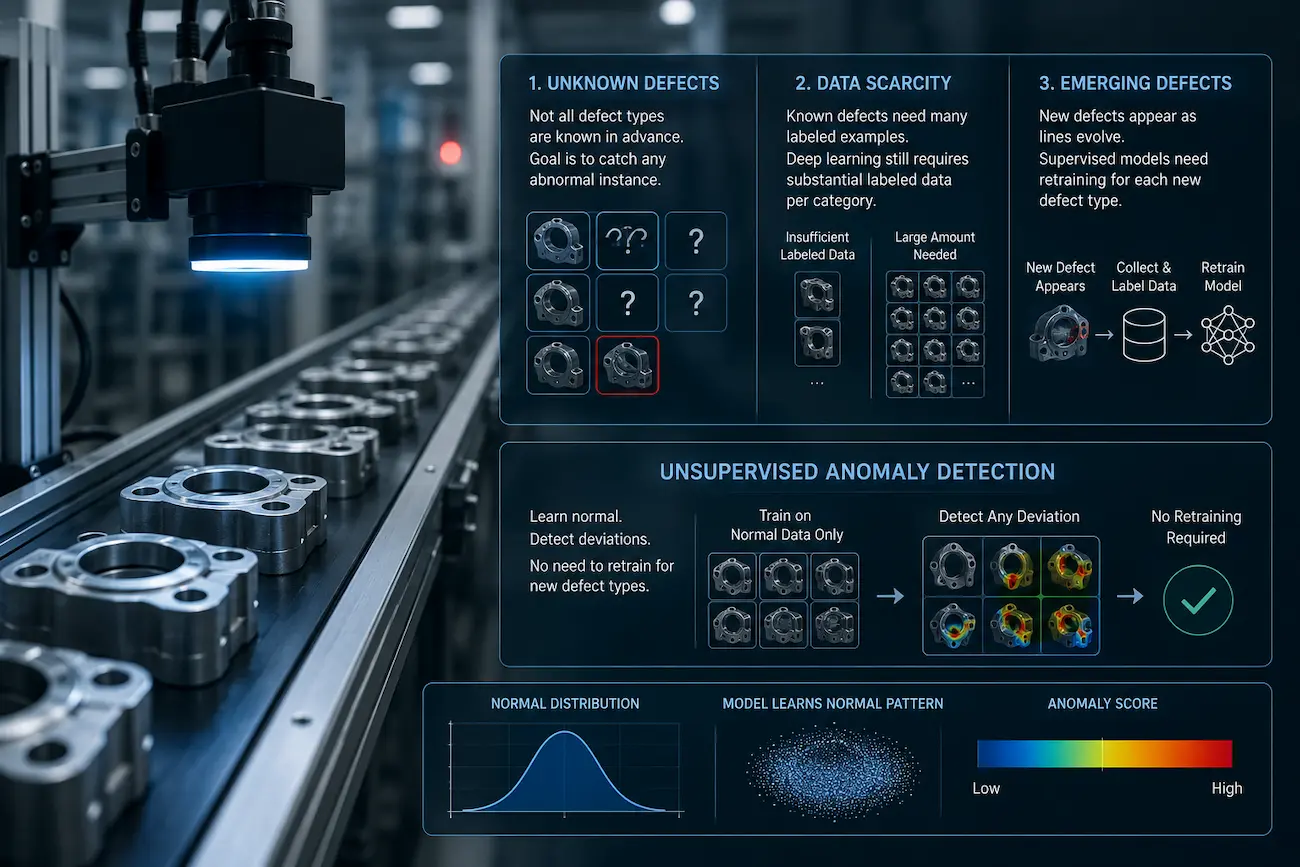





A single undetected inclusion on a hot strip mill can travel through hundreds of tonnes of coil before anyone notices, and by the time a customer claim arrives, the cost has already multiplied. That’s the core problem AI vision inspection solves for steel producers. Manual inspection can’t keep pace with strip speeds, heat, and volume, so real defects slip through even with skilled inspectors on the line. AI vision inspection closes that gap by checking every meter of surface at full production speed, without fatigue or shift variation.
This guide breaks down the real ROI drivers behind AI vision inspection in steel manufacturing and how to evaluate the business case for your own operation.
Why Manual Inspection Struggles to Catch Steel Defects
Steel production runs at speeds that push past the limits of human vision. On a finishing mill running at 900 meters per minute, a new section of strip surface passes an inspector roughly every 67 milliseconds. At that pace, the human eye cannot reliably resolve defects below roughly half a millimeter, which means a meaningful share of surface anomalies on hot strip and cold rolling lines pass through undetected.
Fatigue compounds the problem. Inspector accuracy degrades measurably after a couple of hours of continuous observation, and miss rates tend to climb in the final hours of a shift. Two inspectors reviewing the same coil can also reach different conclusions on severity, introducing inconsistency into what should be a standardized quality gate.
This is a manufacturing quality problem, not a software-testing or general QA concept. In steel specifically, the categories AI vision systems are trained to catch include:
- Mechanical defects: scratches, scuffs, roll marks, handling damage
- Metallurgical defects: inclusions, slivers, laminations, seams
- Process defects: scale residue, pitting, edge cracks
- Coating defects: bare spots, drips, thickness variation on galvanized or coated products
The stakes around quality control have also gotten higher industry-wide. According to the OECD’s 2026 Steel Outlook, global steel excess capacity is projected to keep growing through 2028 as demand growth stays sluggish, which puts sustained pressure on margins and makes it harder to absorb the cost of avoidable scrap or downgraded products. The World Steel Association’s monthly production data shows global crude steel output running in the 140 to 160 million tonne range each month across 2026, underscoring just how much volume is moving through inspection points at any given time, and how much a single percentage point of missed defects can represent at scale.
How AI Vision Inspection ROI Actually Gets Calculated
The ROI case for AI vision inspection in steel manufacturing comes from a combination of avoided costs rather than one single savings line. Framing it this way matters, because vendors sometimes present a single headline ROI number without showing what actually drives it.
The main components of industrial vision inspection cost savings are:
- Avoided customer claims. A quality escape that reaches a customer, particularly in automotive or other precision-grade applications, typically costs far more in rework, sorting, and relationship damage than the value of the material itself.
- Reduced grade downgrades. Coils that would have been sold at a lower grade due to an undetected surface defect can instead be caught and corrected, or the root cause fixed before more coils are affected.
- Lower inspection labor cost. Automated inspection reduces the manual labor hours spent on visual checks, though most producers keep inspectors in the loop for review and edge cases rather than removing the role entirely.
- Reduced scrap and rework. Catching a process drifting toward defect-producing conditions earlier means fewer coils need to be scrapped or reworked in the first place, which ties directly into broader production waste reduction goals across the plant.
| ROI Driver | What It Captures |
|---|---|
| Avoided Customer Claims | Costs associated with rejected shipments, customer complaints, product sorting, warranty issues, and long-term relationship impact. |
| Grade Recovery | More coils qualify for prime-grade pricing instead of being downgraded because defects are detected earlier. |
| Inspection Labor Savings | Reduced manual visual inspection hours while allowing quality teams to focus on validation and root cause analysis. |
| Scrap & Rework Reduction | Early detection prevents process drift, reducing scrap, unnecessary rework, and material waste across production. |
Manufacturers and vision-system providers commonly report AI defect detection accuracy in the high nineties for trained defect classes, a level manual inspection struggles to match given the fatigue and shift-to-shift inconsistency described earlier.
On the market side, the growth numbers are easier to pin down. Grand View Research puts the global machine vision market at over $20 billion as of the mid-2020s, growing at roughly 13 percent annually through 2030. MarketsandMarkets projects the broader AI inspection market to grow from about $33 billion in 2025 to over $102 billion by 2032, a compound annual growth rate near 17.5 percent, and Research and Markets shows a similar trajectory specifically within AI-based visual inspection systems. That pace of investment reflects how far AI-based inspection has moved from early pilots to standard practice.
A Realistic Payback Timeline
Payback periods reported across steel industry case studies vary widely depending on the plant’s starting defect rate, product mix, and how the deployment is scoped. Producers with a documented history of customer quality claims or systemic defect events tend to see faster payback, since avoiding even one or two major claims can cover a meaningful share of deployment cost. Producers with a lower baseline defect rate see a longer but still measurable payback window, typically driven more by labor savings and incremental scrap reduction than by dramatic claim avoidance.
Rather than anchoring to a single headline number, it’s more useful to model payback against your own numbers:
- Your current cost of poor quality, including claims, downgrades, and rework from the past 12 months
- Your current inspection labor cost, including overtime and the shift coverage required for full-line inspection
- The deployment cost for the specific inspection points you plan to cover
- A conservative improvement estimate, using the low end of reported industry ranges rather than best-case marketing figures
This kind of grounded modeling tends to hold up better under finance team scrutiny than a vendor-supplied ROI percentage, since it’s built on your own cost structure instead of someone else’s case study.
Forrester’s 2026 technology predictions note that enterprise AI investments are facing tighter financial scrutiny industry-wide, with fewer than a third of decision-makers currently able to tie AI value directly to financial results. A payback model built on your own numbers is exactly the kind of evidence that holds up under that scrutiny.
For manufacturers evaluating this at a broader level, defect detection in manufacturing covers how these same principles apply across other production environments, and metal defect detection goes deeper into the metal-specific defect categories AI vision systems are trained to catch.
What Makes an AI Vision Deployment Actually Pay Off
Not every deployment delivers the same return, and the difference usually comes down to a few operational factors rather than the technology itself.
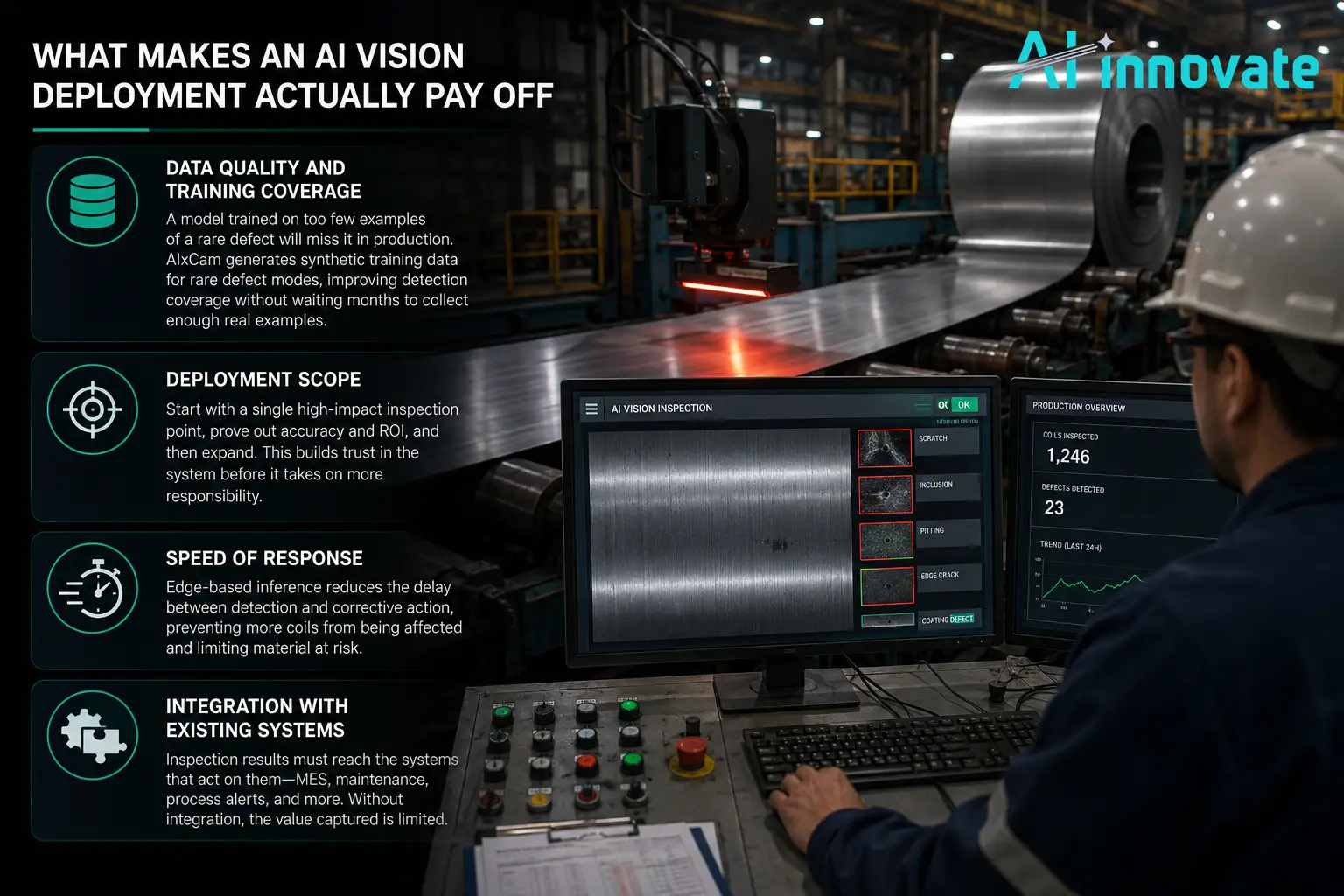
Data quality and training coverage.
A model trained on too few examples of a rare defect will miss it in production. AIxCam addresses this specific gap by generating synthetic training data for defect modes that don’t occur often enough on the live line to build a reliable dataset from production images alone, which improves detection coverage without waiting months to collect enough real examples.
Deployment scope.
Producers who start with a single high-impact inspection point, prove out accuracy and ROI, and then expand tend to see cleaner results than those attempting a full-line rollout on day one. This also gives the quality team time to build trust in the system’s decisions before it takes on more responsibility.
Speed of response.
Detecting a defect only matters if the response happens fast enough to prevent more coils from being affected. This is where edge-based inference matters: running the AI model on-site rather than routing images to the cloud cuts the delay between detection and corrective action, limiting how much material is at risk while a process issue gets identified and fixed.
Integration with existing systems.
Inspection results need to reach the systems that act on them, whether that’s an MES quality hold, a maintenance work order, or a process alert to the melt shop. A detection system that doesn’t route its output anywhere useful captures far less of its potential value. Our guide on automated visual inspection covers how this integration layer typically gets built out.
Building the Business Case Internally
Getting sign-off for an AI vision inspection investment usually comes down to how well the business case connects to numbers finance teams already track. A few practices help:
- Start with the cost of poor quality, not technology features. Executives respond to a clear cost baseline more than a list of AI capabilities.
- Present a range, not a single number. A conservative-to-optimistic range built on your own data holds up better than a single confident figure.
- Tie the pilot to one measurable outcome. Whether that’s claim reduction, downgrade rate, or inspection labor hours, a single clear metric makes the pilot easier to evaluate and easier to expand from. This is also where AI-driven quality control fits into the broader picture, since vision inspection is usually one piece of a larger quality system rather than a standalone tool.
- Loop in quality, maintenance, and finance early. Real-time defect analysis tends to touch all three functions, so early alignment avoids rework on the business case later.
How AI-innovate Supports Steel Manufacturers
We help steel producers build the case for AI vision inspection around their actual defect history, their claim data, and the inspection points where the return is clearest, not a generic deployment plan. The condition data, the model training, and the integration into existing quality systems are where these projects succeed or fail, and that is where we focus.
The components we use:
- AIxEye handles real-time visual defect detection and process monitoring, catching surface and process defects on the line as they happen so fewer coils reach final inspection already compromised
- AIxCore is the industrial AI edge computer powered by NVIDIA Jetson Orin AGX, running inference on-site so inspection decisions happen fast enough to stop a developing defect pattern before it spreads across more coils
- AIxCam provides simulation tools and synthetic data generation for rare defect modes that don’t occur often enough on the live line to train a reliable model from production data alone
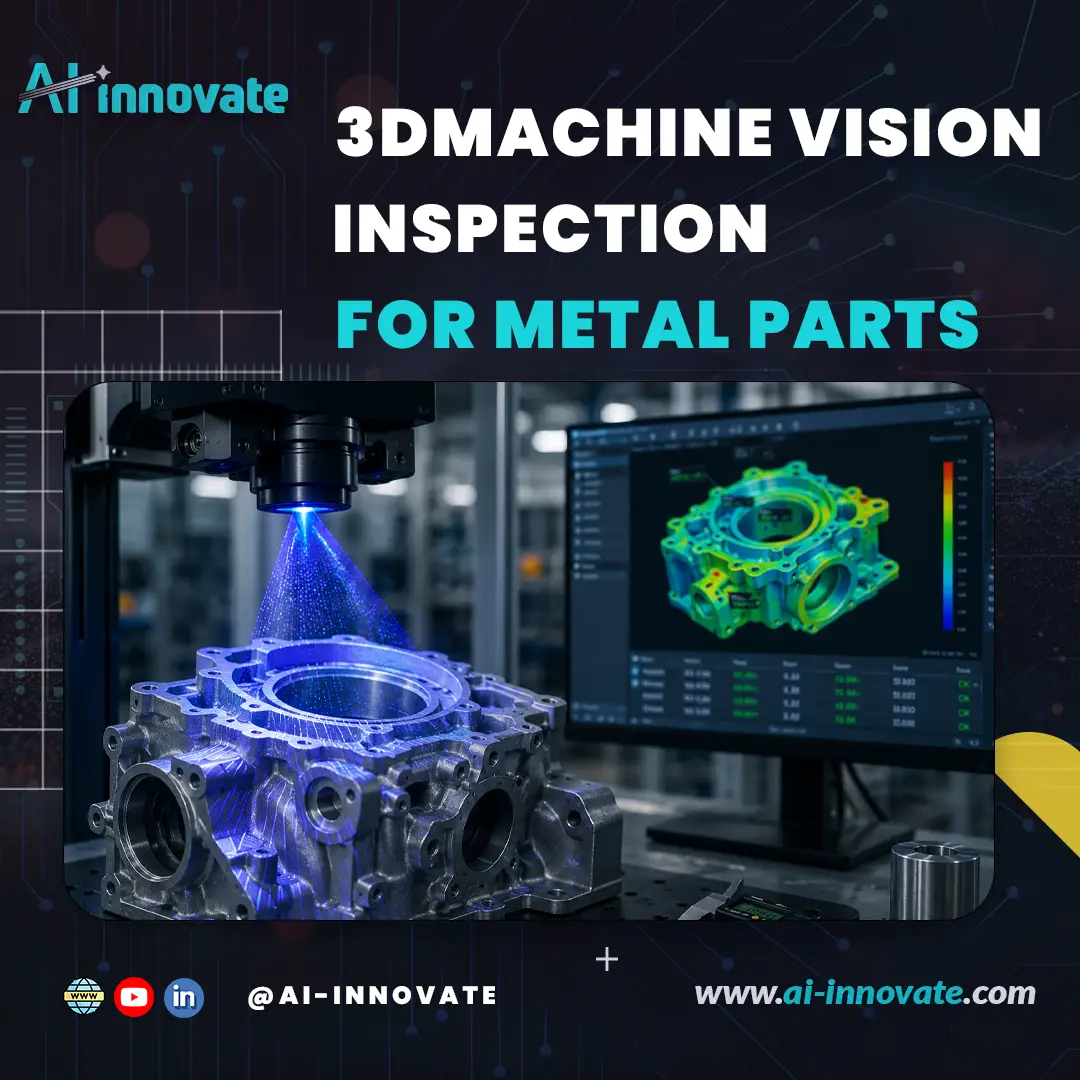
- AIxAM detects surface and geometry anomalies on three-dimensional parts using multi-view images and depth data, extending inspection coverage to dimensional and geometric defects that surface cameras alone may miss
The starting point is always the same: your current cost of poor quality, your highest-risk inspection points, and the defect history you already have. Call +1 (514) 813-1809 or email Info@ai-innovate.com to scope an AI vision inspection pilot around your specific defect profile.
The Bottom Line
AI vision inspection ROI in steel manufacturing rarely comes from one dramatic save. It comes from a combination of avoided claims, recovered grade, reduced inspection labor, and fewer coils lost to preventable defects, compounding month over month once the system is fully integrated into quality and maintenance workflows. This is also where the case connects to broader smart factory cost reduction goals, since a vision inspection system rarely operates in isolation.
The technology itself has matured well past the experimental stage, but the return still depends heavily on deployment scope, data quality, and how well detection connects to a real response. A grounded pilot, measured against your own numbers, remains the most reliable way to know whether the investment pays off for your specific operation.
FAQ
Sources
Ai-Innovate uses only high-quality sources, including peer-reviewed studies, to support the facts within our articles.
- World Steel Association (worldsteel). Global steel production and industry data. https://worldsteel.org
- OECD. “Steel Outlook 2026.” https://www.oecd.org/en/publications/oecd-steel-outlook-2026_99ab9b0c-en.html
- Grand View Research. “Machine Vision Market Size And Share Report, 2026-2033.” https://www.grandviewresearch.com/industry-analysis/machine-vision-market
- MarketsandMarkets. “AI Inspection Market Worth $102.42 Billion by 2032.” https://www.prnewswire.com/news-releases/ai-inspection-market-worth-102-42-billion-by-2032—exclusive-report-by-marketsandmarkets-302667900.html
- Research and Markets. “AI Visual Inspection System Market Report 2026.” https://www.researchandmarkets.com/reports/6226169/ai-visual-inspection-system-market-report
- Forrester. “Predictions 2026: AI Moves From Hype To Hard Hat Work.” General context on enterprise AI ROI evaluation trends. https://www.forrester.com/blogs/predictions-2026-ai-moves-from-hype-to-hard-hat-work/