




Textile quality control is the structured process of inspecting, testing, and verifying fabric and garment quality at every stage of production to ensure products meet performance standards and buyer expectations. A single undetected defect in a fabric roll can cascade through cutting, sewing, and finishing, turning one missed flaw into hundreds of defective garments and thousands of dollars in returns.
With production speeds climbing and customer tolerance for inconsistency shrinking, mills and factories can no longer rely on manual spot checks alone. The cost of poor quality in textiles is not just financial; it is reputational. In a market where buyers switch suppliers over a single bad shipment, that reputation is everything.
This guide covers the key stages of textile QC, the standards that shape it (including the 4-Point System and AQL), the AI and automation technologies transforming how defects are caught, and the challenges and trends defining the future of textile quality control.
What Are the Key Stages of Textile Testing and QC?
Textile quality control is a layered process built around multiple checkpoints, each designed to catch different kinds of problems before they snowball into costly production failures.
Raw Material Inspection
This first stage focuses on the inputs: fiber, yarn, and fabric. Catching problems here saves significant time and money downstream, because a defective raw material that enters the production line will contaminate every process that follows.
What inspectors check:
- Fiber length, cleanliness, and consistency
- Yarn count, twist, and tensile strength
- Fabric weight, composition, and weave structure
- Visible surface defects before cutting begins
Fabric Testing
Once raw materials pass inspection, fabric goes through a battery of lab tests to verify it meets performance specifications. The most common tests include:
- Colorfastness: Resistance to washing, rubbing, and light, measured against AATCC 61 and ISO 105 standards
- Shrinkage: Dimensional stability after washing and drying
- Physical strength: Abrasion resistance, tear strength, and tensile performance
This Topic might also interest you :
In-Process Inspection
Once production starts, in-process inspection takes over. This stage catches problems as they happen, so they can be corrected before defective pieces accumulate.
What gets monitored:
- Sewing alignment and accuracy
- Seam quality and stitch consistency
- Cut piece dimensions and shape
- Real-time defect rates across operators and machines
Final Pre-Shipment Inspection (PSI)
PSI is the last check before goods leave the factory. It happens when 100% of the order is finished and at least 80% is packed, giving inspectors a real-world view of what the customer will actually receive.
What PSI evaluates:
- Visual appearance and workmanship
- Measurements against the tech pack
- Packaging quality and labeling accuracy
- Conformance to ISO, ASTM, or buyer-specified standards
What Are the Core QC Components and Systems?
Beyond inspection stages, textile QC relies on specific systems and standards that bring consistency to how defects are graded and accepted.
The 4-Point System
The 4-Point System is the industry-standard method for grading fabric quality. Inspectors assign penalty points based on defect size and severity:
- 1 point: Defects up to 3 inches long
- 2 points: Defects 3 to 6 inches long
- 3 points: Defects 6 to 9 inches long
- 4 points: Defects over 9 inches, or any hole over 1 inch
Total points per 100 square yards determine whether a roll passes or fails. Most buyers set their own acceptance thresholds, but 20 to 40 points per 100 yards is common across the industry.
AQL (Acceptance Quality Limit)
AQL is a standardized sampling method, defined by ISO 2859-1, that sets the maximum number of defective units allowed in a shipment. Instead of inspecting every single piece, inspectors check a statistically valid sample. Common AQL levels for apparel are 1.5, 2.5, and 4.0, with stricter levels applied to critical defects.
Garment QC Checklist
A complete garment QC checklist covers more than just visual appearance. Key standards include:
- Seam strength: Tested under ASTM D1683 for woven fabrics
- Seam slippage: Also evaluated under ASTM D1683
- Functionality: Zippers, snaps, buttons, and other components verified to work as intended
- Label compliance: Meets regulations including REACH (EU chemical compliance) and CPSIA (US Consumer Product Safety Improvement Act)
How Are AI and Automation Transforming Textile QC?
Traditional QC depends heavily on human inspectors, but they can only see and process so much at modern production speeds. AI and automation are filling that gap, catching defects faster and more consistently than human eyes alone. This transformation is part of a broader shift toward AI-driven quality control across manufacturing.
AI Defect Detection
AI models trained on thousands of fabric images can spot subtle defects in real time. They flag misweaves, stains, holes, and color inconsistencies without slowing down the line. The technology behind this is covered in depth in our guide to fabric defect detection using image processing, where we break down how these models are trained and deployed on textile production floors.
Machine Vision Systems
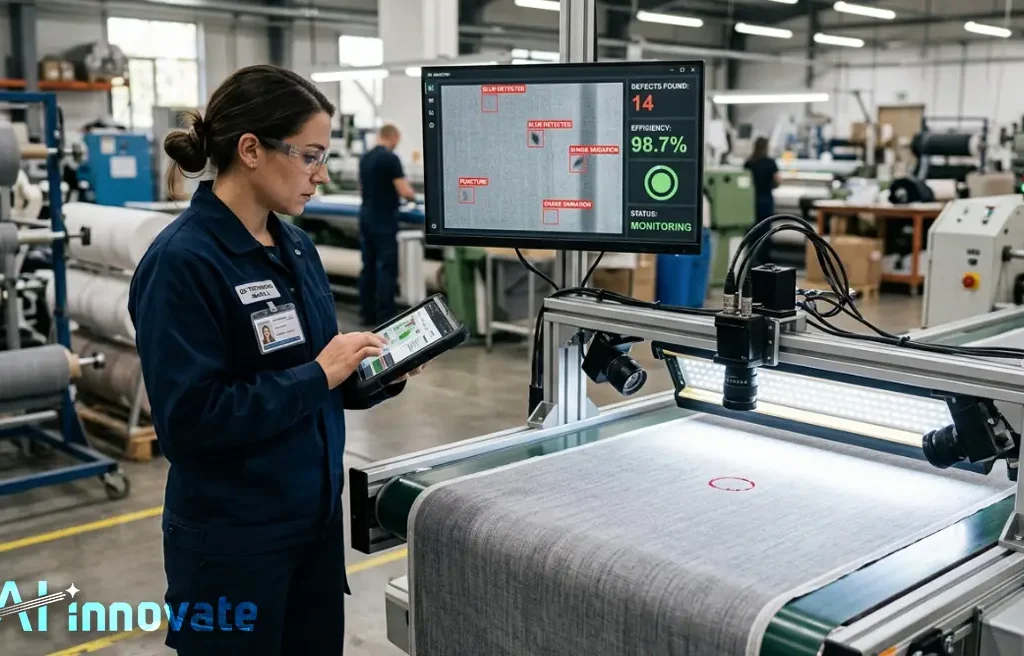
High-resolution cameras paired with AI software inspect fabric continuously as it moves through production. Machine vision systems identify defects instantly and mark or flag affected areas without manual input, maintaining consistent accuracy regardless of line speed, lighting conditions, or operator fatigue.
Smart Factories
Connected factories link inspection systems with broader production data. This gives managers a real-time view of quality across every machine, shift, and product line, the foundation of modern smart factory solutions.
Predictive Analytics
By analyzing inspection data over time, AI can predict where and when defects are likely to happen. This shifts QC from reactive to proactive, letting teams fix root causes before they generate scrap. AI-powered process monitoring makes this possible by tracking variables like yarn tension, dye concentration, and machine settings continuously.
Real-Time Monitoring
Continuous monitoring tools track everything from yarn tension to dye concentration. When something drifts out of spec, the system alerts operators immediately, often before any defective fabric is produced. This is the same principle behind automated visual inspection systems used across manufacturing.
What Challenges Does Textile QC Face?
Even with the best tools, textile quality control comes with challenges that no technology fully eliminates. Understanding them is the first step in building a system that holds up under real production pressure.
The biggest challenges include:
- Fast production speeds: Modern weaving and knitting machines move so quickly that human eyes physically cannot inspect every meter of output
- Complex patterned fabrics: Prints, jacquards, and multi-color designs make defect detection significantly harder because the visual baseline is inherently variable
- Environmental variation: Humidity, temperature, and lighting conditions can affect both fabric behavior and inspection accuracy
- Cost pressure: Buyers demand lower prices while QC adds time and expense to production
- Sustainability requirements: New regulations and customer expectations around water usage, chemical safety, and ethical sourcing add layers of testing and traceability
What Trends Are Shaping the Future of Textile QC?
The technology and approach behind textile QC keeps evolving. Here are the biggest trends shaping where the industry is heading.
AI-Driven Inspection
AI is becoming the default for visual inspection in textiles, not the exception. Newer models handle more fabric types, lighting conditions, and defect categories than ever before, and they keep improving as they process more production data.
Digital Traceability
Blockchain and ERP systems now track every step of production, from fiber source to finished garment. This makes it straightforward to trace defects back to their root cause, whether that is a raw material problem, a machine setting, or an operator error.
Sustainable Quality Systems
QC is starting to include sustainability metrics like water usage, chemical safety, and ethical sourcing. Quality increasingly goes beyond the look and feel of the fabric to encompass how it was made and whether it meets evolving regulatory and consumer standards.
IoT Sensors
Sensors on machines, in dye baths, and along production lines feed real-time data into QC systems. This allows for instant adjustments and tighter process control than periodic manual checks could ever provide.
Autonomous Quality Systems
The next frontier is production lines where AI handles inspection, machines self-correct based on quality data, and human teams focus on oversight, analysis, and continuous improvement rather than repetitive manual checks. The building blocks, including edge AI, real-time monitoring, and predictive analytics, are already in place.
How AI-innovate Powers Textile Quality Control
Textile quality control only delivers its full value when it is backed by the right hardware, data infrastructure, and real-time decision-making capabilities. Moving from manual inspections and isolated quality checks to continuous, production-floor coverage takes reliable edge processing, strong training data, and inspection systems built for the speed and complexity of modern textile manufacturing.
At AI-innovate, we help textile manufacturers bridge the gap between quality control strategy and production-floor execution:
- AIxEye enables real-time detection of defects like misweaves, stains, color inconsistencies, and pattern issues across weaving, knitting, and finishing lines
- AIxCore (powered by NVIDIA Jetson Orin AGX) provides edge AI infrastructure for real-time inspection data processing, sensor integration, and on-site analytics across the full textile production workflow
- AIxCam generates synthetic training data, helping teams strengthen AI models when defects are rare, datasets are limited, or specialized conditions need to be simulated for better model performance
Whether you are upgrading inspection on a single production line or scaling AI for quality assurance across an entire textile operation, the key is combining reliable visual data, explainable AI, and industrial-grade deployment built for real manufacturing environments.
Final Thoughts
Textile quality control has evolved from a final-stage visual check into a multi-stage, technology-driven discipline that runs from raw fiber through final shipment, built on recognized standards like the 4-Point System and AQL and increasingly powered by AI and real-time monitoring.
In our experience working with textile manufacturers, the operations that consistently ship high-quality product are not the ones with the most inspectors on the floor. They are the ones that catch problems earliest, at the raw material and in-process stages, and use data to prevent defects from repeating. Investing in structured QC and intelligent inspection tools is not a cost; it is the most reliable way to protect margins, reduce returns, and build the kind of quality reputation that keeps buyers coming back.
Confused About Where to Start with AI?
Our specialists help you identify the right AI approach based on your process, data, and goals.
Frequently Asked Questions
What is textile quality control?
Textile quality control is the structured process of inspecting, testing, and verifying fabric and garment quality at every stage of production, from raw fiber through final shipment. It combines visual inspection, lab testing, standardized grading systems, and increasingly AI-powered defect detection to ensure products meet performance standards and buyer expectations.
What is the best time to perform textile inspections?
Fabric should be inspected before cutting or production begins. Early detection at the pre-production and raw material stages catches defects like holes, uneven dyeing, and weave inconsistencies before they multiply through cutting and sewing, preventing costly mass-production errors.
What is the 4-Point System in textile inspection?
The 4-Point System is the global standard method for grading fabric quality. Inspectors assign 1 to 4 penalty points to each defect based on its size, and the total points per 100 square yards determine whether a fabric roll passes or fails. Most buyers set acceptance thresholds between 20 and 40 points.
What is the difference between the 4-Point System and AQL?
The 4-Point System is a fabric-grading method that assigns penalty points based on defect size, used during fabric roll inspection. AQL (Acceptance Quality Limit) is a statistical sampling method used during final garment inspection to determine whether a batch meets the buyer’s quality threshold. One grades individual fabric rolls; the other evaluates finished shipments.
How does AI improve textile quality control?
AI improves textile quality control by using computer vision to inspect fabric continuously at production speed, catching defects like misweaves, stains, holes, and color inconsistencies that human inspectors miss due to fatigue and the volume of output. It also enables predictive analytics that identify quality problems before they generate scrap.
What are the most common defects in textile manufacturing?
The most common textile defects include misweaves, broken yarns, stains, holes, color variation, and pattern misalignment. These can occur at any stage from weaving and knitting through dyeing and finishing, which is why multi-stage inspection with checkpoints at each production phase is critical.
Sources
Ai-Innovate uses only high-quality sources, including peer-reviewed studies, to support the facts within our articles.
- International Organization for Standardization. (2015). ISO 9001:2015 – Quality management systems: Requirements. ISO. https://www.iso.org/standard/62085.html
- International Organization for Standardization. (1999). ISO 2859-1 – Sampling procedures for inspection by attributes. ISO. https://www.iso.org/standard/1141.html
- ASTM International. (2017). ASTM D1683/D1683M – Standard Test Method for Failure in Sewn Seams of Woven Fabrics. ASTM. https://www.astm.org/d1683_d1683m-17.html
- PRO QC International. (2024). Textile Inspection: Complete Guide and Quality Control Checklist. Covers textile inspection methods, quality control checkpoints, and defect identification standards used in apparel and fabric manufacturing. https://proqc.com/blog/textile-inspection-complete-guide-and-quality-control-checklist/
- Textile School. (2024). Comprehensive Guide to Textile Testing: Ensuring Quality from Fiber to Garment. Explores textile testing methods, fiber analysis, fabric performance evaluation, and garment quality assessment across the production lifecycle. https://www.textileschool.com/10992/comprehensive-guide-to-textile-testing-ensuring-quality-from-fiber-to-garment/
ExploreTex. (2024). What Is Quality Control in Textiles? Explains the fundamentals of textile quality control, including testing procedures, inspection systems, and manufacturing consistency practices. https://exploretex.com/what-is-quality-control-in-textiles/