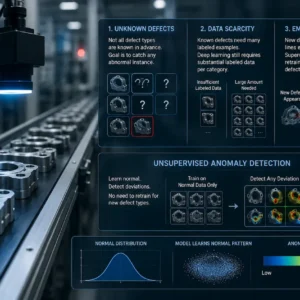





Manufacturers are under constant pressure to keep quality high without slowing the line down. In high-volume production, a single missed defect can snowball into scrap, rework, or a customer complaint that costs far more than the part itself. Manual inspection has been the backbone of quality control for decades, but it gets harder to scale every time production speeds up or quality standards tighten. That’s why so many manufacturers are turning to AI-powered inspection, which uses computer vision and machine learning to check products in real time and catch what tired eyes miss.
This article compares AI defect detection and manual inspection head to head, across accuracy, speed, scalability, cost, and how each actually performs on the factory floor.
Ready to Move Beyond Manual Inspection?
Discover how AI-powered defect detection delivers faster inspections, higher accuracy, and consistent quality control across your production line.

How Do AI Defect Detection and Manual Inspection Compare?
AI inspection generally wins on speed, consistency, and scalability in high-volume settings. Human inspectors still hold the edge on complex or subjective calls. Here’s how the two stack up side by side.
| Factor | AI Defect Detection | Manual Inspection |
|---|---|---|
| Accuracy Consistency | Consistent once properly trained | Varies between operators and shifts |
| Inspection Speed | Real-time, at production-line speed | Slower and labour-dependent |
| Fatigue Impact | None | Performance declines over time |
| Scalability | Scales across facilities easily | Requires additional staffing |
| Data Collection | Automatic reporting and analytics | Limited manual documentation |
| Defect Detection | Catches subtle, repetitive defects | Small defects can slip through |
| Operational Cost | Lower long-term running costs | Higher ongoing labour costs |
| Inspection Coverage | Continuous, 100% coverage | Often sample-based |
| Adaptability | Needs retraining for changes | Humans adapt naturally |
| Best Use Case | High-volume repetitive inspection | Complex or subjective inspection |
The pattern is clear: the more repetitive and high-throughput the inspection, the more an automated system pulls ahead. Lines dealing with recurring defect patterns and tight cycle times tend to see the biggest gains from AI, while low-volume work with constant product variation still leans on human judgement.
Where Is Manual Inspection Still Used?
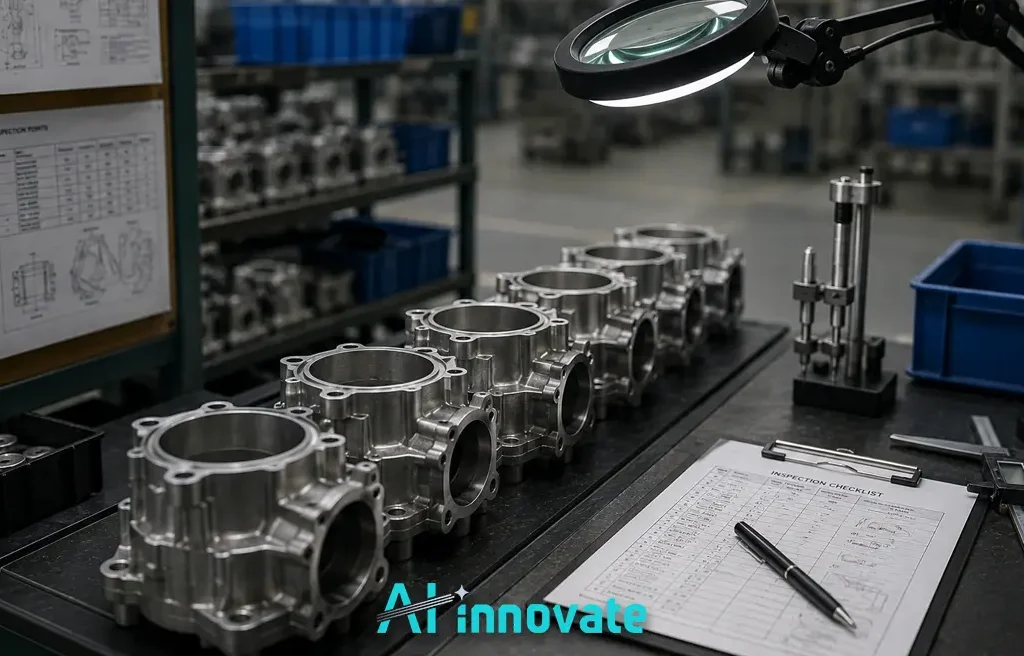
Plenty of manufacturing still depends on human eyes, particularly where flexibility and contextual judgement matter more than raw speed. When a defect is hard to define or standardize, an experienced inspector can spot it in a way an automated system struggles to. Manual checks also serve as a reliable second layer of verification alongside automated visual inspection.
Which Industries Still Rely on Manual Inspection?
Industries with lower volumes or high product variation lean on manual inspection the most:
- Aerospace manufacturing
- Custom metal fabrication
- Luxury product finishing
- Prototype manufacturing
- Low-volume specialty production
In these settings, inspectors draw on experience and visual judgement to catch irregularities that don’t follow a predictable pattern, the kind of one-off issues a model hasn’t been trained to recognize.
What Are the Main Limitations of Manual Inspection?
The flexibility of human inspection comes with trade-offs. Over a long shift, even a skilled inspector deals with:
- Fatigue during repetitive tasks
- Inconsistent judgement from one shift to the next
- Slower inspection times
- Declining accuracy over long production runs
- Difficulty spotting micro-defects
These issues get worse as throughput climbs and there’s less time per unit for a careful look. A subtle surface scratch or a slight alignment problem is easy to miss when you’re inspecting thousands of identical parts in a row.
How Does AI Defect Detection Improve Quality Control?
AI inspection raises quality control by holding consistency steady, catching defects too subtle for the human eye, and monitoring production as it happens. Rather than depending on someone watching the line, these systems evaluate visual patterns, textures, dimensions, and anomalies continuously as products move through.
What Are the Benefits of AI Defect Detection?
Consistency is the headline advantage. An AI system inspects the ten-thousandth part exactly as carefully as the first, with no drop in focus.
- Real-time inspection: Defects get flagged the moment they appear, so problems are caught early instead of being discovered downstream or after shipping.
- Better detection accuracy: AI reliably picks up surface scratches, cracks, missing components, paint inconsistencies, packaging defects, and dimensional deviations, the small flaws that are hardest to catch by hand at speed.
- Higher production efficiency: Automated checks clear the bottlenecks that manual inspection creates, keeping full coverage in place without slowing the line.
- Data and traceability: Every inspection is logged automatically, giving manufacturers a running record they can use to monitor defect trends, tighten process control, cut scrap, and back up quality audits. That depth of visibility is nearly impossible to maintain by hand.
- Around-the-clock operation :The system runs through every shift without interruption, which suits multi-shift and continuous production schedules.
What Challenges Come With AI Defect Detection?
AI inspection isn’t plug-and-play, and it’s worth being honest about what implementation involves.
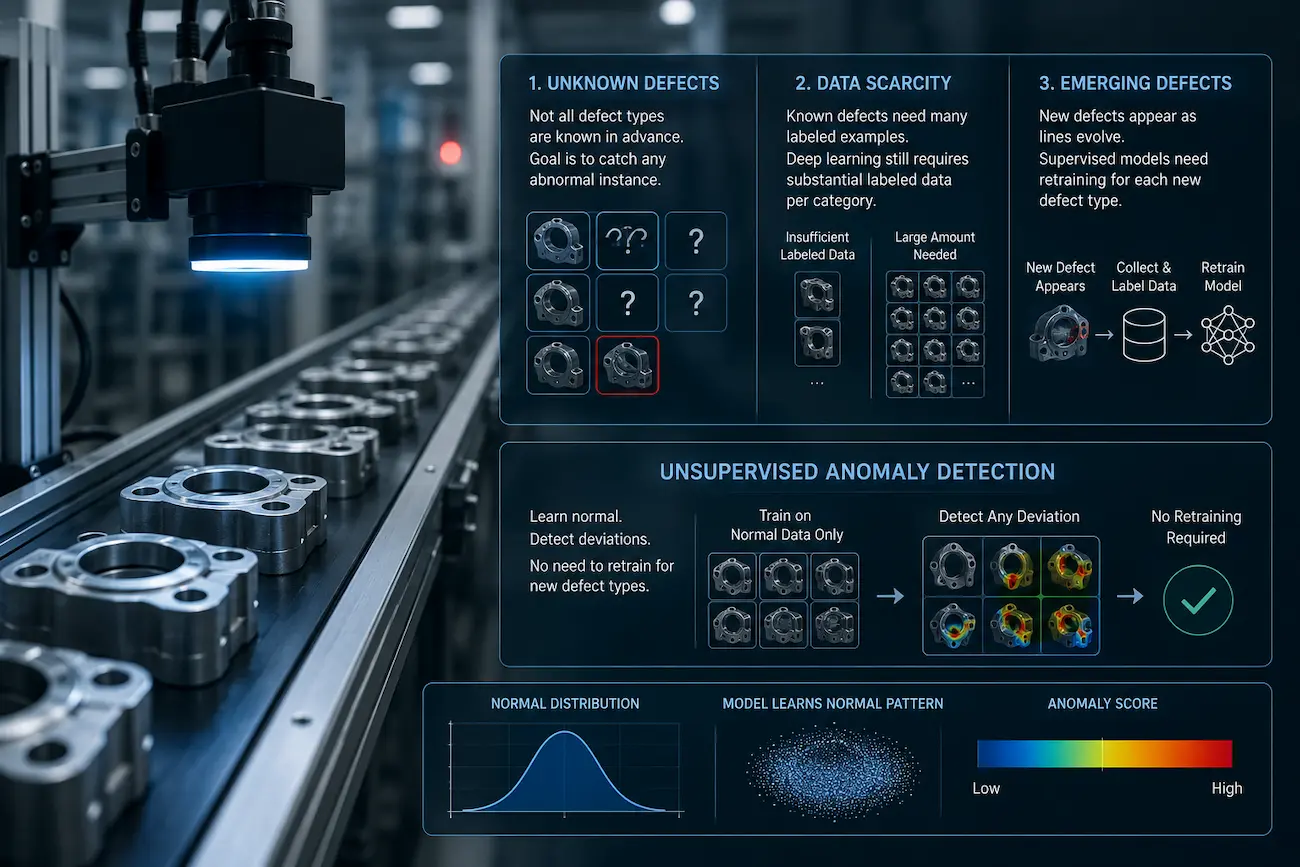
- Training data. Models are only as good as the data behind them. Thin or inconsistent datasets lead to unreliable results.
- Environmental sensitivity. Lighting, camera placement, and line variability all affect accuracy if the system isn’t set up carefully.
- Integration. Bringing AI into an existing operation can mean reworking production workflows, hardware, and data systems.
- False positives. Systems sometimes flag good products as defective, especially when a new product variation or process change is introduced, and that usually calls for retraining.
- Upfront cost. Cameras, software, and integration cost more at the start than a traditional manual setup. Most manufacturers earn that back over time through less waste and higher throughput.
This Topic might also interest you :
Why Are Hybrid Quality Control Systems Becoming More Common?
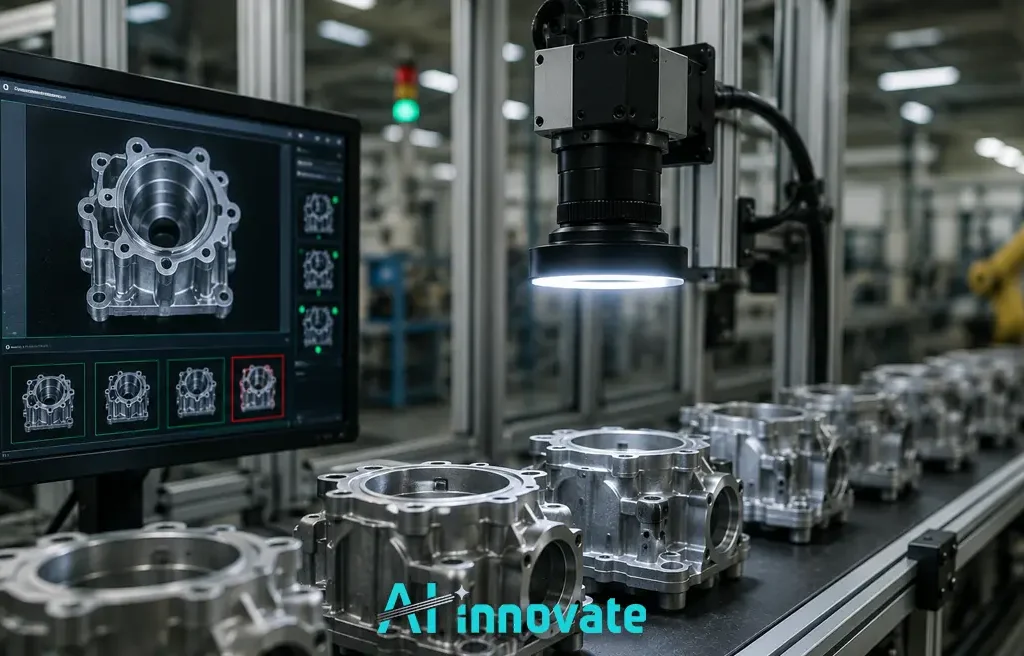
The smartest setups rarely pick a side. Instead, they pair AI with human oversight, letting the system handle repetitive inspection at speed while people step in on the complex or uncertain cases. AI isn’t replacing inspectors here; it’s freeing them up to focus where their judgement actually counts.
Why Do Manufacturers Combine AI and Human Inspection?
A hybrid model balances automation with flexibility. In practice, that usually looks like:
- AI running the high-speed, repetitive inspections
- Human inspectors reviewing edge cases
- Operators verifying uncertain classifications
- Teams spending far less time on routine checking
The result is better throughput with less inspection fatigue and fewer inconsistencies creeping in.
What Are the Best Use Cases for Hybrid Inspection?
Hybrid inspection shines where precision and flexibility both matter:
- Automotive manufacturing
- Electronics assembly
- Pharmaceutical packaging
- Food production
- Surface defect detection
Each of these benefits from AI’s speed and consistency while keeping human expertise on hand for the calls that need context.
Improve Inspection Accuracy With AI-Powered Quality Control
AI defect detection only pays off when it’s built on the right inspection infrastructure, production data, and workflows. Moving from manual checks and isolated quality stations to scalable, real-time inspection across your lines takes reliable edge processing, accurate visual data, and AI that holds up in fast-moving manufacturing conditions.
At AI-innovate, we help manufacturers close the gap between traditional inspection and production-ready AI quality control with:
- AIxEye for real-time defect detection and process optimization, catching surface defects, dimensional inconsistencies, missing components, and packaging issues across high-volume production
- AIxCore, an industrial AI edge computer powered by NVIDIA Jetson Orin AGX, delivering real-time image processing, sensor integration, and reliable on-site machine vision for automated inspection
- AIxCam, advanced simulation tools for camera testing and synthetic data generation, helping you strengthen inspection models when defect samples are limited, datasets are imbalanced, or rare edge cases are hard to capture
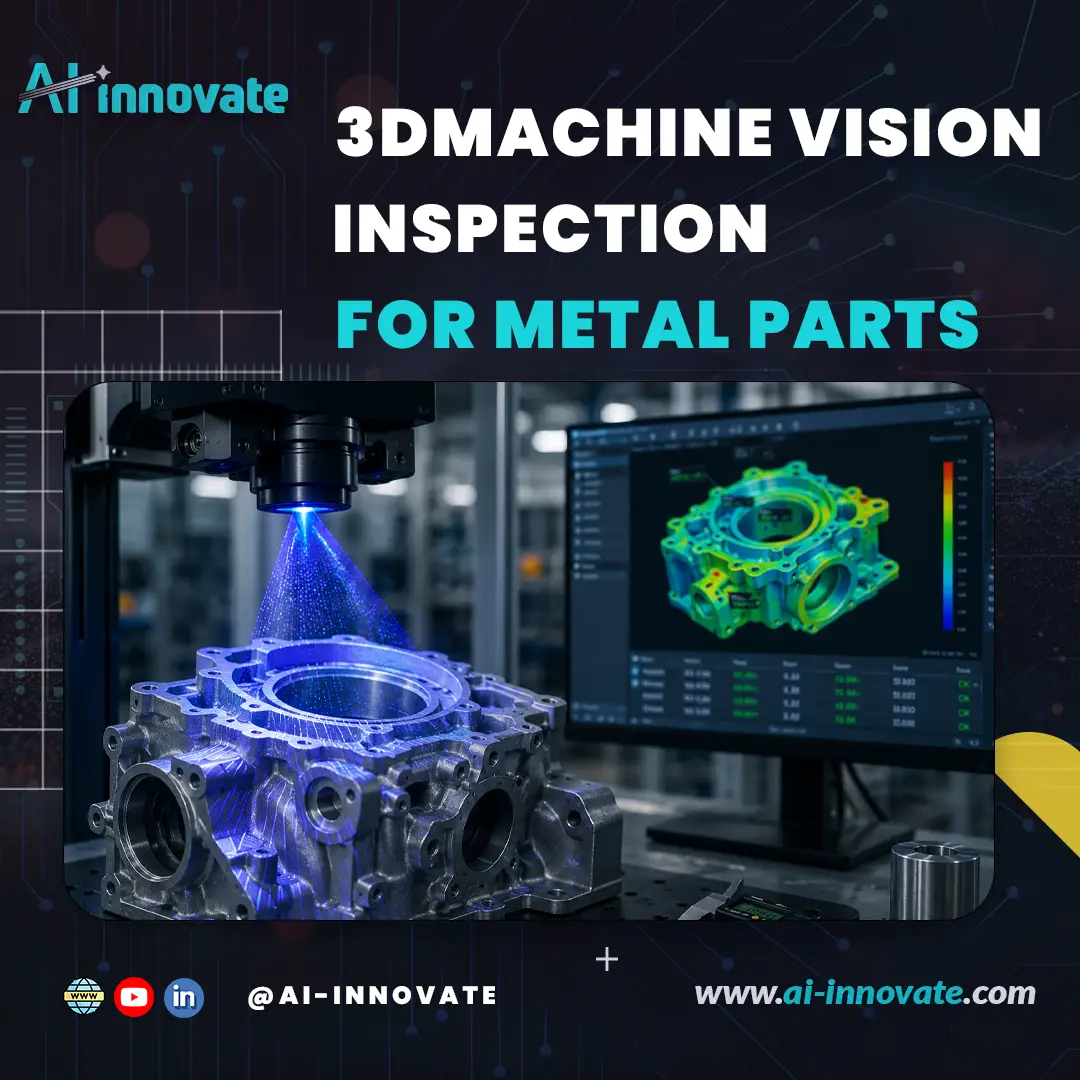
- AIxAM, which detects surface and geometry defects on 3D objects, including scratches, cracks, dents, deformation, assembly misalignment, and dimensional anomalies, by analyzing multi-view images and depth data in real time
Whether you’re tightening inspection on a single line or scaling AI-driven quality control across automotive, electronics, packaging, food, or industrial production, success comes down to combining reliable visual data, explainable AI, and industrial-grade deployment built for real manufacturing conditions.
Final Thoughts
Manual inspection isn’t going anywhere. It remains essential wherever flexibility, experience, and contextual judgement carry the day. But as volumes grow and quality expectations climb, relying on it alone becomes a tougher proposition.
AI defect detection helps manufacturers hold consistency, lighten the repetitive inspection load, and keep quality control moving at modern production speeds. For most operations, the strongest answer isn’t AI or humans, it’s both, working together through a hybrid system that plays to each one’s strengths
Confused About Where to Start with AI?
Our specialists help you identify the right AI approach based on your process, data, and goals.
Frequently Asked Questions
Is AI defect detection more accurate than manual inspection?
In repetitive, high-volume environments, AI inspection delivers more consistent results because it doesn’t fatigue or lose focus. For complex or subjective evaluations, skilled human inspectors still have the advantage.
Can AI replace human quality inspectors?
Not entirely. AI excels at repetitive inspection, but human inspectors remain important for complex evaluations, edge cases, and final verification. Most manufacturers use the two together.
What industries use AI visual inspection systems?
Automotive, electronics, pharmaceuticals, food manufacturing, and metal fabrication are among the most common adopters.
What are the limitations of automated inspection?
AI systems need quality training data, careful calibration, and periodic retraining when production conditions or product variations change.
How does computer vision detect manufacturing defects?
It analyzes images and video to flag abnormalities, comparing what it sees against learned patterns to catch scratches, cracks, missing parts, or dimensional inconsistencies.
How does AI improve fabric inspection?
AI-powered fabric inspection systems use computer vision and machine learning models to detect defects automatically during textile production. These systems can identify holes, stains, misweaves, pattern inconsistencies, and color variations faster and more consistently than manual inspection alone.
AI inspection also helps manufacturers reduce inspection fatigue and improve quality consistency on high-speed production lines.
Why are manufacturers adopting AI-driven quality control?
To improve inspection consistency, cut production waste, and keep quality control from becoming a bottleneck as production speeds ris
What types of defects can AI inspection systems detect?
Cracks, scratches, missing components, alignment issues, dimensional deviations, surface and geometry defects, and packaging defects, among others.
Sources
Ai-Innovate uses only high-quality sources, including peer-reviewed studies, to support the facts within our articles.
- Tabernik, D., Šela, S., Skvarč, J., & Skočaj, D. (2020). Segmentation-Based Deep-Learning Approach for Surface-Defect Detection. Journal of Intelligent Manufacturing. A widely cited study presenting a deep-learning architecture for surface-crack detection that trains effectively on a small number of sample images. https://arxiv.org/pdf/1903.08536
- Bhatt, P. M., et al. (2021). Image-Based Surface Defect Detection Using Deep Learning: A Review. Journal of Computing and Information Science in Engineering, ASME. A survey of deep-learning methods for detecting surface defects in manufacturing, including CNN architectures and defect classification. https://asmedigitalcollection.asme.org/computingengineering/article/21/4/040801/1094064/
- Bhatt, A., et al. (2023). A Systematic Review of Deep Learning Approaches for Surface Defect Detection in Industrial Applications. Engineering Applications of Artificial Intelligence, ScienceDirect. Reviews lightweight CNNs and modern models for steel and PCB surface defect detection. https://www.sciencedirect.com/science/article/abs/pii/S0952197623019012
- Hütten, N., Meyes, R., & Meisen, T. (2024). Deep Learning for Automated Visual Inspection in Manufacturing and Maintenance: A Survey of Open-Access Papers. Applied System Innovation, MDPI. A comprehensive review of deep-learning-based automated visual inspection across industrial use cases. https://www.mdpi.com/2571-5577/7/1/11
- IBM. (2024). AI in Manufacturing. Explains how manufacturers apply AI, automation, and analytics to improve operational performance and quality control. https://www.ibm.com/think/topics/ai-in-manufacturing
- NVIDIA. Jetson AGX Orin for Edge AI and Robotics. Technical overview of the edge AI computing platform used for real-time industrial inspection and machine vision. https://www.nvidia.com/en-us/autonomous-machines/embedded-systems/jetson-orin/