Find quality problems
earlier, without forcing
your food production
line into a one-size-fits
all
inspection system

Food inspection is not one problem. A visible defect on a bakery product, a damaged

seal, a missing label, an incorrect lot code and a foreign material risk all require

different inspection methods.

AI-Innovate starts from the production problem.

Before selecting technology, we define:

  • What you produce,
  • What needs to be inspected,
  • Where the issue appears,
  • Whether the condition is visual or requires another sensing method,
  • How the product or package moves,
  • And what inspection equipment is already installed.
The first question is not:

"Which AI product should we install?"

It is:

What needs to be detected, verified or measured, and where should that inspection happen on your line?

You do not need to select a camera, AI model or inspection product before contacting us.
Start with the product, the quality problem and the production stage.

The Real Inspection Challenge

The challenge is not simply detecting a defect. It is applying the right inspection method at the right point in production.

Not every food-safety problem is visible

Machine vision can inspect conditions that can be captured optically. It does not replace microbiological testing, chemical analysis, metal detection or X-ray inspection where those methods are required.

CFIA guidance itself separates visual inspection from technologies such as metal detectors, X-ray equipment, optical sorting and scanner systems for foreign-material control.

The first technical decision is therefore: Is the condition visual, or does it require another measurement method?
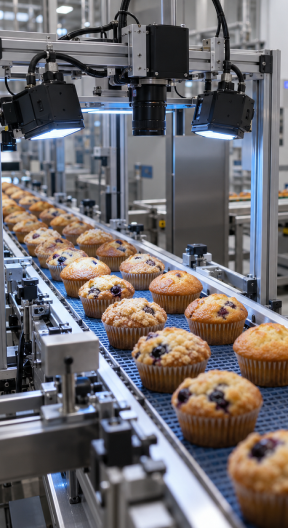
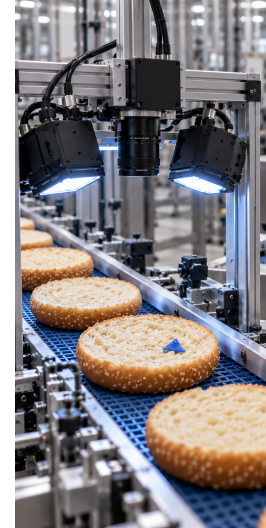
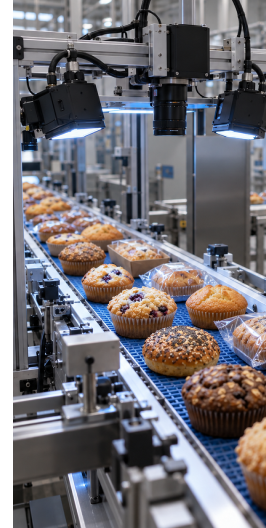
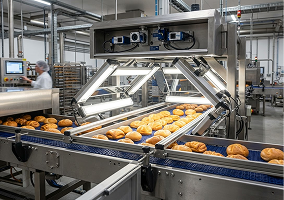
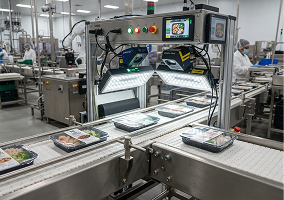
Inspection cameras above muffins on a production line

Foreign material requires the right detection technology

Foreign material is not one inspection category. A visible object on an exposed product is different from metal embedded inside food or material hidden within opaque packaging.

The inspection architecture should match:

  • Material type & Location of hazard
  • Product density & Packaging
  • Line speed & Required detection sensitivity

For visible contamination, machine vision is part of the inspection path. For hidden foreign material, the path shifts to the appropriate sensing technology.

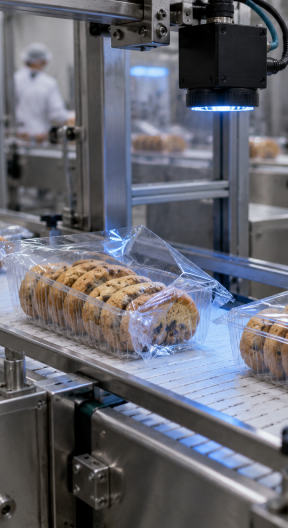
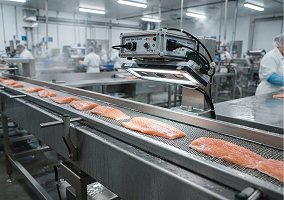
Inspection camera above bakery products

Product appearance changes across batches and SKUs

Food manufacturers work with natural product variation, different recipes, sizes, colours, shapes, toppings, fill conditions and packaging formats.

An inspection system cannot be designed around one perfect reference sample.

The system needs to distinguish between acceptable variation and a condition that requires action.

Different bakery products on a production line

Packaging creates a second inspection layer

The product can be correct while the package is not. CFIA preventive-control requirements explicitly include packaging and labelling alongside food-safety controls.

Inspection requirements include:

  • Damaged packaging & Missing components
  • Incorrect orientation & Visible seal problems
  • Missing or incorrect labels & Product-package mismatch
Packaged bakery products moving through an inspection line

Label accuracy is part of the quality system

A label is not only a branding element. Food manufacturers need controls around mandatory information, product identity and traceability.

CFIA requires businesses to describe measures used to ensure food is packaged and labelled accurately. Visual inspection supports label presence, correct SKU matches, lot/date code checks, and presentation.

NOTE: Visual system does not claim to detect physical allergens inside the food.

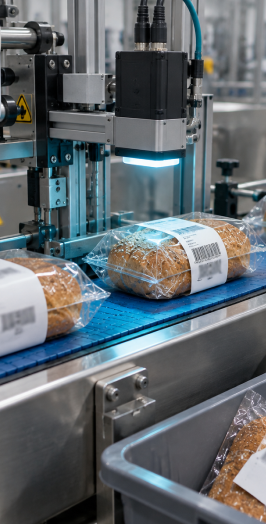
Inspection camera checking a label on packaged bread

What These Inspection Problems Mean
for Quality and Operations Teams

FOR QUALITY LEADERS

Inspection failures become evidence, traceability and recall problems

For a Quality Manager, the issue is not only whether a defect exists. The issue is whether the inspection process is consistent, documented and traceable enough to support corrective action.

In Canada, CFIA recorded 185 food recall incidents and 504 total food recalls in fiscal 2025–26. Among those incidents, 57 involved allergens, 37 involved extraneous material and 73 involved microbiological hazards.

Those figures do not mean machine vision prevents all recalls; many hazards fall outside visual inspection. They show why food-quality controls need to clearly distinguish what can be visually verified, what requires another sensing method, and what evidence must be retained.

Focus Areas:

  • Inspection consistency & quality escape reduction
  • Traceable records & evidence-based corrective action
Explore how AI-Innovate supports Quality Leaders
FOR OPERATIONS LEADERS

Quality loss consumes material, labour and productive capacity

Food quality problems also appear as an operations problem: rejected product, rework, additional manual inspection, line interruption, product loss, and lost productive capacity.

A Canadian government review of food loss notes that at the processing stage, around 10% of produce, meat and field crops entering facilities can become avoidable food loss. Industry sales reached $173.4 billion in 2024.

Process and equipment inefficiency, off-spec product, quality rejection and production-line changes are prime causes. The scale matters because ingredients and materials represent the single largest share of processor costs.

Focus Areas:

  • Protecting throughput, yield & visual inspection labour
  • Optimizing material use, reducing rework & line availability
Explore the AI-Innovate approach for Operations Leaders

Where in Your Food
Process Is the Problem?

Inspection changes with the product and production stage. Food manufacturing includes very different production environments. The inspection requirement for raw product, processed food, packaging and final labelling is not the same.

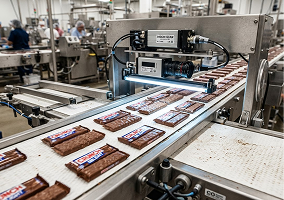
Confectionery inspection line

Confectionery & Snacks

  • Breakage & shape deformity
  • Coating presence & distribution
  • Count & packaging verification

APPROACH: High-Speed 2D Verification

Explore Automated Visual Inspection

What Are You Trying to Inspect?

Start with the inspection problem, not the technology

01 / GEOMETRY

Visible product defects

Shape, colour, surface condition, breakage, missing components and presentation.

02 / CONTAMINATION

Visible foreign material

Material that can be optically distinguished from the expected product.

03 / INTEGRITY

Packaging defects

Damage, missing components, orientation and visible seal or closure problems.

04 / TRACEABILITY

Label & print verification

Label presence, correct product-label match, print, date code and lot code.

05 / QUALITY

Sorting & grading

Visible differences in size, colour, shape and other defined visual characteristics.

06 / OPTICS

Difficult-to-see defects

Low-contrast, reflective, transparent or visually complex conditions requiring engineered imaging.

07 / SPECIALIZED SENSING

Non-visual hazards

Microbiological contamination, chemical hazards and foreign material that requires metal detection, X-ray or another dedicated sensing method.

Can This Problem Be Automated?

Five questions define the inspection architecture

01

Is the condition actually visible?

If the condition requires laboratory testing, chemical analysis, X-ray, metal detection or another physical measurement, machine vision is not the primary detection method.

02

Where should inspection happen?

At: incoming product, preparation, processing, filling, packaging, labelling, or final inspection? The inspection point should be where the condition is both observable and actionable.

03

How does the product move?

Line speed, orientation, spacing, product size and packaging determine the imaging architecture.

04

How much acceptable variation exists?

Natural product variation, recipes, batch conditions, colour, shape and SKU changes must be included in the inspection design.

05

What equipment is already installed?

Existing cameras, metal detectors, X-ray systems, PLCs, checkweighers and rejection mechanisms are assessed before replacement is considered.

Start with Representative Images

Smart Demo provides an initial image-based feasibility screening for visual inspection problems.

Note: Smart Demo evaluates what can be seen in representative images. It does not replace production-line validation, food-safety testing or non-visual sensing.

Choose the Right Inspection Path

The inspection architecture is selected around the actual production problem

Automate AI Visual Inspection

Use this path when: the condition is visually observable, inspection is manual or inconsistent, continuous visual monitoring is required, and the production line needs a complete machine-vision inspection layer.

Explore Automated Visual Inspection

Upgrade Existing Inspection Systems

Use this path when inspection infrastructure already exists and the constraint sits in: lighting, camera setup, processing, detection logic, integration, or data flow. The objective is to keep what works and upgrade what limits inspection.

Assess Your Existing Inspection System

Monitor & Manage Quality
Performance

Use this path when inspection data needs to support: quality trends, lot or batch comparison, operator review, traceability, recurring defect monitoring, and investigation.

Explore Quality Performance Monitoring

Build a Custom Solution

Use this path when the application requires: multiple sensing technologies, complex product presentation, unusual packaging, high SKU variation, difficult imaging, specialised rejection logic, or integration with existing inspection equipment.

Explore Custom Inspection Engineering

Technology in Context

Technology enters the project only after the inspection requirement is defined.
We select and configure the right component modules based on your specific
quality standards.

2D MACHINE VISION

AIxEye – 2D Automated
Visual Inspection

AIxEye provides the 2D visual-inspection layer for requirements such as:

  • Visible surface conditions
  • Shape and appearance inspection
  • Package inspection
  • Label and print verification
  • Product sorting & inspection traceability

Its confirmed platform capabilities include 2D inspection, on-premise processing, storing inspection records and integration with PLC/MES/robots/sorting/rejection systems.

Explore 2D Visual Inspection with AIxEye
3D MACHINE VISION

AIxAm – 3D Inspection for
Shape and Geometry

AIxAm inspects food products and packaging when quality depends on shape, depth, or geometry.

  • Product shape and deformation
  • Container and package geometry
  • Closure position and completeness
  • Dimensional variation
Explore 3D Inspection with AIxAm
ENGINEERED LIGHTING

AIxLight – Engineered
Machine Vision Lighting

Food inspection depends on image quality. AIxLight is used where defect visibility is limited by optical physics.

  • reflective packaging
  • low contrast
  • variable surfaces
  • transparent materials
  • difficult illumination conditions
See How Engineered Lighting Supports Defect Visibility
ON-SITE COMPUTE

AIxCore – Industrial
Edge AI Processing

AIxCore provides on-site processing and industrial connectivity for inspection systems. It connects the inspection layer with:

  • High-speed digital camera integration
  • Multi-spectral sensor arrays
  • PLC and industrial automation protocols
  • MES and plant-level network syncing
  • rejection systems
  • automation equipment
Explore Industrial Edge Processing with AIxCore
QUALITY INTELLIGENCE

AIxInsight – Quality
Intelligence

AIxInsight turns real-time inspection records into deep operational visibility for plant managers and QA teams.

  • Defect trends
  • Live dashboards
  • Configurable instant alert systems
  • Operator review
  • Lot/batch/SKU comparisons
  • reporting and traceability
Explore Quality Trend Monitoring with AIxInsight
INVESTIGATION ENGINE

AIxCause – Recurring
Defect Investigation

AIxCause combines inspection data with relevant production context such as:

  • Process conditions
  • Machine settings
  • Material information
  • Batch data and Environmental conditions
  • Production history
Important: Correlation does not prove root cause. Engineering or human validation is required.
Explore Defect Investigation with AIxCause

Built for Smaller and Existing
Food Production Lines

Improve inspection without rebuilding the entire line

This matters especially in Canada.

95%

In 2024, 95% of Canadian food and beverage processing establishments were small operations with 0–99 employees.

For these manufacturers, the inspection architecture needs to fit:

  • Existing equipment and available line space
  • Current automation and multiple SKUs
  • Production changeovers
  • Labour constraints
  • Phased investment
AI-INNOVATE STARTS WITH THREE PRACTICAL QUESTIONS:
What already works?
What is limiting inspection?
What needs to be added/changed?

The result is a custom solution configured for Automate / Upgrade / Use the Data / or Custom Engineering without total replacement. The objective is to build the right inspection architecture around the line you already operate.

Start with the Problem, Not the Equipment

You do not need to define the final inspection system before evaluating the
application. Start with:

the food product
the package
the condition you
need to inspect
the production
stage
representative
images

For Processing :

01 Provide Representative
Images
02 Define the Inspection
Condition
03 Review Visual
Feasibility
04 Identify correct
inspection path
WHAT HAPPENS NEXT?

The next engineering step is selected based on your project scope

Not every food processing facility requires every stage. We adapt the deployment speed to your operational constraints.

Full Demo

Simulate inspection in our testing laboratory using sample packages sent from your facility.

Technical Assessment

A deep-dive review of current hardware, conveyor speeds, ambient light, and interface protocols.

Pilot Block

Install a low-risk temporary setup on an active production line to log real-world variations.

Technical Consultation

Collaborate directly with our industrial AI architects to structure custom multi-sensor nodes.

Tell us what you are trying to inspect

You do not need to choose a camera, an AI model, a sensor, or an AI-Innovate product before contacting us. We start from the
physical production line.

START WITH FOUR ESSENTIAL INFORMATION POINTS:

1. What do you produce?

Product, ingredients, batch sizes

2. What problem do you detect?

Defect, foreign material, seal check

3. Where does it occur?

Infeed, prep, packing, final label

4. How do you inspect today?

Manual QA, checkweigher, older vision

SUPPORT & COMPLIANCE

Frequently Asked Questions

Clear answers about machine vision, hardware integration, CFIA compliance, and system constraints.

No. Machine vision inspects conditions that can be captured visually. Microbiological hazards, chemical hazards and hidden foreign material require the appropriate laboratory, X-ray, metal-detection or specialised sensing method. The first step is to define what actually needs to be detected or measured.

AI-based visual inspection detects foreign material that is optically visible in the inspection scene. Foreign material hidden inside an opaque product or package requires the appropriate detection method, such as metal detection or X-ray. CFIA itself distinguishes between visual inspection, metal detection, X-ray and optical sorting in foreign-material controls.

Yes, visual inspection can verify conditions such as: label presence, label-product match, print presence, date code, lot code, and other defined visual packaging requirements. The system must be configured around the actual package, code format and acceptance rules.

A camera does not verify the physical presence of an allergen inside food. Visual inspection supports the labelling and packaging control layer by checking whether the correct label, product identity and required visual information are present. Allergen-control processes remain part of the food-safety system.

The inspection architecture is designed around the actual range of production variation. Recipe, colour, shape, size, packaging, label and SKU changes are included in the inspection strategy.

No. Existing inspection and automation equipment is assessed first. The system is upgraded or integrated where the current inspection chain has a gap.

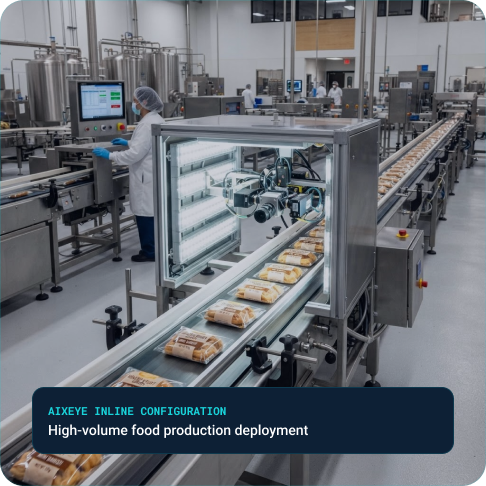
Inline inspection is designed around the actual line speed, product spacing, field of view, resolution, lighting and processing requirements. Those conditions are defined before the system architecture is locked.

Inspection records can be connected with production context such as product, SKU, batch, lot or time. AIxInsight is the quality-intelligence layer for monitoring, comparisons, reporting and inspection traceability. CFIA guidance also emphasizes lot identification and traceability as part of managing investigations and recalls.

Inspection systems detect and record recurring quality events. AIxInsight and AIxCause connect those events with relevant production data to support investigation. Correlation does not prove root cause; engineering or human validation remains required.

Provide representative images of the visual inspection problem. Include: acceptable examples, defect examples where available, product or package information, the production stage, and a short description of what needs to be detected.

The next step is selected based on the application: Full Demo, Technical Assessment, Pilot, or Technical Consultation. Smart Demo is an initial feasibility step, not a production-performance guarantee.

Shopping Basket