




In the previous parts of this series, we explored the critical role of visual inspection in industry and examined the inherent limitations of traditional manual visual inspection. As production volumes increase, tolerances tighten, and quality expectations rise, industry faces a fundamental question:
Machine Vision Fundamentals for Industrial Defect Detection
Why Industry Is Moving Beyond Manual Inspection
How can visual inspection be made more consistent, scalable, and reliable than what human-based systems allow?
The answer has increasingly been machine vision. This transition is not merely a technological upgrade it represents a systemic shift in how inspection is defined, executed, and integrated into industrial processes. In this article, we examine machine vision as the logical evolution of visual inspection, focusing on how automated systems are designed to overcome the structural weaknesses of manual inspection.
Let Vision Systems Lead Inspection
Precise, automated defect detection at scale.

The Motivation for Automation in Visual Inspection
Manual inspection systems fail not because inspectors lack skill, but because human vision and cognition are inherently variable. Fatigue, attention drift, psychological state, and environmental conditions introduce inconsistencies that cannot be fully eliminated through training or procedures.
The transition to machine vision is driven by the need to eliminate or reduce:
- Performance degradation over time
- Subjective decision-making
- Poor repeatability across inspectors and shifts
- Sensitivity to fatigue and emotional state
- Limited scalability and throughput
Machine vision systems are designed explicitly to address these issues at a system level, rather than attempting to correct human limitations individually.
Machine Vision as a Response to Manual Inspection Limitations
Eliminating Fatigue and Vigilance Decrement
One of the most significant advantages of machine vision systems is their immunity to fatigue. Unlike human inspectors, machine vision systems:
- Do not experience vigilance decrement
- Maintain constant inspection criteria over time
- Operate continuously without loss of sensitivity
This directly addresses one of the most critical failure modes of manual inspection: declining defect detection accuracy during prolonged tasks.
Improving Repeatability and Consistency
Manual inspection often suffers from poor repeatability, both within a single inspector over time and across different inspectors. Machine vision systems, by contrast, apply explicit, deterministic decision rules.
As a result:
- The same product yields the same inspection outcome regardless of time or operator
- Inspection decisions become auditable and traceable
- Quality standards are enforced uniformly
This consistency is essential for modern quality assurance systems and regulatory compliance.
Removing Subjectivity from Inspection Decisions
In manual inspection, defect acceptance often depends on subjective judgment. Machine vision replaces subjective interpretation with quantified visual criteria, such as:
- Measured deviations from nominal geometry
- Intensity or texture thresholds
- Defined tolerance limits
By formalizing inspection criteria, machine vision systems reduce ambiguity and prevent decision drift under production pressure or psychological stress.
Machine Vision as a System, Not a Tool
A common misconception is that machine vision simply replaces human eyes with cameras and processing units. In reality, machine vision introduces a fundamentally different inspection paradigm.
Machine vision systems are:
- Explicitly engineered
- Algorithmically defined
- Integrated into industrial control loops
They transform inspection from a human task into a repeatable computational process, embedded directly into production workflows.
Core Stages of an Automated Vision Inspection Pipeline
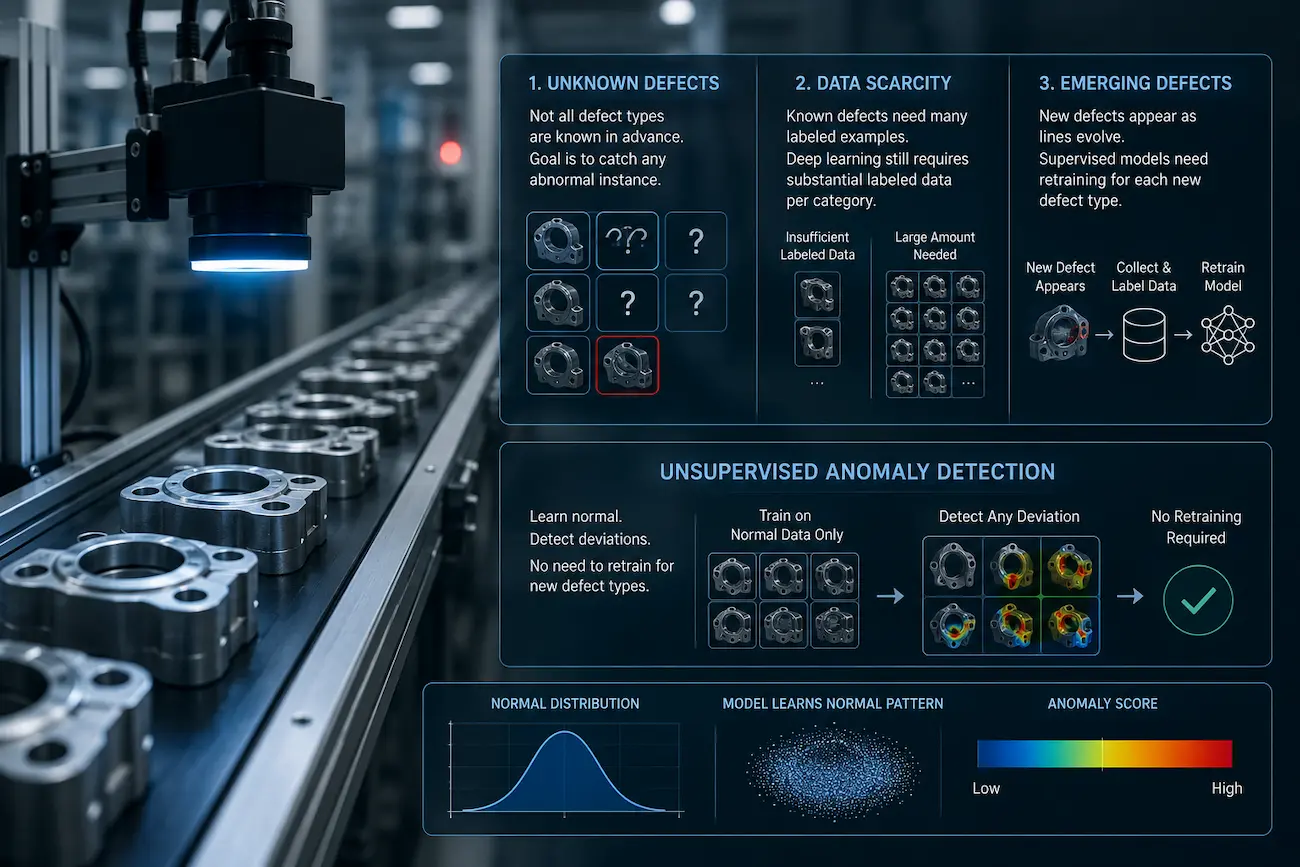
From a system perspective, the transition from manual to automated inspection introduces a structured pipeline:
- Visual data acquisition
- Image stabilization and preprocessing
- Feature representation
- Defect evaluation
- Decision output and system integration
Each stage is designed to reduce variability and isolate defect-relevant information—something manual inspection cannot do systematically.
From Human Judgment to Explicit Normality Models
A key conceptual shift in moving from manual inspection to machine vision is the treatment of normality.
- Human inspectors rely on experience-based intuition
- Machine vision systems rely on explicit models of normal appearance
Defects are detected as measurable deviations from this defined normality, rather than as subjective impressions. This shift enables:
- Consistent enforcement of quality thresholds
- Easier calibration and validation
- Clear documentation of acceptance criteria
Data Generation: From Binary Decisions to Actionable Insight
Manual inspection typically produces limited data often no more than pass/fail outcomes. Machine vision systems, by contrast, generate rich inspection data, including:
- Defect location
- Defect size and severity
- Frequency and distribution patterns
This data supports:
- Root-cause analysis
- Process optimization
- Predictive maintenance
- Continuous improvement initiatives
In this sense, machine vision does not merely automate inspection it elevates inspection into a data source.
Scalability and Throughput Alignment
As production speeds increase, manual inspection becomes a bottleneck. Machine vision systems are inherently scalable:
- Inspection speed matches production speed
- Performance does not degrade under higher throughput
- Parallel inspection architectures are possible
This scalability makes automated inspection compatible with modern high-volume manufacturing environments where manual methods fail structurally.
What Does Not Automatically Disappear?
It is important to note that transitioning to machine vision does not magically solve all inspection challenges. Some issues require careful system design:
- Product variability
- Mechanical stability
- Environmental disturbances
However, these challenges are engineering problems, not human limitations. Crucially, they can be analyzed, modeled, and mitigated unlike fatigue or psychological bias.
Why Imaging Becomes the Next Critical Question
As inspection logic becomes automated and decision-making is formalized, a new dependency emerges: inspection quality becomes limited by image quality.
If defects are not visible in the image:
- No algorithm can detect them
- No automation can compensate
Thus, once the transition from manual to automated inspection is made, imaging quality defines the performance ceiling of the entire system.
Bridging to the Next Stage
Machine vision systems are designed to eliminate the fundamental weaknesses of manual inspection fatigue, inconsistency, subjectivity, and poor scalability. However, their success depends on how effectively the physical world is converted into digital visual information.
In Part 4, we will focus on this critical step by examining:
- The role of cameras in industrial inspection
- The decisive impact of lighting design
- How imaging choices determine defect visibility
Before machines can learn to see, we must first ensure that what they see is engineered correctly.
Confused About Where to Start with AI?
Our specialists help you identify the right AI approach based on your process, data, and goals.