




Most manufacturers do not have an AI shortage in 2026. They have a scaling problem. A widely cited MIT study found that only about 5 percent of generative AI projects, agentic initiatives included, actually reach production scale across industries. The rest sit in what one industry analysis calls “pilot purgatory,” technically impressive, strategically stalled. Meanwhile, Deloitte projects agentic AI adoption in manufacturing to roughly quadruple this year, from around 6 percent to 24 percent of manufacturers, and Gartner expects more than 40 percent of current agentic AI projects to be cancelled by the end of 2027 due to unclear business value or inadequate governance.
That gap between adoption headlines and actual production results is the real story of manufacturing AI in 2026. The technology is not the bottleneck anymore. Execution is. Three forces are making that execution gap harder to ignore: a volatile global trade environment demanding real-time supply chain agility, a structural workforce shortage as experienced workers retire, and AI itself shifting from a passive assistant that answers questions to an active agent that executes decisions.
This guide walks through the specific trends reshaping manufacturing this year, why so many AI initiatives stall before delivering value, and where the clearest, most defensible ROI is actually showing up on the factory floor.
The Manufacturing AI Trends Shaping 2026
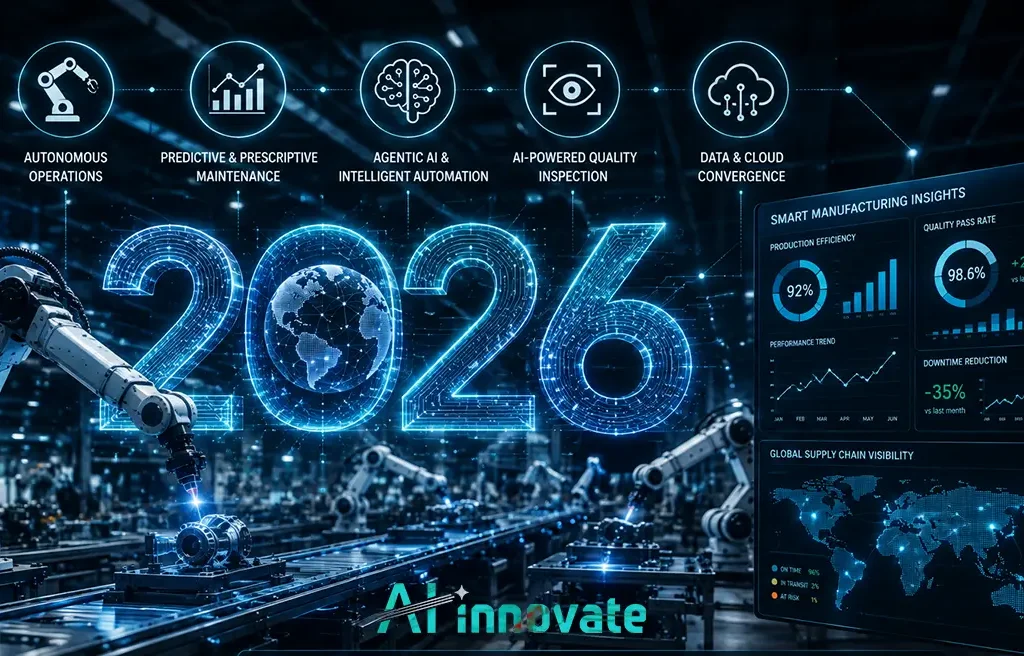
Manufacturing AI in 2026 is defined less by breakthrough technologies and more by successful execution. Organizations moving beyond experimentation are investing in AI applications that deliver measurable operational improvements, strengthen resilience, and create a scalable foundation for future automation. The trends below highlight the technologies and strategies shaping the next generation of smart manufacturing.
Agentic AI Moving From Pilots to Production
The defining shift of the year is from AI that surfaces insights to AI that executes decisions autonomously. On the factory floor, this looks less like a dashboard and more like an agent that ingests equipment data, sensor readings, and maintenance history to draft an actual repair plan for a technician to review, rather than simply flagging that a machine might fail.
The same shift is playing out in procurement and supply chain functions, where agents are increasingly trusted to renegotiate supplier terms in real time as trade conditions shift. Most organizations are earlier in this journey than their public roadmaps suggest, which is exactly why understanding the gap between adoption headlines and production reality matters.
AI-Powered Quality Inspection at the Core of Operations
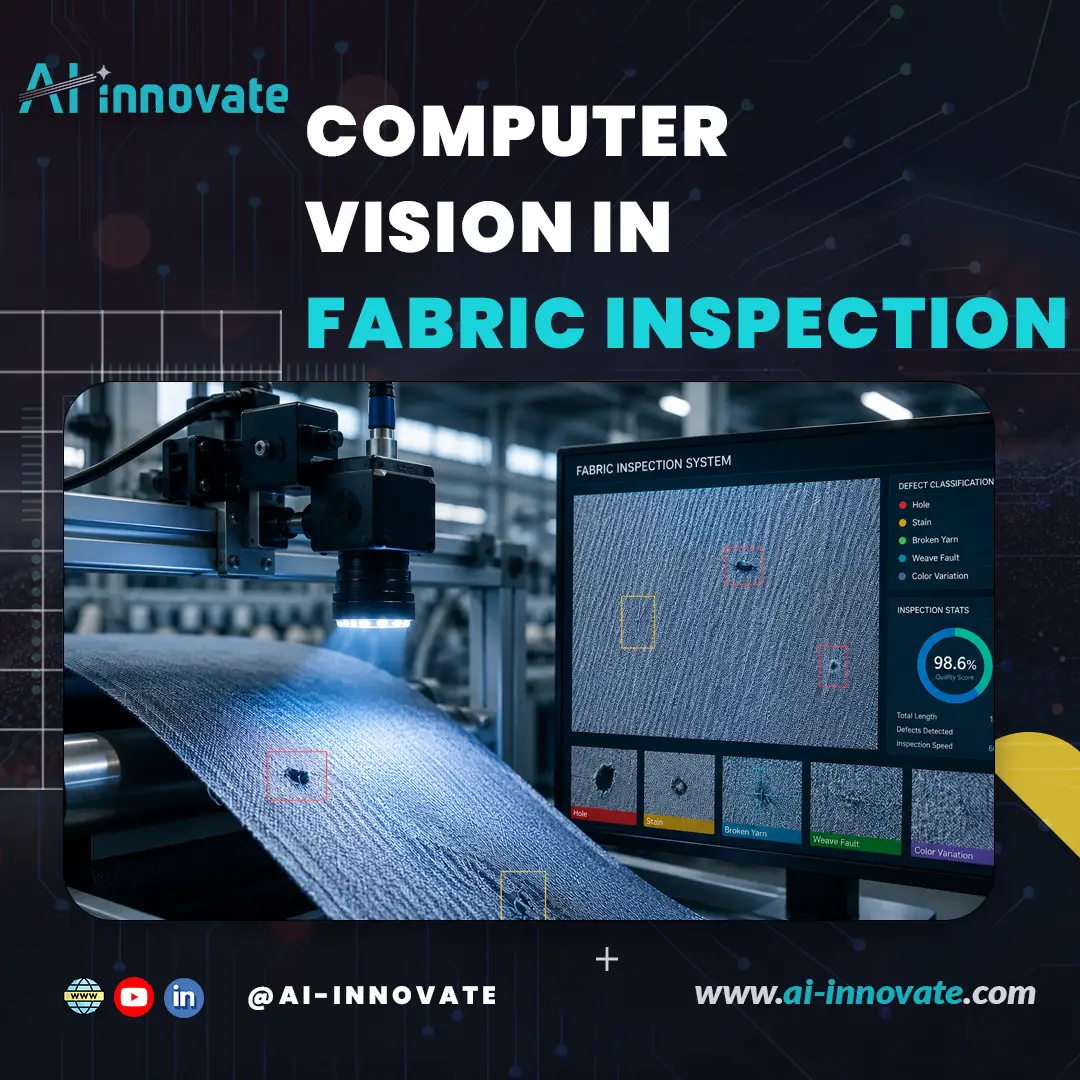
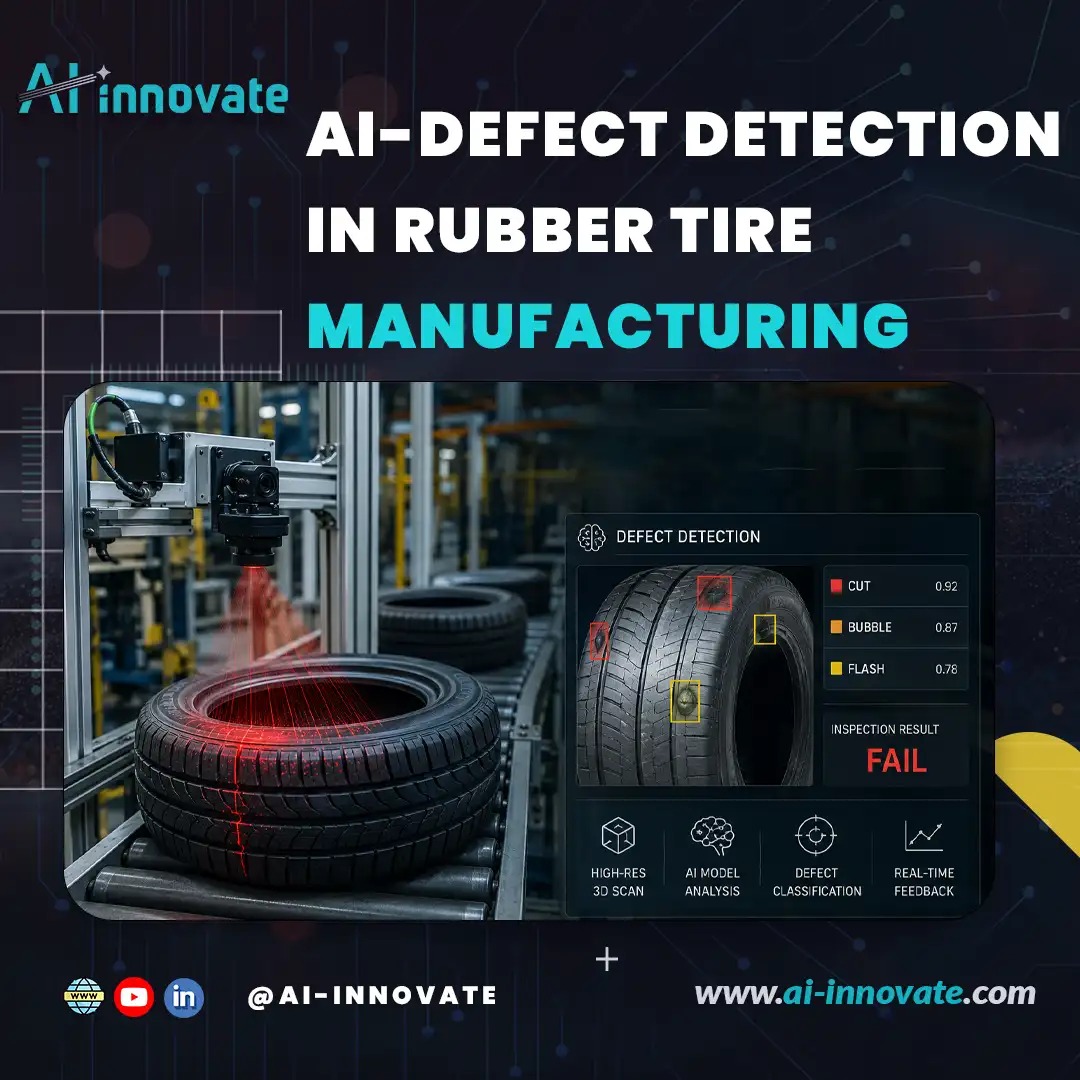
Vision-based defect detection remains one of the clearest, most measurable AI wins available to manufacturers this year. It catches issues at the point of production, before they reach assembly or ship to a customer, rather than after the cost of a defect has already compounded into rework or a warranty claim. Because it operates at a well-defined checkpoint, does this unit meet specification or not, it continues to be one of the easier AI investments to justify and measure, which is covered in more depth further in this guide.
This Topic might also interest you :
Predictive and Prescriptive Maintenance
Maintenance AI is moving past simple alerts toward systems that draft an actual response. Rather than flagging “this bearing may fail,” a prescriptive system ingests sensor data, historical repair records, and current production schedules to propose a specific maintenance window and parts list for a technician to approve. This shift from prediction to action is a meaningful jump in practical value, since a prediction nobody acts on is just another unread notification.
Data Infrastructure as a Strategic Asset
Every other trend on this list depends on this one. Advanced analytics and AI agents only deliver value when the underlying data is unified and trustworthy, which is why manufacturers are investing heavily this year in breaking down the silos between CRM, ERP, and IoT systems rather than layering more AI tools on top of fragmented data. Organizations moving fastest are treating this as foundational infrastructure work, not a side project to revisit later.
IoT and OT Convergence
Translating raw, binary sensor data from plant equipment into usable operational intelligence remains the unglamorous but essential foundation everything else depends on. Time-series data from machines only becomes valuable once it is converted into a form that analytics and AI models can actually reason about. Without that conversion layer, even the most sophisticated AI model has nothing reliable to learn from, which is why this convergence work tends to precede, not follow, more visible AI initiatives.
Workforce Transformation Through AI-Augmented Expertise
As experienced workers retire, AI is increasingly used to capture the knowledge they take with them rather than simply trying to hire replacements fast enough. This means feeding maintenance logs, shift reports, and technical manuals into systems that let a newer technician query what a retiring expert would have known instantly, compressing years of informal apprenticeship into a much shorter, AI-guided ramp-up. This trend carries enough weight on its own that it gets a fuller treatment later in this guide.
Service-Centric Business Models
Manufacturers are increasingly shifting revenue away from one-time equipment sales toward guaranteeing uptime through Equipment-as-a-Service style models, where the manufacturer retains responsibility for how well the equipment actually performs. This shift is not cosmetic: providers accelerating toward service-first models report profit margins more than twice as high as traditional hardware sales, because the model depends on continuous field data and a direct incentive to prevent failures rather than simply sell replacement parts after one occurs. That data dependency is exactly why this trend is inseparable from the data infrastructure and IoT convergence trends above.
Supply Chain Resilience Through Automation
Ongoing global trade volatility has made reactive supply chain management a genuine liability. The manufacturers responding best are building supply chains that anticipate disruption, diversifying suppliers and adjusting sourcing decisions before a shortage actually hits, rather than scrambling once it does. AI plays a growing role here because the sourcing and logistics decisions involved are often too complex and time-sensitive for manual teams to manage in real time, particularly when trade conditions shift on short notice.
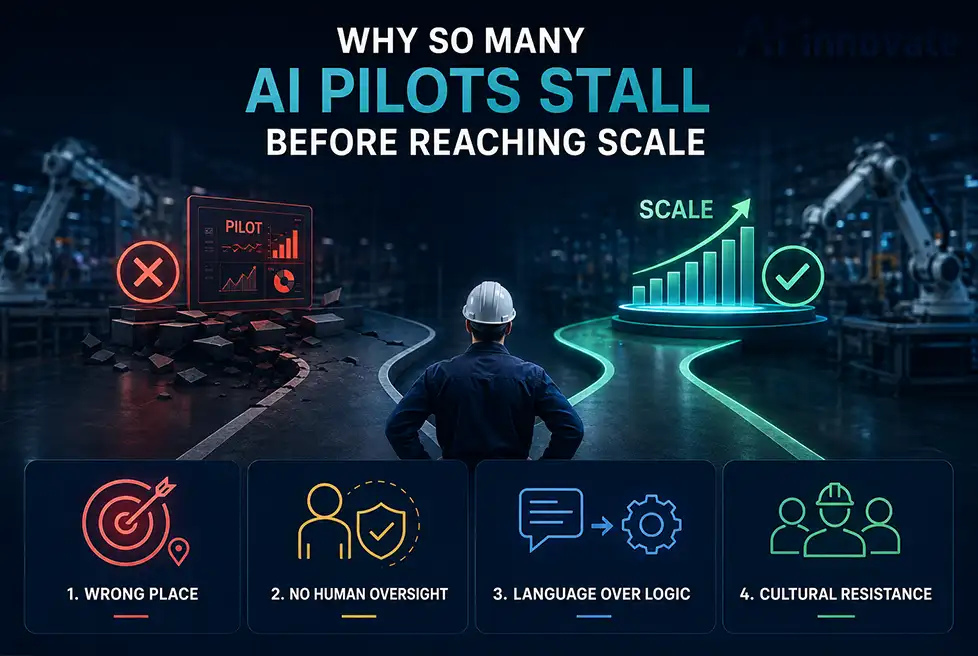
Why So Many AI Pilots Stall Before Reaching Scale
Understanding why most AI initiatives fail to scale matters as much as understanding the trends themselves, since it is the difference between a strategy that delivers results and one that generates an impressive pilot deck.
- They start in the wrong place. The organizations that scale successfully tend to start with high-value, non-production-critical processes, root cause analysis for quality issues, spare parts procurement, rather than attempting to automate core production decisions on day one.
- They skip human-in-the-loop governance. AI agents executing financial or safety-critical actions without a human validation step are exactly the kind of deployment that erodes trust the first time something goes wrong, and trust, once lost, is hard to rebuild internally.
- They optimize for language instead of logic. A chatbot that can discuss your production data is not the same as an agent that can query your systems and take action within them. Platforms built for genuine logic and system integration outperform those built primarily for conversation.
- They underestimate the cultural resistance. If frontline workers experience AI as a surveillance tool rather than a co-pilot, adoption stalls regardless of how technically sound the deployment is. This is consistently underestimated in AI rollout planning.
AI-Powered Quality Inspection: Where the ROI Is Clearest
Of every AI use case on a factory floor, vision-based quality inspection remains one of the least ambiguous in terms of return on investment, and it is a natural starting point precisely because it fits the “high-value, non-production-critical” profile that successful AI programs prioritize. Unlike agentic supply chain orchestration or autonomous scheduling, which touch core production decisions and carry real operational risk if something goes wrong, AI for quality assurance operates at a well-defined checkpoint: does this unit meet specification, yes or no. That clarity is exactly why it scales more reliably than more ambitious agentic initiatives.
This is also where AI automation in manufacturing tends to deliver its most immediate, measurable wins, catching defects before they compound into rework, warranty claims, or a recall, rather than after the cost has already been locked in. As the broader industry works through the harder problem of scaling agentic AI into core operations, quality inspection remains the department where manufacturers can point to concrete, defensible numbers today.
The Workforce Angle: AI as Co-Pilot, Not Replacement
The manufacturing workforce shortage is not a future risk. The industry faces a structural gap of nearly four million jobs as experienced workers retire and take decades of undocumented operational knowledge with them. The manufacturers responding most effectively are not trying to replace that expertise with AI outright. They are using AI to capture it, feeding maintenance logs, shift reports, and technical manuals into systems that let a newer technician query what a retiring expert would have known instantly.
The framing matters as much as the technology here. Positioning AI as the tool that removes tedious, repetitive work and preserves institutional knowledge tends to drive real adoption. Positioning it as a surveillance or replacement tool tends to kill adoption regardless of how capable the underlying system actually is, which is a cultural challenge, not a technical one, and one that gets underestimated constantly.
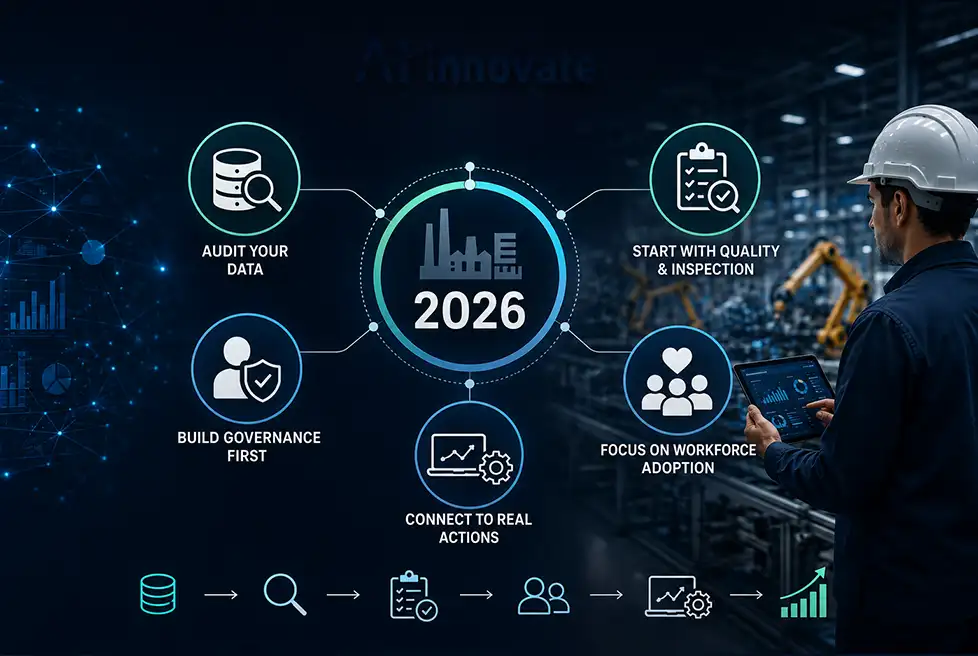
What This Means for Manufacturers Planning 2026
- Audit where your data actually lives. Most manufacturers still have production, quality, and maintenance data sitting in disconnected systems. Unifying it is unglamorous work, but it is the prerequisite for every trend on this list, not a separate initiative.
- Start with quality and inspection, not core production control. It carries lower operational risk, delivers measurable results faster, and builds the internal credibility needed to fund more ambitious smart factory solutions later.
- Build governance before you scale, not after. Human-in-the-loop review for anything safety- or finance-critical should be a design requirement from the first deployment, not a patch added after an incident.
- Treat workforce adoption as a change management problem. The best AI system in the world fails if the people running the line do not trust it, and that trust has to be earned deliberately.
- Connect predictive maintenance to real scheduling and procurement workflows. A prediction that does not trigger an action is just another dashboard nobody checks.
How AI-innovate Supports Modern Manufacturing
The biggest lesson from today’s manufacturing AI landscape is that success isn’t about adopting every new AI technology. It’s about solving the right problems first. Manufacturers that begin with measurable, lower-risk applications such as quality inspection build the data foundation, operational confidence, and internal support needed to scale AI across the business.
AI-innovate helps manufacturers accelerate that journey with purpose-built AI solutions:
- AIxEye : AI-Powered Visual Inspection Detects surface defects and quality issues in real time, reducing scrap, rework, warranty claims, and production waste while improving product consistency.
- AIxCam : Synthetic Data Generation Creates high-quality synthetic images of rare defects, enabling AI models to achieve higher accuracy without waiting months to collect enough real production data.
- AIxCore : Edge AI Processing Runs AI inspection directly on the production line for ultra-fast, low-latency decision-making without relying on constant cloud connectivity.
Together, these solutions help manufacturers improve Ai-driven quality control, increase production efficiency, and build a scalable AI foundation that supports future initiatives such as predictive maintenance, intelligent automation, and smart factory operations.
Confused About Where to Start with AI?
Our specialists help you identify the right AI approach based on your process, data, and goals.
Final Thoughts
The manufacturing AI story in 2026 is less about new capability and more about execution discipline: agentic AI, predictive maintenance, and workforce-augmenting tools are all technically available, but the manufacturers pulling ahead are the ones deploying them where risk is manageable and value is measurable, not the ones chasing the most ambitious use case first.
Quality inspection continues to be the clearest example of that discipline in practice. It is contained, well-defined, and delivers results fast enough to build the internal trust and budget needed to tackle harder, higher-risk AI initiatives later. Manufacturers who treat 2026 as the year to get that foundation right, rather than the year to chase every agentic headline, will be the ones with something real to show for it by 2027.
Frequently Asked Questions
What is the biggest benefit of AI in continuous manufacturing?
Most pilots stall because they start with production-critical processes that carry too much operational risk, lack human-in-the-loop governance for critical decisions, or focus on conversational AI capability rather than systems that can genuinely query data and take action. Cultural resistance from frontline workers who see AI as surveillance rather than support is also a major, often underestimated factor.
How much can AI actually improve efficiency in continuous manufacturing?
Reported results vary by application, but a peer-reviewed systematic review found AI-driven systems deliver an average 15 percent gain in production efficiency, while industry surveys of early adopters report around 14 percent operating-cost improvements once the system stabilizes variability and energy use.
Is AI-powered quality inspection still relevant with all the focus on agentic AI?
Yes, and arguably more relevant than ever. Quality inspection remains one of the clearest, most measurable AI use cases precisely because it is well-defined and lower-risk, making it a strong starting point that builds the credibility and data infrastructure needed for more ambitious agentic initiatives.
How is AI addressing the manufacturing workforce shortage?
Rather than replacing workers, AI is increasingly used to capture the institutional knowledge of retiring experts and deliver it to newer technicians through guided, AI-assisted workflows, compressing years of on-the-job learning into a much shorter ramp-up period.
What should manufacturers prioritize first when planning AI investments for 2026?
Data infrastructure and quality inspection are the two most commonly recommended starting points, since unified data is a prerequisite for every other AI initiative, and quality inspection delivers measurable ROI with comparatively low operational risk.
Will agentic AI actually replace human decision-making in manufacturing this year?
Not broadly in 2026. Gartner projects a significant share of current agentic AI projects will be cancelled by 2027 due to unclear value or weak governance, and most successful deployments still keep humans in the loop for safety- and finance-critical decisions rather than removing them entirely.
Sources
Ai-Innovate uses only high-quality sources, including peer-reviewed studies, to support the facts within our articles.
- Implementation. (2026). Manufacturing AI News: Top AI Trends in Manufacturing 2026. Retrieved from https://www.implementation.com/manufacturing-ai-news-top-ai-trends-in-manufacturing-2026/
- The Trask. (2026). AI Trends in Manufacturing 2026: AI Pilots Are No Longer Enough—Now Execution Decides. Retrieved from https://www.thetrask.com/blog/ai-trends-in-manufacturing-2026-ai-pilots-are-no-longer-enough-now-execution-decides
- Slalom. (2026). Manufacturing Outlook 2026. Retrieved from https://www.slalom.com/us/en/insights/manufacturing-outlook-2026
- IFS. (2026). 2026 Manufacturing Industry Trends and Predictions. Retrieved from https://blog.ifs.com/2026-manufacturing-industry-trends-and-predictions/
- Research and Markets. (2026). AI in Manufacturing Market Report. Retrieved from https://www.researchandmarkets.com/reports/5866001/ai-in-manufacturing-market-report
- BizTech Magazine. (2025). Tech Trends 2026: How AI, Data and Security Are Reshaping Manufacturing. Retrieved from https://biztechmagazine.com/article/2025/12/tech-trends-2026-how-ai-data-and-security-are-reshaping-manufacturing