




In Part 4, we focused on imaging as the foundation of machine vision systems how cameras, lenses, and lighting transform the physical world into digital images. Once this transformation is complete, the next critical question arises:
How should these images be interpreted to reliably detect defects?
Classical Image Processing vs. Learning-Based Methods
Historically, industrial inspection systems relied on classical image processing techniques to answer this question. More recently, learning-based methods have gained prominence, offering a fundamentally different way to extract meaning from visual data. This section explores both approaches, their underlying philosophies, and why industry has gradually shifted toward learning-based solutions.
Classical Vision vs AI Learning Choosing the Right Approach
Compare traditional image processing techniques with modern learning-based methods to understand their strengths, limitations, and best use cases. Learn how AI-driven vision delivers greater flexibility, accuracy, and scalability in complex inspection tasks.

Classical Image Processing: Rule-Based Visual Interpretation
Classical image processing refers to a family of techniques that rely on explicit, human-designed rules to analyze images. These methods dominated industrial vision systems for decades and remain widely used today in well-defined inspection tasks.
Core Characteristics of Classical Methods
Classical image processing typically involves:
- Thresholding and binarization
- Edge and contour detection
- Morphological operations
- Template matching
- Hand-crafted feature extraction
In these systems, engineers explicitly define what constitutes a defect by encoding visual rules into the inspection pipeline.
Strengths of Classical Image Processing
Classical methods offer several advantages that made them attractive for early machine vision systems:
- Deterministic behavior: Given the same input, the system always produces the same output
- Interpretability: Engineers can easily understand why a defect was detected
- Low data requirements: No large datasets are needed for deployment
- Computational efficiency: Suitable for real-time inspection on limited hardware
For applications with stable products, low variability, and well-defined defect characteristics, classical image processing can be highly effectiv e.
Limitations of Classical Approaches
Despite their strengths, classical methods struggle as inspection problems become more complex.
Key limitations include:
- Sensitivity to lighting and appearance variation
- Fragility under small changes in product geometry or texture
- Difficulty handling complex or ambiguous defects
- Extensive manual tuning and maintenance
In practice, rule-based systems often require frequent parameter adjustments as production conditions evolve. This makes them difficult to scale across product variants or production lines.
Learning-Based Methods: Data-Driven Visual Understanding
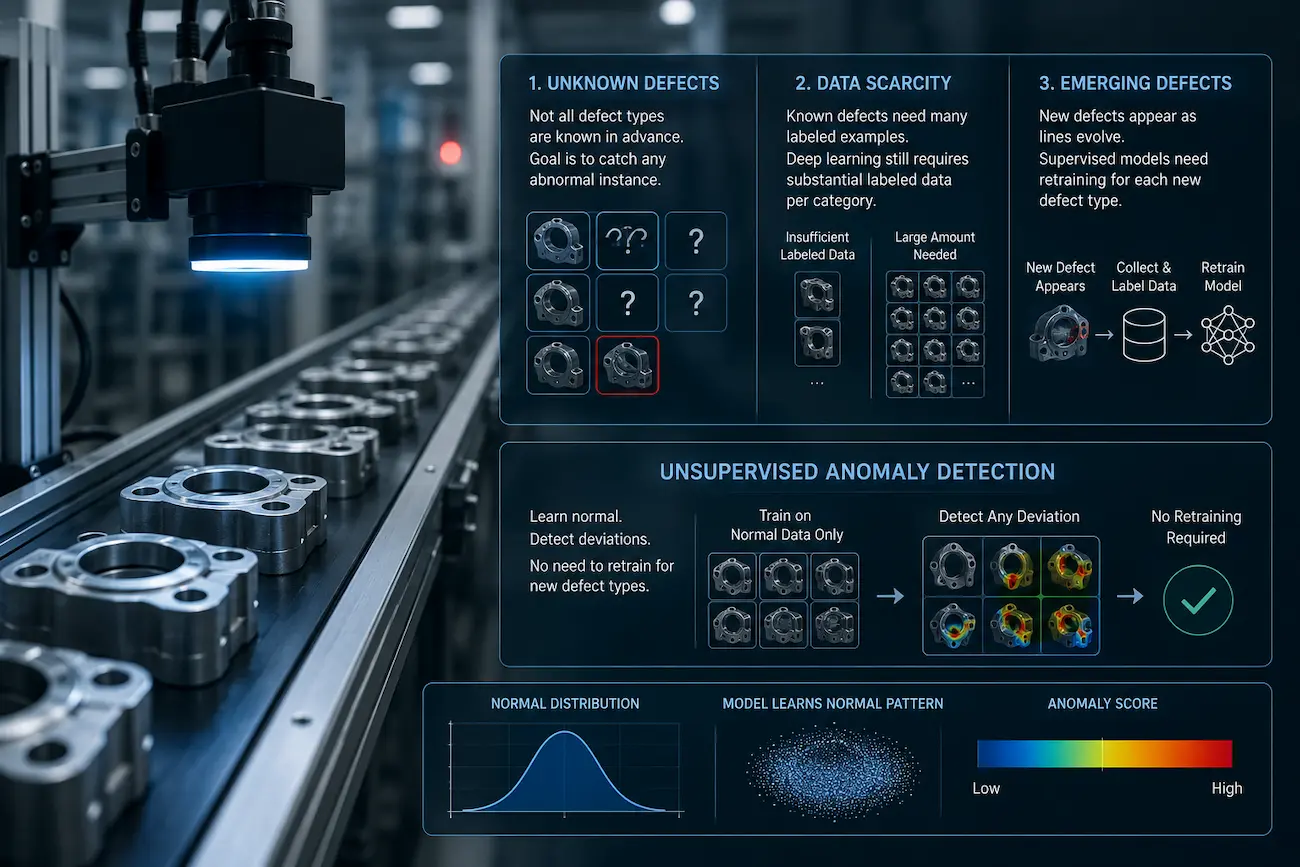
Learning-based methods take a fundamentally different approach. Instead of encoding rules manually, these systems learn patterns directly from data.
At a high level, learning-based defect detection systems:
- Use labeled or unlabeled image data
- Learn statistical representations of normal and defective appearances
- Generalize beyond explicitly programmed rules
This shift replaces manual rule design with model training, transferring much of the system complexity from engineering effort to data.
Advantages of Learning-Based Methods
Learning-based approaches address many of the structural weaknesses of classical image processing:
- Robustness to variability: Better tolerance to changes in lighting, texture, and geometry
- Reduced manual tuning: Fewer hand-crafted thresholds and parameters
- Ability to model complex defects: Effective for subtle, non-linear visual patterns
- Improved scalability: Easier adaptation to new products or defect types
These properties make learning-based methods particularly attractive in modern manufacturing environments with high product diversity.
New Challenges Introduced by Learning-Based Methods
However, learning-based approaches introduce their own challenges:
- Dependence on data quality and quantity
- Reduced interpretability compared to rule-based systems
- Need for training, validation, and monitoring pipelines
- Risk of overfitting or poor generalization
As a result, learning-based methods require a different mindset and infrastructure than classical inspection systems.
A Philosophical Difference: Rules vs. Representations
The distinction between classical and learning-based methods is not merely technical it is conceptual.
- Classical image processing answers:
“How should a defect look?”
- Learning-based methods answer:
“What patterns distinguish defects from normality?”
In classical systems, knowledge is encoded explicitly by engineers. In learning-based systems, knowledge is embedded implicitly within trained models.
This difference has profound implications for system design, maintenance, and scalability.
When Classical Methods Still Make Sense
Despite the rise of learning-based approaches, classical image processing remains valuable in certain contexts:
- Simple, well-controlled inspection tasks
- Applications requiring full explainability
- Low-volume production with limited data
- Environments with strict validation requirements
In many industrial systems, classical and learning-based methods are combined, leveraging the strengths of both.
Why Learning-Based Methods Set the Stage for Deep Learning
Learning-based inspection methods represent a stepping stone toward deep learning, but not all learning-based systems are deep learning systems.
Early learning-based approaches often relied on:
- Hand-crafted features
- Traditional machine learning classifiers
- Statistical models of appearance
While powerful, these methods still depend on human feature design. Deep learning extends this idea further by learning both features and decision logic simultaneously.
Preparing the Transition to Deep Learning
As inspection problems grow more complex, the limitations of both classical image processing and shallow learning-based methods become apparent.
This naturally raises the next question:
Can systems learn directly from raw images, without relying on hand-crafted features?
This question leads directly to deep learning-based visual defect detection, which will be the focus of the next part.
What Comes Next
In Part 6: Deep Learning for Visual Defect Detection, we will focus specifically on:
- Deep learning architectures for vision tasks
- Supervised vs. unsupervised defect detection
- The strengths and limitations of each paradigm
- How deep learning reshapes inspection system design
By understanding classical and learning-based foundations, we are now ready to explore how machines truly learn to see.
Confused About Where to Start with AI?
Our specialists help you identify the right AI approach based on your process, data, and goals.