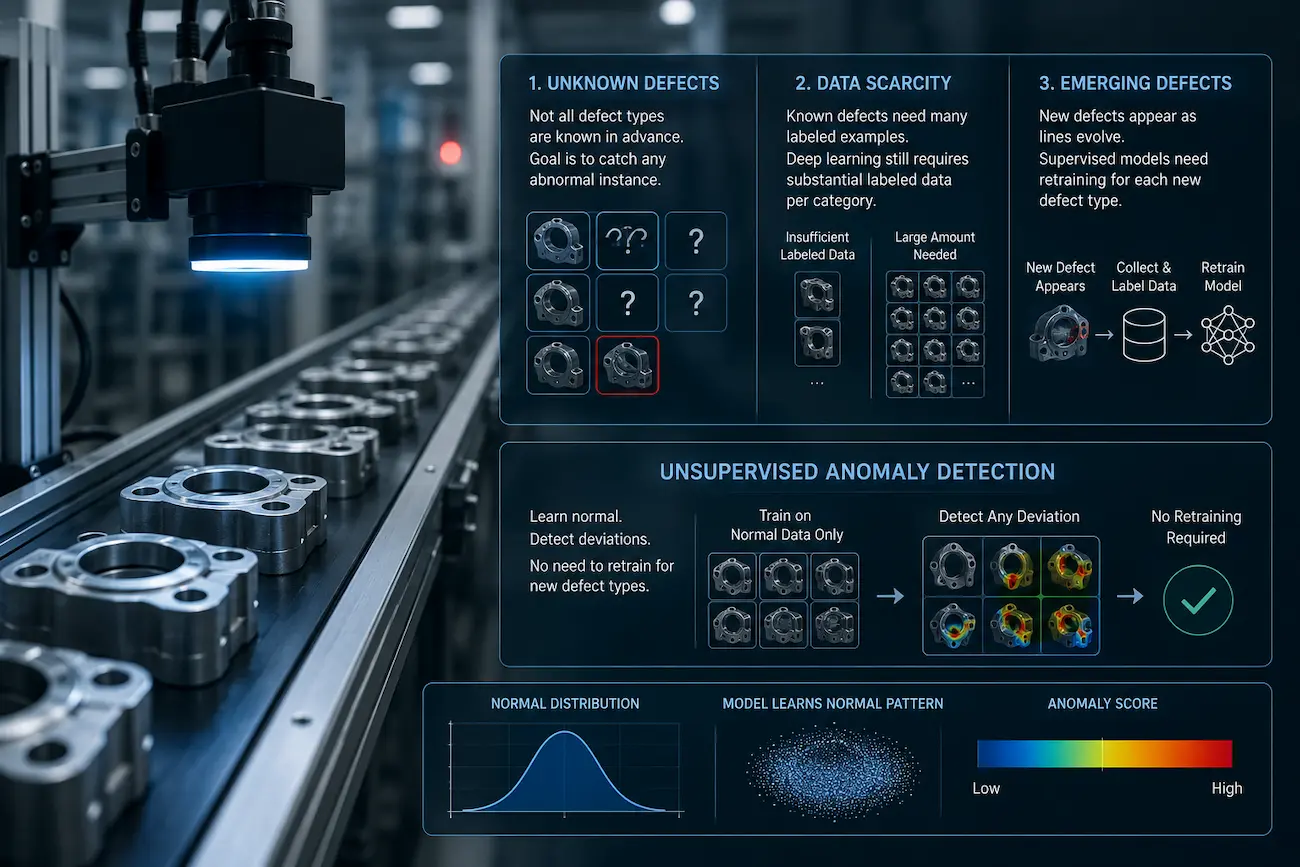





In Part 5, we compared classical image processing with learning-based methods and saw how data-driven approaches overcome many limitations of rule-based inspection. However, as industrial products become more complex and defect patterns more subtle, even traditional learning-based methods relying on hand-crafted features begin to fall short.
Deep Learning for Visual Defect Detection
This gap is where deep learning has fundamentally reshaped visual defect detection. By learning visual representations directly from raw images, deep learning enables inspection systems to detect defects that are difficult, ambiguous, or even impossible to describe explicitly with rules or engineered features.
In this section, we introduce deep learning-based defect detection, explain why it is different from earlier approaches, and outline its two main paradigms: supervised and unsupervised learning. This sets the conceptual foundation for a deeper exploration of unsupervised methods in Part 7.
Deep Learning for Visual Defect Detection. Precision at Scale.
Harness deep learning to identify complex visual defects with unmatched accuracy. Scale inspection across high-speed production lines while maintaining consistent quality, reducing false positives, and accelerating manufacturing excellence.

What Makes Deep Learning Different?
Deep learning refers to neural network models—most commonly convolutional neural networks (CNNs) that learn hierarchical representations of visual data.
Unlike classical or shallow learning approaches:
- Features are not designed by engineers
- Representations are learned automatically from data
- Complex visual patterns can be modeled end-to-end
This ability to jointly learn features and decision logic is the key reason deep learning excels at defect detection tasks involving:
- High intra-class variability
- Subtle texture changes
- Complex surface patterns
- Non-linear defect appearances
- Read Also:
Deep Learning as a Visual Representation Engine
At its core, deep learning transforms images into high-dimensional feature representations, often called embeddings.
These embeddings encode:
• Shape information
• Texture statistics
• Structural relationships
• Contextual visual cues
Defect detection then becomes a problem of identifying deviations in this learned representation space, rather than detecting defects through explicit visual rules.
This shift from rule-based reasoning to representation learning is what enables deep learning systems to generalize across variations that break traditional inspection pipelines.
This Topic might also interest you :
Supervised Deep Learning for Defect Detection
The Supervised Paradigm
In supervised deep learning, models are trained using labeled datasets, where each image (or region) is annotated as:
- Normal
- Defective
- Or belonging to a specific defect class
The model learns to directly map images to labels, making defect detection a classification or segmentation problem.
Strengths of Supervised Approaches
Supervised deep learning can achieve:
- Very high detection accuracy
- Precise defect localization
- Multi-class defect recognition
It is particularly effective when:
- Defect types are known in advance
- Large, well-annotated datasets are available
- Defect appearance is relatively stable
In such settings, supervised models often outperform all other inspection methods.
Practical Limitations of Supervised Learning
Despite their power, supervised approaches face serious challenges in industrial defect detection:
- Data annotation cost: Defect labeling requires expert knowledge and significant time
- Class imbalance: Defects are rare by nature, leading to skewed datasets
- Limited coverage: Models can only detect defect types seen during training
- Poor adaptability: New defect types require dataset expansion and retraining
In many real-world manufacturing environments, collecting sufficient labeled defect data is impractical or impossible.
Why Industry Looks Beyond Supervised Learning
The limitations of supervised learning become especially pronounced in:
- Early-stage production lines
- High-mix, low-volume manufacturing
- Processes where defects are unpredictable or evolving
In these cases, asking “Which defect class is this?” is less realistic than asking “Does this look normal?”
This shift in perspective naturally leads to unsupervised and weakly supervised approaches, where models learn primarily from normal (defect-free) data.
Unsupervised Deep Learning: Learning Normality
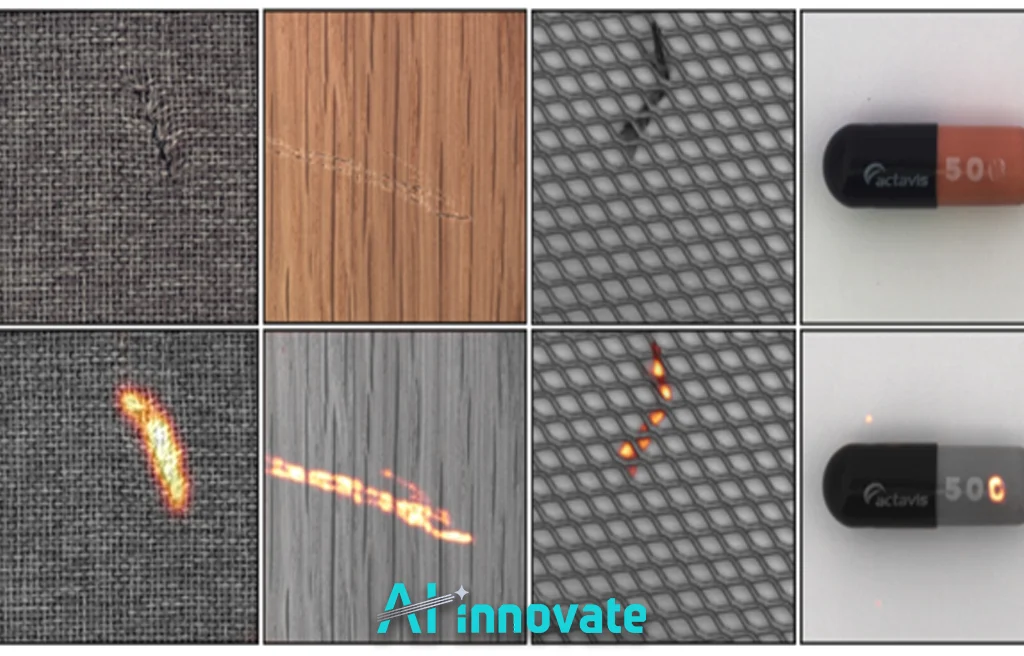
In unsupervised deep learning for defect detection, models are trained without explicit defect labels. Instead, they learn a representation of normal appearance.
Defects are then detected as:
- Poor reconstructions
- Outliers in feature space
Deviations from learned similarity patterns
This paradigm aligns naturally with industrial reality, where:
- Normal samples are abundant
- Defects are rare, diverse, and unpredictable
Why Unsupervised Methods Are a Natural Fit for Inspection
Unsupervised deep learning offers several conceptual advantages:
- No need for defect annotation
- Ability to detect previously unseen defects
- Better scalability across products and lines
Rather than enumerating defect types, these methods model the manifold of normality and flag deviations as anomalies.
However, unsupervised approaches are not monolithic. In practice, they fall into distinct methodological families, each with different assumptions and trade-offs.
Two Fundamental Perspectives on Unsupervised Defect Detection
At a high level, unsupervised deep learning methods answer one of two questions:
- Can the system accurately reconstruct what it has learned as normal?
- How similar is a new sample to known normal representations?
These perspectives give rise to two major categories:
- Reconstruction-based methods
- Embedding similarity-based methods
Each category defines “anomaly” in a fundamentally different way and exhibits different strengths in industrial settings.
Why This Distinction Matters
Although both approaches are unsupervised, they:
- Respond differently to subtle vs. structural defects
- Scale differently with image resolution and complexity
- Exhibit different failure modes
Understanding this distinction is critical for selecting the right defect detection strategy.
Bridging to the Next Section
Deep learning has transformed visual defect detection by enabling machines to learn rich representations directly from data. Within this paradigm, unsupervised learning plays a central role due to its alignment with real-world manufacturing constraints.
However, unsupervised methods themselves are not uniform. Their effectiveness depends strongly on how normality is modeled and how deviations are measured.
In Part 7, we will take a deeper dive into unsupervised defect detection by examining:
- Reconstruction-based approaches (e.g., autoencoder-driven methods)
- Embedding similarity-based approaches (e.g., feature-space comparison and nearest-neighbor methods)
By analyzing their assumptions, mechanisms, and practical behavior, we move one step closer to understanding how machines truly learn to recognize defects without being explicitly taught what defects look like.
Confused About Where to Start with AI?
Our specialists help you identify the right AI approach based on your process, data, and goals.