




In the steel manufacturing industry, surface quality is extremely important. Small defects such as scratches, cracks, pits or edge damage can quickly escalate into larger-scale quality issues if they’re not identified and addressed promptly. The challenge lies in the fact that steel production lines move quickly, so inspections must keep up without missing important issues.
Manual inspection can be difficult as it requires constant focus, and traditional vision systems don’t always perform well when lighting, textures or defect patterns change. This is why more and more manufacturers are turning to machine learning.
In this blog, we’ll go over the job of machine learning in steel defect detection, how such a system works, its benefits and challenges, and real life use cases.
Smarter Steel Inspection, Powered by Machine Learning
Detect defects early, reduce scrap, and improve quality with AI-driven precision.

What Is Steel Defect Detection Using Machine Learning?
Steel defect detection using machine learning is an automated quality inspection approach that uses AI models, computer vision, and industrial cameras to identify surface defects in steel products during manufacturing. Unlike traditional manual inspection, machine learning systems analyze images in real time, detect abnormal patterns, classify defects, and help manufacturers improve quality consistency and production efficiency.
The Main Role of Machine Learning in Steel Defect Detection
Machine learning allows steel inspection systems to perform more than just simple rule-based checks. Rather than depending solely on rules that have been defined manually, the system learns patterns from real defect examples and uses that information to examine new images.
This makes machine learning particularly useful in environments where defects vary in appearance, or where the production line creates natural visual variations that would confuse a more rigid system.
In steel defect detection, machine learning can help:
- Detect abnormal regions on the steel surface
- Classify different types of defects
- Estimate defect size or severity
- Reduce false alarms by learning from real examples
- Read Also:
Detection vs Classification vs Segmentation
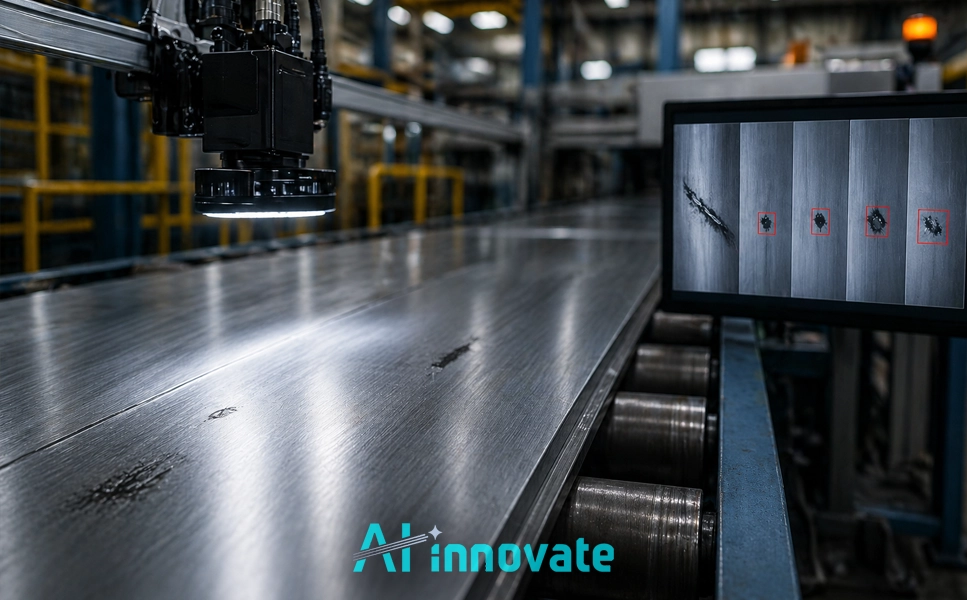
These three tasks are closely related, but they’re not the same.
- Detection means: finding where a defect is located in the image. The system identifies the region that appears abnormal.
- Classification means: deciding what kind of defect it is. For example, the system may determine whether the issue is a scratch, crack, pit, or roll mark.
- Segmentation means: outlining the exact shape and area of the defect at the pixel level. This is useful when manufacturers need more precise measurements or a more detailed understanding of the damaged area.
Types of Steel Defects Detected by Machine Learning
Machine learning-based steel inspection systems can identify different types of surface and production defects by analyzing images captured from industrial cameras. AI models trained on steel manufacturing data can recognize complex defect patterns, classify imperfections, and support real-time quality decisions. Common defects such as cracks, scratches, pits, inclusions, and surface irregularities can be detected automatically, helping steel manufacturers reduce waste, improve product consistency, and maintain higher quality standards.
| Steel Defect Type | Description | How Machine Learning Detects It | Manufacturing Impact |
|---|---|---|---|
| Surface Cracks | Small fractures or breaks on steel surfaces caused by stress, cooling problems, or processing conditions. | Deep learning models analyze surface images to identify irregular lines, patterns, and crack formations. | Helps prevent structural failures and improves steel reliability. |
| Scratches and Scoring | Linear marks caused by handling equipment, rolling processes, or contact with machinery. | Computer vision models detect abnormal surface textures and classify defect severity. | Reduces cosmetic defects and unnecessary material rejection. |
| Pits and Holes | Small cavities or missing material areas caused by corrosion, contamination, or production issues. | AI segmentation models identify defect location, shape, and size from inspection images. | Improves surface quality and prevents defective steel from reaching customers. |
| Roll Marks | Repeating surface patterns created by damaged or contaminated rolling equipment. | Machine learning recognizes repeated defect patterns and connects them with production conditions. | Allows early identification of equipment-related quality problems. |
| Inclusions | Foreign materials or non-metallic particles trapped within or on the steel surface. | AI anomaly detection identifies unusual surface characteristics compared with normal products. | Improves material consistency and reduces downstream failures. |
| Surface Contamination | Oil, dirt, oxidation, scale, or other unwanted materials affecting steel quality. | Vision models classify contamination patterns using trained image datasets. | Supports better finishing quality and fewer production interruptions. |
| Edge Defects | Damage, deformation, or irregular edges found on steel sheets, plates, or coils. | AI inspection analyzes edge regions using image recognition algorithms. | Reduces trimming waste and improves final product quality. |
How an ML-Based Steel Inspection System Works
The first step is to capture images of the steel surface using industrial cameras positioned along the line. Lighting is also important because it affects how clearly surface features appear.
Next, pre-processing may be used to enhance contrast, eliminate noise or prepare the images for the model. The machine learning model then analyses the images and looks for patterns linked to known defects.
Once a defect is detected, the system can identify its location, classify its type and sometimes estimate its size or severity. This information can then inform automatic pass-fail decisions, operator review or further quality control measures.
The process often includes:
- Image capture with industrial cameras
- Pre-processing to improve image quality
- Model inference using a trained ML system
- Defect localization and classification
- Pass-fail or quality decisions based on inspection results
Data and Model Training
The performance of an ML inspection system depends heavily on the quality of the training data. The model requires labelled images of normal steel surfaces and examples of real defects.
This training data should cover a wide range of defect types, surface conditions, lighting situations and production scenarios. The more diverse the data, the better the model can handle real-world conditions.
Manufacturers often use augmentation, which involves making slight changes to training images to create more variation. This can help the model become more robust.
Retraining is also important over time. As production conditions change or new types of defects emerge, the model may require updating to ensure continued optimal performance.
Benefits of Machine Learning for Steel Manufacturers
Machine learning offers several practical benefits to steel manufacturers, particularly when inspections need to be carried out quickly and consistently.
This matters because steel production involves large volumes, tight deadlines, and strict quality standards. An accurate inspection process can improve yield, reduce waste and enable teams to respond more quickly to problems.
Machine learning can also support better traceability by creating more detailed inspection records. Over time, this can enable manufacturers to connect defect patterns to issues in the upstream process and improve the production line itself.
Some of the main benefits include:
- Faster inspection at production speed
- More consistent quality control
- Fewer missed defects
- Lower scrap and rework
- Better traceability and process improvement
Challenges in Real-World Deployment
Even though machine learning offers strong advantages, deployment in real steel plants still comes with challenges.
Some of the most common challenges include:
- Imbalanced datasets, where some defect types have far fewer examples than others
- Changing lighting and surface textures
- Rare defects that are difficult to train on
- Integration with plant systems and inspection workflows
- The need for retraining as conditions change over time
These issues are important because real production environments aren’t perfectly controlled. Steel surfaces can vary from one production batch to the next, and some defects may be so rare that it’s difficult to collect enough examples for training purposes.
There are also practical considerations regarding integration. The inspection system must work with existing cameras, line speeds, plant software and quality processes.
Use Cases for ML-Based Steel Defect Detection
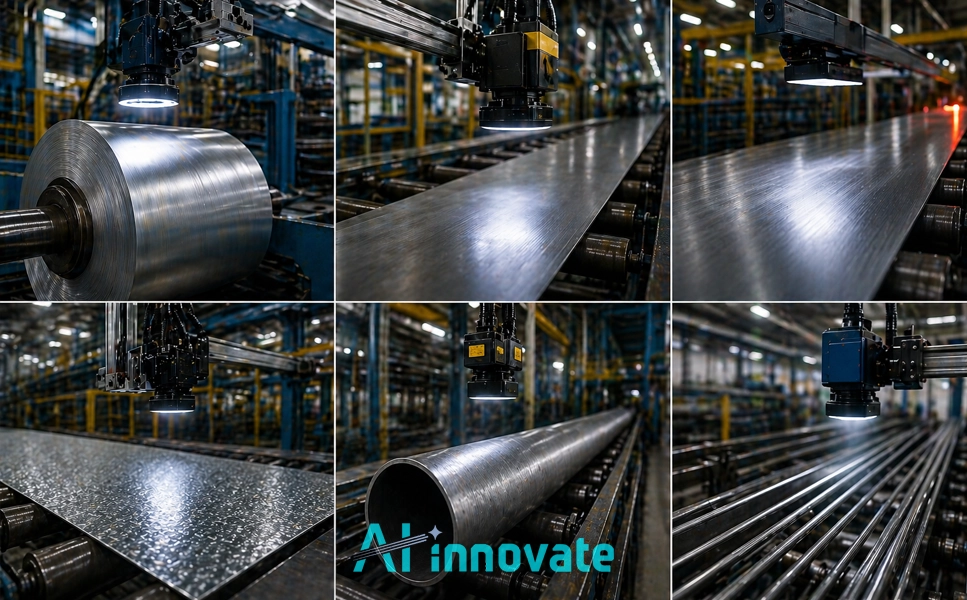
Machine learning can be used in a variety of steel production and inspection settings. Each of these environments presents different inspection challenges. For example, hot-rolled steel may have rougher surfaces and scale-related variation. Cold-rolled products often require closer visual inspection. Galvanised steel can present additional surface complexity due to the appearance of the coating.
Machine learning is valuable in these settings because it can adapt more easily to different materials, finishes and production conditions than traditional fixed-rule systems.
Common use cases include:
- Hot-rolled steel inspection
- Cold-rolled steel inspection
- Galvanized steel inspection
- Strip and coil inspection
- Inline quality monitoring
The Future of Steel Surface Inspection
Steel surface inspection is moving towards faster, smarter and more connected systems. Machine learning is already playing a significant part in this change, and future systems are likely to become even more capable.
Edge AI is one important development, where models run close to the production line to enable faster, real-time decision-making. This can reduce delays and make in-line inspection more practical.
The use of real-time analytics and feedback loops is another trend. Rather than merely identifying defects, future systems may also assist production teams in responding immediately by adjusting process settings or flagging upstream causes.
This is closely connected to broader Industry 4.0 goals, where inspection systems form part of a larger digital manufacturing environment.
Turn Steel Defect Detection into Measurable Quality and Throughput Gains
Machine learning for steel inspection only creates value when it is deployed with the right imaging setup, data strategy, and real-time production integration. Moving from manual inspection or rigid rule-based systems to reliable inline detection requires robust vision pipelines, scalable edge processing, and models that can identify defects accurately under real plant conditions.
At AI-innovate, we help steel manufacturers bridge the gap between machine learning capability and production-floor execution by providing:
- Intelligent visual inspection with AIxEye, enabling real-time detection, classification, and analysis of steel surface defects such as scratches, cracks, pits, edge damage, and other abnormal regions
- Edge AI infrastructure with AIxCore (powered by NVIDIA Jetson Orin AGX) for high-speed image processing, inline defect detection, and on-site inference directly where inspection decisions need to happen
- Synthetic data capabilities through AIxCam, helping teams strengthen defect detection models when rare defect examples, imbalanced datasets, or changing surface conditions make training more difficult
Whether you’re improving inspection on a single steel line or scaling surface defect detection across multiple products and production stages, the key is combining reliable image capture, explainable AI models, and industrial-grade deployment built for real manufacturing environments.
Conclusion
Machine learning is transforming steel defect detection, allowing manufacturers to inspect surfaces more quickly and consistently than with manual inspection alone. Machine learning can detect abnormal regions, classify defect types, estimate severity and reduce false alarms by learning from real-life examples.
For steel manufacturers, this means improved quality control, reduced scrap and greater production insight. Although there are still challenges to overcome in terms of real-world deployment, machine learning is becoming an increasingly practical tool for steel surface inspection.
I believe as factories continue to adopt smarter manufacturing practices, ML-based steel defect detection is likely to become an even more integral component of modern quality control.
Sources
Ai-Innovate uses only high-quality sources, including peer-reviewed studies, to support the facts within our articles.
1. International Journal of Enhanced Research in Management & Computer Applications. (2024). Steel Defect Detection using Machine Learning — A journal article focused on machine learning methods for identifying and classifying steel surface defects, with discussion of preprocessing, feature extraction, and defect classification techniques. Retrieved from https://www.erpublications.com/uploaded_files/download/g-arunalatha_jidXX.pdf
2. PubMed Central. (2021). A New Steel Defect Detection Algorithm Based on Deep Learning — A research article examining a deep learning-based approach to steel surface defect detection, with emphasis on improving accuracy and automation in industrial inspection. Retrieved from https://pmc.ncbi.nlm.nih.gov/articles/PMC8007367/
3. IEEE Xplore. (2024). Steel Surface Defect Detection Using Machine Learning Techniques — A conference publication on applying machine learning techniques to steel surface inspection and defect detection in manufacturing environments. Retrieved from https://ieeexplore.ieee.org/document/10698084
FAQ
Which algorithm is better: YOLO or Faster R-CNN?
YOLO (You Only Look Once) is preferred for real-time detection because it processes images in a single pass, often reaching speeds above 45 FPS.
Faster R-CNN is a “two-stage” detector that typically offers higher precision, especially for small or complex defects, but is generally slower and more computationally expensive.
How do you handle "rare" defects with no data?
Engineers use Data Augmentation (rotating, scaling, or blurring existing images) or Synthetic Defect Generation (SDG) using GANs to create artificial examples of rare flaws for the model to learn
What are the biggest technical hurdles of ML in steel defect detection?
- Intra-class Diversity: Defects in the same category can look very different in shape and size.
- Inter-class Similarity: Different types of defects (like scratches vs. crazing) may share similar visual features, leading to misclassification.
- Environmental Noise: Reflections, uneven lighting, and surface dust can be mistaken for actual defects.
How does machine learning detect defects in steel products?
Machine learning detects steel defects by analyzing images captured from industrial cameras and identifying patterns associated with defects such as cracks, scratches, pits, and surface irregularities. AI models are trained using examples of defective and acceptable steel products, allowing the system to classify defects and support real-time quality inspection during manufacturing.
What types of steel defects can machine learning identify?
Machine learning can identify various steel defects, including surface cracks, scratches, pits, holes, inclusions, roll marks, corrosion, contamination, and edge defects. The detection capability depends on factors such as image quality, camera configuration, training data, and the AI model used for inspection.
Why is machine learning better than traditional steel inspection methods?
Machine learning improves steel inspection by enabling continuous automated analysis instead of relying only on manual checks or fixed inspection rules. AI systems can detect complex defect patterns, reduce human inspection variability, analyze every product on the production line, and provide data-driven insights for improving manufacturing quality.
Can AI detect steel surface defects in real time during production?
Yes, AI-based steel inspection systems can detect surface defects in real time by processing images from high-speed industrial cameras while steel products move through production lines. This allows manufacturers to identify quality issues immediately and take corrective actions before defective materials continue through the manufacturing process.
What cameras are used for machine learning-based steel inspection?
Steel defect detection systems commonly use industrial cameras such as line-scan cameras and high-resolution area-scan cameras combined with controlled lighting systems. The camera selection depends on factors such as steel product speed, surface characteristics, defect size, and inspection accuracy requirements.