




A defect in a roll of fabric can cut its market price by 45 to 64 percent. Traditional visual inspection, the industry’s default method for decades, catches only about 75 percent of defects even under ideal conditions, and that number falls further as inspector fatigue sets in over a shift. Fabric is one of the hardest materials computer vision has to inspect: it moves continuously, its texture varies naturally even when defect-free, and the same flaw can look completely different depending on fabric color, weave, and lighting angle.
This is not a theoretical problem. The textile industry generates close to 7 million tonnes of waste annually across the EU alone, a meaningful share of it tied directly to defects that went undetected until it was too late to prevent the loss. Computer vision has become the industry’s answer, but getting it right requires understanding a genuinely technical stack: camera technology, image processing, and detection algorithms, each with real trade-offs that determine whether a system actually catches what matters on a real production line.
This guide covers the camera technologies used in fabric inspection, the processing pipeline that turns raw images into defect decisions, how classical and deep learning approaches compare, and what a real industrial deployment actually looks like.
Why Fabric Is a Uniquely Hard Computer Vision Target
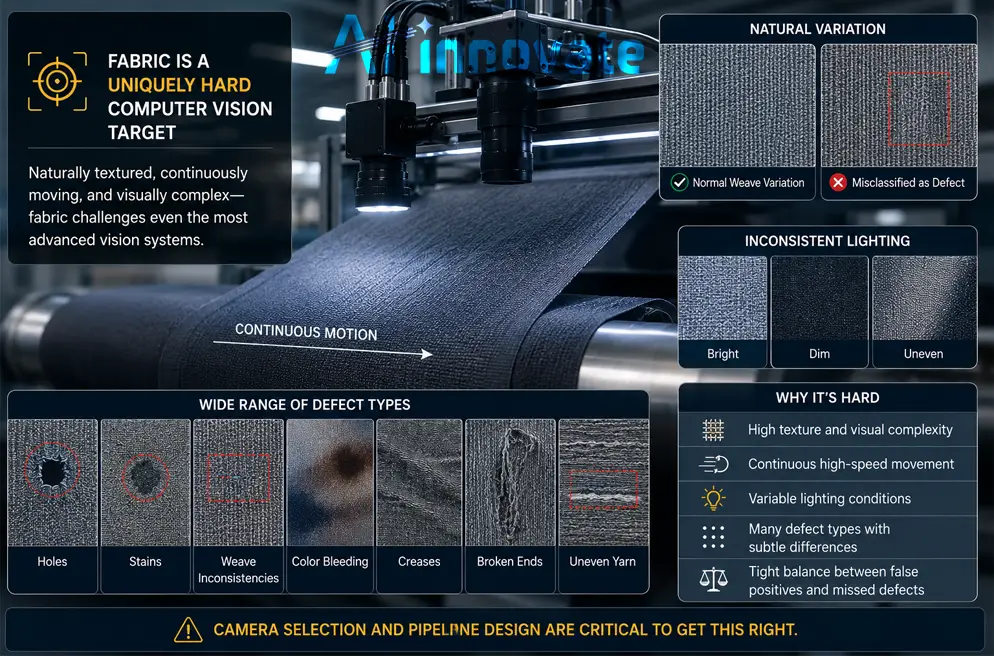
Unlike a flat metal panel or a rigid manufactured part, fabric is a continuously moving, naturally textured material with meaningful color and weave variation even within a single defect-free roll. A system tuned too tightly to one fabric’s texture will flag normal variation as a defect.
A system tuned too loosely will miss the real thing. Add continuous motion, inconsistent factory lighting, and the sheer variety of defect types, holes, stains, weave inconsistencies, color bleeding, creases, and the inspection challenge compounds quickly. This is exactly why camera selection and processing pipeline design matter so much more in fabric inspection than in many other industrial vision applications.
Choosing the Right Camera Technology
Different camera technologies are suited to different defect types, and the choice shapes everything downstream in the machine vision for defect detection pipeline.
Area-Scan Cameras
Area-scan cameras capture two-dimensional images similar to a standard photographic camera, making them effective and low-cost for static or slow-moving inspection, identifying stains, lines, pattern inconsistencies, and loose threads. Their limitation is field of view and throughput, which makes them less suited to high-speed continuous production.
Line-Scan Cameras
Line-scan cameras capture one line of pixels at a time, making them particularly suited to surfaces in continuous motion. They offer high spatial resolution and are ideal for fast-moving fabric rolls, detecting broken threads, transverse lines, and fine stains, though they require precise synchronization with fabric movement and consistent, uniform lighting to avoid distortion or missed defects.
Multispectral Cameras
Multispectral cameras capture images across multiple light bands, including infrared and ultraviolet alongside standard RGB, revealing chemical stains and yarn inconsistencies that evade RGB-only methods. This makes them valuable for defects invisible to the human eye, though at the cost of higher computational overhead and stricter lighting control requirements.
RGB-D (Depth) Cameras
RGB-D cameras capture standard color images alongside depth maps, enabling detection of three-dimensional defects like wrinkles, folds, and creases. Depth data helps distinguish real defects from shadows, a genuine advantage, though precision generally runs lower than dedicated industrial imaging systems, and performance declines on reflective or very smooth surfaces like silk or satin.
Thermal Cameras
Thermal cameras detect heat emissions, making them suited to identifying defects invisible to standard imaging, such as yarn density variation. Their sensitivity to ambient temperature changes means they require controlled environmental conditions to avoid false positives from thermal noise.
From Pixels to Decisions: The Core Processing Pipeline
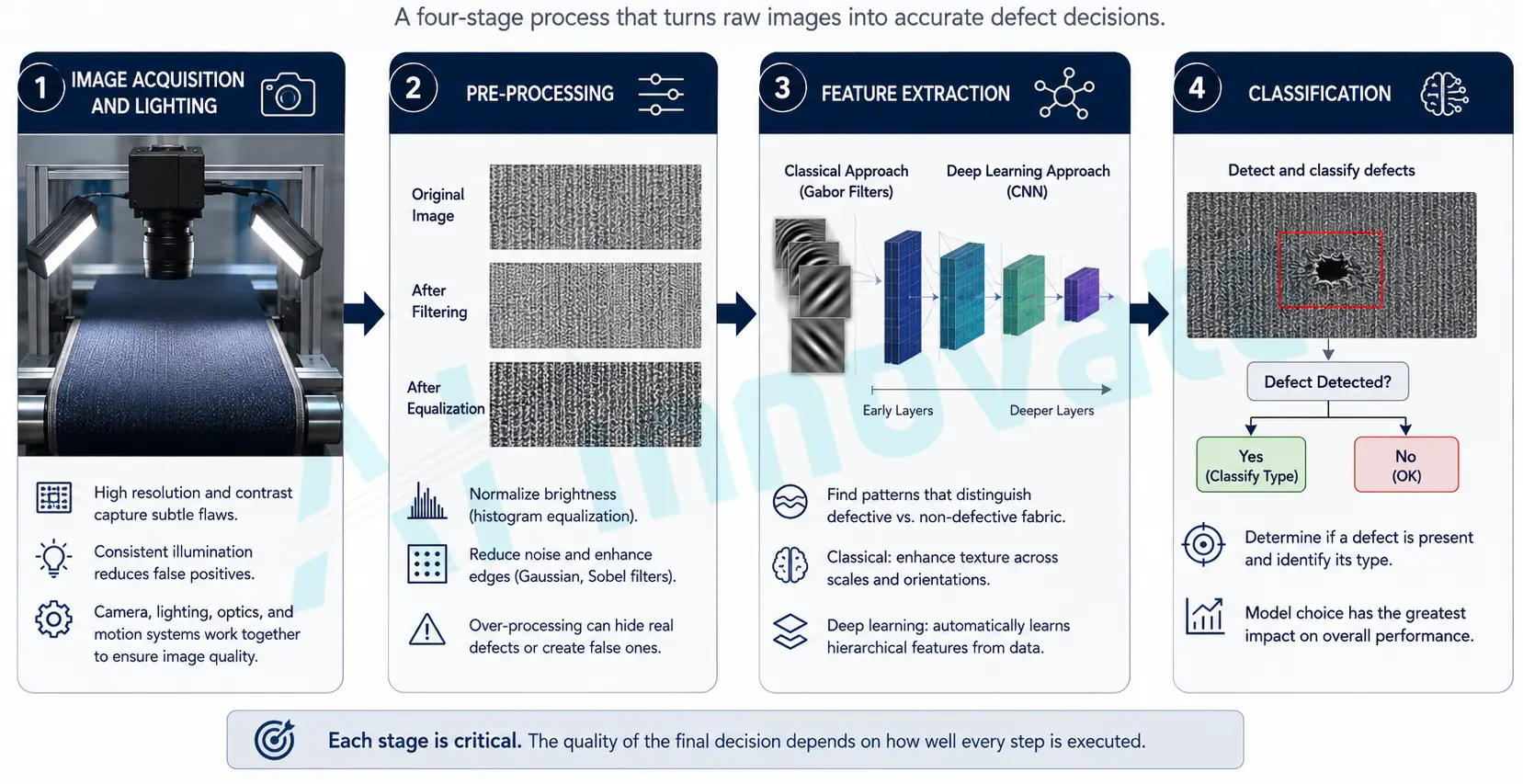
Regardless of camera choice, automated fabric inspection systems follow a consistent four-stage pipeline, each stage shaping how reliably the final defect decision holds up.
Image Acquisition and Lighting
The acquisition stage requires high image resolution, contrast, and consistent illumination to catch even subtle flaws. Beyond the camera itself, lighting, optics, and mechanical motion systems all factor into image quality, and poor lighting is one of the most common sources of false positives in real deployments, since shadows and inconsistent texture appearance can easily be mistaken for defects.
Pre-Processing
Pre-processing improves image quality and consistency before analysis, using techniques like histogram equalization to normalize brightness and Gaussian or Sobel filtering to reduce noise and highlight edges, the same fundamentals behind surface defect detection across other materials.
This step has to be calibrated carefully: applied in excess, it can obscure genuine defects or introduce false ones, and grayscale conversion in particular can strip the color information needed to detect chromatic defects like discoloration.
Feature Extraction
Feature extraction identifies the patterns that distinguish defective from non-defective fabric. Classical approaches like Gabor filters enhance texture patterns across scales and orientations, while modern deep learning models learn optimal filters directly from labeled data, with early network layers detecting basic edges and textures and deeper layers combining them into abstract representations of structural anomalies.
Classification
The final stage determines whether a defect is present and identifies its type. This is where the choice between classical machine learning and deep learning object detection has the largest practical impact on system performance, covered in detail below.
Classical vs. Deep Learning for Fabric Inspection
Traditional machine learning can work well in controlled inspection environments, but deep learning is better suited to the variation and speed of modern textile production.
| Parameter | Classical Machine Learning | Deep Learning |
|---|---|---|
| Feature Extraction | Hand-engineered features | Features learned automatically |
| Typical Models | SVM, KNN | YOLO, Faster R-CNN |
| Fabric Variation | More sensitive to texture and lighting changes | Better at handling complex visual variation |
| Defect Detection | Works well with predefined patterns | Learns complex defect characteristics |
| Accuracy | KNN example: 95.48% | YOLOv8: 0.756 mAP |
| Processing Speed | Depends heavily on feature processing |
YOLOv5: 118 FPS YOLOv8: 103.5 FPS |
| Scalability | More difficult to adapt to new defect types | Easier to retrain for new defects |
| Production Use | Best for controlled applications | Better suited to real-time automated inspection |
The Practical Difference
- Classical methods: Effective when defects are predictable and the inspection environment is highly controlled.
- Deep learning: Better suited to production lines where fabric texture, defect appearance, lighting, and operating conditions can vary.
For modern automated fabric inspection, the key advantage of deep learning is not simply higher accuracy. It is the ability to learn complex visual patterns while maintaining the speed required for real-time inspection.
A Real-World Fabric Inspection Deployment
Computer vision has also been tested under actual textile production conditions, not just in laboratory experiments. In one Portuguese textile manufacturing line, researchers deployed YOLOv11n on an NVIDIA Jetson Orin Nano with two Intel RealSense RGB-D cameras positioned about one meter from the fabric.
The system inspected cotton and linen fabric moving at 15 meters per minute, looking for holes, color bleeding, and creases. It processed the camera feeds at approximately 100 frames per second and achieved a mean Average Precision (mAP) above 82%, demonstrating that edge-based AI can support real-time inspection at production speed
What the Results Reveal
The system didn’t perform equally well on every defect. Hole detection reached 87% precision, while color bleeding reached 62% precision.
The difference came largely from the imaging technology. RGB-D cameras are particularly effective at capturing depth and physical surface changes, which gives the system an advantage when detecting structural defects such as holes and creases. Color bleeding, however, depends more heavily on accurate color information.
This example highlights an important principle in automated fabric inspection: the camera and the AI model need to be selected together. Even a highly capable detection model cannot reliably identify a defect if the imaging system doesn’t capture the visual characteristics that distinguish it.
Best Practices for Deploying Computer Vision on a Fabric Line
- Match camera technology to your primary defect types. A system built around RGB-D sensors will underperform on chromatic defects like color bleeding regardless of how well the detection model is trained.
- Invest in consistent, controlled lighting before optimizing the model. Published deployments consistently identify poor lighting as the leading cause of false positives, more so than model architecture choice.
- Avoid preprocessing that strips information your defects depend on. Grayscale conversion, for instance, improves contrast for structural defects but destroys the color data chromatic defect detection needs.
- Choose deep learning object detection over classical classifiers for production deployment. Classical methods can match or exceed deep learning accuracy in narrow, controlled tests, but they scale poorly to the variability of a real factory floor.
- Deploy at the edge for real-time response. Cloud-based processing introduces latency and connectivity risk that time-sensitive real-time defect analysis, where even minor delays mean undetected defects, generally cannot tolerate.
How AI-Innovate Powers Computer Vision Fabric Inspection
Fabric inspection is a genuinely difficult computer vision problem: continuous motion, natural texture variation, and defect types that span structural, chromatic, and depth-based categories all at once. Solving it well requires more than a single camera and a generic model.
AIxEye: Detection Tuned to Fabric-Specific Defects
AIxEye performs the real-time visual inspection at the core of fabric quality control, trained to recognize the specific defect signatures, holes, color bleeding, creases, weave inconsistencies, that matter on a given production line, rather than relying on a single generic detection profile that treats every material the same way.Lorem ipsum dolor sit amet, consectetur adipiscing elit. Ut elit tellus, luctus nec ullamcorper mattis, pulvinar dapibus leo.
AIxAm: Closing the Data Gap for Rare Defects
AIxAm addresses a challenge fabric inspection shares with nearly every industrial vision application: some defect types occur too rarely in normal production to build a large real-world training set. Generating synthetic training examples for these rarer cases closes that gap without waiting months to accumulate enough real-world defect images.
AIxCore: Real-Time Processing at Production Speed
AIxCore handles the on-site inference that keeps inspection running at the pace fabric actually moves through production, without the latency a cloud round-trip would introduce on a continuously moving material where every second of delay is more fabric that has already passed the inspection point.
Final Thoughts
Computer vision in fabric inspection is a genuinely technical discipline, camera technology, image processing, and detection algorithm choice all shape what a system can reliably catch, and getting any one of them wrong quietly limits the whole pipeline regardless of how good the rest of the system is.
The deployments delivering real results are not the ones chasing the single most advanced model available. They are the ones that start by understanding which defect types matter most on their specific line, choose camera technology that can actually see those defects, and build the processing pipeline around that choice rather than forcing one generic setup to handle everything. In an industry where a single undetected defect can cut a fabric’s value by half, that kind of deliberate, defect-specific engineering is where the real return sits.
Frequently Asked Questions
What type of camera is best for fabric defect detection?
There is no single best camera; the right choice depends on the defect types that matter most. Line-scan cameras suit high-speed continuous fabric, RGB-D cameras excel at structural defects like creases and holes, and multispectral cameras are needed for chemical or color-based anomalies that RGB imaging alone cannot detect.
How accurate is computer vision compared to manual fabric inspection?
Manual visual inspection typically catches around 75 percent of defects and declines further with inspector fatigue. Published deep learning systems have reported mean Average Precision figures above 82 percent in real industrial deployments, with individual defect types like holes reaching accuracy above 87 percent.
Why do some fabric defects get detected more reliably than others?
Detection reliability depends heavily on whether the chosen camera technology is suited to that defect type. A system built around depth-sensing cameras, for example, typically performs better on structural defects like holes and creases than on color-based defects like bleeding, which depend on chromatic information the camera may not capture as strongly.
Can computer vision handle patterned or textured fabrics as well as solid colors?
Most published research and real deployments focus on solid-colored, patternless fabric, since pattern and texture introduce additional visual complexity that current models generalize to less reliably. Extending detection to patterned fabrics remains an active area of development.
Does fabric inspection require cloud computing or can it run locally?
Real-time fabric inspection is generally better suited to local edge processing rather than cloud computing, since even minor latency can mean a defect passes the inspection point undetected. Published deployments using edge devices have achieved real-time processing at production speeds without cloud dependency.
What is the biggest factor limiting computer vision accuracy in fabric inspection?
Camera and lighting choice consistently outweigh model architecture as the limiting factor. A well-optimized detection model still cannot reliably catch a defect type the camera technology was never suited to seeing in the first place, which is why camera selection should come before model selection in any deployment plan.
Sources
Ai-Innovate uses only high-quality sources, including peer-reviewed studies, to support the facts within our articles.
- Senarathne, R., & Thennakoon, R. (2024). Fabric Inspection Using Computer Vision. Research Square. https://doi.org/10.21203/rs.3.rs-5498346/v1
- Machado, R., Barros, L. A. M., Vieira, V., Silva, F. D. da, Costa, H., & Carvalho, V. (2025). Textile Defect Detection Using Artificial Intelligence and Computer Vision: A Preliminary Deep Learning Approach. Electronics, 14(18), 3692. https://doi.org/10.3390/electronics14183692
- Rasheed, A., Zafar, B., Rasheed, A., Ali, N., Sajid, M., Dar, S. H., Habib, U., Shehryar, T., & Mahmood, M. T. (2020). Fabric Defect Detection Using Computer Vision Techniques: A Comprehensive Review. Mathematical Problems in Engineering, 2020, 8189403. https://doi.org/10.1155/2020/8189403
- OPAST Publishers. (2024). Fabric Inspection Using Computer Vision.
https://www.opastpublishers.com/open-access-articles/fabric-inspection-using-computer-vision-8691.html - VA Imaging. (2025). Fabric Defect Detection with Machine Vision Cameras.
https://va-imaging.com/en-us/blogs/machine-vision-solutions-applications/fabric-defect-detection-with-machine-vision-cameras - WarpDriven. (2025). The Future of Computer Vision in Fabric Inspection.
https://warpdriven.ai/en/blog/industry-1/computer-vision-in-fabric-inspection-and-detection-254