To evaluate false rejects in textile AI inspection, measure them together with missed defects on an independent set of good, defective and borderline fabric. The quality team labels that set against agreed acceptance criteria, and the results are broken down by fabric, pattern, color and batch. Before you change a threshold or replace the system, find out whether the rejects come from the images, from variation the system was never shown, or from the decision limit itself.
False rejects in fabric defect inspection are good fabric that the system flags, stops or rejects as defective. Reducing them on their own is the wrong target, because the same change can let real defects pass. With the approach below, you can tell a real false-reject problem from an acceptable trade-off, decide what to change first, and define what a pilot has to prove before production approval.

What Is a False Reject, and What Is the Opposite Error?
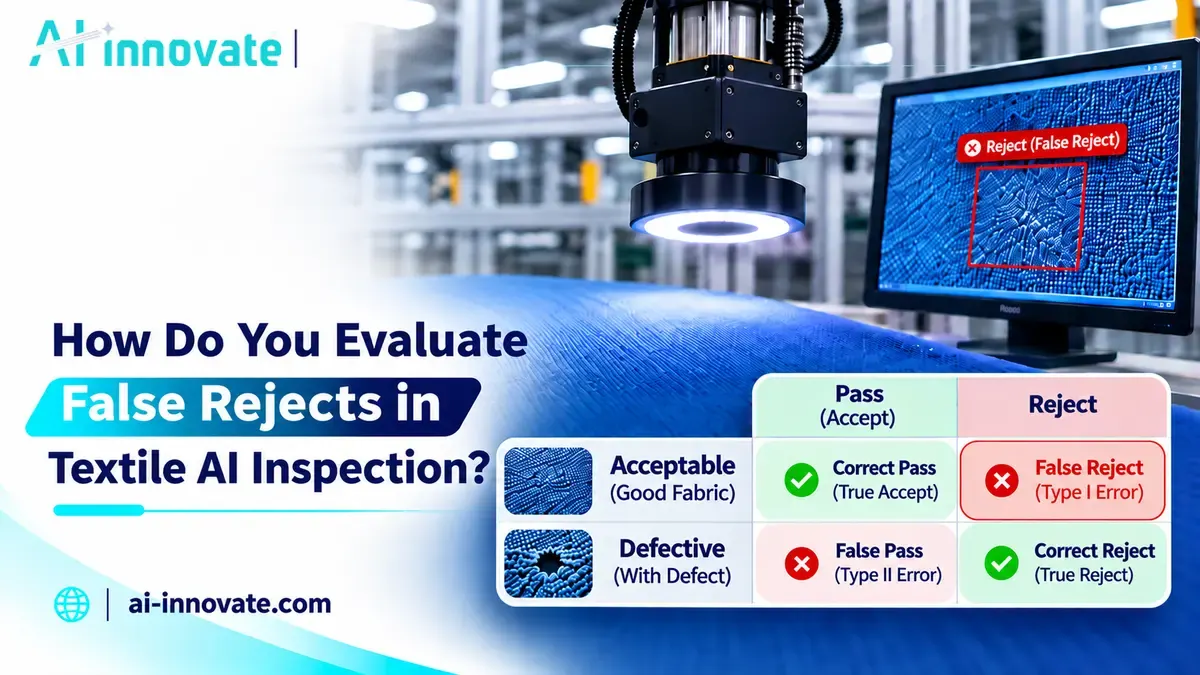
A false reject is acceptable fabric that the system flags or rejects as defective. The opposite error is a missed defect: defective fabric that the system passes. The two have different consequences, so measure each one on its own.
Research on textile defect detection usually treats a defect as the positive class, so false rejects appear there as false positives or false alarms, and missed defects as false negatives. Figure 1 shows the four possible outcomes. Two simple rates follow from it. In machine vision, the false reject rate is the share of good items that the system rejects, and the missed defect rate is the share of defective items that it passes. Count both in the same units the plant already uses, such as rolls, meters or defects.
False alarms in fabric inspection also create work. In a study of unsupervised defect detection models, the authors note that spurious alerts add to the work of reconfirmation and hold back the use of such models in industry [1]. On a fabric line, each false reject means a stop, a second look by an operator, or good fabric that is downgraded or cut out.
The two errors land on different teams. For quality leaders, the main risk is a defect that escapes to the next process or the customer. For operations leaders, every good roll that is stopped, re-inspected or downgraded is lost output. The balance of missed defects versus false rejects therefore needs both teams to agree. A single accuracy figure mixes the two, and on a line where most fabric is good, it can look high while one of the errors is still too frequent.
Why Do Good Fabrics Get Rejected?
Good fabric gets rejected when acceptable variation, or a change in imaging conditions, looks like a defect to the system. Typical sources are color and shade, pattern, texture, batch-to-batch differences, reflection, alignment, lighting, focus, vibration and other changes in conditions. Which of these matter depends on the fabric, the process and the inspection setup.
Table 1. Common sources of false rejects and what to check
| Source | How it can look to the system | What to check |
|---|---|---|
| Color and shade | A lighter or darker area, or a new shade, read as a stain or shade defect | Whether the shade is within the agreed tolerance and whether the system has seen that shade before |
| Pattern and print | Repeating motifs, stripes or prints read as irregularities | Rejected images of good patterned fabric, grouped by design |
| Texture and structure | Slubs, natural yarn variation or surface texture read as defects | Whether the texture is within the standard for that fabric |
| Batch and production run | A new lot looks slightly different from the samples used in setup | Rejects grouped by batch or lot, compared with earlier lots |
| Reflection and sheen | Glare from shiny or coated fabric read as a spot or hole | Light angle and type for that fabric |
| Alignment and position | Skewed fabric, folded edges or a shifted web read as distortion | Fabric path, edge position and tension at the camera |
| Lighting, focus and vibration | Uneven light, blur or shaking images read as defects | Light stability over a shift, focus, and vibration at the inspection point |
Swipe to see the full table
False positives in patterned fabric inspection are a known difficulty. In research on motif-based detection for patterned fabric, a simple decision region worked in distinct cases but did poorly on ambiguous false-positive and false-negative cases, and a different form of decision region improved the results [2]. The design itself can resemble a defect, and the boundary between the two has to be drawn with care.
The same product can also change from run to run. That is why inspection is planned around the actual range of variation in production, as described for textile inspection across changing products and materials. When the reason for rejects is a change to a new fabric type, the setup itself needs a fresh check, as covered in inspection changes for different fabric types.
How Should Acceptable Variation Be Defined?
In visual inspection, acceptable variation should be defined by the quality team before the system is tuned, from the approved standard, customer requirements and reference samples. The system then applies that boundary. Record borderline samples and the cases where inspectors disagree, because they show where the boundary is still unclear.
Reference samples: approved examples of acceptable fabric for each product, including the normal range of shade, pattern and texture.
A written rule: what is accepted, what is rejected and what goes to an operator for review, in the terms the plant and its customers use.
Borderline samples: cases near the limit, kept as a separate group so their effect on false rejects can be seen.
Inspector agreement: two or more inspectors label the same samples, and each disagreement is resolved by the quality team and recorded with the reason.
If experienced inspectors do not agree on a sample, the system cannot be expected to agree with all of them. Such samples belong in the review category, or the rule needs to be made clearer before the system is judged on them. How to select and label these samples is covered in representative images and borderline samples for textile defect detection.
How Do You Test False Rejects Without Hiding Missed Defects?
Test every threshold or model change on an independent, representative set of good, defective and borderline samples, and report false rejects and missed defects together. Loosening the threshold reduces false rejects but lets more real defects pass; tightening it catches more defects and rejects more good fabric.
A survey of industrial visual anomaly detection describes the same trade-off. A threshold that is too low leads to excessive false alarms, frequent line interruptions and higher manual inspection costs, while one that is too high lets real defects through [3]. Changing the sensitivity of the system moves errors from one cell of Figure 1 to another, so a change can only be judged when both errors are measured on real samples.
The test set has to come from the line. The authors of a fabric defect dataset collected at an operational inspection station note that laboratory images are usually taken under clean and static conditions, while active production adds motion, variation in image capture and naturally occurring defects [4]. A test built only from lab samples or public images can make the false reject rate look lower than it will be in production.
Freeze the test set first: select and label it before tuning, and keep it separate from the images used for training or setup.
Cover the variation: include each product, color, pattern and batch type the line runs, and the conditions it runs under.
Include every target defect: a test without enough real defects cannot show whether a looser setting is hiding them.
Report both rates for each setting: compare candidate thresholds or models on the false reject rate and the missed defect rate together.
Choose against agreed limits: the setting is acceptable only if both errors are within the limits the quality team agreed for that product.
Repeat after changes: run the same test again after any change to the model, the threshold, the lighting or the products.
Should Results Be Reviewed by Fabric, Pattern, Color or Batch?
Yes. One overall figure can hide a product, pattern or color where the system rejects too much or misses too much, so report results for each scenario: fabric type, pattern, color, batch, and line conditions such as speed. Patterned and high-mix fabrics may behave differently from plain fabric.
The patterned fabric study above evaluated three groups of patterns, and its results differed between them [2]. The same can happen on a line: plain fabric may pass the test while one printed design or one dark shade produces most of the false rejects.
By product and construction: plain weave, twill, knit, jacquard or nonwoven, as the line runs them.
By pattern and color: each design or color group with enough samples to judge.
By batch or lot: to see whether rejects rise with a new lot of material.
By line condition: speed range, changeovers and the start of a roll, where conditions differ.
Keeping these results over time, and comparing them across products, batches and shifts, is the role of quality trend and inspection review. Mark a scenario with too few samples as incomplete, so that it is tested further before approval.
When Is the Problem Imaging, Data or Decision Logic?
Look at the rejected images before you change the model. If the good fabric looks different in the image, because of glare, shadow, blur or missing coverage, the problem is imaging. If the image is clear but that kind of variation was never in the training or reference data, it is data coverage. If both are fine and the result changes with the setting, it is the threshold or decision logic.
Table 2. Where false rejects come from and the first check
| What you see in rejected good fabric | Likely source | First check |
|---|---|---|
| Glare, shadows, blur or a dark edge in the image | Imaging: lighting, focus, optics or vibration | Compare the image with how the fabric looks; check light, focus and mounting |
| Rejects only on part of the width or at the edges | Imaging: coverage or alignment | Field of view, camera overlap and fabric position |
| Clear images of a shade, pattern or lot not seen in setup | Data: variation not represented | Whether samples of that variation were in the training or reference set |
| Rejects rise after a product change or a new lot | Data or setup for that product | Rejects grouped by product and batch |
| Clear images, known variation, rejects change with the setting | Decision logic: threshold or rule | False rejects and missed defects at several settings on the same test set |
Swipe to see the full table
With models trained mostly on good fabric, data coverage deserves an early check. In one study, false alarms were traced to the model overfitting the dominant patterns in its anomaly-free training images [1]. Adding more good fabric that shows the real range of variation is then a better first step than loosening the threshold.
When the images themselves are unstable, no threshold setting will fix the false rejects reliably. The fix is in the lighting, optics, mounting or fabric path, which is where the work to upgrade an existing inspection system starts. Diagnose first, and tune only once the cause is known.
What Should a Pilot Prove Before Production Approval?
A pilot should show, under representative production conditions, that the system meets acceptance limits agreed in advance for both false rejects and missed defects, for each product scenario, with operators reviewing what the system flags. The result applies to the line, products and conditions tested.
Representative production conditions: the normal speed range, full width, real light at the inspection point, and several rolls and batches.
Good, defective and borderline samples: labeled by the quality team, with every target defect represented.
Scenario breakdown: results reported by fabric, pattern, color and batch, as in the previous sections.
Operator review and final disposition: who reviews a flagged item, who makes the final decision, and what happens to the fabric afterward.
Agreed acceptance limits: limits for both errors, set by the quality team before the pilot starts.
A record of settings and conditions: so the result can be repeated and compared after any later change.
For systems that classify products as good or defective, the VDI/VDE/VDMA 2632 guideline series includes a part on acceptance tests of classifying machine vision systems, with a sub-part on testing their classification performance [5]. The same logic applies whether the pilot tests an upgraded system or a new automated visual inspection system.
Not every project starts with a pilot. The right next step depends on how much is already known about the fabric and the defects. It can be a technical assessment, a pilot on the line or, where only product images are available so far, a Smart Demo with representative images.
Send representative images of acceptable fabric, of good fabric that is being rejected and of real defects, together with your current acceptance criteria and the products where false rejects occur. AI-Innovate will review whether the rejects are likely to come from imaging, from variation that is not covered or from the decision limit, and what a representative test should include. No false reject rate or other result is promised before that review.
Frequently Asked Questions
Is a high false-reject rate always an AI-model problem?
No. False rejects can come from unstable lighting, glare, focus or fabric position, from shades, patterns or lots that were not in the training data, or from a threshold that is set too tight. Review the rejected images of good fabric first, and change the model only when the images are clear and the variation was already covered.
Can we reduce false rejects simply by loosening the threshold?
Loosening the threshold reduces false rejects, but a threshold that is too high lets real defects through [3]. Any change should be tested on an independent set of good, defective and borderline samples, with false rejects and missed defects measured together against limits agreed in advance.
Should patterned and plain fabrics use the same acceptance limits?
Not necessarily. The quality team sets acceptance limits for each product from its standard and customer requirements, and patterned fabric can produce ambiguous cases that plain fabric does not [2]. Evaluate patterned and plain fabrics as separate scenarios, so that one does not hide the results of the other.
What samples should be included in a false-reject validation test?
Good fabric from normal production covering each product, color, pattern and batch type, examples of every target defect, and borderline cases kept as a separate group. All samples should be labeled by the quality team against the written acceptance rule and kept separate from the images used to train or set up the system.
References & Sources
- Qiu, J., Shi, H., Hu, Y., Yu, Z. Unraveling False Positives in Unsupervised Defect Detection Models: A Study on Anomaly-Free Training Datasets. Sensors, 23, 9360, 2023. doi:10.3390/s23239360
- Ngan, H.Y.T., Pang, G.K.H., Yung, N.H.C. Ellipsoidal decision regions for motif-based patterned fabric defect detection. Pattern Recognition, 43(6), 2010, pp. 2132 to 2144. doi:10.1016/j.patcog.2009.12.001
- Li, Z., Yan, Y., Wang, X., Ge, Y., Meng, L. A survey of deep learning for industrial visual anomaly detection. Artificial Intelligence Review, 58, 279, 2025. doi:10.1007/s10462-025-11287-7
- Carrilho, R., Rashidunnabi, M., Proença, H. LUSITANOv2: A Real-World Dataset for Fabric Defect Detection in Active Textile Production. Electronics, 15(19), 4403, 2026. doi:10.3390/electronics15194403
- VDI/VDE/VDMA 2632, Machine vision guideline series, Part 3: Acceptance test of classifying machine vision systems, and Part 3.1: Test of classification performance. VDMA overview of the series