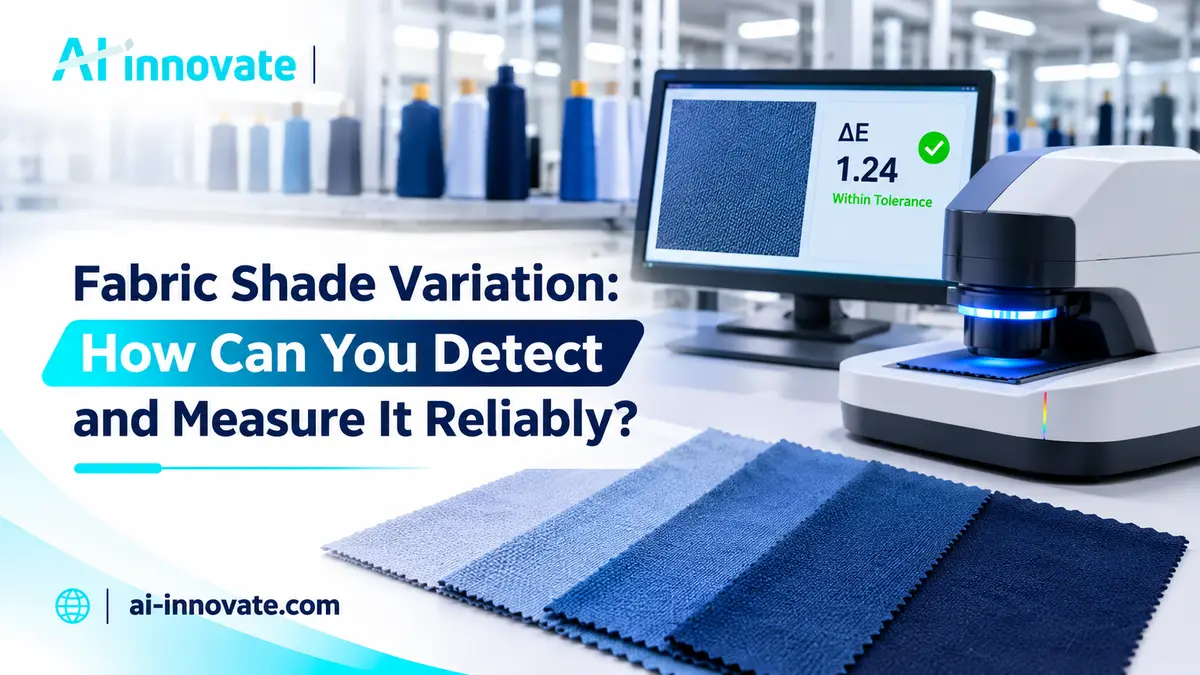
Fabric shade variation is a visible difference in color between parts of a fabric that should match. Shade variation in fabric can run across the width of a roll, from its start to its end, or between rolls and lots made to the same color reference. It is detected by comparing the fabric with an approved reference under controlled light, at known positions across the width and along the length. It is measured as a color difference (ΔE) against that reference, usually with a spectrophotometer, while a calibrated camera can follow the color across the whole run. The differences are often small and are judged against a reference under a particular light, so two inspectors, or an inspector and an instrument, can reach different conclusions about the same fabric. On a production line, the practical questions are which type of variation is present, which check gives the same answer every time, and when a camera is enough and when a spectrophotometer has to confirm the result.
With those answers, you can match each type of shade variation to a suitable check, decide what the camera and the spectrophotometer should each do, and know what to validate before approving a color monitoring system.
What Is Fabric Shade Variation, and Where Can It Occur?
Shade variation in fabric is an unwanted difference in shade, meaning depth, brightness or hue, between areas of fabric that are meant to be one color. Fabric color variation of this kind can appear across the width of a roll, along its length, between rolls, or between production lots.
Inspection practices treat shade variation as a fabric defect and, inside a single roll, separate three directions. A US Department of Defense practice for evaluating wool cloth, for example, examines each sampled roll for shade variation “side to side, side to center, or end to end,” and any such roll is cause to reject the whole lot the sample represents [1].
Across the width: side-to-side shade variation, where one edge of the fabric differs from the other, and side-to-center variation, where the edges differ from the middle.
Along the length: end-to-end variation, where the shade drifts gradually from the start of a roll to its end.
Between rolls: roll-to-roll shade variation, where each roll can look even on its own while rolls of the same color do not match each other.
Between lots: batch-to-batch variation, where fabric from different dyeing or finishing lots differs.
The type decides how the fabric is checked. Variation across the width is found by comparing zones of the same section, and variation along the length by comparing readings taken at known positions over the run. Rolls and lots can only be judged against a shared reference, such as the approved standard.
Table 1. Types of fabric shade variation, how to check them and what to validate
| Type | Where to look | Suitable check | What to validate |
|---|---|---|---|
| Across the width (side-to-side, side-to-center) | Left edge, center and right edge at the same position along the length | Measure or image the three zones together; compare each edge with the center and with the other edge | Even lighting across the full width, so a darker edge comes from the fabric and not from light falloff; agreement with spectrophotometer readings at the same points |
| Along the length (end-to-end) | Start, middle and end of the roll, with each position recorded | Readings at fixed intervals along the roll, followed as a trend against the reference | Light and camera stay stable for the whole run, so a trend in the readings comes from the fabric and not from drift |
| Roll-to-roll | A sample from each roll of the same color | Compare every roll with the approved standard under the same measurement conditions | The same reference, formula and conditions for every roll; agreement between instruments if more than one is used |
| Batch-to-batch | Samples from each dyeing or finishing lot | Spectrophotometer measurement against the approved standard, with visual approval where the buyer requires it | The tolerance agreed with the buyer and the condition of the reference sample |
Swipe to see the full table

Why Is Visual Shade Inspection Difficult to Keep Consistent?
Visual shade inspection is hard to keep consistent because the result depends on the viewing conditions and on the person judging, and both vary. Visual comparison is still the usual way to approve a shade. ASTM D1729, the standard practice for visual appraisal of colors and color differences, notes that color matches are usually checked visually even though color-measuring instruments are widely used. The same practice assumes an observer with superior color vision who is trained and experienced in judging color differences, and states that the significance of the results depends on that assumption [2].
Even trained people do not see color identically. In a study of observer metamerism, calculations based on the color-matching data of 10 individual observers suggested that, in practical situations, two people are likely to disagree on both the size and the direction of a visible color difference in metameric matches, which are pairs that match even though their spectral makeup differs [3].
Daily inspection adds its own variation: different lamps at different stations, fatigue late in a shift, viewing angle, sample size, the background behind the fabric and whether the samples lie side by side. A written procedure reduces it. AATCC EP9, for example, standardizes how textile specimens are compared visually with a standard [4].
A visual check can therefore be consistent inside one controlled booth with one trained team, and still give different results between shifts, between sites, or between a mill and its customer.
Why Does Lighting Change How Fabric Color Looks?
The color you see is light reflected from the fabric, so it depends on the light that falls on it. A study of 48 dyed plain-woven fabrics and 24 paper samples calculated how their colors appear under four standard illuminants representing incandescent light, two types of fluorescent light common in stores, and daylight. The more strongly textured fabrics showed larger hue changes, and larger overall shifts from their true color, than smooth paper, and the size and direction of the change depended on the chroma and hue of each color [5].
Surface structure matters as well. The three-dimensional surface of a textured fabric changes the amount and the angle of the light it reflects, and that shifts its color appearance away from its true color [5].
Gloss, transparency and the direction of the light add to the effect. In a laboratory imaging study of 11 textiles, light from a single direction exaggerated or weakened certain reflections and distorted the color, while images taken under light from four directions and then combined gave more stable color values [6].
Light also decides whether two fabrics match at all. Metamerism is the property of spectrally different color stimuli that have the same tristimulus values [7]. In practice, two fabrics colored with different dye recipes can match under one light and separate under another, so a match approved under one lamp can fail under the buyer’s lighting.
For shade checks, this means controlling the light source and its spectrum, the light level and its evenness, the angles of illumination and viewing, and the background. ASTM D1729 notes that the International Commission on Illumination (CIE) recommends simulated average daylight, D65 [2]. Many buyers also name the additional light sources a match must pass under, which is one more reason to use the same conditions every time a shade is checked.
Can a Camera Measure Fabric Shade Variation Reliably?
A camera can show that color changes, where it changes and how the change develops across and along the fabric. Whether its readings count as a reliable measurement depends on how the images are captured and calibrated, and on how closely they agree with a reference instrument.
Cameras are already used for broader color defect detection with machine vision, where a stain or a miscolored area stands out from the fabric around it. Shade variation is a harder case. The difference is small and spread over a large area, so variation in the light or the camera can be as large as the variation in the fabric.
A camera records red, green and blue signals that depend on its sensor, lens, exposure and light, so the values have to be converted through calibration before they can be compared with measurements in a standard color space such as CIELAB. A 2026 review of image-based fabric color measurement names the main obstacles as ambient lighting, camera angles, fabric materials and discrepancies between measuring devices, and describes correction methods such as spectral reflectance reconstruction, color balancing and machine learning [8].
Capture conditions still matter after calibration. In the laboratory study of 11 textiles, a three-step procedure (an imaging environment that limits scattered light, images taken under four-directional light and fused into one, then calibration with a standard color chart) brought the image colors closer to the real fabric than conventional color calibration alone, by 21.2% on average [6].
For repeatable fabric color measurement with a camera on a production line, that means stable and shielded light, fixed geometry and exposure, a calibration target checked at regular intervals, and a documented comparison with a spectrophotometer on the same fabric.
Camera vs Spectrophotometer: Which Should You Use?
Use each instrument for the question it answers. A spectrophotometer gives the reference value for a sample. A camera shows how the color behaves across the width and along the length of the fabric. Neither is the right tool for every check.
A spectrophotometer measures how much light the fabric reflects at each wavelength, over a small area and with fixed illumination and viewing geometry. From that spectral data, color values can be calculated for different standard illuminants, which also makes it possible to check a match for metamerism. Researchers who built an online camera system for fabric color describe the other side: spectrophotometers give accurate point measurements under controlled conditions, but they work off the line and sample only small areas, so they cannot follow color continuously across the full width and length of production [9].
In color management in fabric quality control, spectrophotometers are the usual tool for comparing batches with approved references. A camera system adds coverage: it can follow the color along the whole run and show where the shade starts to move.
Table 2. Visual check, camera-based inspection and spectrophotometer compared
| Aspect | Visual check in a light booth | Camera-based inspection | Spectrophotometer |
|---|---|---|---|
| What it records | The judgment of a trained observer comparing the fabric with the standard | Color signals, usually red, green and blue, over a large image area | Spectral reflectance of a small measured area |
| Coverage | Samples or selected areas | Full width and length when mounted on the line | Readings on samples or selected positions |
| Output | Accept, reject or review decision | Trends and maps that show where and when the color changes | Values such as CIELAB coordinates and ΔE against the standard, for a stated illuminant and observer |
| Strengths | The way many buyers approve shades; checks under several light sources can reveal metamerism | Coverage, the position of the change, early warning | Reference values, metamerism checks under several illuminants, results that can be reported and compared between laboratories |
| Limits | Depends on the observer, the light and the procedure; hard to repeat between people and sites; no numeric value | Depends on lighting, calibration, texture and gloss; one fixed light cannot reveal metamerism | Small area per reading; slow for full-width, full-length coverage |
| Typical use | Final approval against the buyer's standard, borderline cases, checks under the buyer's light sources | Following variation within and between rolls, and flagging positions for a check | Approving shades, comparing rolls and lots with the standard, confirming camera alerts |
Swipe to see the full table
In practice, the camera finds where and when the shade changes, the spectrophotometer decides how large the difference is against the standard and whether it is within tolerance, and a visual check in a light booth remains the approval step wherever the buyer requires it. When the camera flags a position, a reading on a sample taken from that position confirms the result.
What Do CIELAB and ΔE Tell You About Fabric Color Difference?
CIELAB tells you where a color sits and in which direction a sample differs from its reference, and ΔE tells you how large that difference is. Neither tells you on its own whether the difference is acceptable. CIELAB describes a color with three coordinates: L* for lightness, a* for red to green and b* for yellow to blue. The international standard for the CIELAB color space also defines measures of chroma and hue, and uses the straight-line distance between two colors in that space to represent how large their difference looks [10].
ΔE (Delta E) is a single number for the difference between a sample and its reference. The simple CIELAB distance, ΔE*ab, treats the same distance as the same visual difference everywhere in color space, which does not hold well for small differences. CIEDE2000 extends the CIELAB color-difference formula with corrections for the way perceived color difference depends on lightness, chroma and hue [11].
For textiles, two weighted formulas are in common use. AATCC EP14 states that CIEDE2000 and CMC(l:c) may both be used for the color evaluation of textiles, that current data show CIEDE2000 agreeing slightly better with visual evaluations, and recommends it as the primary method for instrumental evaluation [12].
ISO 105-J03 specifies the CMC calculation for textiles. It allows one maximum value, the tolerance, that depends only on the closeness of match required for the end use, whatever the color involved, and it lets the user set the ratio of lightness differences to chroma and hue differences [13].
A ΔE value only means something when it comes with its formula, the illuminant and observer used, the measurement conditions and the reference. A ΔE of 1.0 does not describe the same difference in ΔE*ab, CMC (2:1) and CIEDE2000, so values from different formulas cannot be compared directly. The parts of the difference are often more useful in production than the total: the lightness part shows whether the sample is lighter or darker, and the chroma and hue parts show whether it is duller, brighter or shifted in hue.
There is no universal acceptance limit. In the online system study mentioned above, the authors used a CMC (2:1) threshold of 1.0 as the working tolerance for their trial, stated that it is not a universal limit for all textile products, and noted that acceptable tolerances vary with fiber composition, weave structure, gloss, color depth, finishing and customer specification [9]. The tolerance for a product is agreed with the buyer and written down together with the formula and conditions, and every check uses the same ones.
What Should You Compare the Fabric Against?
Compare the fabric with an approved reference: the buyer’s standard, an approved lab dip, or a bulk standard the buyer has approved. Visual procedures for textiles are built around this comparison. AATCC EP9 describes how to judge the color difference of test specimens by visual comparison with a standard [4].
The choice of reference decides what the check can find. In the online system trial, each roll was compared with the first stable section of the same roll, which shows variation along that roll. The authors note that a customer-approved standard or a calibrated reference color can be set as the reference when matching to a product standard is required [9]. A reference taken from the roll itself shows end-to-end drift, but it cannot show whether the whole roll is off-shade against the standard.
Position matters for checks within a roll. Compare the left edge, the center and the right edge at the same point along the length, and compare the start, the middle and the end of the roll, recording where each sample or reading was taken. For roll-to-roll and lot-to-lot checks, compare every roll and lot with the same approved standard. Comparing each roll only with the previous one lets small steps add up: the third roll can match the second and still be outside the tolerance against the standard.
Keep the physical reference in good condition. Store it away from light and dirt, record its measured values when it is approved, and remeasure it at intervals, so that a change in the reference is not mistaken for a change in production.
Can Shade Variation Be Monitored While Fabric Is Moving?
Yes, under controlled conditions, but whether it works on a particular line has to be shown on that line. The online system study mentioned above shows what that involves. In that study, researchers installed a camera system on a factory’s cloth-guiding and rolling equipment, calculated CMC(2:1) color differences for 1 m segments of ten fabric rolls, and found that the system’s roll-level pass or fail decisions matched those of three experienced inspectors for all ten rolls. The authors describe this as preliminary evidence of feasibility under the tested conditions and caution against reading it as general proof of accuracy [9].
The same study shows what had to be controlled. The authors list these measures against error sources [9]:
Stable light and fixed geometry: an illumination shield and a fixed geometry of linear LED lighting with D65 characteristics reduced changes caused by ambient light.
Position tracking: an encoder synchronized image capture with fabric movement, so each reading was tied to a position on the fabric.
Controlled exposure: a fixed exposure setting limited brightness drift between frames, and the exposure time was matched to the line speed to control motion blur.
Steady running: images were taken after the fabric had reached steady movement.
Even with these controls, the authors note that strong texture, local changes in reflectance and mechanical vibration may still affect color values taken from images. Their method was also designed mainly for fabrics with a single background color, and it was not benchmarked against a calibrated spectrophotometer [9].
Two more conditions decide whether online fabric shade monitoring stays reliable over months. Lamps age and change with temperature, camera response can drift, and dust settles on lenses and covers, so the setup needs a reference target checked at fixed intervals and a rule for recalibration. The results are also most useful as trends: a rising color difference along a roll, or a step between rolls, shows the team where to take a sample for a spectrophotometer reading.
AI-Innovate approaches color and appearance inspection in textile manufacturing in the same order: controlled lighting, calibration, a defined acceptance condition and repeatable imaging are set up first, and color-related decisions are automated only after that.
How Should You Validate a Fabric Shade Inspection Setup?
Validation shows two things: the setup gives the same result for the same fabric, and that result agrees with an accepted reference. The online system study is a useful example of what a field trial can leave open. Its authors state that future work should add standard spectrophotometer measurements to quantify ΔE accuracy, repeatability and reproducibility more rigorously [9].
Before approving a setup, check:
Repeatability: measure the same fabric position several times without changing anything. The spread of the readings shows the smallest difference the setup can tell apart from its own noise.
Agreement with a reference: compare the setup’s results with spectrophotometer readings taken at the same positions, or with a controlled visual check against the standard in a light booth, using the same formula and illuminant.
Stability over time: repeat the reference check at the start of shifts, over several days and after maintenance or lamp changes, and track any drift.
Range of colors and fabrics: include the dark, light, bright and muted shades and the constructions, textures and finishes the line actually produces.
Agreed limits: fix the formula, the tolerance and the rule for accept, reject and review with quality control and, where needed, with the buyer.
Real line samples: test on fabric from the line, including rolls with known shade problems, under normal running conditions.
Approve the setup only for the colors and fabrics it was tested on. The authors of the ten-roll trial describe their own validation as “insufficient to support broad claims across all fabric types, color depths, textures, and production conditions” [9].
The instruments need the same care. ASTM E2214 gives standard terms and a process for describing, specifying and verifying the performance of color-measuring instruments [14]. Where more than one spectrophotometer or camera is used, check that they agree with each other on the same samples before their results are compared.
Keep a short validation record that lists the colors, fabrics, reference, formula, tolerance and agreement found. It shows everyone what the setup has been approved for, and what still needs a laboratory check.
When Is Machine Vision Not Enough for Fabric Color Inspection?
A camera system needs support from a laboratory instrument or a trained visual check in these situations:
Final approval against the buyer’s standard: when the contract calls for visual approval or a spectrophotometer reading, a camera result supports the decision but does not replace it.
Very small differences: when the tolerance is close to the camera’s own repeatability, the camera cannot reliably tell a real shade change from its own variation.
Metamerism: a camera under one fixed light sees one lighting condition. A pair that matches under that light can still differ under the buyer’s lights, and checking these needs spectral data or a visual check under several light sources.
Glossy, textured or reflective surfaces: texture and local reflections can change color values taken from images [9], so these fabrics need extra validation and often a spectrophotometer reading.
A numeric report the buyer can cite: a report based on a standard formula such as CIEDE2000 or CMC usually comes from a spectrophotometer measurement under controlled laboratory conditions.
Visual approval also stays important when the fabric and the standard are different materials. ASTM D1729 notes that visual appraisal is particularly important when the product inspected is not of the same material as the color standard [2].
In these cases, machine vision can still cover the full width and length of the fabric and show where a sample should be taken for measurement.
Send a sample of your fabric, the approved reference color sample and samples that show the shade variation, with a note of where each one was taken (edge, center, start or end of the roll, roll and lot number) and the tolerance you work to. AI-Innovate will use them in a technical assessment of which inspection or measurement approach suits the application. No measurement accuracy, ΔE limit or monitoring result is promised before testing.
Frequently Asked Questions
Is shade variation treated as a fabric defect?
Yes, when it exceeds what the buyer accepts. Inspection practices check rolls for shade variation across the width and along the length, and one US Department of Defense practice treats such variation in a sampled roll as cause to reject the whole lot it represents [1]. What counts as acceptable is set by the reference and the tolerance agreed with the buyer.
What is the difference between side-to-side and roll-to-roll shade variation?
Side-to-side shade variation is a difference across the width of one roll, between its two edges. Roll-to-roll shade variation is a difference between separate rolls that should be the same color, even when each roll is even in itself. The first is checked by comparing zones of the same roll, the second by comparing each roll with the approved standard.
What Delta E value is acceptable for a fabric color difference?
There is no universal value. The acceptable ΔE depends on the formula, the product, its end use and the buyer’s specification, and tolerances vary with fiber, weave, gloss, color depth and finishing [9]. Agree the formula, the conditions and the tolerance with the buyer before production.
Can a camera replace a spectrophotometer for fabric color measurement?
Not as a general rule. A validated camera setup can follow color across the whole width and length of the fabric and flag where it changes. Shade approval, metamerism checks and reports based on a standard formula usually still need a spectrophotometer, and on some fabrics a visual check against the standard.
Is a light booth check still needed if color is measured with instruments?
Often, yes. Color matches are usually still checked visually even where measuring instruments are widely used [2], and many buyers approve shades visually under named light sources. A controlled booth and a written procedure keep that check as consistent as possible.
References & Sources
- US Department of Defense. MIL-STD-655E, Standard Practice: Provisions for Evaluating Quality of Cloth, Wool, Worsted and Wool Blends, 26 March 2021, section 5.3. ASSIST document
- ASTM International. ASTM D1729-22, Standard Practice for Visual Appraisal of Colors and Color Differences of Diffusely-Illuminated Opaque Materials. Standard page
- Oulton, D., Taylor, H. Inter-observer agreement on visual colour matches and the role of metamerism as a cause of disagreement. Surface Coatings International Part B: Coatings Transactions, 85(2), 2002, pp. 105 to 109. doi:10.1007/BF02699749
- AATCC. EP9, Evaluation Procedure for Visual Assessment of Color Difference of Textiles. Standard page
- Chae, Y. Color appearance shifts depending on surface roughness, illuminants, and physical colors. Scientific Reports, 12, 1371, 2022. doi:10.1038/s41598-022-05409-2
- Cho, Y. Improving color reliability of digital textile images via optimized acquisition and preprocessing. Scientific Reports, 16, 1244, 2026 (published online December 2025). doi:10.1038/s41598-025-30857-x
- CIE. International Lighting Vocabulary, term 17-23-006, metamerism. e-ILV entry
- Nguyen, T.A. A Review of Image-Based Fabric Color Measurement: Methods, Challenges, and Future Prospects. Color Research & Application, 51(2), e70060, 2026. doi:10.1002/col.70060
- Wang, J.-H., Min, Y., Xiong, J.-Q., Fang, M., Mohd Rahim, M.S., Chen, D.-L. Novel online fabric color difference detection system based on machine vision. Scientific Reports, 16, 28554, 2026. doi:10.1038/s41598-026-58724-3
- ISO/CIE 11664-4:2019, Colorimetry, Part 4: CIE 1976 L*a*b* colour space. Standard page
- ISO/CIE 11664-6:2022, Colorimetry, Part 6: CIEDE2000 colour-difference formula. CIE publication page
- AATCC. EP14, Evaluation Procedure for Small Color Differences. Standard page
- ISO 105-J03:2009, Textiles, Tests for colour fastness, Part J03: Calculation of colour differences. Standard summary
- ASTM International. ASTM E2214-23, Standard Practice for Specifying and Verifying the Performance of Color-Measuring Instruments. Standard page