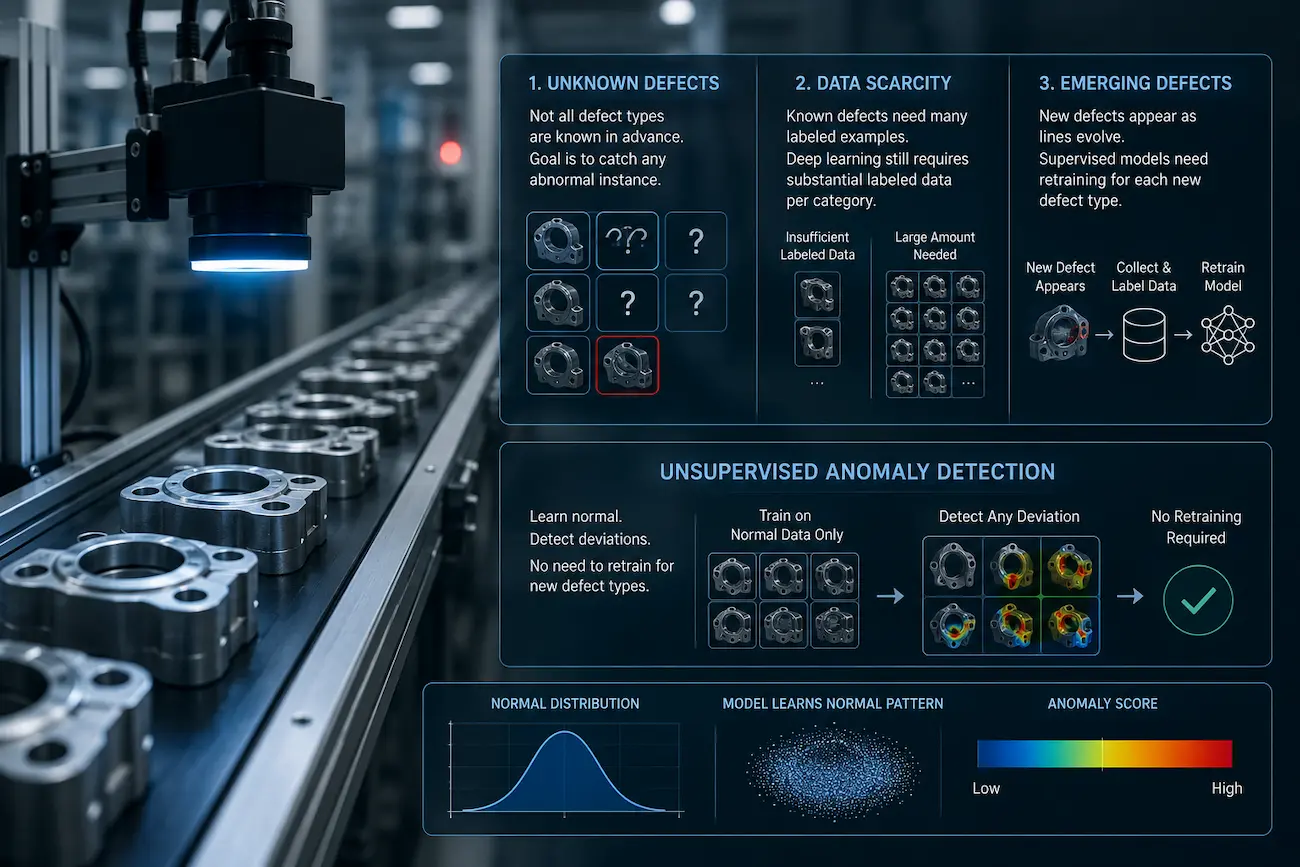





A model that classifies defects with 96 percent accuracy in a benchmark is not yet a production system. It becomes one only after someone specifies the actual hardware that will run it, at the frame rate the production line genuinely demands, continuously, inside an industrial enclosure managing heat, vibration, and dust rather than the climate-controlled server room the benchmark was measured in.
Edge AI deployment for manufacturing inspection is fundamentally a hardware sizing problem wrapped around a software optimization problem, and getting either half wrong produces the same result: a vision system that performs beautifully in a demo and fails to keep pace the moment it is bolted to a real line running at real speed.
This is the gap between a research paper and a working inspection station, and it is a bigger gap than most teams expect going in.
This guide covers how to size edge compute correctly, how to optimize a model to actually fit within that compute budget, how to split responsibilities between edge and cloud, and what published research shows about real-world edge inference performance.
What Is Edge AI Deployment in Manufacturing Inspection?
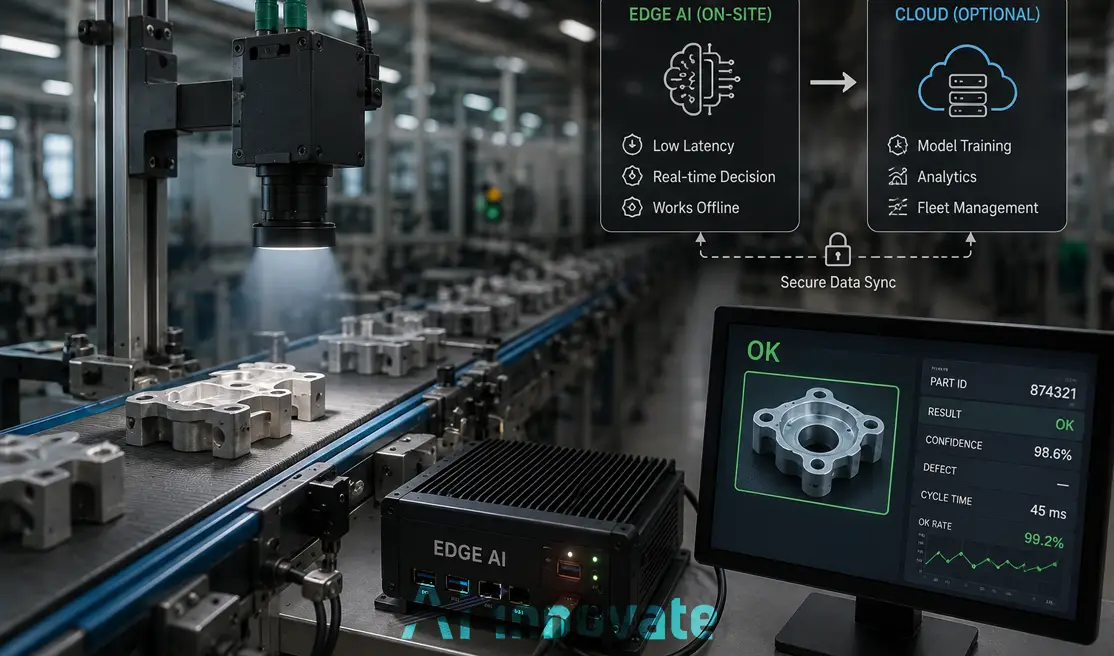
Edge AI deployment means running inference, the actual defect classification or detection decision, on hardware physically located at or near the production line, rather than sending images to a remote server or cloud platform and waiting for a response. For manufacturing inspection specifically, this matters because a reject mechanism often has to fire within milliseconds of image capture to intercept a defective part before it passes a fixed point on the line, a timing requirement that a round trip to the cloud cannot reliably guarantee. Edge deployment trades some of the raw computational power available in a data center for the low, predictable latency that a real production line actually requires.
This Topic might also interest you :
Throughput vs Latency: The Two Numbers That Actually Matter
Hardware selection is meaningless without first establishing the actual performance requirement in concrete numbers, a step frequently skipped in favor of simply buying the fastest available option, which either overspends significantly or, worse, still underperforms if the wrong performance dimension was optimized. Manufacturing inspection has two distinct requirements that are easily conflated.
Calculating Throughput Requirements
Throughput is how many parts or frames per second the system must process to keep pace with the line, calculated as required FPS equals line speed divided by the inspection interval. A discrete parts line running 600 parts per minute with one inspection per part needs a minimum of 10 frames per second. Continuous web inspection at 30 meters per minute with a required 0.1mm along-web resolution translates to several thousand line-scans per second, a dramatically different order of magnitude that has to be calculated explicitly rather than assumed.
Calculating Latency Requirements
Latency is how quickly a single inference decision must complete, measured from image capture to the actuator decision point. If a reject mechanism must fire within 50 milliseconds of capture to intercept a defective part, the entire pipeline, preprocessing, model inference, post-processing, and decision logic, must complete within that window, not just the model’s raw inference time considered in isolation. Throughput and latency are independent constraints that both have to be satisfied: a GPU capable of high aggregate throughput through batching can still fail a tight single-inference latency requirement if the batching strategy introduces queuing delay.
Choosing the Right Edge Hardware
Edge GPU selection spans a wide performance and cost range, and the correct choice depends on model complexity, resolution requirements, and the number of simultaneous camera streams, not on defaulting to the highest-spec option available.
| GPU Class | Typical Compute | Simultaneous Streams | Best Fit |
|---|---|---|---|
| Entry edge | ~20–40 TOPS | 1–2 streams, compact models | Single-camera stations, lightweight classification |
| Mid-range edge | ~70–275 TOPS | 2–6 streams, moderate complexity | Multi-camera inspection stations, standard detection models |
| High-performance edge | 300+ TOPS | 8+ streams, complex models | Wide-web line-scan inspection, heavy segmentation models |
One detail matters more than the spec sheet: published TOPS and TFLOPS figures represent peak theoretical performance under ideal lab conditions. Sustained real-world throughput under continuous production load and realistic thermal conditions typically runs 40 to 70 percent of that peak figure, which is why any serious sizing calculation should use sustained-performance estimates rather than marketing specifications.
Optimizing Models for Edge Inference
A model trained and validated at full precision on a development GPU almost always needs optimization before it meets edge deployment targets on lower-power hardware. This is a required engineering phase, not optional overhead.
Quantization
Reducing numerical precision from 32-bit floating point to 16-bit or 8-bit integer representation dramatically reduces memory footprint and increases inference speed, often by 2 to 4 times, at a typically small accuracy cost when calibrated correctly against representative production data. Poorly calibrated INT8 quantization can degrade accuracy disproportionately on subtle defect classes, which is why calibration against real imagery, not generic sample data, is essential rather than optional.
Pruning
Removing redundant or low-importance network connections and channels reduces model size and computation without a proportional accuracy loss, since trained networks typically contain significant redundancy. Structured pruning, removing entire channels or filters, produces hardware-friendly speedups more reliably than unstructured pruning, which often requires specialized sparse computation support to realize actual gains.
Knowledge Distillation
Training a smaller, faster student model to replicate the behavior of a larger, more accurate teacher model often achieves accuracy closer to the larger model than training the compact architecture from scratch would produce. This technique earns its place when target edge hardware genuinely cannot support the full-size model regardless of how aggressively it is quantized and pruned.
Graph and Kernel Optimization
Runtime-specific graph compilation, through frameworks like TensorRT or ONNX Runtime, fuses operations and selects hardware-optimized kernel implementations for the specific target architecture, often providing meaningful speedup with no accuracy trade-off at all. This makes it the logical first optimization step to apply before considering any technique that risks affecting accuracy.
This Topic might also interest you :
Edge vs Cloud: What Runs Where
Not every computational task in a manufacturing vision system belongs at the edge, and not every task belongs in the cloud. The correct split is determined by latency sensitivity and data volume.
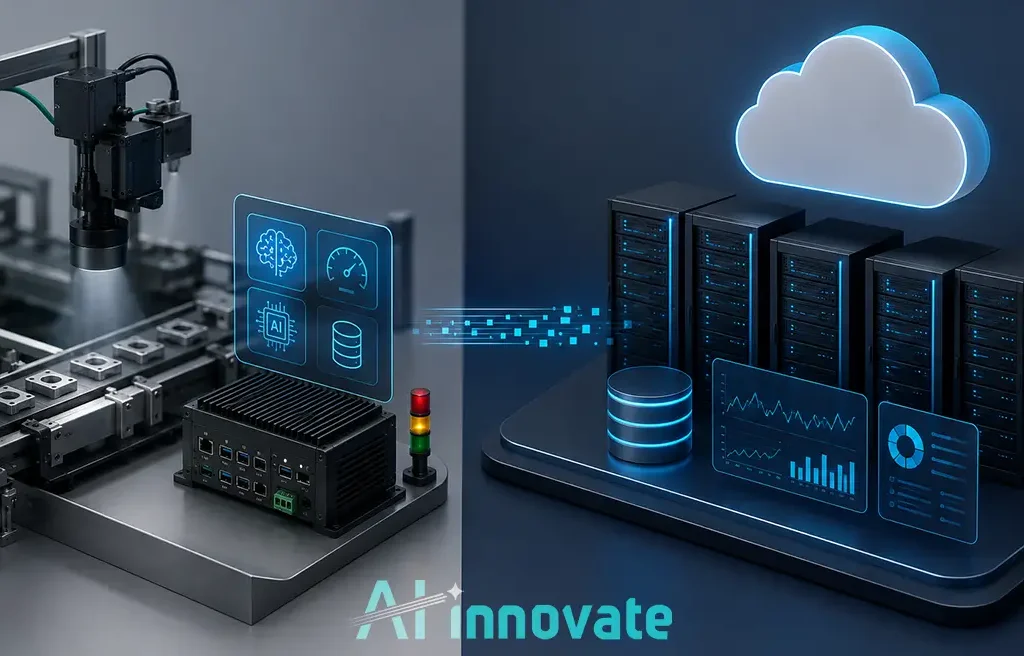
- Edge responsibilities: real-time inference that gates an immediate production action, preprocessing and image capture pipeline management, local buffering for network interruption resilience, and basic anomaly flagging before data leaves the local network.
- Platform responsibilities: model training and retraining on aggregated historical data, cross-line and cross-plant analytics, long-term data storage and trend analysis, and model version management and deployment orchestration back out to edge devices.
Tasks requiring sub-100ms response ride on the edge. Tasks requiring large historical context or cross-line aggregation belong in the platform, which is precisely why AI for industrial process control increasingly depends on this same edge-cloud division of labor, not just visual inspection specifically.
Real-World Performance: What the Research Shows
Published, peer-reviewed benchmarking confirms both the promise and the real constraints of edge deployment. A 2025 study deploying YOLOv8 models for automotive tube inspection on a CPU-only Raspberry Pi 500 found the compact YOLOv8 Nano model achieved 93.2 percent precision and a 93.8 percent mAP@0.5 with an average inference time of approximately 470 milliseconds, fast enough for real-time deployment at moderate line cadence. The larger YOLOv8 Small model reached slightly higher accuracy, 95.1 percent precision, but required roughly 1,315 milliseconds per inference, more than 100 times slower than the same model running on a GPU workstation, and the researchers concluded it was not practical for real-time use without GPU acceleration.
The lesson generalizes well beyond that specific study: the highest-accuracy model available is not automatically the right choice for edge deployment. The right model is the one that meets your actual throughput and latency budget on the actual hardware it will run on, which is exactly the kind of trade-off explored in 2D vision vs 3D vision systems for inspection as well: matching technology to the constraint, not chasing the most capable option in isolation.
Scaling From One Station to a Full Plant
Edge AI deployments typically start at a single inspection station and expand across additional lines and plants over time, and the architecture decisions made at that first deployment significantly determine how smoothly the rest of that scaling goes.
- Single station validation. Initial deployment on one station, validated against real production throughput and accuracy over a sustained period, surfaces integration issues, thermal, vibration, network reliability, that a lab benchmark simply cannot reveal.
- Standardized edge node template. Once validated, the hardware configuration and software deployment package get standardized into a repeatable template, turning each additional station from a custom integration project into a configuration exercise.
- Fleet management infrastructure. As edge node count grows beyond a handful, centralized fleet management for model deployment, health monitoring, and remote diagnostics becomes necessary, since manually managing individual devices does not scale past a small initial rollout.
- Cross-plant standardization. Expanding across multiple plants introduces variation in line speed and product mix, requiring an architecture that accommodates plant-specific model variants while maintaining consistent fleet-wide governance.
KPIs That Define a Healthy Edge AI Deployment
A handful of concrete metrics separate a genuinely production-ready deployment from one that merely looks good in a pilot.
- Sustained inference throughput above 120 percent of the calculated line requirement, providing margin for demand variability.
- End-to-end decision latency measured on production hardware, within the actual actuator response window, not just raw model inference time.
- GPU utilization sustained between 60 and 80 percent; persistently near 100 percent signals insufficient headroom, persistently low utilization signals over-provisioned hardware.
- Thermal throttling events at zero per month; any occurrence indicates inadequate cooling design for the real enclosure and ambient conditions.
- Edge node uptime above 99.5 percent of scheduled production time.
- Model deployment lead time under 24 hours fleet-wide, keeping the feedback loop between model improvement and production benefit tight.
How AI-Innovate Deploys Edge AI for Real-Time Inspection
Edge deployment is not an afterthought bolted onto a vision system after the fact. It is core infrastructure that determines whether an inspection model that performs well in testing actually holds up on a real production line.
AIxCore: The Edge Processing Foundation
AIxCore is built specifically around this challenge, running inference on-site so inspection decisions happen in real time without depending on a round trip to the cloud. This is what keeps a reject decision fast enough to matter on a line running at full speed, and it is designed to scale from a single validated inspection station to a fleet-managed deployment across multiple lines and plants.
AIxEye: Detection Tuned for Edge Constraints
AIxEye delivers the visual defect detection that actually runs on that edge infrastructure, built to perform reliably within the throughput and latency budget a real production line demands rather than only in an unconstrained benchmark environment.
AIxam: Closing the Training Data Gap Before Deployment
AIxAm supports the model optimization work that happens before anything reaches the edge, generating synthetic training data for rare defect types so the model deployed to production hardware is genuinely ready for the conditions it will actually encounter, not just the conditions available in a limited real-world dataset.
Final Thoughts
Edge AI deployment for inspection is a hardware and optimization discipline as much as it is a modeling one: establishing real throughput and latency requirements, selecting GPU compute that meets them under sustained real-world conditions, and optimizing the model itself through quantization, pruning, and graph compilation to actually fit within that budget.
The teams that get this right treat deployment as engineering, not an afterthought to the model training phase. They benchmark the actual model, optimized the way it will run in production, on the actual candidate hardware, under conditions that approximate the real deployment environment, before committing to a purchase. It takes longer than trusting a spec sheet. It is also the difference between a vision system that works in a demo and one that still works six months into full production.
Sources
Ai-Innovate uses only high-quality sources, including peer-reviewed studies, to support the facts within our articles.
- Edge AI Deployment for Inspection
https://www.mdpi.com/1999-5903/18/8/510 - Edge AI Deployment: GPU for Manufacturing Vision Real-Time
https://ifactoryapp.com/blog/edge-ai-deployment-gpu-manufacturing-vision-real-time - Edge AI Deployment for Inspection
https://averroes.ai/blog/edge-ai-deployment - Edge AI for Visual Inspection: Real-Time Quality at the Edge
https://www.eurotech.com/blog/edge-ai-for-visual-inspection-real-time-quality-at-the-edge/ - AI Inspection and Edge Computing
https://aiinspectionauthority.com/ai-inspection-edge-computing/ - Edge AI Inspection for Real-Time Quality Control
https://xis.ai/blogs/edge-ai-inspection-real-time-quality-control - Edge AI Inspection Robot: ROS 2 Native
https://www.edgeimpulse.com/blog/edge-ai-inspection-robot-ros-2-native/ - Improving Visual Inspections With AI and Edge Computing
https://www.controleng.com/improving-visual-inspections-with-ai-and-edge-computing/
Frequently Asked Questions
What is the difference between edge AI and cloud AI for manufacturing inspection?
Edge AI runs inference locally on hardware at the production line, delivering the low, predictable latency real-time inspection requires. Cloud AI excels at tasks edge hardware cannot cost-effectively replicate, like full model training and cross-plant analytics, but cannot reliably meet the sub-100ms latency many inspection decisions demand.
How do I calculate the GPU compute I actually need for an inspection station?
Start by calculating throughput as line speed divided by inspection interval, and latency as the time budget from image capture to the actuator decision point. Both requirements must be satisfied independently, and the correct hardware should then be benchmarked against your actual model, not selected from a spec sheet alone.
Does optimizing a model for edge deployment reduce its accuracy significantly?
With proper calibration, INT8 quantization typically produces accuracy degradation of only 0.5 to 2 percentage points on standard detection metrics, a generally acceptable trade-off for the throughput gained. Poorly calibrated optimization, using generic rather than representative production data, can produce meaningfully worse results, particularly on rare or subtle defect classes.
What happens if an edge device or its network connection fails during production?
A well-architected deployment handles this explicitly. For network failure, the edge device continues operating autonomously since inference runs locally, with results buffered until connectivity restores. For hardware failure, mitigation depends on station criticality, ranging from redundant compute with automatic failover to a defined fallback procedure for the duration of replacement.
How much accuracy can real edge hardware achieve compared to lab benchmarks?
Published research on a Raspberry Pi-based inspection system found a compact YOLOv8 model achieved 93.2 percent precision at approximately 470 milliseconds per inference on CPU-only hardware, confirming that meaningful accuracy is achievable on modest edge hardware when the model is sized appropriately for the device.
How often does edge hardware need to be upgraded?
Edge hardware typically has a useful production lifespan of four to six years before performance or vendor support considerations justify replacement. Sizing initial hardware with reasonable headroom above current requirements extends useful life meaningfully compared to sizing precisely to current-day needs with no growth allowance.