




A 0.1mm sink mark on a black bumper. A weld line on a transparent housing. A flash burr on a connector body. Each one is the kind of defect a quality engineer can spot instantly in a lab under the right light, and loses just as easily to fatigue on a twelve-hour shift running at 240 parts per minute. Injection molding produces an unusually specific, unusually visual category of defects, and catching them reliably at production speed has always been a genuine limitation of manual inspection, not a matter of inspector skill.
The results when AI vision closes that gap are not aspirational numbers. BMW’s Leipzig plant reported a 34 percent reduction in scrap rates after integrating AI vision into bumper production, and that figure sits comfortably within the 20 to 40 percent scrap reduction most injection molding deployments report once the system is properly tuned.
This guide covers the specific defect catalog injection molding produces, building on the broader ground AI quality control solutions for plastic manufacturing covers, how AI vision detects each one, where the camera and lighting actually belong, and what the economics look like once a system is running.
Why Injection Molding Produces Such a Distinct Set of Defects
Injection molding runs through a six-phase cycle, and understanding it explains why the defect catalog looks the way it does, a process-to-defect link that mirrors what common causes of defects in manufacturing shows across other industries: most escaped defects trace back to a specific, identifiable point in the process rather than a random occurrence. Resin drying removes moisture that would otherwise cause splay.
Plasticization melts and homogenizes the material charge. Injection fills the cavity volumetrically in a matter of seconds. Hold pressure packs out volumetric shrinkage after the cavity is full. Cooling solidifies the part to ejection temperature. Each phase has its own tight control tolerances, and a deviation in any one of them, melt temperature drifting by a couple of degrees, fill time shifting by fractions of a second, hold pressure dropping a percentage point, produces a specific, visually distinct defect in the finished part. That tight coupling between process parameter and visible defect is exactly what makes this category so well suited to AI vision: the defects are concrete, repeatable, and tied to a bounded set of part geometries rather than open-ended visual variation.
The Injection Molding Defect Catalog
Each defect type traces back to a specific point in the molding cycle, and detection approaches vary accordingly.
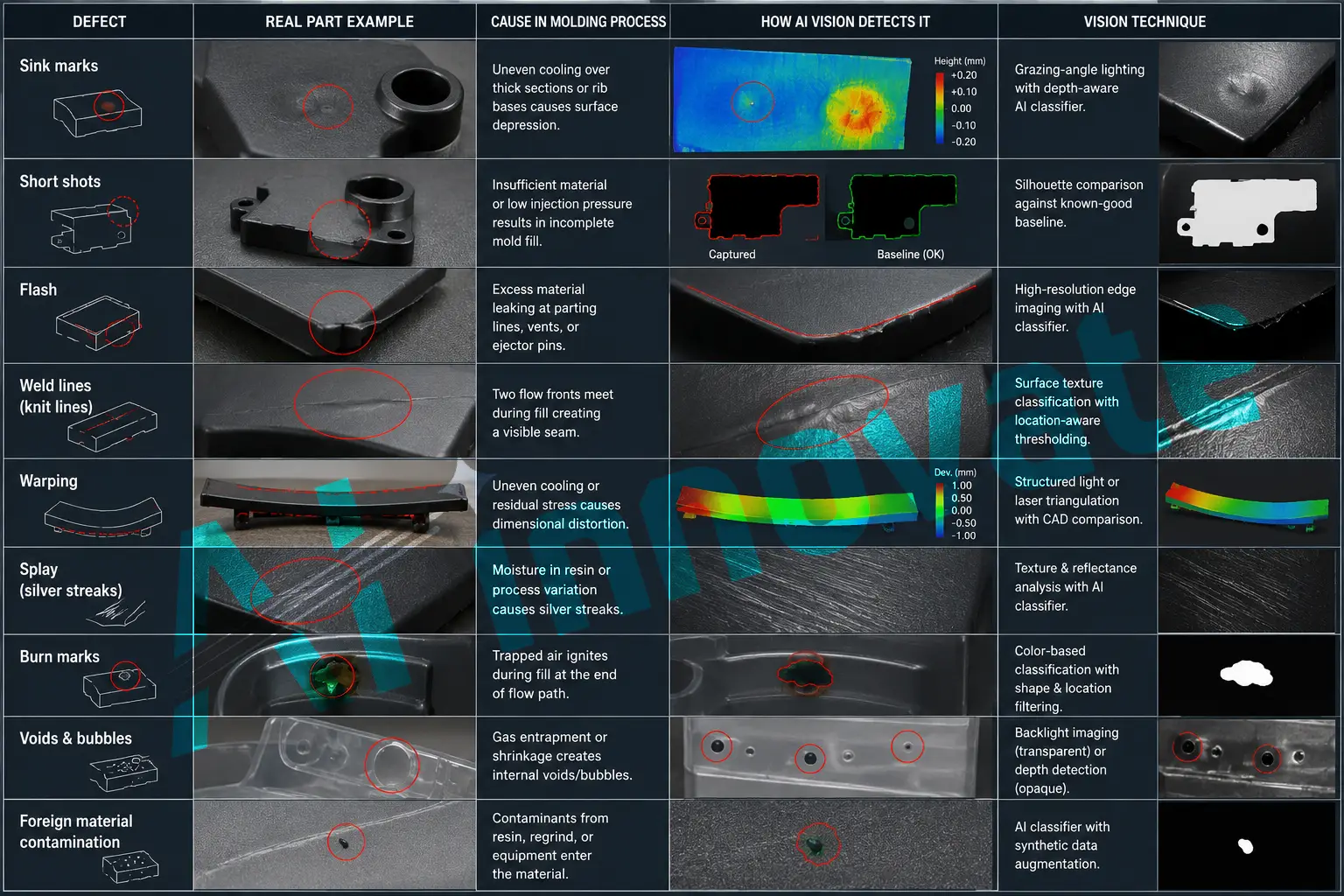
- Sink marks. Small surface depressions from uneven cooling, typically over thick wall sections or rib bases. Sub-millimeter sink marks, as shallow as 0.1mm, are the hardest class to catch by eye, particularly on dark or textured surfaces, but AI vision detects them reliably with grazing-angle lighting and a depth-aware classifier.
- Short shots. Incomplete mold fill leaving a part with missing geometry, always a reject. Detection by silhouette comparison against a known-good baseline is straightforward, which is why short shots are typically the first defect class deployed on a new line.
- Flash. Excess material at parting lines, vents, or ejector pin locations. Detection requires sub-millimeter edge resolution along the entire parting line, a task where rule-based vision struggles because the parting line varies subtly across mold tools and material lots, but a trained AI classifier handles well.
- Weld lines (knit lines). Visible seams where two flow fronts meet during fill, always present but sometimes prominent enough to be a cosmetic reject, especially on transparent or translucent parts. Detection uses a surface texture classifier with location-aware thresholding, since some weld lines are acceptable in non-visible regions.
- Warping. Dimensional distortion from uneven cooling or residual stress. This is one of the cases where pure 2D vision falls short; warping generally needs structured-light or laser triangulation paired with a dimensional comparison against the CAD model.
- Splay (silver streaks). Streaks caused by moisture in the resin or process variation, a cosmetic reject on visible surfaces that often signals an upstream resin handling issue worth investigating, not just a part-level defect.
- Burn marks. Dark discolored regions where trapped air ignites during fill, typically at the end of long flow paths, and always a reject. Detection uses a color-based classifier with shape and location filtering to distinguish burns from ordinary texture variation.
- Voids and bubbles. Internal pockets on transparent parts, detected with backlight imaging, or surface-level depressions on opaque parts, which require depth-aware detection.
- Foreign material contamination. Particulate, fiber, or color contamination introduced during upstream resin handling. Because real contamination samples are rare and highly varied, synthetic data augmentation is particularly valuable for training a reliable classifier here.
Cavity-Pressure Prediction vs Vision Confirmation: Two Complementary Systems
Vision inspection catches defects after a part is ejected. A second, complementary approach catches many of the same defects before the part ever leaves the mold. Cavity pressure is the single most information-dense process signal available on an injection molding press: it encodes the entire fill and pack history of that specific shot, and a deviation from the validated baseline is often the earliest available indicator that a defect is forming. Neural network models trained on in-mold temperature and cavity pressure data can predict outcomes like part mass, wall thickness, and tensile strength directly from that in-cycle sensor trace, while the part is still inside the mold.
These two systems are complementary, not redundant. Cavity-pressure prediction catches process-origin defects before they even become finished parts. Vision confirms the prediction after ejection and catches anything the process model missed, providing the geometric ground truth needed to validate and improve that model over time. The most common mistake facilities make is running these two systems independently, which means a sink-mark increase on one cavity generates a vision alert and a separate process alert that nobody automatically connects, turning a root-cause investigation into a multi-day manual correlation exercise instead of an answer available in seconds.
The Cost of Catching a Defect Late
Where in the process a defect gets caught changes its cost by an order of magnitude, sometimes two. A defect caught at the press costs roughly the value of one part and one shot’s worth of cycle time. The same defect discovered at assembly, where it causes a downstream failure or requires disassembly and rework, costs five to ten times as much. Caught only at the customer, as a warranty return or field failure, the cost multiplies again to fifty to one hundred times the press-side figure.
This is precisely why the hidden cost of missed defects compounds so severely in injection molding specifically: manual visual inspection typically covers only around 5 percent of production volume, which means a defect affecting even 3 percent of shots can produce thousands of defective parts in a single shift before anyone notices, and by the time it does, most of those parts have already moved well past the point where catching them was cheap.
Where to Place the Inspection Camera
Camera placement involves real trade-offs, and the right choice depends on part value, cycle speed, and the cost of downstream handling.
Press-Side, Immediately After Ejection
Catches defects before any handling damage occurs and lets the press control system flag and divert a bad part automatically. The drawback is thermal stress on the camera, press vibration, and constrained camera angles, which makes this placement worth the added engineering investment mainly for high-cycle, high-cost parts where catching a reject before it leaves the press meaningfully reduces downstream waste.
Post-Conveyor, Before Downstream Processing
The most common placement and the right starting point for most lines. It offers a stable thermal environment, multiple camera angles, and full 360-degree inspection feasibility, though defective parts may have already been handled or stacked by the time they reach this point.
Post-Trim or Post-Secondary Operation
Useful when secondary operations like degating, trimming, or bonding introduce their own distinct defect classes. Running inspection both before and after each secondary step helps localize exactly which operation is responsible when a new defect appears.
Lighting Considerations for Injection Molded Parts
Most injection molding inspection failures trace back to lighting design, not algorithm limitations. Black plastic, glossy surfaces, and complex part geometry all demand deliberate lighting choices rather than a single generic setup.
- Diffuse dome lighting for highly reflective or glossy surfaces.
- Grazing-angle structured lighting for sink marks, dents, and other subtle surface defects.
- Backlighting for transparent or translucent parts, revealing voids and inclusions.
- Coaxial lighting for highly specular surfaces where reflections need to be controlled.
- Multi-spectral imaging for contamination that is color-similar to the base material and invisible in standard RGB.
Training Data and the Rare Defect Problem
Modern AI vision platforms reach production-grade accuracy on injection molding defect classes with as few as 5 to 20 real defective images per class, which surprises many teams expecting to need thousands of examples. The real constraint is not raw image volume but the quality and diversity of those images within the actual production envelope. For genuinely rare defect classes, those occurring less than once per 10,000 parts, synthetic defect generation closes the gap without waiting months to accumulate enough natural samples, which matters enormously for defect types like foreign material contamination that are both rare and highly variable in appearance.
Real-World Results: What Deployments Actually Show
Typical injection molding lines run scrap rates of 1 to 5 percent on stable production, and AI vision deployments consistently report a 20 to 40 percent reduction in that baseline scrap rate. On a line producing 10 million parts a year at 50 cents per part, a 30 percent reduction against a 3 percent baseline scrap rate recovers roughly $45,000 annually, a figure that scales directly with line volume and part cost. Most inspection systems pay back within a year on typical production volumes, and on automotive Tier-1 part programs, payback frequently lands under six months.
Getting Started: A Practical Deployment Timeline
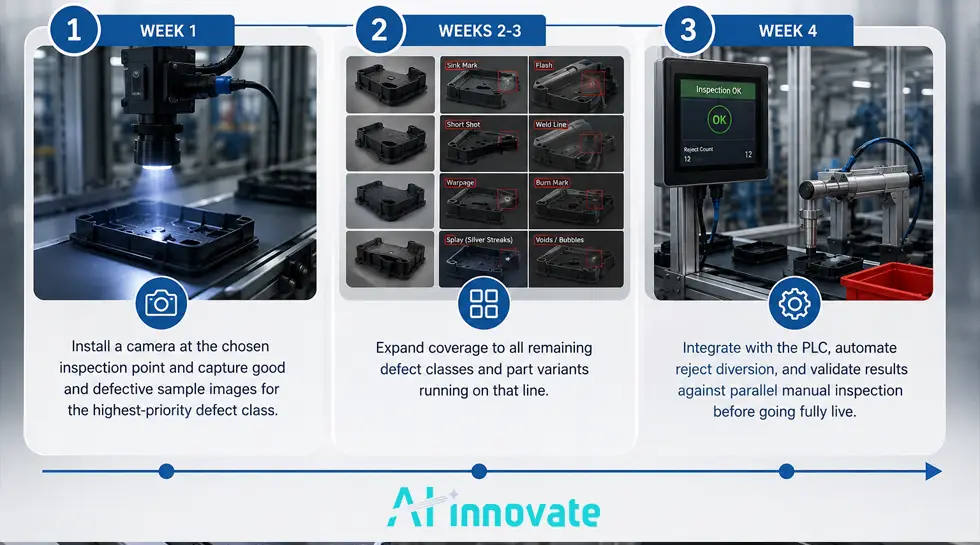
- Week 1. Install a camera at the chosen inspection point and capture good and defective sample images for the highest-priority defect class.
- Weeks 2-3. Expand coverage to all remaining defect classes and part variants running on that line.
- Week 4. Integrate with the PLC, automate reject diversion, and validate results against parallel manual inspection before going fully live.
How AI-Innovate Powers Injection Molding Defect Inspection
Injection molding compresses a lot of inspection difficulty into a single part: sub-millimeter defects, glossy and dark surfaces that punish generic lighting setups, dimensional distortion that pure 2D imaging cannot catch, and rare contamination classes that real production data alone would take years to accumulate examples of.
AIxEye: Real-Time Detection Across the Full Defect Catalog
AIxEye performs the visual inspection that covers the injection molding defect catalog end to end, sink marks, short shots, flash, weld lines, splay, burn marks, and contamination, adapting detection criteria to the specific part geometry, material, and color running on a given line rather than applying one fixed threshold across every mold tool.
AIxAm: Synthetic Data for Rare and Variant-Specific Defects
AIxAm addresses the training data gap that matters most in injection molding: generating synthetic examples for defect classes that occur too rarely in real production to build a large natural dataset, and helping propagate a known defect class across part color and material variants without re-collecting samples for every combination a single mold tool produces.
AIxCore: Edge Processing Fast Enough for Press-Side Inspection
AIxCore handles the on-site inference that makes press-side inspection viable even at fast cycle times, processing each part locally so a reject decision can trigger automatic diversion before the part moves further down the line, without depending on a network round trip that press-side thermal and vibration conditions would make unreliable anyway.
Final Thoughts
Plastic injection molding produces a defect catalog that is unusually well suited to AI vision: concrete, visually distinct, tightly coupled to specific process parameters, and expensive to catch late rather than at the press. Sink marks, short shots, flash, warping, and the rest of the catalog each trace back to a specific point in the six-phase molding cycle, which is exactly why detection approaches tuned to each defect type outperform a single generic inspection setup.
The facilities getting the strongest results are not just bolting a camera onto the line. They are pairing vision inspection with cavity-pressure process data where possible, placing cameras and lighting deliberately rather than defaulting to whatever fits, and treating rare defect classes as a data problem synthetic generation can solve rather than a gap to wait out. With scrap reduction in the 20 to 40 percent range and payback typically under a year, the economics of getting this right are no longer a hard case to make.
Frequently Asked Questions
What defects can AI vision detect on injection molded parts?
AI vision systems detect the full range of injection molding defects: sink marks, short shots, flash, weld lines, warping, splay, burn marks, voids, and foreign material contamination. Sub-millimeter sink marks down to 0.1mm can be detected reliably with proper lighting and camera resolution.
How fast can AI vision inspect injection molded parts?
Sub-100ms inference per part is standard for production AI vision systems, comfortably supporting cycle times under one second per part on most molding lines. Image capture, particularly lighting and motion stability, is typically the bottleneck rather than inference speed.
What ROI does AI defect inspection deliver in injection molding?
Most injection molding deployments report scrap reduction in the 20 to 40 percent range, with payback periods of 3 to 9 months on typical line volumes. BMW’s Leipzig plant reported a 34 percent scrap rate reduction after integrating AI vision into bumper production.
How many training images are needed for injection molding defect detection?
Modern AI vision platforms reach production-grade accuracy with as few as 5 to 20 real defective images per defect class on most applications. Synthetic data generation can supplement genuinely rare defect classes occurring at roughly 1 per 10,000 parts or less.
Where should the inspection camera be placed on an injection molding line?
Post-conveyor placement is the right starting point for most lines, offering a stable thermal environment and full inspection angle coverage. Press-side placement catches defects before handling damage but requires managing thermal stress and vibration, and is generally worth that investment for high-cycle, high-cost parts.
Can vision inspection alone catch every injection molding defect?
Not entirely. Vision inspection catches defects after a part is ejected, while cavity-pressure sensors can predict certain process-origin defects, like those tied to mass, wall thickness, or tensile strength, before the part is even out of the mold. The two approaches are complementary, with vision providing the geometric ground truth that process models need to stay accurate.
Sources
Ai-Innovate uses only high-quality sources, including peer-reviewed studies, to support the facts within our articles.
- Overview.ai. (2026). Plastic Injection Molding AI Defect Inspection: A Practical Guide. https://www.overview.ai/blog/plastic-injection-molding-ai-defect-inspection/
- Niobia AI. (2026). Injection Molding AI: Cavity-Pressure + Vision, Zero-Escape Defect Control. https://niobia.ai/applications/injection-molding