




On a packaging line moving 300 to 600 units a minute, a human inspector pulling one sample every few minutes catches a fraction of what actually needs catching. A seal head drifts out of tolerance mid-shift from a temperature fluctuation. A label applicator slips after a roll change. A filler valve starts under-dosing because of a worn gasket. None of these failures announce themselves between sample checks, and by the time a supervisor spots a trend on a paper log, or worse, a retailer chargeback arrives, thousands of flawed units have often already shipped.
Packaging quality control is a genuinely different inspection problem than product quality control, and it is easy to underestimate just how different. A bottle, a blister pack, a flexible pouch, and a corrugated case all fail in distinct ways, and a vision system built around one format’s defect signatures will often miss what matters on another entirely.
This guide covers the defect categories that actually drive packaging complaints, how inspection approaches differ by packaging format, what a real deployment timeline looks like, and what plants running these systems actually report once they are live.
Why Packaging Inspection Resists a One-Size-Fits-All Approach
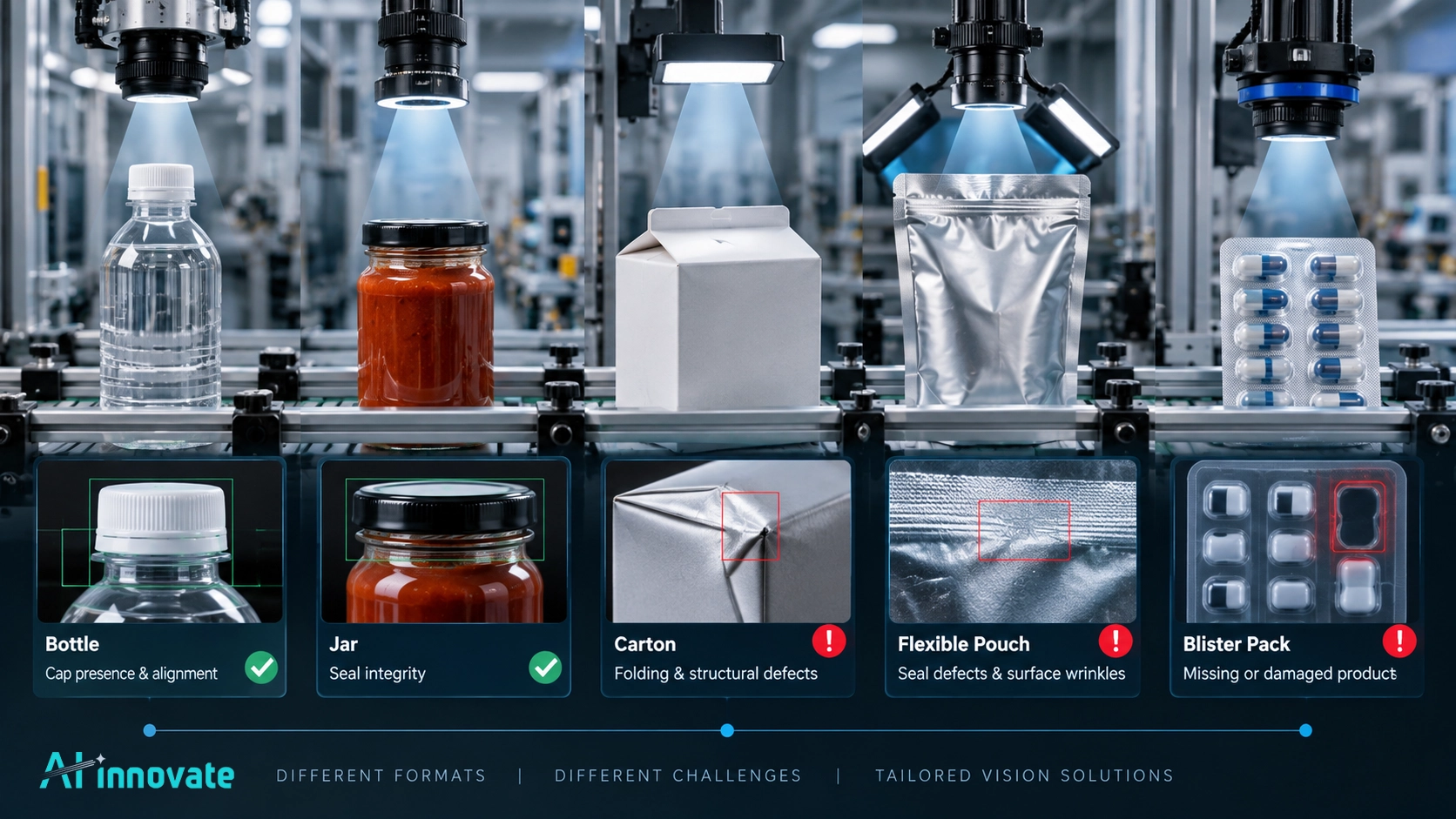
Packaging spans an unusually wide range of physical formats within a single product category, let alone across an entire plant’s product line. Rigid containers like bottles and jars behave predictably under a camera. Cartons introduce structural concerns, deformation, improper folding, dimensional inconsistency, that a flat label check alone never catches.
Flexible pouches and blister packs are worse still: their surfaces flex, reflect light unpredictably, and can hide seal defects behind wrinkles or print graphics that a rigid container never presents. This variation is exactly why a single generic inspection setup tends to underperform across a real production environment, and why the specific format being inspected has to shape both the imaging approach and the detection logic from the start.
This Topic might also interest you :
The Four Defect Categories That Drive Most Packaging Complaints
Across food, beverage, pharmaceutical, and consumer goods packaging lines, the overwhelming majority of quality escapes trace back to a small number of recurring categories, and understanding where they originate helps a plant decide where to place cameras first.
- Seal failures. Incomplete heat seals, channel leaks, and contamination on the seal surface account for a large share of shelf-life complaints and are the leading cause of retailer rejections in flexible packaging specifically.
- Label misalignment. Skewed, wrinkled, or missing labels create real compliance risk when regulatory or allergen information becomes unreadable, and they are among the most visible defects to an end consumer.
- Fill-level deviation. Underfill triggers weights-and-measures violations, while overfill increases material cost directly on every affected unit, making fill accuracy one of the highest-return inspection points on nearly any line.
- Print and barcode errors. Smudged date codes and unreadable barcodes cause scanning failures at distribution centers, generating chargebacks that surface long after the product has already left the plant.
Inspection Approaches by Packaging Format
Each packaging format presents its own imaging challenge, and the right camera, lighting, and detection logic vary meaningfully from one to the next.
Blister Packs
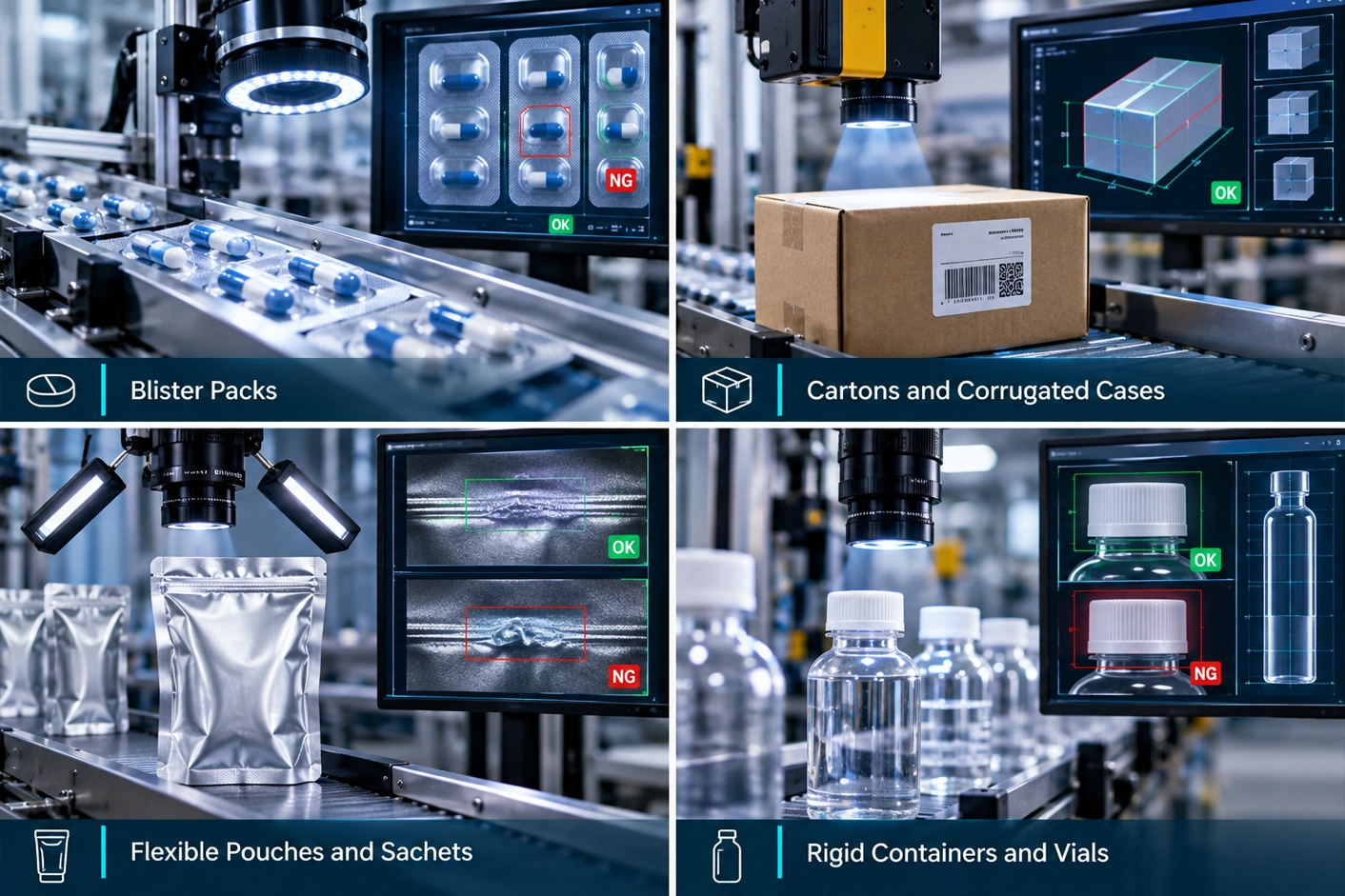
Blister packs combine reflective plastic surfaces with a requirement for dose-level accuracy, making them one of the harder packaging formats to inspect reliably. High-speed imaging paired with backlighting techniques detects missing, broken, or improperly filled cavities before the pack is sealed, since transmitted light reveals cavity contents that reflected light alone would miss. Foil integrity and cuts in the blister tray itself require a second pass of inspection focused specifically on the sealing surface, since a defect here compromises sterility even when every cavity is correctly filled.
Cartons and Corrugated Cases
Carton inspection extends well beyond a simple label check into structural validation. Cartons can deform, seal improperly, or come off the line with dimensional inconsistencies that only 3D vision reliably catches, since a flat 2D image cannot capture whether a carton’s actual shape matches its intended geometry. Case-level inspection adds a further layer: verifying case count, confirming proper closure, and checking that shipping labels and barcodes remain legible after the case has been through palletizing and wrapping.
Flexible Pouches and Sachets
Flexible packaging is where seal integrity becomes the dominant concern, since a pouch or sachet has no rigid structure to hold a seal defect open for easy visual detection. Dark-field illumination from a low angle creates distinct shading patterns across the seal area, and a compromised seal produces a visibly different shading profile than an intact one, a technique that remains effective even when the pouch surface itself is printed, textured, or semi-reflective.
Rigid Containers and Vials
Rigid containers and vials introduce their own precision requirements, particularly around small, high-density text that has to remain readable on a curved or reflective surface. Cap alignment and fill-level inspection typically use 3D profiling to measure deviations at the millimeter level, a level of precision this guide’s companion piece on bottle quality control with AI covers in more depth for beverage-specific applications, where fill tolerance carries both a regulatory and a direct cost dimension.
Manual Sampling vs. Continuous AI Vision Inspection
The operational gap between sampling and continuous inspection is easiest to see side by side, and it explains why so many packaging defects historically went undetected until a customer complaint surfaced them.
| Inspection Factor | Manual Sampling | AI Vision Inspection |
|---|---|---|
| Coverage per shift | 1–5% of units checked | 100% of units checked |
| Detection speed | Minutes to hours of delay | Milliseconds, inline reject |
| Consistency across shifts | Varies with inspector fatigue | Identical criteria on every unit |
| Root-cause traceability | Paper logs, limited detail | Timestamped image evidence |
| Typical scrap reduction | Baseline | Up to 40% reduction reported |
| Complaint reduction | Baseline | Up to 60% reduction reported |
How Continuous Inspection Actually Works on the Line
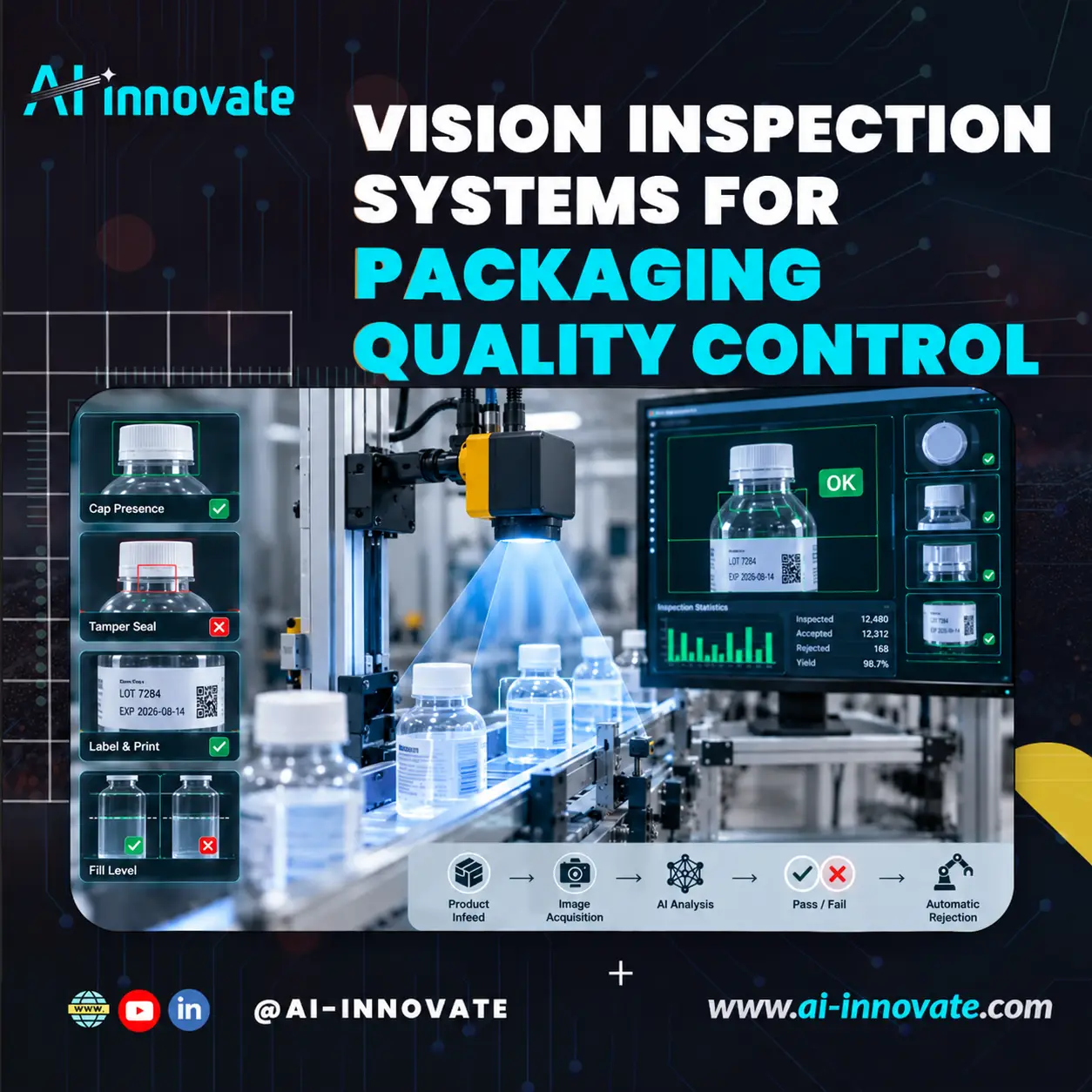
A packaging vision system typically runs a consistent four-stage sequence for every unit that passes the camera, regardless of the specific packaging format involved.
- Seal detection. High-resolution cameras scan seal edges for gaps, wrinkles, and incomplete fusion at full line speed, before the unit moves further down the line.
- Label verification. Vision models check label position, skew angle, and print clarity against a stored reference template specific to the SKU currently running.
- Fill-level check. Contour and depth analysis confirms fill height falls within the approved tolerance band, catching both underfill and overfill in the same pass.
- Reject and log. Non-conforming units are diverted automatically at line speed, and every rejection event is logged with image evidence for later root-cause review.
Compliance and Traceability: Why Packaging Inspection Carries Extra Weight
In regulated industries, packaging inspection is not only a quality function. It is a compliance control point, and errors here do not stay isolated to a single unit. An incorrect label or dosage marking creates direct risk of misuse, a missing insert makes an otherwise correct product non-compliant, and a serialization mismatch weakens the track-and-trace systems regulators rely on for anti-counterfeiting enforcement. A regulatory violation triggered by a packaging error can halt an entire batch, not just the specific defective units, which is why the stakes on a pharmaceutical or medical device line differ meaningfully from a purely cosmetic packaging defect on a consumer goods line.
This is where machine vision extends beyond simple pass or fail detection into genuine compliance infrastructure. OCR and OCV technologies verify that batch numbers, expiry dates, and serialization codes are not just present but correct for that specific production run, cross-checked against a production database rather than a generic template. Every inspection event, pass or reject, feeds into an audit-ready digital record, which materially reduces the preparation burden during a regulatory review compared to reconstructing paper logs after the fact.
This Topic might also interest you :
A Practical Rollout Timeline
Packaging lines rarely install vision inspection across every line simultaneously, and they should not. A staged rollout de-risks the investment and gives quality teams real time to tune detection thresholds against actual product variation before scaling further.
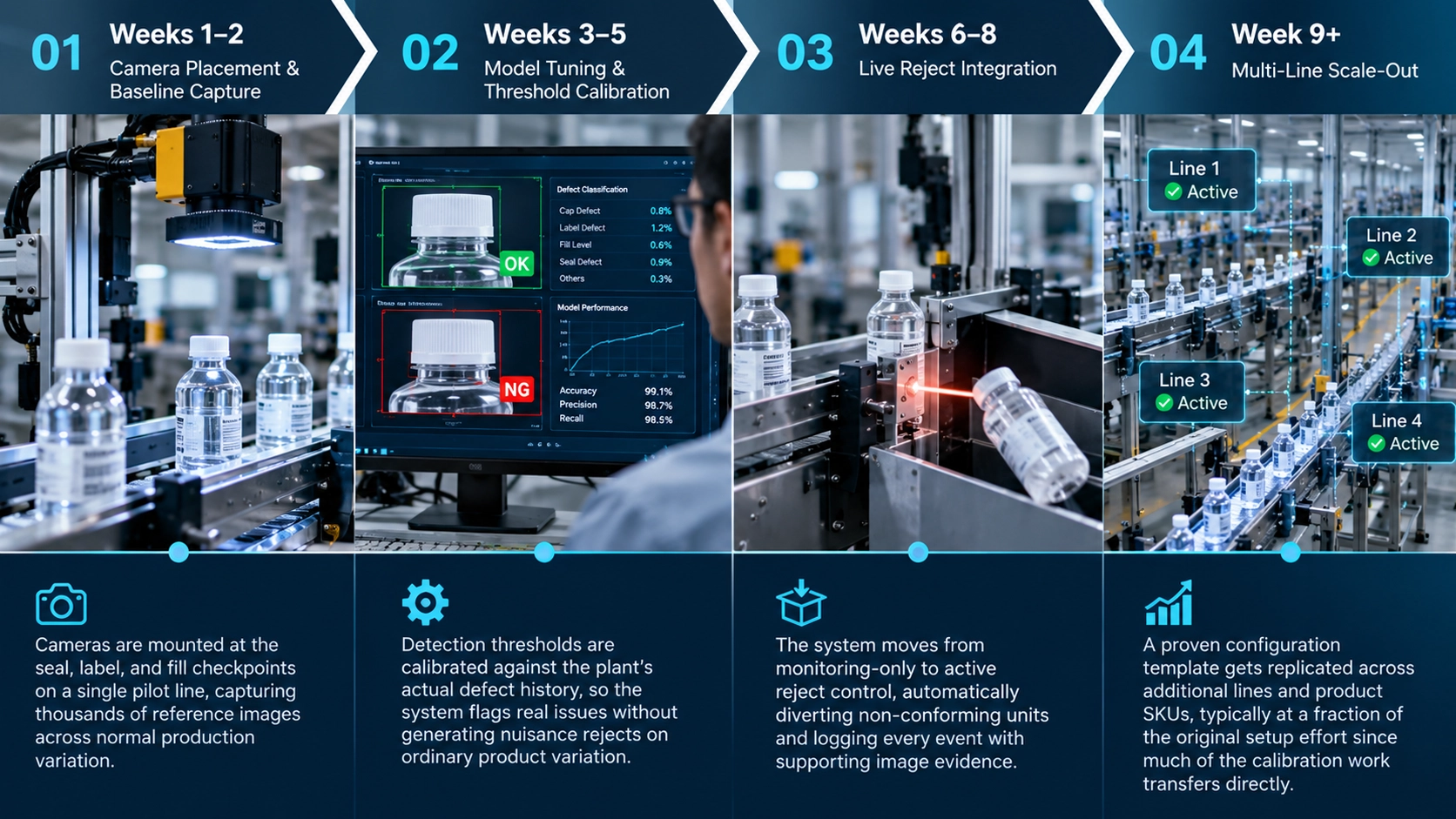
- Weeks 1 to 2: camera placement and baseline capture. Cameras are mounted at the seal, label, and fill checkpoints on a single pilot line, capturing thousands of reference images across normal production variation.
- Weeks 3 to 5: model tuning and threshold calibration. Detection thresholds are calibrated against the plant’s actual defect history, so the system flags real issues without generating nuisance rejects on ordinary product variation.
- Weeks 6 to 8: live reject integration. The system moves from monitoring-only to active reject control, automatically diverting non-conforming units and logging every event with supporting image evidence.
- Week 9 and beyond: multi-line scale-out. A proven configuration template gets replicated across additional lines and product SKUs, typically at a fraction of the original setup effort since much of the calibration work transfers directly.
Real-World Results: What Plants Actually Report
Manufacturers running continuous AI vision inspection on packaging lines report scrap reductions near 40 percent and customer complaint drops of roughly 60 percent within the first two quarters of operation, figures that track closely with the broader pattern seen across defects detected by AI vision systems in other manufacturing contexts: full coverage consistently catches what sampling structurally cannot. A single retailer chargeback for under-filled product, or a recall triggered by a compromised seal, can cost more than a full year of inspection camera investment, which is exactly the kind of asymmetric risk continuous inspection is built to close.
How AI-Innovate Powers Packaging Quality Control
Packaging inspection compresses several distinct hard problems into one production checkpoint: reflective and flexible surfaces, format-specific defect signatures, dimensional verification alongside surface checks, and, in regulated industries, compliance requirements that go well beyond a simple pass or fail decision.
How Continuous Inspection Actually Works on the Line
A packaging vision system typically runs a consistent four-stage sequence for every unit that passes the camera, regardless of the specific packaging format involved.
- Seal detection. High-resolution cameras scan seal edges for gaps, wrinkles, and incomplete fusion at full line speed, before the unit moves further down the line.
- Label verification. Vision models check label position, skew angle, and print clarity against a stored reference template specific to the SKU currently running.
- Fill-level check. Contour and depth analysis confirms fill height falls within the approved tolerance band, catching both underfill and overfill in the same pass.
- Reject and log. Non-conforming units are diverted automatically at line speed, and every rejection event is logged with image evidence for later root-cause review.
Compliance and Traceability: Why Packaging Inspection Carries Extra Weight
In regulated industries, packaging inspection is not only a quality function. It is a compliance control point, and errors here do not stay isolated to a single unit. An incorrect label or dosage marking creates direct risk of misuse, a missing insert makes an otherwise correct product non-compliant, and a serialization mismatch weakens the track-and-trace systems regulators rely on for anti-counterfeiting enforcement. A regulatory violation triggered by a packaging error can halt an entire batch, not just the specific defective units, which is why the stakes on a pharmaceutical or medical device line differ meaningfully from a purely cosmetic packaging defect on a consumer goods line.
This is where machine vision extends beyond simple pass or fail detection into genuine compliance infrastructure. OCR and OCV technologies verify that batch numbers, expiry dates, and serialization codes are not just present but correct for that specific production run, cross-checked against a production database rather than a generic template. Every inspection event, pass or reject, feeds into an audit-ready digital record, which materially reduces the preparation burden during a regulatory review compared to reconstructing paper logs after the fact.
A Practical Rollout Timeline
Packaging lines rarely install vision inspection across every line simultaneously, and they should not. A staged rollout de-risks the investment and gives quality teams real time to tune detection thresholds against actual product variation before scaling further.
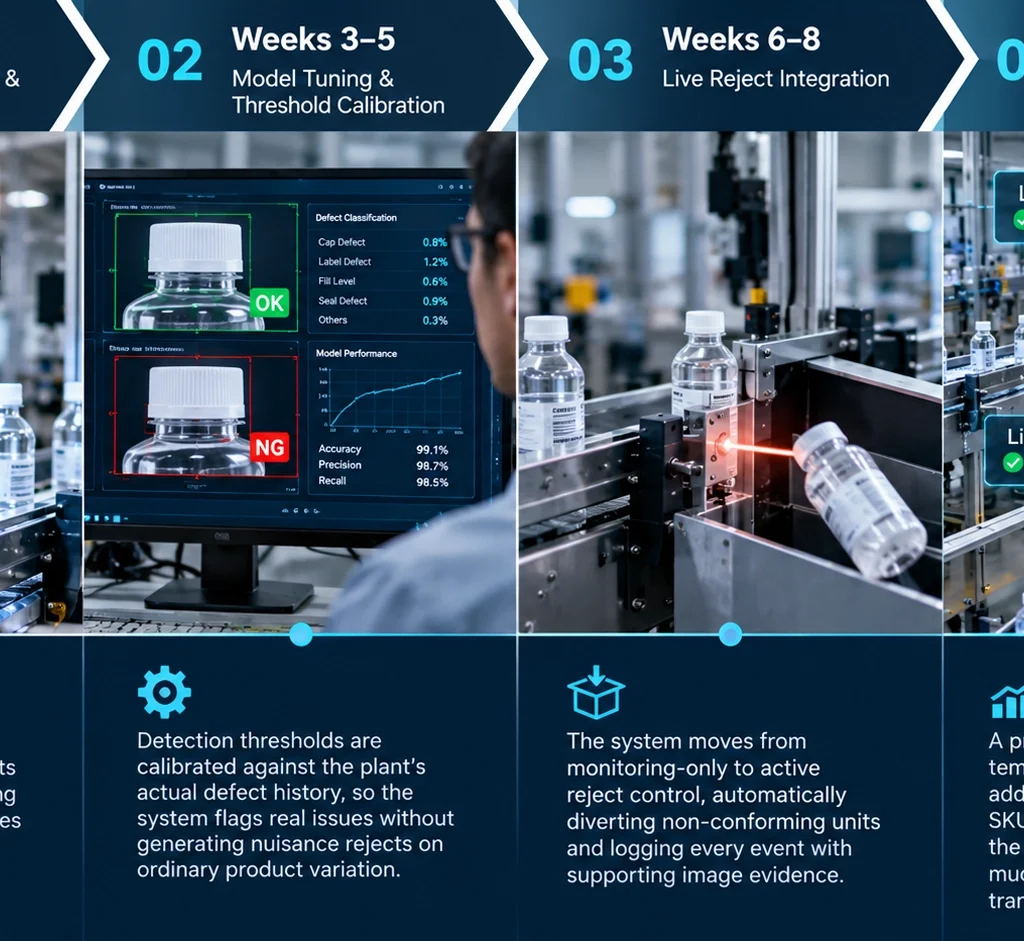
- Weeks 1 to 2: camera placement and baseline capture. Cameras are mounted at the seal, label, and fill checkpoints on a single pilot line, capturing thousands of reference images across normal production variation.
- Weeks 3 to 5: model tuning and threshold calibration. Detection thresholds are calibrated against the plant’s actual defect history, so the system flags real issues without generating nuisance rejects on ordinary product variation.
- Weeks 6 to 8: live reject integration. The system moves from monitoring-only to active reject control, automatically diverting non-conforming units and logging every event with supporting image evidence.
- Week 9 and beyond: multi-line scale-out. A proven configuration template gets replicated across additional lines and product SKUs, typically at a fraction of the original setup effort since much of the calibration work transfers directly.
Real-World Results: What Plants Actually Report
Manufacturers running continuous AI vision inspection on packaging lines report scrap reductions near 40 percent and customer complaint drops of roughly 60 percent within the first two quarters of operation, figures that track closely with the broader pattern seen across defects detected by AI vision systems in other manufacturing contexts: full coverage consistently catches what sampling structurally cannot. A single retailer chargeback for under-filled product, or a recall triggered by a compromised seal, can cost more than a full year of inspection camera investment, which is exactly the kind of asymmetric risk continuous inspection is built to close.
How AI-Innovate Powers Packaging Quality Control
Packaging inspection compresses several distinct hard problems into one production checkpoint: reflective and flexible surfaces, format-specific defect signatures, dimensional verification alongside surface checks, and, in regulated industries, compliance requirements that go well beyond a simple pass or fail decision.
AIxEye: Detection Tuned to Format-Specific Defect Signatures
AIxEye performs the real-time visual inspection across the full defect catalog covered in this guide, seal integrity, label placement, fill-level accuracy, print and barcode readability, adapting its detection logic to the specific packaging format running on a given line rather than applying one fixed threshold across bottles, cartons, and pouches alike.
AIxAm: Dimensional Verification for Structural Packaging Defects
AIxAm addresses the structural side of packaging inspection that a flat 2D image cannot capture: carton deformation, cap alignment, and fill-level measurement at the millimeter level, comparing captured geometry against the tolerances a specific packaging format actually requires.
AIxCore: Edge Processing Fast Enough for High-Speed Lines
AIxCore handles the on-site inference that keeps inspection decisions synchronized with reject mechanisms at full line speed, processing every unit locally so a flagged defect is diverted before it reaches a case packer, without the latency a cloud round-trip would introduce on a line running several hundred units a minute.
Final Thoughts
Packaging quality control succeeds or fails on a detail that is easy to overlook: the recognition that bottles, cartons, blister packs, and flexible pouches are not variations on a single inspection problem, but genuinely distinct challenges that each demand their own imaging approach, lighting technique, and detection logic.
The plants seeing the strongest results are not deploying one generic vision setup across every format on their line. They are matching inspection technique to the specific packaging format in front of them, backlighting for blister cavities, dark-field illumination for flexible seals, 3D profiling for cartons and caps, while building the compliance and traceability infrastructure that regulated industries require as a matter of course. With scrap reductions near 40 percent and complaint reductions near 60 percent consistently reported once these systems are properly tuned, the case for moving past sampling on any high-volume packaging line is no longer a difficult one to make.
Frequently Asked Questions
What are the most common defects found on packaging lines?
Seal failures, label misalignment, fill-level deviation, and print or barcode errors account for the overwhelming majority of packaging complaints across food, beverage, pharmaceutical, and consumer goods lines, each tied to a distinct point of failure in the packaging process.
Does packaging inspection work the same way for bottles, cartons, and pouches?
No. Each format presents a different imaging challenge: blister packs need backlighting to reveal cavity contents, flexible pouches need dark-field illumination to expose seal defects, and cartons need 3D vision to catch structural deformation that a flat label check would miss entirely.
How much can AI vision inspection actually reduce packaging defects?
Manufacturers running continuous AI vision inspection commonly report scrap reductions near 40 percent and customer complaint reductions of roughly 60 percent within the first two quarters of deployment, compared to manual sampling-based inspection.
How fast does a vision system need to run to keep up with a packaging line?
Modern inspection systems process each unit in milliseconds, comfortably keeping pace with lines running 300 to 600 units per minute. The camera and reject mechanism are synchronized so a flagged unit is diverted before reaching the next stage, without slowing the line.
Why does packaging inspection matter more in regulated industries like pharmaceuticals?
In regulated industries, a packaging error is a compliance failure, not just a quality issue. An incorrect label, missing insert, or serialization mismatch can halt an entire batch and trigger regulatory action, which is why pharmaceutical packaging inspection extends into serialization verification and audit-ready record keeping beyond simple defect detection.
How long does it take to deploy a packaging vision inspection system?
A typical staged rollout takes around eight to nine weeks from initial camera placement to full live reject control on a single pilot line, with additional lines added afterward using the proven configuration template, usually at a fraction of the original setup effort.
Sources
Ai-Innovate uses only high-quality sources, including peer-reviewed studies, to support the facts within our articles.
- iFactory AI. (2026). AI Vision for Packaging Line Inspection — 2026 Guide. https://ifactoryapp.com/blog/ai-vision-packaging-line-seal-label-fill-detection
- Bar Code India (BCI). (2026). Strengthening Pharma Packaging with AI-Powered Machine Vision. https://www.barcodeindia.com/blogs/ai-powered-machine-vision-for-pharma-packaging