




Glass wool is one of the most commonly used insulation materials for construction, bringing benefits like thermal insulation and soundproofing. Of course, the practicality of the product and the extent to which we can make use of these benefits depends entirely on the quality of the glass wool.
As such, quality control (QC) in glass wool production finds significance. Traditionally, QC was done by manual inspection, but it was slow, inconsistent, and time-consuming. Recent AI innovations, like computer vision, have enabled a faster and better inspection instead.
In this blog, we’ll take a look at how AI quality control works in glass wool production, how computer vision supports inspection, where AI can have the biggest impact, and what the main benefits are for manufacturers.
Improve Glass Wool Quality Control , With AI-Powered Inspection
Detect insulation defects, improve production consistency, reduce material waste, and automate quality inspection using AI vision systems.

Understanding AI Quality Control in Glass Wool Manufacturing
AI in quality control for glass wool production is a layer of smart monitoring systems that work alongside the production line. Instead of relying only on manual checks or end-of-line testing, AI helps track quality throughout the process.
The quality of glass wool depends on a number of important elements, such as fiber diameter, density, mat uniformity, binder application, curing quality, and final dimensions, all of which can be measured or monitored using sensors, cameras, thermal systems and process data. This is why AI is a good candidate for this type of manufacturing.
In simple terms, AI looks at large amounts of production data, compares it to normal operating conditions, and helps identify when something is about to go wrong. This allows quality teams to react faster and reduce the chance of producing off-spec material.
This Topic might also interest you :
What AI Looks Like on a Glass Wool Production Line
On a real glass wool production line, AI quality control usually works through several connected systems. These systems help monitor the product and the process at the same time.
This means that AI doesn’t only inspect finished glass wool. It can also support decision-making during the production process, helping operators to identify trends earlier and understand the source of any quality variations.
Common AI quality control functions include:
- Vision inspection to monitor surface appearance, color, and visible defects
- Soft sensors or predictive models to estimate quality values that are hard to measure directly in real time
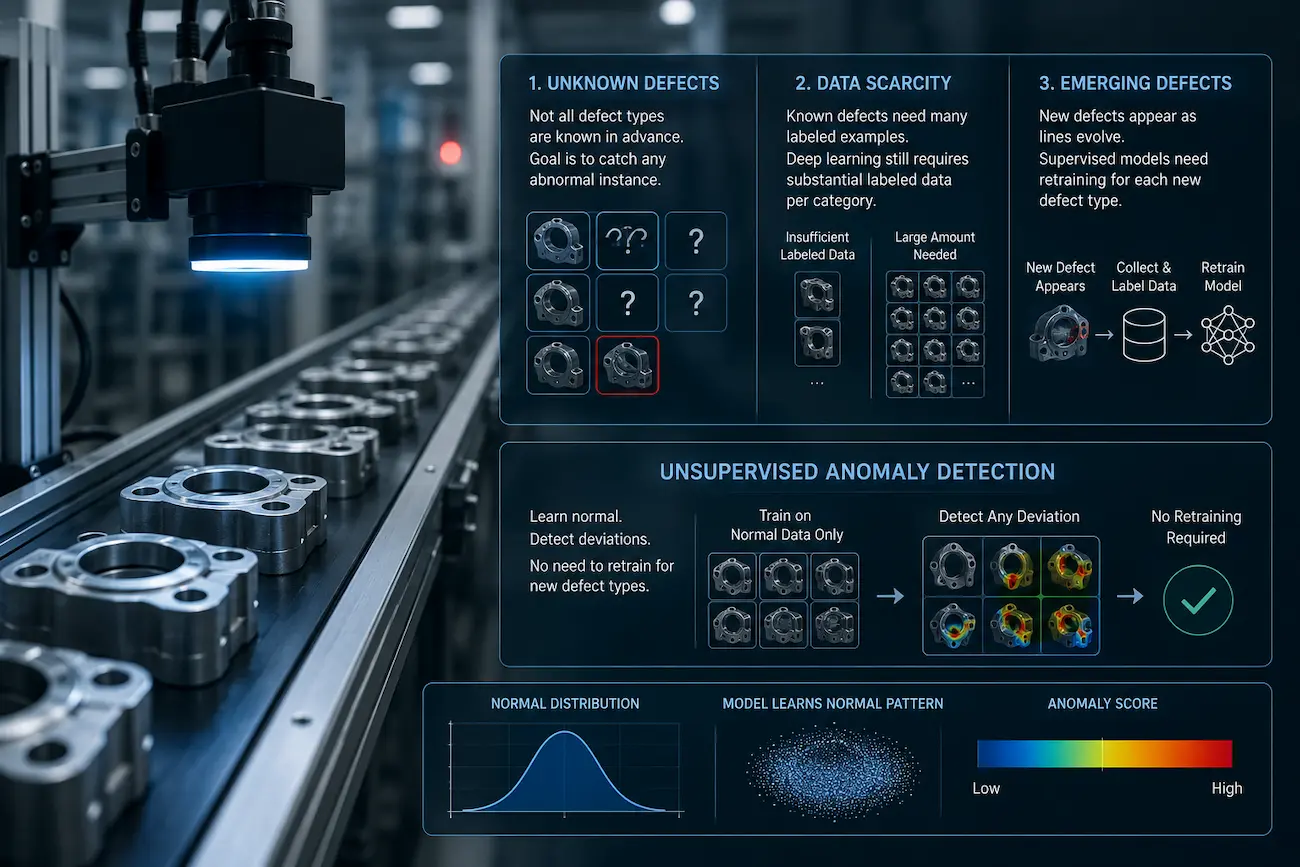
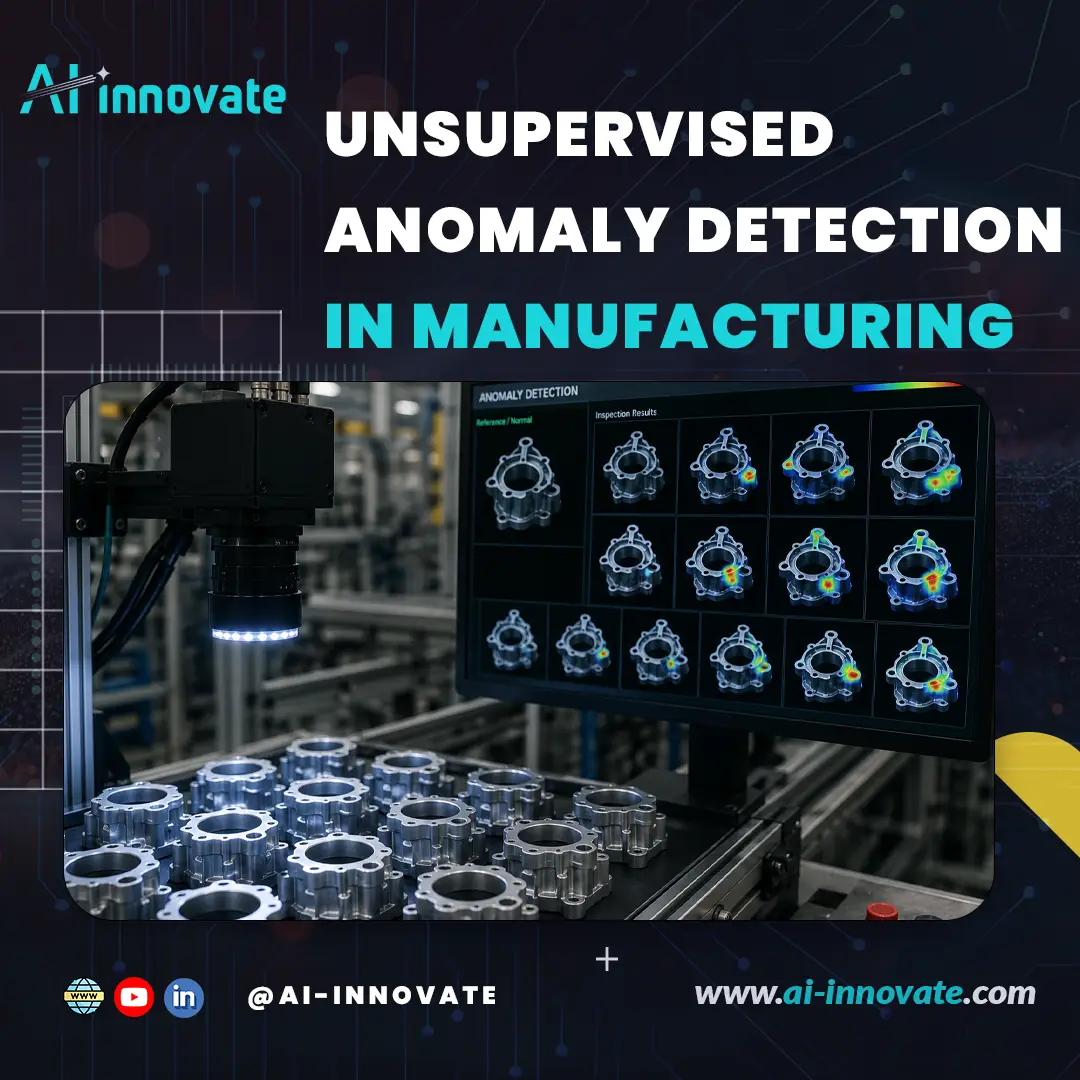
- Anomaly detection to identify unusual process behavior before it becomes a major quality issue
- Closed-loop recommendations that suggest changes to settings when performance starts to drift
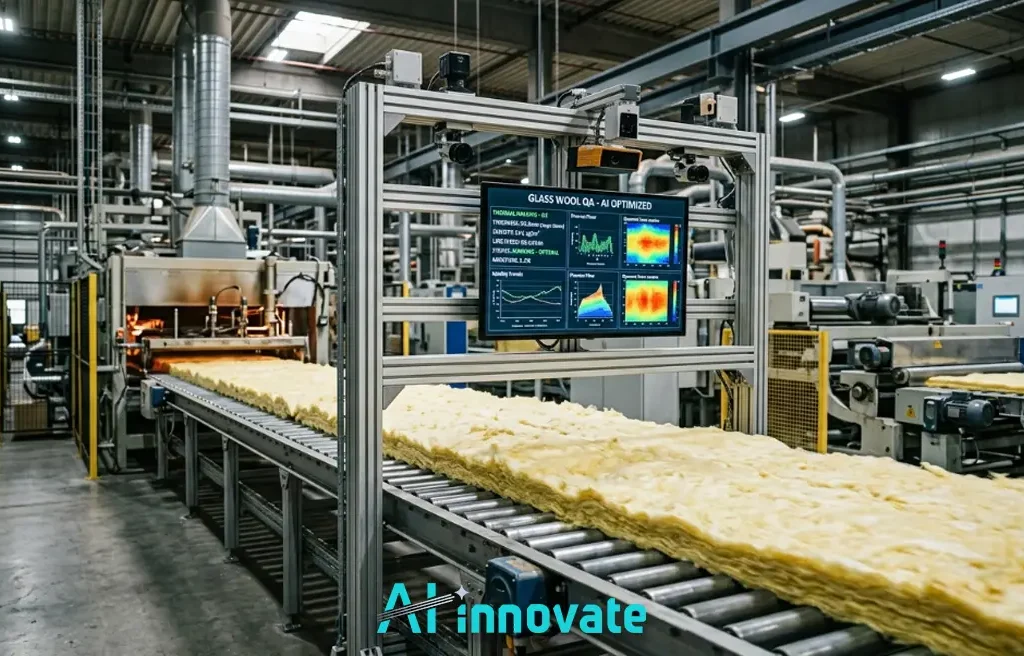
The Role of Computer Vision in Glass Wool Quality Control
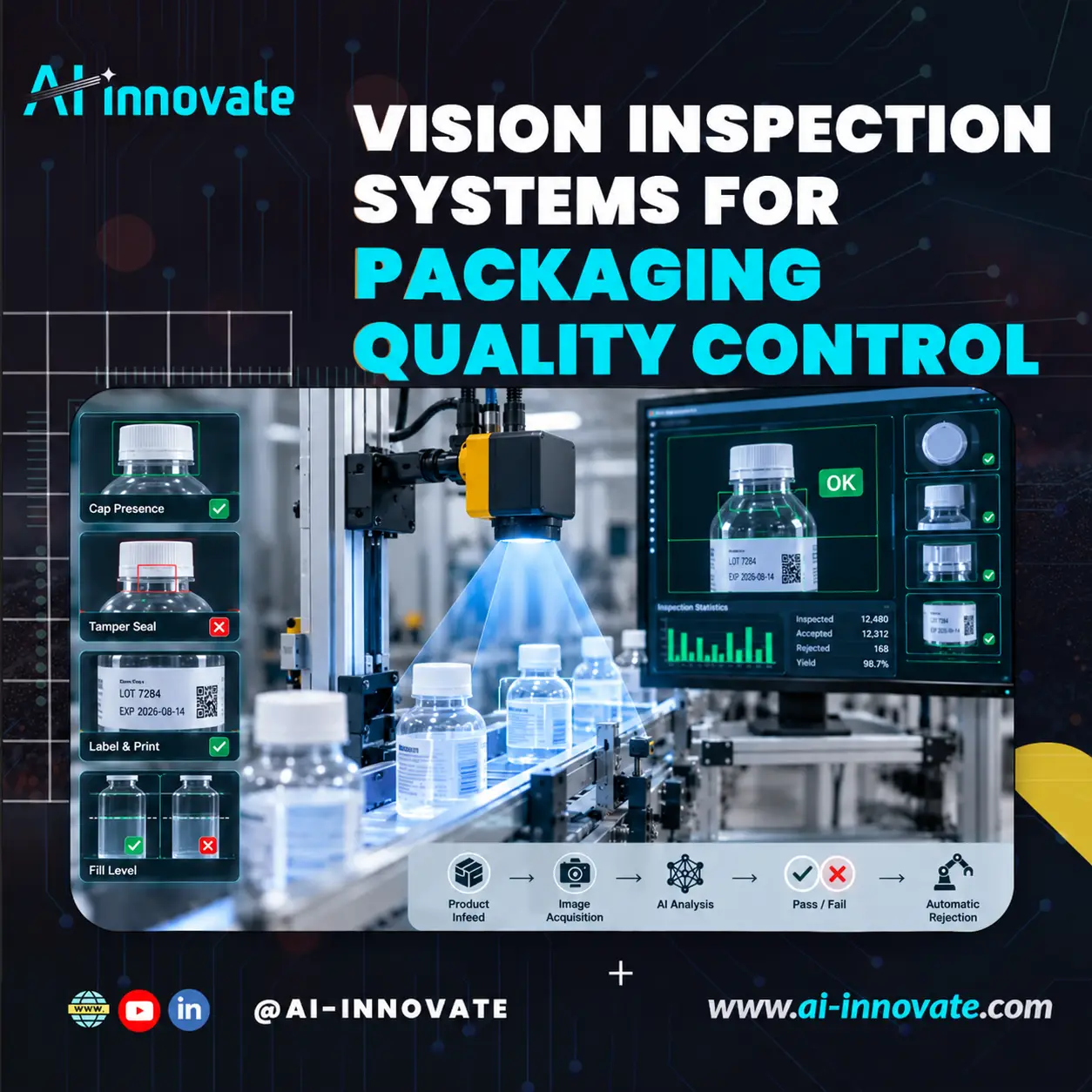
Computer vision is one of the most valuable AI tools in glass wool quality control. Cameras placed along the line can inspect the product continuously and detect patterns that are difficult to catch through manual inspection alone.
Surface Defect and Color Detection
Computer vision can identify visible surface issues such as dark spots, uneven coloration, tears, contamination, or irregular texture. These problems may be linked to process instability, binder distribution, or curing issues.
By checking the product surface in real time, vision systems can alert operators quickly and reduce the number of defective rolls or batts moving further down the line.
Lamella Inspection
For lamella products, a consistent structure and appearance are crucial. Computer vision systems can inspect various aspects of the product, including the cut orientation, edge quality, dimensional consistency and visible defects.
This helps manufacturers ensure that products meet quality requirements, reducing the risk of inconsistent material being sent to the next stage of handling or packaging.
Thermal Anomaly Detection
Thermal cameras can also be used as part of AI-powered inspection systems. They can detect unusual heat patterns during curing and other stages of production.
If one part of the production line is running hotter or cooler than expected, this could indicate issues with binder curing, oven performance or an imbalance in the process. AI can analyse these temperature patterns and help teams identify problems earlier.
This Topic might also interest you :
Key Areas Where AI Improves Glass Wool Quality Control
AI can be applied in various parts of glass wool production, but some areas tend to offer the highest value since they’re closely tied to product quality and process stability.
Fiberizing and Spinning Stability
One of the most important aspects of producing consistent glass wool is stable fibre formation. If the spinning conditions start to change, the quality of the product can deteriorate quickly.
AI models can monitor process signals and detect patterns that suggest instability in the fibre formation stage. This enables operators to respond before larger quality issues arise.
Density Uniformity Across the Mat
The performance of glass wool depends heavily on achieving the correct density throughout the product. If the density varies too much, the final product may not meet the required standards for insulation, strength or dimensions.
AI can analyse line data and inspection signals to identify uneven density patterns, thereby supporting better control of mat formation.
Binder and Cure Quality
The application and curing of the binder have a significant impact on the integrity and performance of the product. If the binder is not distributed properly, or if the curing process is inconsistent, the product may not perform as expected.
AI can help with tracking process conditions linked to binder quality and curing performance, making it easier to identify when adjustments are required.
Final Product Conformity
Before leaving the production line, the final product must still meet dimensional and appearance standards. AI inspection systems can be used to check thickness, width, visual quality and other key conformity points.
This provides manufacturers with an additional safeguard against shipping off-spec material.
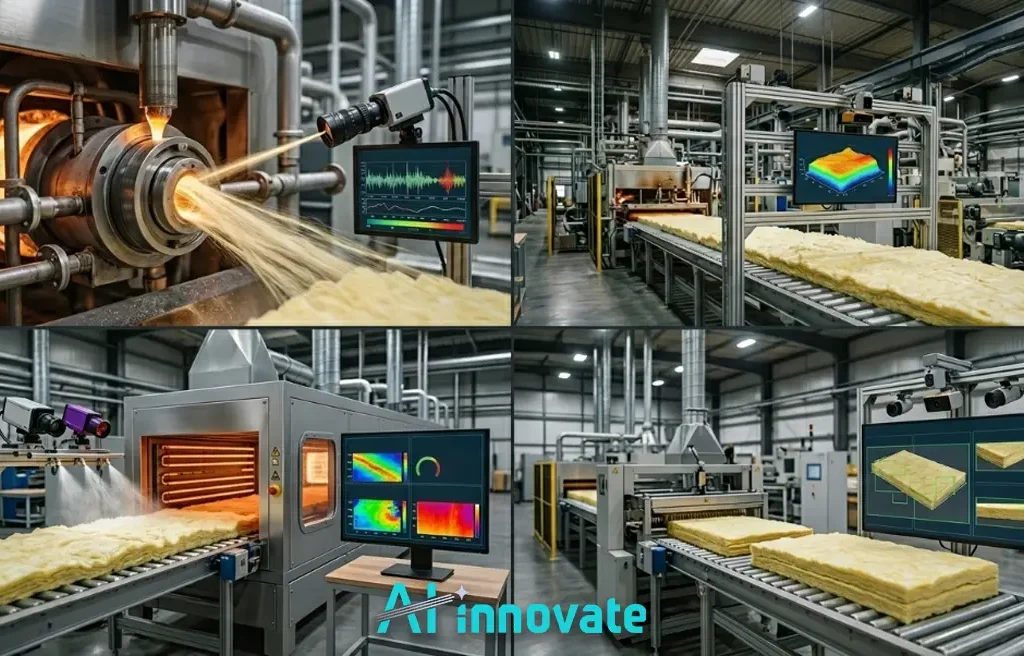
The Benefits of Using AI in Glass Wool Quality Control
When applied properly, AI can offer benefits beyond automation. It can improve consistency, reduce waste and enable production and quality teams to solve problems more quickly. These improvements can help manufacturers reduce costs while boosting customer confidence in their products.
Some of the main benefits include:
- Less scrap caused by process drift or undetected defects
- Fewer off-spec rolls or batts reaching the end of the line
- Faster root-cause finding when quality problems appear
- More stable quality across shifts and production runs
Turn AI Quality Control in Glass Wool Production into Measurable Manufacturing Gains
AI quality control only creates value when it is connected to the right inspection infrastructure, production data, and real-time decision-making systems. Moving beyond manual checks and isolated quality tests requires scalable edge processing, reliable vision pipelines, and AI models that can detect defects, process drift, and thermal anomalies directly on the production line.
At AI-innovate, we help glass wool manufacturers bridge the gap between inspection theory and plant-floor execution by providing:
- Edge AI infrastructure with AIxCore (powered by NVIDIA Jetson Orin AGX) for real-time process monitoring, thermal anomaly detection, and multi-sensor analysis across fiberizing, curing, and final inspection stages
- Intelligent visual inspection with AIxEye, enabling continuous detection of surface defects, color inconsistencies, lamella irregularities, and dimensional conformity issues before off-spec product moves downstream
- Synthetic data capabilities through AIxCam, helping teams strengthen quality models when labeled defect data, rare anomaly cases, or historical production failures are limited
Whether you’re improving defect detection on a single line or scaling AI quality control across multiple production stages, the key is combining robust data capture, explainable models, and industrial-grade deployment that works in real manufacturing environments.
Conclusion
AI-based quality control is becoming a practical tool in glass wool production, as AI can support better control over fibre formation, density, binder quality, curing and final dimensions by combining machine vision, process data, anomaly detection and predictive models.
More specifically, computer vision plays a particularly important role in detecting surface defects, inspecting lamella products, and identifying thermal anomalies in real time. When used effectively, these tools can lead to reduced scrap and off-spec products, faster troubleshooting and more consistent quality.
We believe as glass wool manufacturers continue to focus on efficiency and consistency, AI is likely to become an even more valuable part of modern glass wool quality control.
FAQ
What types of defects can AI identify in glass wool?
Surface & Structural Defects: Holes, scratches, fiber irregularities, and uneven cuts in lamellae.
Color Variations: Patches of discoloration or “yellowness” that signal chemical inconsistencies or aging.
Hidden Thermal Anomalies: Overheated glass particles trapped inside the material that could weaken insulation performance.
Density & Delamination: Structural issues like missing fibers or uneven density that affect the material’s thermal and soundproofing properties.
Does AI replace human quality controllers?
In many systems, the AI flags potential defects, but a human operator provides the final approval or correction. This creates a feedback loop where operator input is fed back into the AI to improve its accuracy over time
How long does it take to implement an AI system?
Implementation often starts with a Proof of Concept (PoC) to prove feasibility before a full-scale rollout.
Diagnostic Time: AI can reduce the time spent diagnosing quality issues from weeks to just one day by automatically applying engineering rules and formulas.
Retraining: Once a system is established, it can be retrained for new product specifications with minimal downtime, unlike traditional rule-based systems that require manual recalibration.
Sources
Ai-Innovate uses only high-quality sources, including peer-reviewed studies, to support the facts within our articles.
- DAC.digital. (2025). AI Quality Control in Glass Wool Production with Computer Vision — A case-study-style look at how computer vision and AI can automate defect detection in glass wool manufacturing, including surface inspection, lamella checks, and thermal anomaly detection. Retrieved from https://dac.digital/ai-quality-control-of-glass-wool/
- Intelecy. (2024). Unlocking Opportunities with No-code AI in the Glass Industry — An overview of how no-code AI can support glass manufacturers with energy optimization, quality assurance, process efficiency, and sustainability improvements. Retrieved from https://www.intelecy.com/blog/unlocking-opportunities-with-no-code-ai-in-the-glass-industry
- Glass Manufacturing Industry Council. (2025). How AI Is Supporting Sustainability Goals in the Glass Industry — An industry-focused article on how AI helps reduce emissions, improve energy efficiency, cut waste, and strengthen recycling performance in glass production. Retrieved from https://gmic.org/how-ai-is-supporting-sustainability-goals-in-the-glass-industry/
- Thinkivity. AI for Quality Control and Inspection in Glazing: Improving Precision and Efficiency — A practical explainer on how AI-driven inspection can improve precision, consistency, and operational efficiency in glazing and glass quality control. Retrieved from https://thinkivity.co.uk/faq/ai-for-quality-control-and-inspection-in-glazing-improving-precision-and-efficiency/