



Publication Note
This article is Part 5 of AI‑Innovate’s publication of the review paper ‘Evolution of AI‑Based Fabric Defect Detection: From Classical Vision to Foundation Models’. The manuscript has been divided into multiple articles solely to improve readability on the AI‑Innovate website. Apart from this publication note, article navigation, and editorial transitions, the research content remains unchanged.
6. Frequency-Based (Spectral) Methods
While deep learning was becoming increasingly dominant, another line of research returned to one of the most fundamental physical properties of textiles: periodicity.
Unlike natural images, woven fabrics are not random visual scenes. They are highly structured materials formed by the repetitive interlacing of warp and weft yarns. This repetitive arrangement creates a characteristic periodic texture that remains remarkably consistent across large areas of defect-free fabric. From a signal processing perspective, a fabric is therefore not merely an image, it is a periodic signal.
This observation led researchers to ask a fundamentally different question.
Instead of learning what a normal fabric looks like, could we detect defects simply by measuring how they disturb the fabric’s natural periodic structure?
This idea became the foundation of frequency-based anomaly detection.
Rather than analyzing individual pixels or deep feature embeddings, these methods transform the image into the frequency domain, where repetitive structures become significantly easier to characterize. In this representation, a defect is no longer viewed as an unusual collection of pixels but as a disturbance in the regular spectral pattern generated by the woven texture. Since even small structural changes alter the distribution of spectral energy, frequency-domain analysis offers a natural way to identify defects without explicitly modeling their appearance.
The earliest methods relied on global Fourier analysis.
Their underlying assumption was simple. A defect-free fabric produces a stable and highly regular frequency spectrum because of its repetitive weave pattern. Structural defects such as broken yarns, missing threads, holes, or weave distortions interrupt this periodicity, causing measurable changes in the spectral energy distribution.
By transforming the image into the frequency domain using the Fast Fourier Transform (FFT), these methods extracted characteristic spectral descriptors representing the overall fabric structure. Deviations from the expected spectral profile indicated the presence of anomalies, enabling inspection without directly analyzing local pixel intensities.
This approach offered several important advantages.
Because Fourier magnitude is inherently translation invariant, fabrics did not require precise alignment with the imaging system. Furthermore, periodic structures that appeared difficult to distinguish in the spatial domain often became highly organized in the frequency domain, making structural abnormalities easier to identify.
However, global frequency analysis also introduced an important limitation.
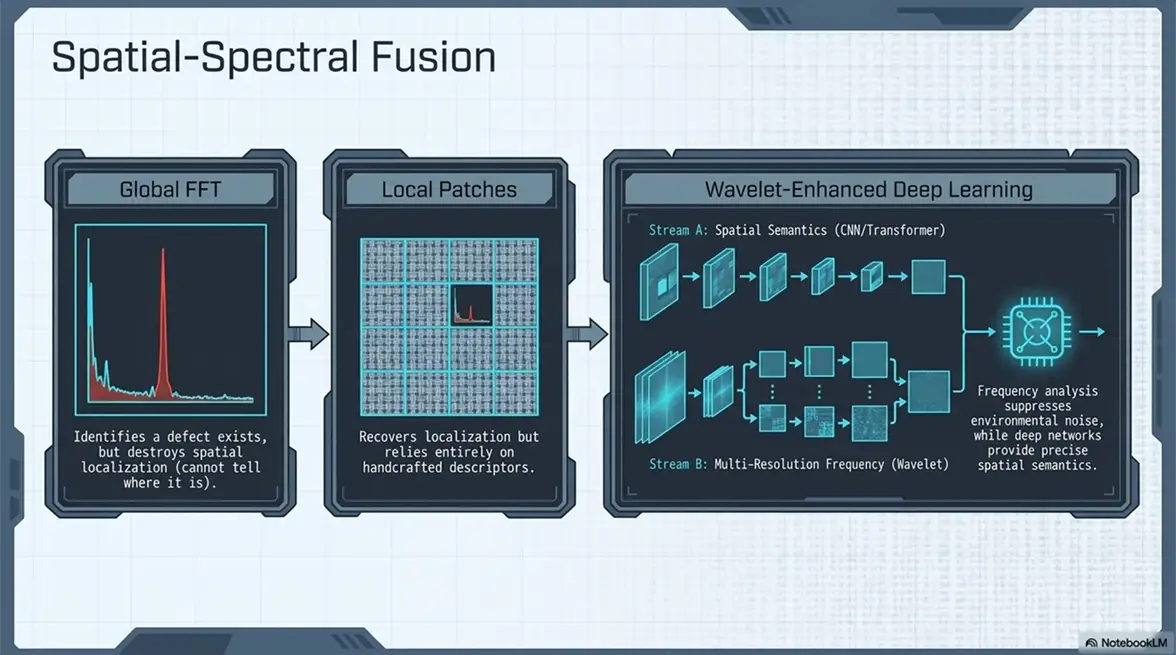
Although it could often determine that a defect existed somewhere within the image, it generally could not determine where the defect was located. Since the Fourier transform represents the entire image as a single global spectrum, valuable spatial information is largely lost. Small defects could also become masked by the dominant periodic structure, while illumination variations and sensor noise frequently distorted the spectral representation.
Researchers therefore sought a way to preserve the advantages of spectral analysis while recovering spatial localization.
This objective led to local spectral analysis.
Instead of computing one Fourier transform for the entire image, the fabric was divided into smaller patches, each analyzed independently in the frequency domain. By comparing the local spectrum of each patch with a refined estimate of the normal fabric spectrum, defects could be localized with much greater precision.
An important innovation of this generation was the realization that an explicit defect-free reference image was not always necessary. Since most industrial images contain predominantly normal regions, the algorithm could automatically estimate the characteristic spectrum of the fabric directly from the image itself by identifying the most consistent patches. This refinement process greatly improved robustness while preserving the fully unsupervised nature of the method.
For the first time, frequency-based inspection could simultaneously detect and localize anomalies without requiring dedicated training or manually collected reference samples. Nevertheless, these methods still relied entirely on handcrafted spectral descriptors and mathematical distance measures. While efficient and interpretable, they lacked the ability to learn rich hierarchical representations from data.
Meanwhile, deep learning has already demonstrated its remarkable capacity for extracting increasingly sophisticated visual features.
Rather than viewing these two research directions as competitors, researchers began exploring whether they could be combined.
This idea marked the emergence of wavelet-enhanced anomaly detection.
Unlike the Fourier transform, which represents frequency information globally, wavelet decomposition simultaneously preserves both spatial and frequency information. Every feature map is separated into multiple frequency subbands representing coarse structural information together with horizontal, vertical, and diagonal high-frequency details. This multi-resolution representation is particularly well suited to textile inspection because defects may appear across a wide range of spatial scales, from large structural distortions to individual broken yarns.
Instead of replacing deep neural networks, wavelet analysis became an additional stage within the feature extraction pipeline. Intermediate representations produced by convolutional backbones were decomposed into frequency components before being combined into unified feature embeddings. This strategy introduced physically meaningful feature selection, allowing the detector to emphasize either coarse structural variations or fine texture details depending on the inspection objective.
The integration of wavelet analysis with deep feature modeling substantially improved both anomaly detection and localization. At the same time, however, it also increased computational complexity and memory consumption. Modeling high-dimensional feature distributions together with multi-scale frequency information demanded considerable storage and processing resources, limiting deployment on industrial edge devices.
This progression reveals a remarkable evolution in frequency-based anomaly detection.
The earliest generation relied on global Fourier analysis, demonstrating that defects naturally disrupt the periodic structure of woven fabrics. The next generation introduced local spectral refinement, restoring spatial localization while eliminating the need for dedicated reference samples. Researchers then combined deep learning with wavelet decomposition, integrating semantic representations with multi-resolution frequency analysis to improve both localization and interpretability.
Most recently, these concepts have evolved into memory-efficient dual-stream architectures that merge semantic understanding with frequency-aware filtering, enabling robust real-time inspection on resource-constrained industrial hardware.
Although frequency-based methods approach anomaly detection from a fundamentally different perspective than feature-based or distillation-based models, they pursue the same objective: identifying deviations from the normal structure of a fabric. Their evolution illustrates that advances in industrial AI are not driven solely by increasingly larger neural networks, but also by combining modern learning algorithms with the physical characteristics of the materials being inspected.
Together with feature modeling, knowledge distillation, reverse distillation, and anomaly synthesis, frequency-based methods complete the major families of techniques that currently define the state of the art in automated fabric defect detection. The final section of this paper examines several complementary approaches and discusses how these developments translate into practical industrial inspection systems.
Next in the Series
Frequency-based methods demonstrate that combining physical knowledge of textile structures with modern AI can improve robustness and interpretability. In the final article of this series, the discussion turns to other complementary approaches before comparing the major families of methods, examining future research directions, and concluding with the key lessons from the evolution of AI-based fabric defect detection.
Series Navigation
Evolution of AI-Based Fabric Defect Detection
Continue reading all six parts of this research publication.