



Publication Note
This article is Part 4 of AI‑Innovate’s publication of the review paper ‘Evolution of AI‑Based Fabric Defect Detection: From Classical Vision to Foundation Models’. The manuscript has been divided into multiple articles solely to improve readability on the AI‑Innovate website. Apart from this publication note, article navigation, and editorial transitions, the research content remains unchanged.
5. Anomaly Synthesis Strategies
The methods discussed so far all shared a common philosophy. Regardless of whether they modeled feature distributions, transferred knowledge through teacher–student learning, or constrained information flow using reverse distillation, they relied exclusively on one assumption: only normal samples are available during training.
This assumption closely reflects real manufacturing environments, where defect-free products are abundant while defective samples are scarce and highly unpredictable. Nevertheless, it also introduces an inherent limitation. A model that has never observed defective patterns must infer anomalies solely as deviations from normality. Although this strategy has proven remarkably successful, it becomes increasingly difficult when defects are extremely subtle and lie very close to the boundary of the normal feature distribution.
Researchers therefore began asking a different question:
Instead of waiting for defects to appear naturally, why not create them?
This simple idea marked the beginning of anomaly synthesis.
Rather than treating the absence of defective data as an unavoidable limitation, anomaly synthesis methods transformed it into a controllable training process. Artificial anomalies are generated automatically from defect-free samples, enabling the model to learn not only what is normal but also what abnormality might look like.
The objective is not to reproduce every possible industrial defect perfectly, but to expose the detector to sufficiently diverse abnormal patterns that allow it to construct a more discriminative decision boundary.
The earliest synthesis methods operated directly in the image domain.
Their underlying principle was straightforward. A normal fabric image serves as the background, while artificial defect regions are inserted using simple masks and texture transformations. Geometric shapes such as circles, rectangles, or elongated regions simulate common manufacturing defects including holes, broken yarns, missing threads, and surface contamination. Within these regions, the original texture is modified through operations such as rotation, intensity adjustment, or shadow generation to create visually plausible defective samples.
This represented an important practical breakthrough. Manufacturers no longer needed to collect and annotate thousands of defective samples before training an inspection system.
These automatically generated images make supervised learning possible without requiring manually annotated industrial defects. Since the exact location of every synthetic defect is known during generation, pixel-level segmentation labels are obtained automatically, eliminating one of the most labor-intensive stages of dataset preparation.
However, experience quickly revealed another challenge.
Although image-level synthesis produced visually convincing defects, these artificial anomalies often failed to capture the enormous diversity of real manufacturing defects. Industrial defects rarely resemble perfect geometric shapes. Their appearance depends on complex interactions between yarn structure, weaving conditions, lighting, and material properties. Consequently, a noticeable realism gap often existed between synthetic and real defects, limiting the detector’s ability to generalize to previously unseen anomalies.
This observation motivated a fundamental shift in thinking.
Rather than modifying the image itself, researchers asked whether anomalies could instead be generated inside the feature space learned by deep neural networks.
Feature-space synthesis fundamentally changes where artificial anomalies are created.
Instead of manipulating pixels, the model first extracts feature representations from normal images using a pre-trained backbone. These representations are then projected into a domain better suited for industrial inspection before controlled perturbations are introduced. By slightly modifying the feature vectors rather than the original image, synthetic anomalies can be generated much more efficiently while remaining closer to the underlying representation used by the detector.
This strategy offers several important advantages.
Because feature vectors already encode high-level texture and structural information, relatively small perturbations can simulate subtle industrial defects that would be difficult to reproduce realistically in the image domain. Moreover, synthesis occurs after feature extraction, reducing computational complexity and avoiding many of the artifacts introduced by direct image manipulation.
Despite these improvements, another limitation gradually became apparent.
Most feature-space synthesis methods generated anomalies by injecting random Gaussian noise into normal feature representations. Although effective, these perturbations were inherently stochastic. A synthesized feature might move toward the decision boundary separating normal and abnormal samples, but it might equally move in an uninformative direction that contributes little to learning. As a result, many generated anomalies provided limited training value.
Researchers therefore began asking a more refined question:
Can anomaly generation itself become an intelligent optimization problem?
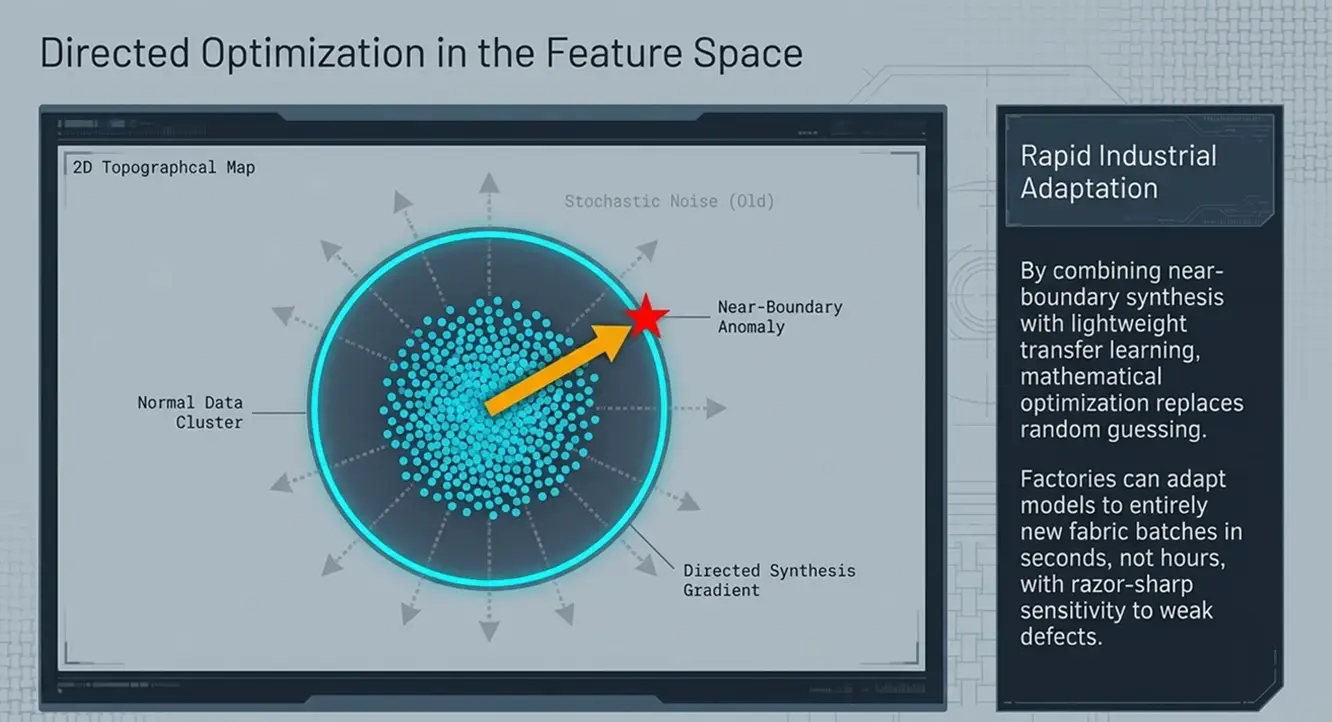
This question led to the development of directed anomaly synthesis.
Instead of relying on random perturbations, the synthesis process became guided by the detector’s own learning objective. Beginning with a normal feature representation, optimization techniques such as gradient ascent progressively move the feature toward the decision boundary that separates normality from abnormality. Rather than producing arbitrary synthetic defects, the model deliberately creates near-boundary anomalies, samples that remain very similar to normal fabrics while being sufficiently different to challenge the detector.
These difficult examples significantly improve the model’s discriminative capability.
As anomaly synthesis matured, attention gradually shifted from maximizing benchmark performance toward solving practical manufacturing problems.
By repeatedly training on anomalies located close to the normal distribution, the detector learns a much sharper decision boundary and becomes considerably more sensitive to weak industrial defects such as tiny broken fibers, faint stains, slight scratches, or subtle weaving inconsistencies. Image-level synthesis also continued to evolve alongside feature-level synthesis, generating increasingly realistic local defect textures that complemented the near-boundary feature representations.
In industrial environments, production lines frequently switch between different fabric types. Waiting several minutes, or even hours, for a new anomaly detector to be trained can interrupt production and reduce operational efficiency. Consequently, recent research has emphasized rapid adaptation rather than increasingly sophisticated synthesis algorithms.
Most recently, the emphasis has shifted toward rapid industrial adaptation, where lightweight transfer learning enables anomaly detectors to be deployed on new textile products with minimal training time and operational interruption.
The earliest methods generated anomalies directly in the image space, making supervised learning possible without manual annotation. The next generation moved synthesis into the feature space, producing more efficient and semantically meaningful abnormal representations. Subsequent research replaced random perturbations with directed optimization, generating challenging near-boundary anomalies that substantially improved sensitivity to weak defects.
This new generation combines lightweight transfer learning with synthetic anomaly generation to dramatically reduce training time. Instead of retraining an entire deep network, only a small number of intermediate feature layers are adapted to the current fabric type while synthetic defects provide the supervision required for learning. As a result, models can be prepared for new production batches within seconds rather than minutes, enabling inspection systems to begin operating almost immediately after a fabric change.
This progression illustrates a clear evolution in synthesis-based anomaly detection.
The earliest methods generated anomalies directly in the image space, making supervised learning possible without manual annotation. The next generation moved synthesis into the feature space, producing more efficient and semantically meaningful abnormal representations. Subsequent research replaced random perturbations with directed optimization, generating challenging near-boundary anomalies that substantially improved sensitivity to weak defects.
Most recently, the emphasis has shifted toward rapid industrial adaptation, where lightweight transfer learning enables anomaly detectors to be deployed on new textile products with minimal training time and operational interruption.
Although synthesis-based methods significantly reduce the dependency on real defective data, they continue to rely primarily on learning representations in the spatial domain. Yet fabrics possess another defining characteristic that has been exploited since the earliest days of automated inspection: their highly regular and repetitive structure. Because defects naturally disrupt this periodicity, researchers revisited an older but remarkably powerful idea, analyzing fabrics in the frequency domain. This perspective forms the basis of the next family of anomaly detection methods.
Next in the Series
Anomaly synthesis reduced the dependence on real defective samples by creating representative artificial defects for training. The next article examines a different perspective on the same problem by exploiting one of the defining characteristics of textiles: their periodic structure. Part 5 explores Frequency-Based Methods and explains how spectral analysis complements modern deep learning for industrial fabric inspection.
Evolution of AI-Based Fabric Defect Detection
Continue reading all six parts of this research publication.