





Every supervised defect detection model shares the same hidden assumption: you already know what the defect looks like. You collected examples of it, labeled them, and trained a model to recognize that specific pattern. That assumption quietly fails the moment a genuinely new failure mode shows up, a defect nobody has seen before, introduced by a process change, a new material batch, or a piece of equipment wearing in an unfamiliar way. A supervised model has no category for it. It was never trained to look for something it has never seen.
Unsupervised anomaly detection solves a fundamentally different problem. Instead of learning what specific defects look like, it learns what a normal, defect-free product looks like, and flags anything that deviates meaningfully from that learned pattern, whether or not that specific deviation has ever been seen before. This is not a theoretical distinction. In real manufacturing, defective samples are inherently scarce, the full range of possible defect types is rarely known in advance, and production lines evolve continuously, which means the defects a model needs to catch next month may not resemble anything in this month’s training data.
This guide covers why unsupervised anomaly detection has become a mainstream approach in industrial inspection, complementing the broader landscape covered in AI for defect detection, how the main technical methods actually work, what the field’s standard benchmark shows about real-world performance, and where this approach fits alongside supervised detection rather than replacing it outright.
Why Unsupervised Anomaly Detection Exists: The Labeled Data Problem
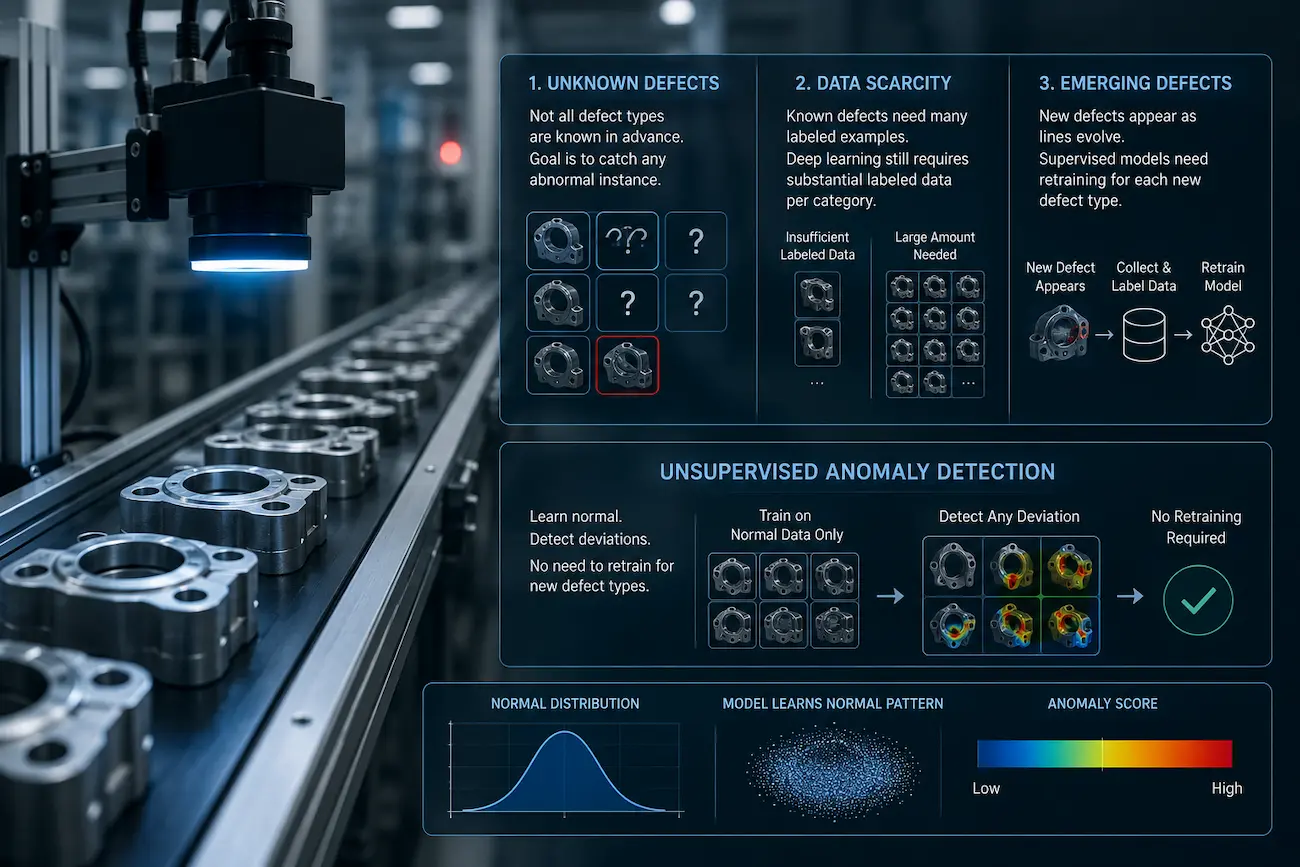
Three distinct problems push manufacturers toward unsupervised methods, and understanding them explains why this is not simply a workaround for insufficient data, but often the more appropriate approach entirely.
First, defect types frequently are not known beforehand. A manufacturer generally wants to catch any abnormal instance, not just the specific failure modes anticipated in advance, which is a poor fit for supervised models that depend on prior knowledge of exactly what they are looking for. Second, even when defect types are known, each one needs a meaningful number of labeled examples to train reliably, and most deep learning approaches still depend on substantial labeled volume per category despite advances in few-shot and one-shot learning, the same data scarcity challenge covered in AI machine vision for wafer defect detection, where synthetic data generation is used to work around a nearly identical constraint. Third, and often overlooked, new defect types emerge over time simply because production lines evolve, a resource change, a personnel change, a process drift, and a supervised model has to be retrained specifically on data representing that new defect type before it can catch it. Unsupervised models trained only to recognize deviation from normal do not carry this retraining burden in the same way, since they were never looking for a specific, named category of defect to begin with.
How Unsupervised Anomaly Detection Actually Works
The core mechanism is a form of one-class classification. During training, the model sees only normal, defect-free examples and learns to represent that normality as a statistical distribution, a learned feature space, or a reconstruction target, depending on the specific technique. At inference time, any input that falls meaningfully outside that learned boundary is scored as anomalous.
This is a genuinely different setup from standard object detection or classification, which require labeled examples of every category the model needs to recognize, defects included. Unsupervised anomaly detection needs zero defect labels for training. The training set contains only good samples, which is precisely what makes it a natural fit for manufacturing inspection, where defective samples are scarce by definition and represent exactly the class the model needs to catch.
The Main Technical Approaches
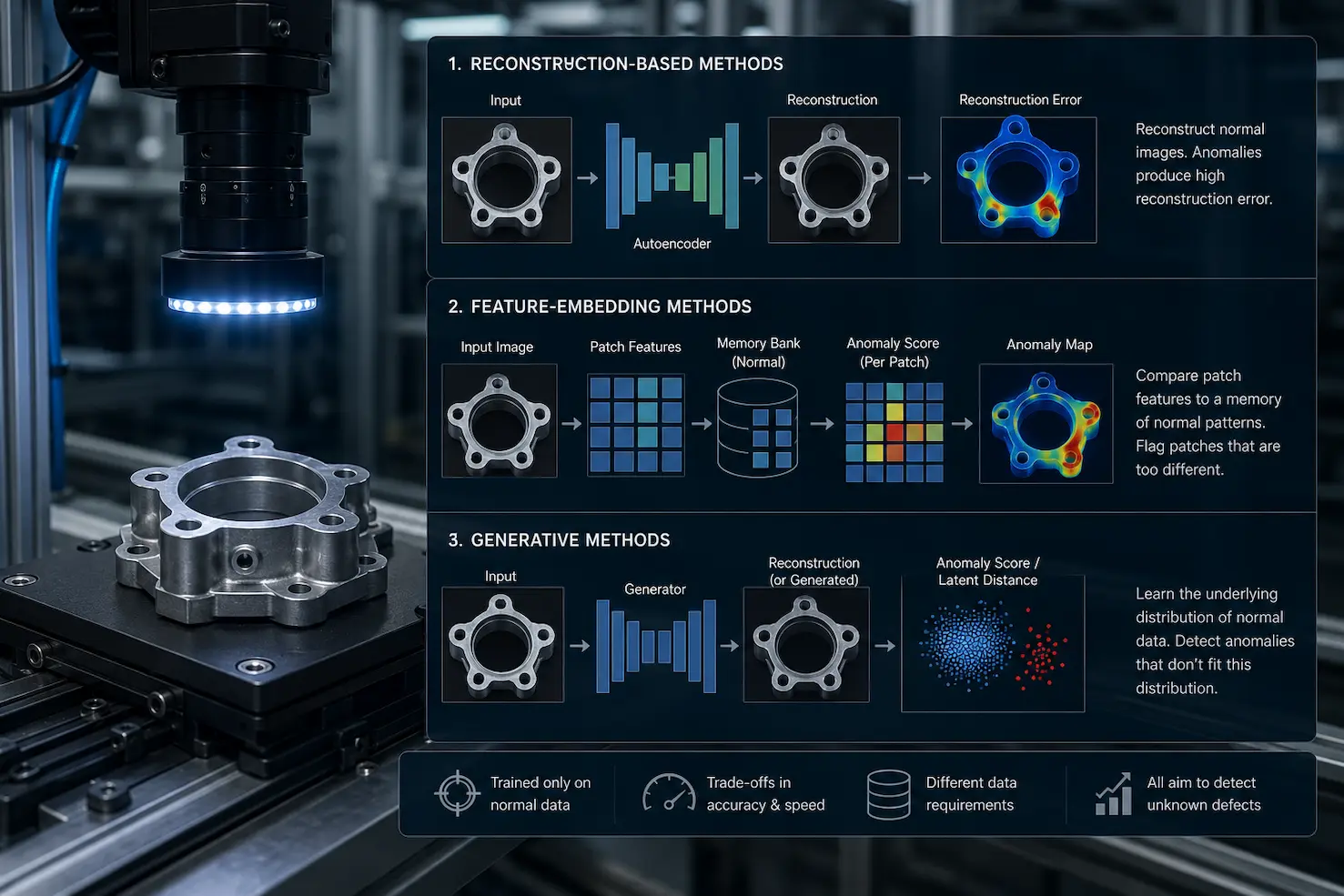
Unsupervised anomaly detection research has converged on a handful of distinct technical strategies, each with real trade-offs in accuracy, speed, and data requirements.
Reconstruction-Based Methods
Autoencoder architectures learn to compress and reconstruct normal images, and because they are trained exclusively on defect-free examples, they reconstruct anomalous regions poorly, producing a measurable reconstruction error that highlights where a defect likely sits. More advanced variants combine this with structural similarity loss or apply image inpainting techniques to improve robustness. DRAEM, a reconstructive-discriminative approach that trains against artificially generated anomalies using Perlin noise patterns, achieves a mean detection AUROC of 0.98 and localization AUROC of 0.973 on the standard industrial benchmark, approaching fully supervised results without ever training on a single real defect image.
Feature-Embedding Methods
Rather than reconstructing images, feature-embedding methods extract deep feature representations from normal samples and compare new samples against that learned feature space. PatchCore, one of the most widely adopted methods in this category, segments images into local patches, builds a memory bank of normal patch features, and flags anomalies based on how far a test patch’s features sit from anything in that memory bank. This patch-level, local approach to anomaly detection achieves strong detection and localization performance without requiring task-specific retraining for each new product line.
Generative Methods
Generative adversarial approaches, such as AnoGAN, learn the underlying distribution of defect-free texture patches directly, then detect anomalies by searching for the closest latent representation that could plausibly reproduce a given input. If no close match exists within the learned normal distribution, the input is flagged as anomalous. These methods were among the earliest unsupervised approaches applied to industrial inspection and remain an active area of ongoing research.
The Benchmark That Defined This Field: MVTec AD
Nearly every unsupervised anomaly detection method gets measured against the same standard: MVTec AD, a real-world dataset comprising 5,354 images across 15 industrial object and texture categories, established specifically to give the field a rigorous, comparable benchmark for unsupervised detection and localization.
Its significance goes beyond convenience. Because the dataset provides pixel-precise ground truth annotations for every defect type across diverse, realistic industrial categories, it has become the reference point that any new method has to beat to be taken seriously. The benchmark family has since expanded to MVTec AD 2, which raises the difficulty bar further, and MVTec 3D-AD, extending unsupervised anomaly detection into three-dimensional geometric data captured by industrial 3D sensors, covering defects like scratches, dents, and deformations that manifest as geometric anomalies rather than pure surface texture changes.
Lorem ipsum dolor sit amet, consectetur adipiscing elit. Ut elit tellus, luctus nec ullamcorper mattis, pulvinar dapibus leo.
Add Your Heading Text Here
Published, comparative research evaluating multiple unsupervised methods head-to-head gives a clearer picture than any single paper’s reported numbers.
| Method | Approach | Notable Strength |
|---|---|---|
| DRAEM | Reconstruction with synthetic anomaly training | 0.98 detection AUROC, 0.973 localization AUROC |
| PatchCore | Patch-level feature memory bank | Requires as few as 294 training images; strong localization accuracy |
| PaDiM | Feature distribution modeling | Fast training, well suited to rapid iteration across product categories |
| AnoGAN | Generative adversarial modeling | Early foundational approach; learns normal texture distribution directly |
The practical takeaway from comparative evaluation is that unsupervised models are genuinely able to meet the performance expectations of real industrial use cases, while offering the flexibility of training without any predefined knowledge of what specific defect types to expect. PatchCore in particular has demonstrated that inference time, initially around 2 seconds per image, can be reduced to roughly 500 milliseconds by tuning the size of the training dataset, without materially sacrificing detection quality.
PatchCore in Practice: What Makes It the Practical Choice
PatchCore deserves particular attention because its practical characteristics solve real deployment problems, not just benchmark scores. It requires only a few hundred training images, in published evaluation as few as 294, a dramatically smaller data requirement than most supervised approaches demand even for a single defect category.
It does not require retraining when a new defect type appears, since it is not looking for a specific defect signature to begin with, only for meaningful deviation from the normal patch features it has already learned. And with sufficient dataset refinement, published results show it approaching perfect classification performance on standard benchmarks, closing much of the gap that once separated unsupervised methods from their supervised counterparts.
When Unsupervised Beats Supervised (and When It Doesn't)
Unsupervised anomaly detection is not universally the better choice, and understanding where it genuinely outperforms supervised approaches, and where it still falls short, matters for choosing the right method for a specific line.
- Where unsupervised wins: catching defect types that have never been seen before, deploying on lines where defective samples are too rare to build a labeled dataset, and avoiding the retraining cycle every time a production change introduces a new failure mode.
- Where unsupervised still struggles: the field’s own benchmark research is candid that no current method fully solves the problem, particularly at the low false-positive rates industrial deployment actually demands, and subtle, low-contrast defects that closely resemble normal texture variation remain genuinely difficult across nearly every published method.
- Where a hybrid approach fits best: many production environments benefit from combining unsupervised detection as a broad first pass, catching genuinely novel anomalies, with supervised classification for well-characterized, high-volume defect types where labeled data already exists in abundance.
Getting Started: A Practical Path
- Collect a clean, representative set of normal-only images. The model’s entire understanding of “normal” comes from this dataset, so it needs to capture the real variation your line produces under normal operation, not just a handful of ideal samples.
- Choose a method based on your actual constraint. PatchCore for the best localization accuracy when defect location drives a repair decision; PaDiM when rapid iteration across many product variants matters more than squeezing out the last percentage point of accuracy.
- Set and validate your anomaly threshold carefully. The line between normal variation and a genuine anomaly is a tuning decision, not a fixed constant, and it should be validated against real production samples before going live, the same calibration discipline covered in real-time defect analysis.
- Monitor and periodically refresh the normal baseline. As legitimate process changes occur, materials, tooling, minor process adjustments, the definition of “normal” needs to evolve with them, or the model will begin flagging acceptable variation as anomalous.
How AI-Innovate Powers Unsupervised Anomaly Detection
Unsupervised anomaly detection addresses one of the most persistent constraints across every defect category this content has covered: the difficulty of building large labeled datasets for defects that are rare, evolving, or simply not yet known to exist.
AIxEye: Detection That Adapts as New Anomalies Emerge
AIxEye supports the kind of continuous, adaptive detection unsupervised approaches enable, catching genuine deviations from learned normal patterns rather than depending exclusively on a fixed catalog of previously labeled defect types.
AIxCore: Fast Enough Inference to Run Anomaly Detection at Line Speed
AIxCore handles the on-site processing that keeps anomaly detection fast enough for real production use, since the practical value of catching a novel defect drops sharply if the inference itself becomes a bottleneck on the line.
AIxAm: Extending Anomaly Detection Into Geometric and Dimensional Deviation
AIxAm applies the same underlying principle to 3D surface and geometric inspection, comparing captured part geometry against a learned normal baseline to catch dimensional anomalies that a purely 2D, texture-based approach was never built to see.
Final Thoughts
Unsupervised anomaly detection reframes the defect detection problem in a way that matches how manufacturing actually works: defective samples are scarce, new failure modes appear without warning, and waiting to accumulate enough labeled examples of a new defect type before a model can catch it is often not acceptable. Learning what normal looks like, and flagging genuine deviation from it, sidesteps that constraint entirely.
The manufacturers getting the most value from this approach are not treating it as a replacement for supervised detection everywhere. They are using it where it is genuinely suited, catching the unknown and the rare, while keeping supervised classification for well-characterized, high-volume defect categories where labeled data already exists. That combination, rather than a single universal method, is what closes the gap between what a model was trained to expect and what a real, continuously evolving production line actually produces.
Frequently Asked Questions
What is the difference between supervised and unsupervised anomaly detection?
Supervised detection trains on labeled examples of specific defect types and can only recognize defects it was explicitly trained to identify. Unsupervised anomaly detection trains only on normal, defect-free samples and flags any meaningful deviation from that learned pattern, including defect types it has never encountered before.
Why would a manufacturer choose unsupervised anomaly detection over supervised methods?
Unsupervised methods are especially valuable when defect types are not fully known in advance, when defective samples are too scarce to build a reliable labeled dataset, or on production lines that evolve frequently enough that a supervised model would need constant retraining to keep up with new failure modes.
How much training data does unsupervised anomaly detection actually need?
Requirements vary by method, but published research on PatchCore, one of the most widely used approaches, shows strong performance with as few as 294 training images, all of them normal, defect-free samples, since no labeled defect examples are required at all.
What production volume justifies investing in a vision system?
MVTec AD is the standard benchmark dataset for unsupervised anomaly detection, comprising 5,354 real-world images across 15 industrial categories with pixel-precise defect annotations. It is the reference point nearly every new unsupervised method is measured against, and its extensions now cover harder 2D scenarios and 3D geometric anomaly detection.
Can unsupervised anomaly detection replace supervised defect detection entirely?
Not entirely. Research in this area is candid that current unsupervised methods have not fully solved the problem, particularly for subtle defects at the low false-positive rates real production lines require. Most effective deployments combine unsupervised detection for novel or rare anomalies with supervised classification for well-characterized, high-volume defect types.
How fast can unsupervised anomaly detection run in production?
Performance varies by method and configuration, but published results on PatchCore show inference time reduced from around 2 seconds to approximately 500 milliseconds per image through dataset size tuning, fast enough for real production line deployment in most applications.
Sources
Ai-Innovate uses only high-quality sources, including peer-reviewed studies, to support the facts within our articles.
- Rippel, O., Mertens, P., & Merhof, D. (2023). Anomaly detection for industrial quality assurance: A comparative evaluation of unsupervised deep learning models. Computers & Industrial Engineering. https://www.sciencedirect.com/science/article/pii/S0360835223000694
- Bergmann, P., Fauser, M., Sattlegger, D., & Steger, C. (2019). MVTec AD: A Comprehensive Real-World Dataset for Unsupervised Anomaly Detection. Proceedings of the IEEE/CVF Conference on Computer Vision and Pattern Recognition. https://arxiv.org/pdf/2309.06884