A broken end or a missing pick can run through a long stretch of cloth before anyone notices it. Finished fabric is conventionally inspected by hand, often on a sample of the rolls, so faults in the rolls nobody checks can stay hidden until the fabric is sold [4]. A camera on the loom promises an earlier warning, but the loom is a hard place to take pictures. It vibrates, space around the new fabric is tight, and lint is everywhere. Inspecting the roll after weaving gives a steadier view of the whole surface, but only after the fault is already woven.
This guide compares on-loom and end-of-line fabric inspection defect by defect, so you can judge where each fault in your fabric is best caught and what to test before you decide. It is written for technical, production and weaving quality managers at the feasibility stage.
On-Loom vs End-of-Line Fabric Inspection: Which Should You Use?
Inspect on the loom when your main concern is catching faults that start and continue during weaving, such as broken ends, before more fabric is affected. Inspect the roll on an inspection machine when you need a complete, steady check of every roll for grading and acceptance. Many weaving mills need both, because no single point catches every defect equally well.
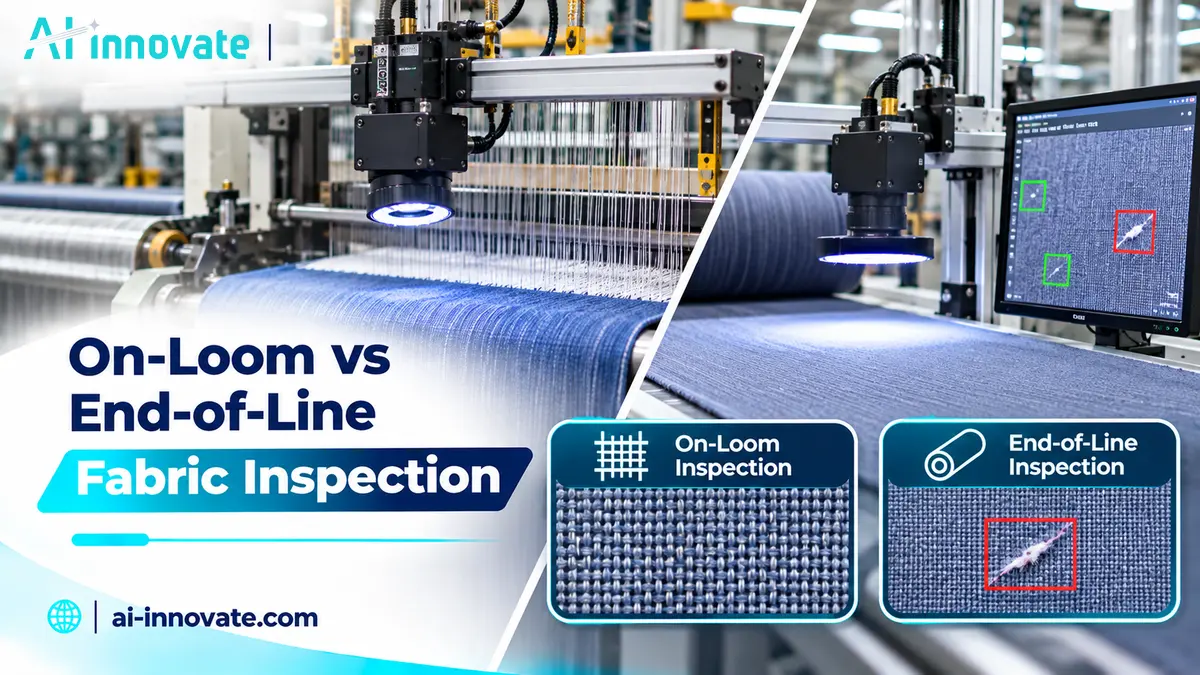
On-loom inspection watches the fabric while it is being made, near the fell, where each new weft yarn joins the cloth. Patents for this approach describe imaging the fell region to enable early detection or prevention of fabric defects [5]. The value is an early warning, so the weaver can react before more faulty fabric is produced.
Post-weaving inspection checks the woven fabric after it leaves the loom, while the roll is unwound on an inspection machine or table. The value is a full check of each roll before the fabric moves on. Conventional practice is manual inspection of finished fabric, and often only a sample of the rolls is inspected [4].
In this article, end-of-line fabric inspection means inspection right after weaving, not during dyeing or finishing. Later checkpoints in those stages are a separate decision. For the wider comparison across manufacturing, see our guide to inline inspection versus end-of-line quality checks.

Which Defects Can Start During Weaving?
Many visible faults in woven fabric are created on the loom itself. Standard terminology for fabric defects includes the defects of woven fabrics [7]. The faults most relevant to this choice are:
Broken ends start when a warp yarn breaks. The fault can show as soon as that part of the fabric passes the fell, and it continues along the length until the end is repaired.
Missing or broken picks start when a weft insertion fails. They can show across the width right after beat-up, unless the faulty yarn is caught before it is woven (see below).
Holes start when yarns break or go missing over a small area during weaving. They can show near the fell, although small holes may only be clear under suitable light.
Floats start when a yarn does not interlace as the weave intends. They can show soon after weaving, but may be easier to see on one face of the fabric.
Some stains can be picked up during weaving. Whether they show early depends on their contrast with the fabric and the light on it.
Some faults can even be stopped before they are woven. A weft fault can start before the yarn is beaten into the cloth. In one study on an industrial air-jet loom, weaving a faulty weft yarn into the fabric would cause a defect in its appearance and mechanical properties [3]. Once a fault is woven, it stays in the fabric. What changes afterward is whether, and where, someone can see it.
This is not a general guide to fabric defects. For defect types and detection methods across fabrics, see fabric defect detection using image processing.
What Can On-Loom Inspection Detect Earlier?
On-loom inspection is not new. Systems for in-process inspection on weaving machines have been commercially available since 2003 [1]. Their main promise is earlier detection.
That promise can reach the loom itself. In one patented design, the controller can optionally stop the loom when it detects a critical weaving fault [5].
Research systems show what a loom-mounted camera can reach. One prototype used a traversing camera sled, with a vibration damper and back lighting, to capture high-resolution images and track individual yarns [2].
Another used fixed cameras above the shed, as the example below describes.
Quick Insight
Example from research: catching a faulty weft before it is woven
RWTH Aachen researchers mounted four industrial cameras in a sensor bar above the shed of an industrial air-jet loom, a Dornier A1, facing down at 200 dpi. On this loom, a weft sensor stops production when a weft yarn fails, and an automatic routine then tries to remove the faulty yarn. The authors report that this removal succeeds in only 80% of detected cases. The cameras check whether a faulty weft yarn is still in the shed, so the operator can correct the machine before any defective fabric is produced [3]. Roll inspection cannot catch this fault at that point, because by then the yarn is already woven.
The limits come from the field of view. A traversing camera sees one part of the width at a time, so a short fault elsewhere can pass while the camera is away. A fixed camera array avoids the motion problems of a moving camera, but each camera covers only its own region [3]. Neither sees what happens to the fabric after it leaves the loom.
Where Should the Camera Look?
The answer depends on the fault you want to catch first:
At the shed, to see a faulty weft yarn before it is beaten in.
At the fell region, to see newly woven fabric as early as possible.
Across the woven fabric before take-up, to see defects over the full structure at high resolution.
Each position trades earliness against how much of the fabric, and of each defect, the camera can see. Mounting space, safe operator access and the loom’s moving parts also limit where a camera fits.
How Do Lighting and Vibration Affect the View?
A loom is a demanding place for imaging. Researchers note that most on-loom systems are prone to the machine’s unavoidable vibrations [1]. Vibration can blur the image and shift the fabric relative to the camera, which hides small or low-contrast faults.
Research systems treat vibration as a design problem. One added a camera vibration damper, as described above, and another built its detection to cope with vibration and variable loom speed [10].
Lighting is the second constraint. Ambient light on a weaving floor can change from loom to loom and through the day. Controlled lighting, such as the back lighting used in the traversing prototype, can make yarn structure and gaps easier to see. Choosing the light source and lens is part of the image acquisition design, not an afterthought [9].
Lint and fluff add a third problem. Loose fibers can settle on lenses and lights, and lint can be woven into the cloth, where it becomes a defect in its own right [5].
View obstructions add a fourth constraint. Near the fell, loom parts such as the reed and the temples that hold the fabric width, along with the take-up path, can block part of the view. Weavers also need access to the same area to repair breaks, so the camera must keep a clear line of sight without getting in their way.
Together, these four factors often decide the camera position as much as the defect itself does. A position with less vibration, controllable light, room to clean the lens and a clear view may sit further from the fell, which delays detection slightly. That trade-off is worth testing on the loom you plan to use.
Quick Tip
Before you fix a camera position, measure vibration at that exact spot and check how quickly lint builds up on the lens and light there. A steady position that is easy to keep clean can be worth a slightly later detection point.
What Changes on Patterned Fabrics?
Plain fabrics are the easier case. Defect detection on plain, unpatterned fabrics is well developed, while patterned fabrics such as jacquards need methods built for the design [8].
In practice, the system has to tell a planned change in the design from an unplanned one, so the pattern repeat, colors and weave structure must all be part of the test.
What Does Post-Weaving Roll Inspection Add?
Roll inspection can see the whole surface of each roll it checks, under steadier conditions. The check happens as the roll is unwound, because a wound roll shows only its outer layer. The fabric moves at a controlled pace, away from the loom’s vibration, and the light and camera, or the inspector, can be set up for the fabric being checked. Standard methods for visually inspecting and grading fabrics can be used, when buyer and seller agree, to accept individual rolls and shipments [6].
It can also record where each defect is. Because the fabric passes at a known pace, each defect can be logged by its position along the roll and across its width. A fabric inspection equipment maker describes its automated system as detecting, recording and locating defects in every roll and generating a defect map [11].
The limitation is timing. By the time a roll is inspected, a fault that continues, such as a broken end, may already run along a long length of fabric. When inspection is manual, results also depend on the inspector’s detection rate and limited span of concentration [1]. A later checkpoint does not make every defect clearer, either. Some faults are easier to judge on the steady roll, while others are easier to catch as they form on the loom. Color differences are a separate topic, covered in color defect detection.
Which Inspection Point Fits Each Defect?
The table gathers the points made in the sections above, where the sources are cited. For each defect, it shows where it is often easier to catch, when it becomes visible and what limits each point. Treat the second column as a starting point. Testing on samples of your own fabric decides the final answer.
| Defect | Often easier to catch at | When it becomes visible | Limits on the loom | Limits on the roll |
|---|---|---|---|---|
| Faulty weft yarn | Loom, at the shed | Before beat-up | Needs a camera at the shed | Seen only once woven |
| Broken end | Loom, for early warning | As it passes the fell; runs on until repaired | Camera must cover that part of the width | May already run a long length |
| Missing or broken pick | Loom, soon after beat-up | Right after beat-up | A traversing camera can miss a short fault | Found after more fabric is woven |
| Hole | Either; roll to judge size and position | Near the fell | Small holes need suitable light and resolution | Found later |
| Float | Roll, for a steady check | Soon after weaving; sometimes on one face only | Small floats need a steady, high-resolution view | May be missed if only one face is checked |
| Some stains | Roll, for steady light and contrast | Depends on contrast with the fabric | Lint on lenses can look like marks | Found later |
Swipe to see the full table
No single answer fits every line. The result depends on your fabric, the defects that matter and your loom conditions, so confirm it on real samples. Once you know which defects matter most, compare them with the woven fabric inspection applications that AI-Innovate describes for textile production.
When Is Inspection at Both Stages Needed?
Use both when your defect list includes faults that are best caught at different moments. A typical case combines continuous faults, such as broken ends, where an early warning limits waste, with the need for a complete roll record for grading and customer acceptance [6].
Both stages also make sense when the fabric range is wide. A loom camera set up for one fabric may need new settings after a style change, while roll inspection still checks each roll. One inspection point does not have to cover every defect type, and on many lines it cannot.
For production, the two points place different demands on the floor. On-loom inspection needs a system on every loom you want to cover, and its alerts reach weavers during the shift, so false alarms cost loom time. Roll inspection can serve fabric from many looms at one station, but the response comes later. Lenses and lights at the loom also need regular cleaning of lint.
If you use both, plan how on-loom alerts reach the weaver and how on-loom records relate to roll grading, so the two stages support each other instead of repeating the same work.
Quick Note
Hypothetical example: combining both inspection points
A weaving mill runs a dense plain weave and a jacquard. Its most frequent fault on the plain weave is broken ends, a continuous fault that runs along the warp direction until the end is repaired. Its customers accept fabric as graded rolls. Following the logic of this article, the mill would first trial a loom-mounted camera near the fell on the plain-weave looms, where an early warning limits how far a broken end runs. Every roll of both fabrics would still go through roll inspection for grading [6]. The jacquard would stay on roll inspection until tests on its samples show that a loom camera can separate the planned pattern from real faults. This scenario is illustrative and does not describe a specific mill or project.
What Should You Test Before Choosing a Location?
Test each candidate position with the same fabric and the same defects: image the fabric on the loom while it is being woven, and run sample rolls on the inspection machine. Check these factors before you decide:
Loom model: mounting space, operator access and moving parts near the fell.
Fabric width: the full width the inspection must cover.
Fabric type and design: weave, yarn, color and pattern repeat.
Smallest defect that matters: it sets the resolution you need.
Lighting: ambient light at the loom and on the inspection machine.
Line speed: weaving speed on the loom and unwinding speed on the inspection machine.
Vibration: measured at the exact position where the camera would sit.
This guide does not cover hardware selection, camera count or return on investment. How speed affects image capture is covered in high-speed imaging for automated inspection.
Author's Suggestion
Start with the one or two defects that cost you the most, and trial a single inspection point on real samples of that fabric. Widen the setup only once those defects show clearly and the false alarms stay at a level your weavers can live with.
How Can AI-Innovate Assess Your Application?
The assessment uses your own fabric and follows three steps:
Sample review: the defects you need to catch, the smallest one that matters and the range of fabrics you produce.
Line conditions: space, light, vibration and speed at each candidate point, on the loom and at the inspection machine.
Imaging tests: images of your samples under controlled lighting, to see whether each defect shows clearly enough to be told apart from acceptable fabric.
AIxEye, AI-Innovate’s 2D automated visual inspection system, is used for visible woven fabric defects. Where visibility and contrast limit reliable capture, AIxLight, AI-Innovate’s engineered machine vision lighting, can be evaluated as part of the imaging setup. It is not a required part of every project.
The result shows whether AIxEye is a realistic fit for your application and whether the lighting needs to be engineered for your fabric. If the fit looks promising, the next step can be a full demo, a technical assessment or a pilot.
Share a sample of your woven fabric, the defects you want to catch, the specifications of your loom and inspection machine, and the conditions on your line, such as light, vibration and speed. AI-Innovate will review whether inspection on the loom, on the roll or at both points is feasible for your fabric. No detection accuracy, speed or automatic loom stop is promised before testing.
Frequently Asked Questions
What is on-loom fabric inspection?
On-loom inspection uses a camera mounted on the weaving machine to check the fabric while it is being made, near the fell where each new weft yarn joins the cloth. Its main value is an early warning, so the weaver can react before more faulty fabric is produced.
What is end-of-line fabric inspection?
End-of-line fabric inspection checks the woven fabric after it leaves the loom, while the roll is unwound on an inspection machine or table. It gives a full, steady check of each roll for grading and acceptance, but it finds faults only after they are woven.
Is roll inspection still needed if you inspect on the loom?
Often, yes. On-loom inspection gives an early warning, while roll inspection gives a complete record for grading and acceptance. Whether you can reduce roll inspection depends on test results for your fabric.
What sample should you send for an evaluation?
Prepare four things:
- Defect samples: fabric with and without each defect you care about, labeled by defect type, including the smallest defect that matters.
- Fabric details: weave, yarn, color, width and pattern repeat.
- Loom details: loom type and model, weaving speed, and photos of the planned camera position under current lighting.
- Inspection machine details, if you have one: machine type, unwinding speed, lighting, and how you inspect today.
References & Sources
- Neumann, F., Holtermann, T., Schneider, D., Kulczycki, A., Gries, T., Aach, T. In-process fault detection for textile fabric production: onloom imaging. Proc. SPIE 8082, Optical Measurement Systems for Industrial Inspection VII, 808240, 2011. doi:10.1117/12.889345
- Schneider, D., Holtermann, T., Merhof, D. A traverse inspection system for high precision visual on-loom fabric defect detection. Machine Vision and Applications, 25, 2014, pp. 1585 to 1599. doi:10.1007/s00138-014-0600-y
- Kopaczka, M., Saggiomo, M., Güttler, M., Gries, T., Merhof, D. Fully automatic faulty weft thread detection using a camera system and feature-based pattern recognition. Proceedings of ICPRAM 2018, pp. 124 to 132. Paper (PDF)
- US Patent 9,499,926 B2. On-loom fabric inspection system and method. Granted November 22, 2016. Patent text
- US Patent 11,091,858 B2. On-loom fabric inspection system and method. Granted August 17, 2021. Patent text
- ASTM International. ASTM D5430-26, Standard Test Methods for Visually Inspecting and Grading Fabrics. Standard page
- ASTM International. ASTM D3990-12(2020), Standard Terminology Relating to Fabric Defects. Standard page
- Ngan, H.Y.T., Pang, G.K.H., Yung, S.P., Ng, K.P. Defect detection on patterned jacquard fabric. 32nd Applied Imagery Pattern Recognition Workshop, 2003, pp. 163 to 168. doi:10.1109/AIPR.2003.1284266
- Hanbay, K., Talu, M.F., Özgüven, Ö.F. Fabric defect detection systems and methods: a systematic literature review. Optik, 127(24), 2016, pp. 11960 to 11973. doi:10.1016/j.ijleo.2016.09.110
- Texas Tech University, Applied Vision Lab. Defect Detection (on-loom fabric defect detection). Web page
- Uster Technologies. Data-based yield improvement: Uster automatic fabric inspection leads the way to the future. Press release, April 11, 2022. Press release (PDF)