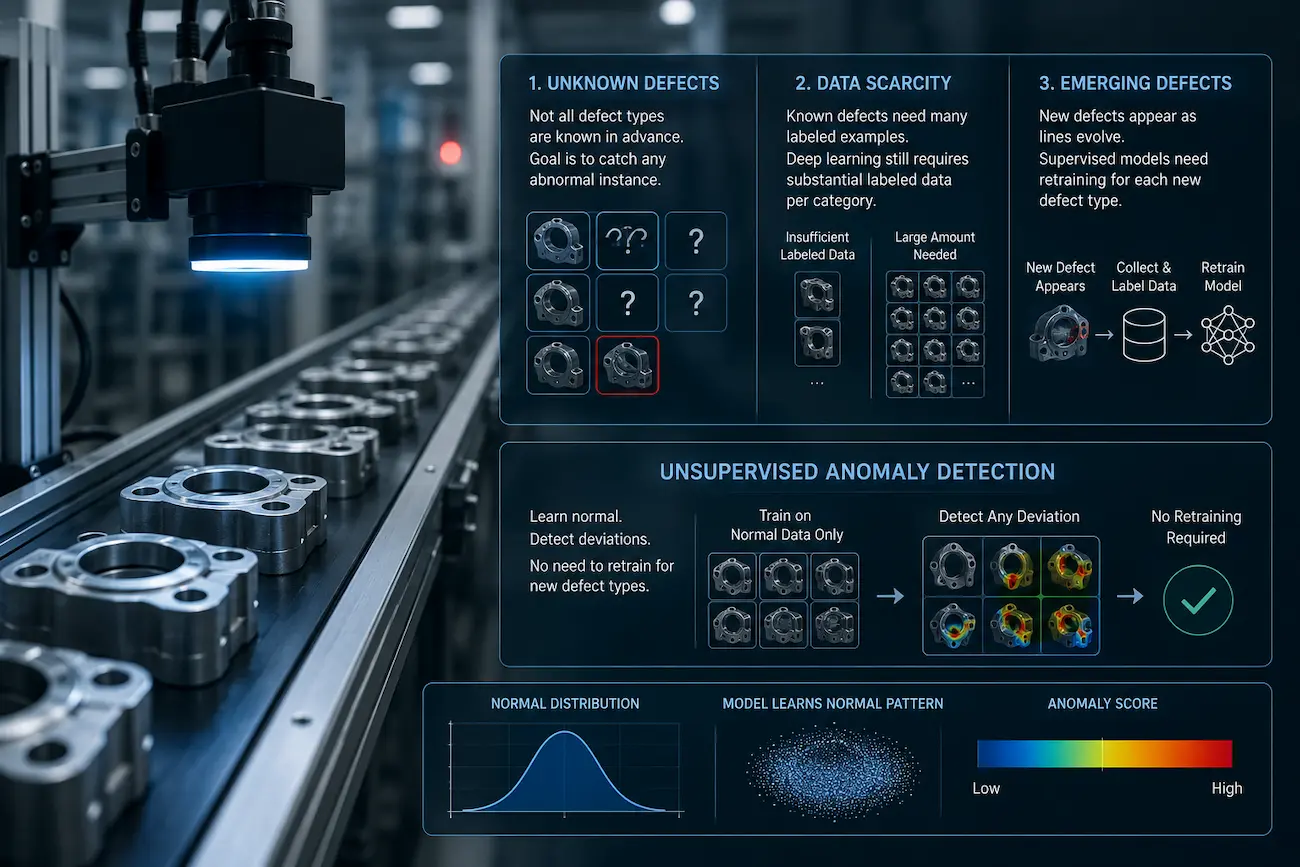





Carbon-fiber composites are the foundation of our airplanes, cars, and other high-performance products. These strong materials might have some defects that weaken them and cause problems. Traditionally, technicians used non-destructive testing (NDT) methods like ultrasound, X-ray, or visual inspection to find these defects, but as technology advanced, AI improved defect detection for carbon fiber composites by scanning data and automatically detecting problems. We’re going to further investigate the key technologies used, the type of defects that commonly occur, where it’s applied, and the potential benefits and limits.

Key Technologies Used in AI Defect Detection for Carbon Fiber Composites
AI is used with different NDT methods to examine complex data and find problems on the surface and inside an object.
- Computer Vision and Deep Learning: High-resolution cameras take pictures, which are then checked by deep learning models, such as Convolutional Neural Networks (CNNs) and YOLO (You Only Look Once) variants. These models are trained on large sets of images containing various defects to learn defect patterns.
- Ultrasonic Testing (UT) & Phased Array UT (PAUT): AI works with ultrasonic signals to detect internal defects. Machine learning models like optimized Backpropagation (BP) neural networks and Support Vector Machines (SVM) are used to analyze time-domain and time-frequency-domain features from the signals, and they can achieve high recognition rates for defects of different sizes and depths.
- Infrared (IR) Thermography: AI and deep learning team up with infrared cameras to spot subsurface defects by checking out surface temperature changes caused by internal flaws. This non-contact method is great for scanning large areas quickly.
- Vibration Analysis: Machine learning algorithms are used with vibration data from composite structures to spot changes in natural frequencies and mode shapes that indicate damage.
- X-ray Computed Tomography (XCT): X-rays are used in radiography methods to create detailed internal images. Then, AI can analyze the images to find defects.
How AI Detects Defects in Carbon Fiber Composites
There are many defects that can be found using AI defect detection. AI is able to find the defects usually found in carbon fiber composites by either a general method that’s used in quality assurance (e.g. getting trained on data and recognizing defect patterns) or more specific methods for more challenging defects (like process heat-flow patterns or ultrasonic wave reflections).
| Defect Type | Best Imaging Method | AI Approach | General or Specific? |
| Cracks | Optical, X-ray, CT | CNN / YOLO | General |
| Voids / Porosity | CT, Ultrasound | 3D CNN | Specific |
| Delamination | Thermography, Ultrasound | Spatiotemporal CNN | Specific |
| Fiber Misalignment | Optical / Specialized lighting | Texture-focused models | Semi-specific |
| Resin-rich / poor zones | Optical, Thermography | Segmentation | General |
| Foreign debris | Optical | Detection model | General |
| Surface defects | Optical | Any CV model | General |
Strengths and Limitations of AI in Composite Defect Detection
AI is especially valuable in this field precisely because the defects are hard, subtle, or impossible to detect reliably using traditional methods alone. Although it’s not perfect and has some downsides, the benefits are numeral:
Benefits of AI for Carbon Fiber Composites Defect Detection
- Detects Hard to See Defects: A lot of composite defects are subtle or you can’t even see them. AI can spot these patterns in thermography, ultrasound, or CT scans. This makes AI much better at composites than at working with metal, where defects are more noticeable.
- Handles Complex Textures and Fiber Orientations: Carbon fiber comes in woven patterns, unidirectional fibers, and multi-ply layups. These can create visual textures that can confuse human inspectors. AI models, especially Vision Transformers, are great at analyzing repeating or complex patterns.
- Can Identify Fiber Misalignment Earlier: Fiber alignment is key to making composites strong. Even a little misalignment or waviness can mess up how well it works. AI can spot slight angle deviations, periodic distortions, and abnormal local fiber orientation.
- Enhances Interpretation of NDT Signals for Layered Structures: Composites are anisotropic and layered, so thermal or ultrasonic signals behave differently depending on the angle of the ply, the thickness of the layer, and the fiber orientation. AI can learn these complex relationships and interpret signals more accurately.
- Reduces Reliance on Hard-to-Find Composite NDT Experts: Composite inspection is a specialized field, and there aren’t a lot of experts in it. AI helps by making interpretation more consistent, reducing reliance on individual expertise, and supporting technicians who are less experienced.
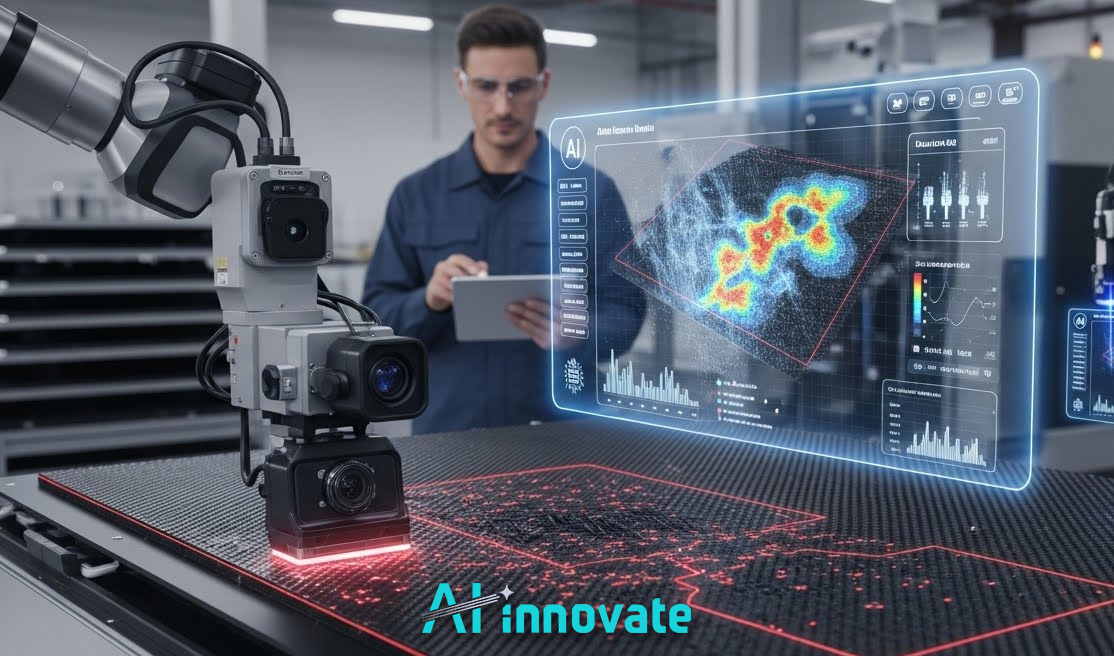
Enhance your composite defect detection process with AI Innovate’s AI2Cam and AI2Eye. AI2Cam provides AI-powered visual inspection to quickly identify subtle surface and internal defects, while AI2Eye offers real-time monitoring and analysis of production data, helping manufacturers ensure consistent quality, reduce errors, and optimize efficiency in high-performance carbon-fiber components.
Limits of AI for Carbon Fiber Composites Defect Detection
- Hard Data Collection: As previously mentioned, the layered structure of carbon fibers requires thermography or ultrasound. This makes the data harder to collect and interpret using AI.
- Model Confusion: Many of the carbon fiber defects look very similar to each other, like voids and resin-poor zones or delamination and kissing bonds. This increases dataset labeling difficulty and model confusion.
- Complexity: Different weave patterns and ply orientations create different textures and appearances, even when “perfect.” AI models need to learn about unidirectional composites, woven fabrics, braided materials, and multi-ply layups. This adds complexity that you don’t see in simpler materials like metal or plastic.
- Composite Thickness and Geometry Affect NDT Signals: When analyzing thermography or ultrasound, AI systems must handle things like different ways heat can spread, curved surfaces, changes in thickness, reflections, and noise. These factors are more challenging in composites than in homogeneous materials.
- Inconsistent Labels: For example, the acceptance of slight fiber misalignment depends on the application. This can lead to problems like: labels that don’t always match, disagreements between human inspectors, and datasets that are unclear or subjective. AI has a hard time understanding things when the labels aren’t consistent.
Conclusion
Undoubtedly, AI makes it much easier to find defects in carbon-fiber composites, as it can improve the accuracy, speed, and consistency of different NDT methods. While AI is not perfect, it works well hand in hand with traditional inspection techniques. We believe with continued advances in imaging and machine learning, AI is going to play an increasingly important role in ensuring the quality and reliability of carbon fiber composite composites.
Note: Some graphics and visuals in this post were produced using AI-generated content.