





Wood quality inspection has long been a blend of craftsmanship and intuition. For generations, seasoned inspectors have studied grain patterns, knots, and surface texture to determine whether a board meets production standards. Today, that expertise is being enhanced with artificial intelligence. As manufacturing expectations rise and wood products become more complex, traditional manual inspection struggles to deliver consistent, fast, and objective results. Variability in human assessment can lead to waste, unexpected defects, and production slowdowns. AI-powered wood quality inspection combines advanced machine vision and real-time analysis to bring objectivity, speed, and repeatability to quality checks.
In this article, you will learn what AI wood inspection is, how it works in practical and industrial settings, what challenges manufacturers face, and how this technology helps reduce waste, increase throughput, and achieve higher confidence in product quality.

Beyond Visual Spectrum Analysis
Standard RGB cameras form the baseline for automated inspection, but their capabilities end where the human eye’s perception does. True comprehensive analysis requires venturing into non-visible light spectrums. Hyperspectral Imaging (HSI) elevates this process by capturing data across hundreds of narrow spectral bands, creating a detailed “fingerprint” for the material.
This technique enables the detection of subtle chemical and physical properties invisible to standard cameras, such as internal moisture variations, incipient decay, or resin pockets, a method effectively demonstrated in advanced industrial solutions. The practical distinctions between these imaging modalities, as outlined below, highlight the depth of insight gained when moving beyond the visible.
| Defect Detected by RGB | Defect Detected by HSI |
| Surface knots, cracks, and color variations. | Internal moisture content and distribution. |
| Obvious discoloration from stains or fungus. | Early-stage fungal decay (before visible signs). |
| Physical damage like holes or surface irregularities. | Presence and location of resin or sap pockets. |
| Basic grain pattern and texture analysis. | Chemical composition changes indicating wood integrity. |
Algorithmic Defect Cartography
Effective quality control is not merely about finding flaws, but about meticulously mapping and categorizing them according to precise standards. Instead of simple classification, advanced algorithms perform a “cartography” of each wood piece, charting its unique surface landscape.
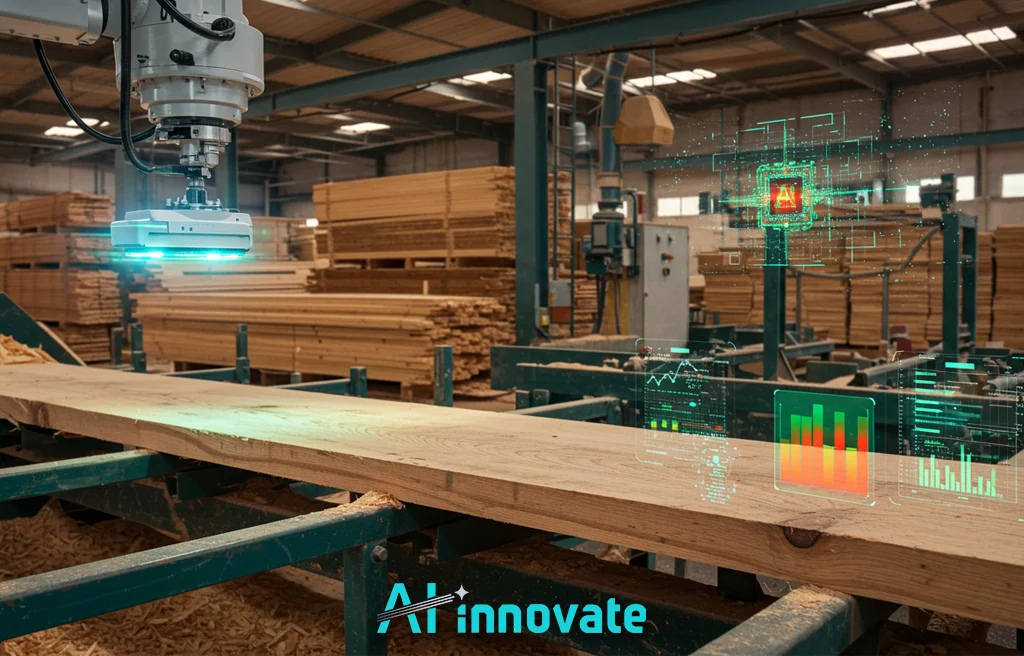
This detailed mapping allows systems to differentiate between acceptable natural characteristics and disqualifying defects with high precision. An effective Ai Powered Wood Quality Inspection platform can robustly identify and catalogue a wide array of specified imperfections, ensuring that each piece is sorted for its optimal application, whether for high-grade furniture or structural use. This includes, but is not limited to, the following types:
- Knots: Differentiating between sound knots (structurally integrated) and dead or encased knots that may compromise the wood’s strength.
- Surface Checks & Cracks: Identifying the length, depth, and location of fissures that can affect both aesthetic appeal and structural integrity.
- Stains & Discoloration: Detecting and classifying color variations caused by minerals, fungus, or chemicals to ensure visual consistency.
- Insect Holes: Pinpointing damage from pests, which is critical for preventing further infestation and ensuring product quality.
- Warpage & Dimensional Faults: Measuring deviations from desired straightness or flatness, such as bow, cup, or twist, to guarantee geometric accuracy.
Correlating Speed with Granularity
For industrial leaders, technological adoption hinges on tangible performance gains. The operational metrics emerging from automated systems confirm that enhanced speed does not come at the cost of inspection detail or granularity.
On the contrary, automation introduces a level of precision and throughput that is simply unachievable through manual methods. The data from various industry reports illustrates a compelling business case, where increased efficiency and reduced waste translate directly to a stronger bottom line.
The table below presents key performance indicators that highlight the tangible ROI that Ai Powered Wood Quality Inspection delivers in demanding production environments:
| Metric | Quantitative Improvement |
| Inspection Speed | Up to 700 pieces per minute |
| Throughput vs. Manual Labor | 27 times faster than human inspectors |
| Error Rate Reduction | As much as a 70% decrease in inspection errors |
| Material Waste Optimization | Up to 35% reduction through optimized cut patterns |
Volumetric Insights via Acoustic and X-Ray
A complete assessment of wood quality cannot be confined to what is visible. The most consequential flaws—those compromising structural integrity—often lie hidden beneath the surface.
To achieve a true three-dimensional understanding, advanced systems integrate technologies capable of non-destructively penetrating the material and creating a volumetric map of its internal landscape.
By moving beyond optics, manufacturers can identify latent weaknesses and make far more informed decisions. Let’s explore some of the key technologies driving these volumetric insights.
X-Ray Scanning for Internal Cartography
X-ray scanning offers an unparalleled, direct view into the timber’s core structure. This technology excels at identifying volumetric features invisible to any optical system by mapping density variations within the material.
Algorithms process this data to precisely locate and measure internal knots, discover hidden pockets of rot, and even detect foreign objects like embedded metal fragments. For structural applications, this internal map is invaluable, allowing for optimized cutting paths that maximize yield by working around—rather than discarding—wood with internal flaws.
Acoustic Analysis for Structural Integrity
Acoustic emission testing probes the mechanical soundness of wood by analyzing the propagation of sound waves. By emitting ultrasonic pulses and measuring the response, the system can assess the material’s internal cohesion.
The speed and attenuation of the waves correlate directly with properties like fiber bond strength and the presence of micro-fractures. AI models are crucial here, as they interpret complex acoustic signatures—patterns often too subtle for human analysis—to reliably predict the material’s structural integrity before it undergoes stress.
Thermographic Imaging for Subsurface Anomalies
A further layer of insight comes from thermography, which uses infrared cameras to visualize the heat signature of a wood surface. Subsurface defects such as hidden moisture pockets, voids, or areas of delamination disrupt the normal flow of heat through the material.
These anomalies appear as distinct hot or cold spots on the thermal image. By analyzing these thermal patterns, an AI system can infer the presence and location of subsurface issues that might otherwise go undetected until a critical failure occurs.
Calibrating Models for Wood’s Heterogeneity
The greatest challenge in wood inspection is its inherent lack of uniformity; no two boards are identical. Effectively handling this natural variance is where Ai Powered Wood Quality Inspection showcases its true intelligence.
A rigid, one-size-fits-all algorithm is destined to fail. Modern systems are designed with adaptability at their core, utilizing a powerful machine learning concept known as Transfer Learning.
This approach allows a foundational, pre-trained model to be rapidly fine-tuned or calibrated for the specific wood species, grain patterns, and lighting conditions of a particular production line. This ensures the system remains robust and accurate, adapting to new materials and environments without requiring a complete redesign from the ground up.
Accelerate Your Vision Initiative
Harnessing this technology does not have to be a decade-long R&D project. Our solutions are designed to bridge the gap between advanced concepts and immediate industrial application, addressing the distinct needs of both operational leaders and technical developers.
For QA Managers and Operations Directors struggling with the high costs and inconsistencies of manual inspection, we offer AI2Eye. This is our turnkey, real-time inspection system that integrates directly into your production line. It is engineered to reduce waste, boost throughput, and ensure a consistently high standard of product quality, delivering a clear and rapid return on investment.
For Machine Learning Engineers and R&D Specialists facing development bottlenecks, we built AI2Cam. This powerful camera emulator allows you to prototype, test, and validate your machine vision applications without any physical hardware dependency.
AI2Cam accelerates your innovation cycle, reduces capital expenditure, and enables flexible, collaborative development. If you are ready to implement a proven and adaptable inspection solution, contact our team for a specialized consultation.
Conclusion
AI-powered wood quality inspection is transforming how manufacturers assess material fitness, consistency, and readiness for further processing. By combining machine vision, real-time analysis, and adaptable learning models, manufacturers can move beyond subjective manual inspection to objective, data-driven evaluation. This approach improves throughput, reduces waste, and supports more reliable downstream operations.
From my experience with industrial inspection and automation, the most impactful benefit of AI is confidence. When manufacturers trust the quality data flowing from their inspection systems, they make better decisions, reduce rework, and improve customer outcomes. As this technology continues to evolve, I believe AI inspection will become a standard capability across wood-processing operations of all scales.
Note: Some graphics and visuals in this post were produced using AI-generated content.