



Publication Note
This article is Part 6 of AI‑Innovate’s publication of the review paper ‘Evolution of AI‑Based Fabric Defect Detection: From Classical Vision to Foundation Models’. The manuscript has been divided into multiple articles solely to improve readability on the AI‑Innovate website. Apart from this publication note, article navigation, and editorial transitions, the research content remains unchanged.
7. Other Methods
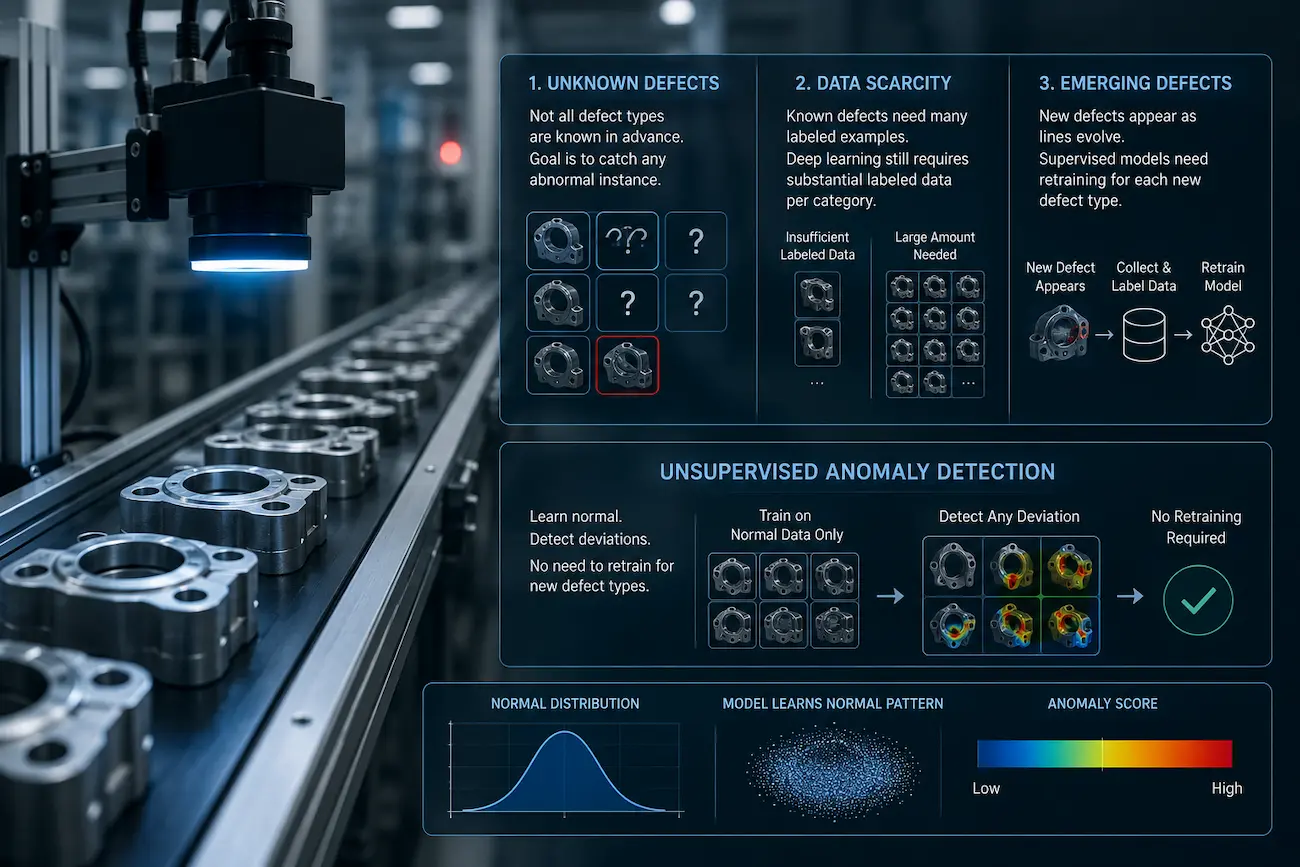
Despite the remarkable progress achieved through feature learning, knowledge distillation, anomaly synthesis, and frequency-domain analysis, several practical challenges continue to limit the deployment of anomaly detection systems in real manufacturing environments.
Industrial inspection is often performed under conditions that differ substantially from those assumed in laboratory benchmarks. Variations in illumination, camera noise, motion blur, moiré patterns, and the complex surface geometry of textile products can all introduce visual artifacts that resemble defects. At the same time, manufacturers frequently have access to only a limited number of defect samples, making it difficult to train increasingly sophisticated deep learning models.
Rather than learning complex feature representations, these approaches focus on the intrinsic visual characteristics of defects themselves.
The underlying assumption is intuitive.
A defect is often visually different from its surrounding texture. Instead of modeling normality through deep neural networks, the system first identifies visually salient regions that naturally stand out from the regular fabric pattern. Candidate regions are then analyzed using handcrafted geometric, intensity, and texture descriptors before being grouped through adaptive clustering algorithms.
This strategy offers several practical advantages for industrial inspection. It requires only a small number of samples, produces highly interpretable decisions, and avoids the computational cost associated with large deep neural networks. Because the extracted features correspond to meaningful physical properties, such as defect size, shape, brightness, or texture variation, the system can also provide explanations for why a particular region has been classified as defective.
However, this simplicity also introduces important limitations.
Saliency-based approaches become less reliable when defects exhibit very low contrast or when fabrics contain highly complex decorative patterns. Under these conditions, visually distinctive regions do not necessarily correspond to actual defects, increasing the likelihood of false detections. Furthermore, handcrafted feature extraction often requires parameter tuning for different fabric categories, reducing the scalability of these methods across diverse industrial environments.
While these alternative approaches demonstrate that classical computer vision remains valuable, the broader question is no longer which individual algorithm performs best.
Instead, researchers increasingly seek to understand how the different families of anomaly detection methods compare under realistic manufacturing conditions.
This objective motivated several comprehensive benchmarking studies that evaluated modern anomaly detection techniques on challenging industrial datasets rather than introducing entirely new algorithms.
One particularly important direction has focused on carpet manufacturing.
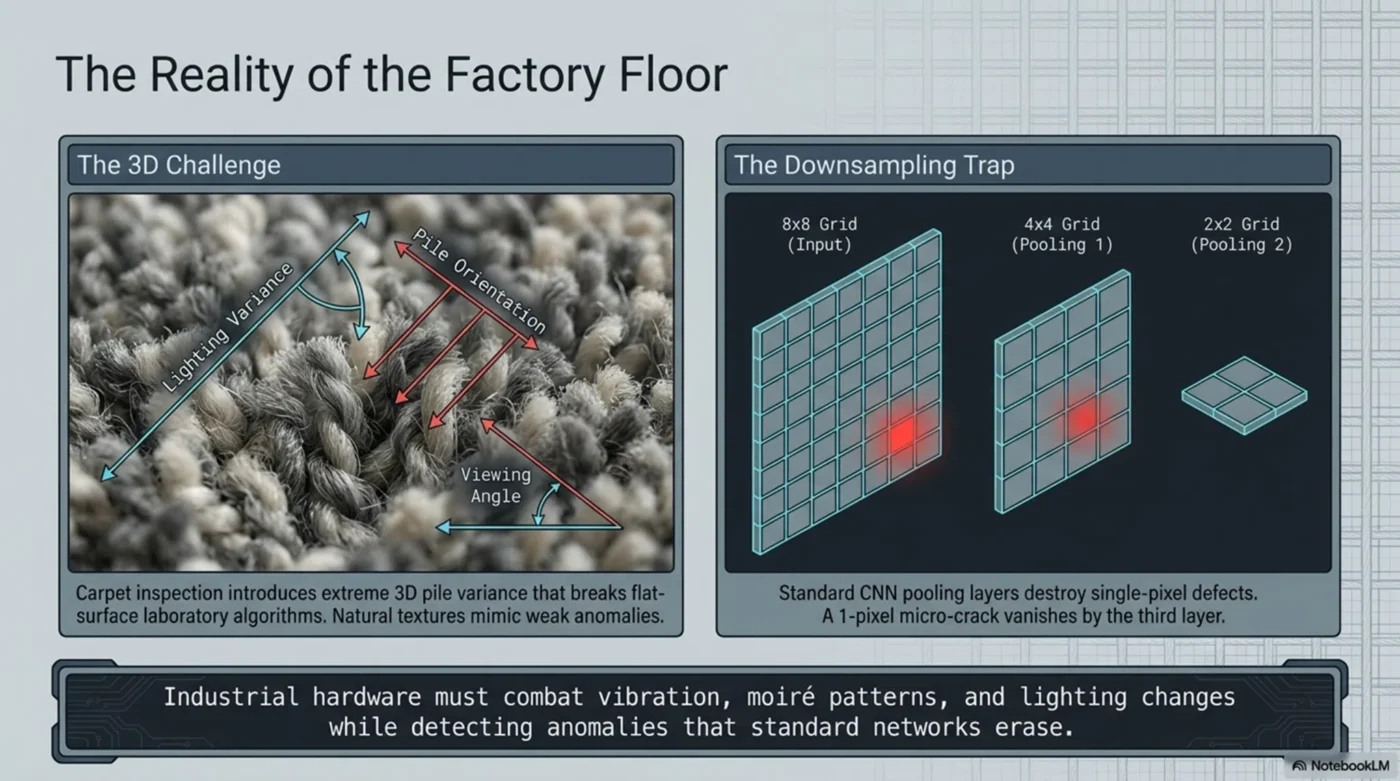
Unlike conventional woven fabrics, carpets possess a three-dimensional pile structure that produces significant appearance variations depending on lighting direction, viewing angle, and pile orientation. In addition, carpet defects span multiple spatial scales, ranging from microscopic fiber contaminants to long structural faults caused by machine malfunctions. These characteristics make carpet inspection considerably more difficult than the inspection of relatively flat textile surfaces used in many benchmark datasets.
First, teacher–student and reverse distillation methods generally achieve the highest overall detection accuracy while producing cleaner and less noisy localization maps than reconstruction-based approaches. Their ability to model normal representations without explicitly reconstructing the input makes them particularly well suited for complex industrial textures.
Second, larger image patches often improve performance because they provide additional structural context. This broader field of view helps distinguish genuine defects from normal texture variations, especially in materials with complex repetitive patterns.
Third, models trained using multiple fabric categories frequently generalize as well as, or even better than, models trained on a single material type. This finding suggests that future industrial inspection systems may increasingly rely on unified anomaly detectors capable of serving multiple production lines simultaneously rather than maintaining separate models for every individual fabric.
Perhaps the most valuable outcome of these benchmarking efforts is not identifying a single “best” algorithm, but revealing which challenges remain unresolved across nearly all current approaches.
The first persistent challenge is the detection of extremely subtle anomalies.
Small color variations, weak stains, slight yarn misalignment, or barely visible thread damage often remain difficult to distinguish from natural texture variations. Although modern deep learning models have dramatically improved sensitivity, these weak anomalies continue to produce missed detections in practical inspection systems.
The second challenge concerns very thin structural defects.
Operations such as pooling and feature downsampling, which are fundamental components of most convolutional neural networks, inevitably reduce spatial resolution. As a consequence, defects that occupy only a few pixels, such as single broken yarns or extremely fine cracks, may disappear before reaching the deeper layers responsible for anomaly prediction.
Finally, robustness remains an important open problem.
Industrial production environments rarely match the controlled conditions under which many benchmark datasets are collected. Variations in illumination, sensor characteristics, machine vibration, fabric tension, motion blur, and environmental noise all influence image quality. Models that perform exceptionally well in laboratory settings may therefore experience noticeable performance degradation after deployment unless they explicitly account for these real-world variations.
Taken together, these observations suggest that fabric anomaly detection has entered a new stage of maturity.
The central challenge is no longer demonstrating that deep learning can detect defects. Modern methods have already established impressive levels of accuracy across numerous benchmark datasets.
Instead, current research is shifting toward making these systems more practical, more reliable, and more adaptable to real industrial environments. Future progress will likely come from integrating complementary ideas developed across the different research directions presented throughout this paper: rich feature representations, efficient knowledge distillation, robust reverse distillation, controllable anomaly synthesis, frequency-aware analysis, and physically interpretable inspection strategies.
Rather than competing with one another, these approaches increasingly appear to represent complementary components of the next generation of intelligent textile inspection systems.
8. Comparative Discussion
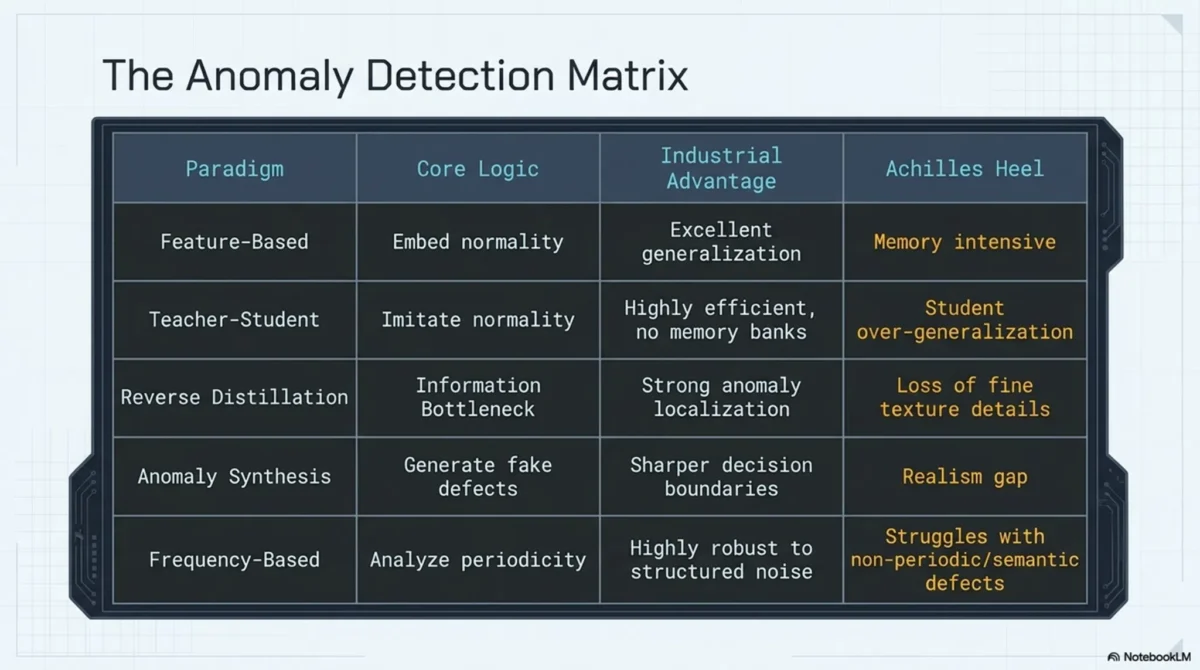
The evolution of fabric anomaly detection over the past decade reveals a clear progression in both research priorities and industrial requirements. Rather than replacing one another, the major families of methods introduced throughout this paper represent successive attempts to overcome the limitations of previous approaches while addressing increasingly practical deployment challenges.
The earliest unsupervised methods focused on learning a representation of normality from defect-free samples. Feature-based approaches demonstrated that defects could be detected without collecting examples of every possible anomaly. By embedding normal images into a discriminative feature space, these methods established the one-class learning paradigm that remains the foundation of modern industrial anomaly detection.
However, storing and comparing large collections of normal features introduced considerable computational and memory overhead. Teacher–student distillation addressed this limitation by transferring the knowledge of a powerful pretrained network into a lightweight student model. Instead of memorizing normal samples, the student learned to reproduce the teacher’s representation of normality, significantly reducing memory requirements while maintaining competitive detection accuracy.
As distillation methods matured, researchers recognized another limitation. Highly capable student networks gradually became able to reconstruct abnormal patterns almost as effectively as normal ones, reducing the discrepancy required for reliable anomaly detection. Reverse Distillation addressed this issue by fundamentally redesigning the information flow through a bottleneck representation that deliberately restricted the student’s ability to reconstruct unseen anomalies. Subsequent industrial adaptations further demonstrated that preserving shallow texture information is essential for textile inspection, where defects often consist of only a few damaged yarns.
A parallel research direction approached the problem from a different perspective. Instead of relying exclusively on normal data, anomaly synthesis methods artificially generated defective samples during training. This progression evolved from simple image-level synthesis to feature-space perturbation, then to gradient-guided synthesis capable of producing highly informative near-boundary anomalies. More recent work has emphasized rapid transfer learning, enabling inspection systems to adapt to new fabric types within seconds rather than requiring lengthy retraining procedures.
Frequency-based methods followed a complementary path. Rather than learning visual representations directly from images, they exploited the inherent periodicity of textile structures. Beginning with global Fourier analysis, progressing through localized spectral refinement, and eventually integrating wavelet decomposition with deep neural networks, these methods demonstrated that incorporating physical knowledge of textile structures can substantially improve robustness and interpretability. Recent architectures further combined frequency analysis with lightweight semantic networks to satisfy the strict latency and memory constraints of industrial edge devices.
Taken together, these developments reveal an important trend.
Research has gradually shifted from maximizing detection accuracy alone toward balancing three equally important objectives: accuracy, computational efficiency, and deployment practicality. Early work primarily asked whether defects could be detected automatically. Contemporary research instead focuses on whether anomaly detection systems can operate continuously under real production conditions while adapting to changing products, varying environments, and limited computational resources.Lorem ipsum dolor sit amet, consectetur adipiscing elit. Ut elit tellus, luctus nec ullamcorper mattis, pulvinar dapibus leo.
Despite substantial progress, no single methodology completely satisfies all industrial requirements. Feature-based approaches provide excellent generalization but often require considerable memory. Distillation methods achieve high efficiency but remain sensitive to architectural design. Reverse distillation improves localization but may lose global contextual information.
Synthesis-based methods reduce dependence on defect datasets but still struggle to perfectly reproduce real industrial anomalies. Frequency-based methods offer strong interpretability and robustness to periodic textures but may underperform on highly irregular or semantic defects.
These observations suggest that the future of industrial anomaly detection is unlikely to be dominated by a single algorithmic family. Instead, the strongest systems will likely integrate complementary ideas developed across multiple research directions.
9. Future Research Directions
Although automated fabric inspection has advanced remarkably over the past decade, several important research challenges remain open. Addressing these challenges will be essential for the next generation of intelligent quality inspection systems.
One major direction is improving the detection of extremely subtle defects. Weak stains, slight color inconsistencies, single broken yarns, and other low-contrast anomalies remain difficult for many existing approaches because they differ only minimally from normal fabric textures. Future models will need to preserve fine-grained spatial information while maintaining robust semantic understanding, potentially through improved attention mechanisms and high-resolution feature representations.
Another important challenge is generalization across diverse textile products. Most current systems still require adaptation when deployed on new fabric types, weave structures, or manufacturing processes. Developing truly universal anomaly detectors capable of transferring knowledge across different textile domains with minimal or no retraining remains an important research objective.
Robustness under real manufacturing conditions also deserves greater attention. Industrial environments introduce numerous sources of variability, including illumination changes, camera noise, vibration, motion blur, fabric deformation, and environmental contamination. Future systems must become increasingly resilient to these disturbances while maintaining reliable detection performance throughout long-term operation.
A further opportunity lies in combining multiple complementary information sources. Most current approaches emphasize either spatial features, frequency information, synthetic anomalies, or teacher–student representations. Future architectures may integrate these perspectives within unified frameworks that simultaneously exploit semantic understanding, physical texture characteristics, frequency-d
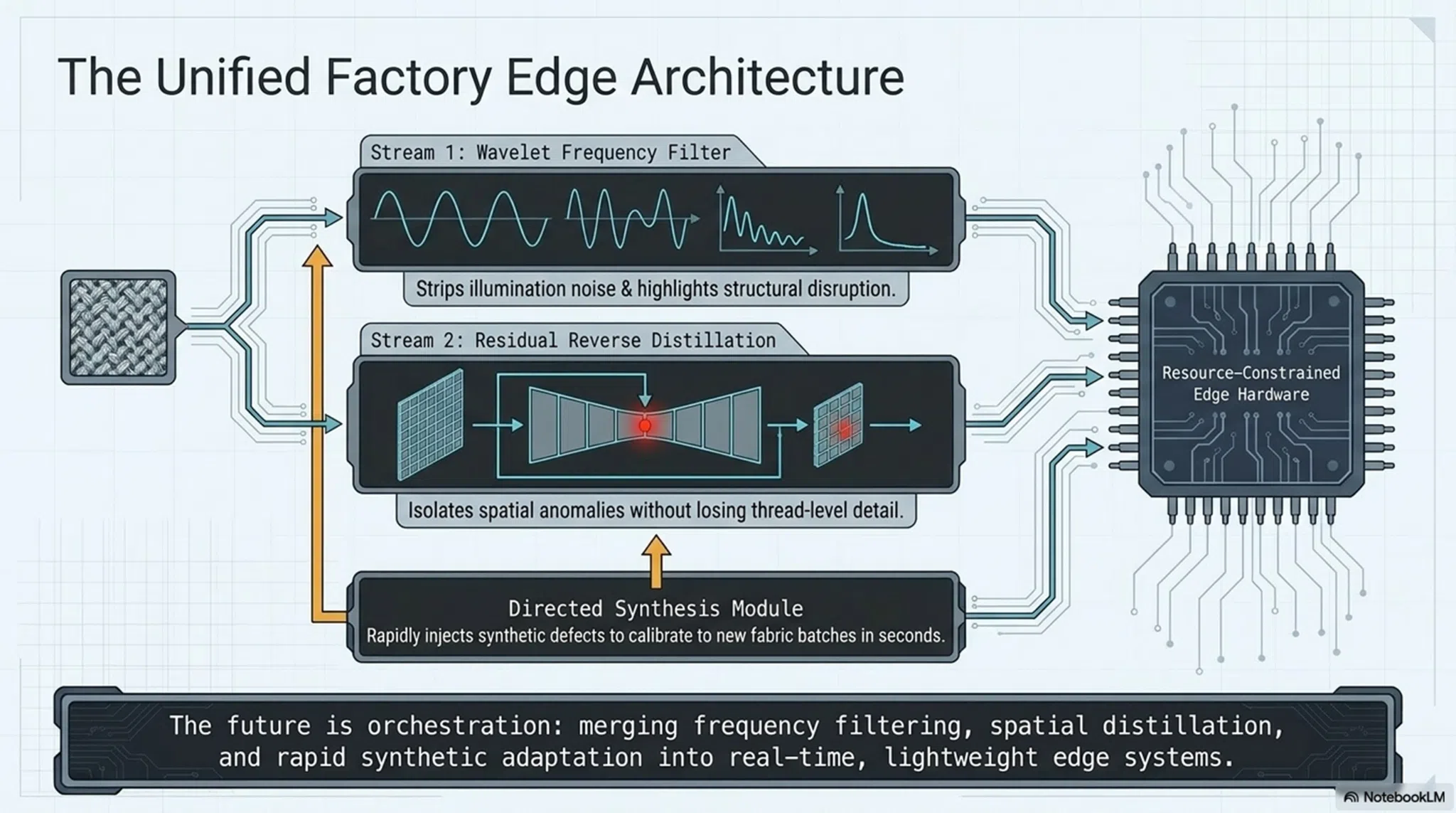
Efficiency will remain another critical consideration. Modern production lines increasingly require inspection systems that operate directly on embedded hardware with limited computational resources. Consequently, future research should continue developing lightweight architectures capable of delivering high detection accuracy while minimizing latency, memory consumption, and energy requirements.
Interpretability is also becoming increasingly important. Beyond simply indicating that an anomaly exists, industrial users often require explanations regarding why a region has been classified as defective and which visual characteristics influenced the decision. More transparent anomaly detection systems would increase operator confidence and facilitate integration into industrial quality assurance workflows.
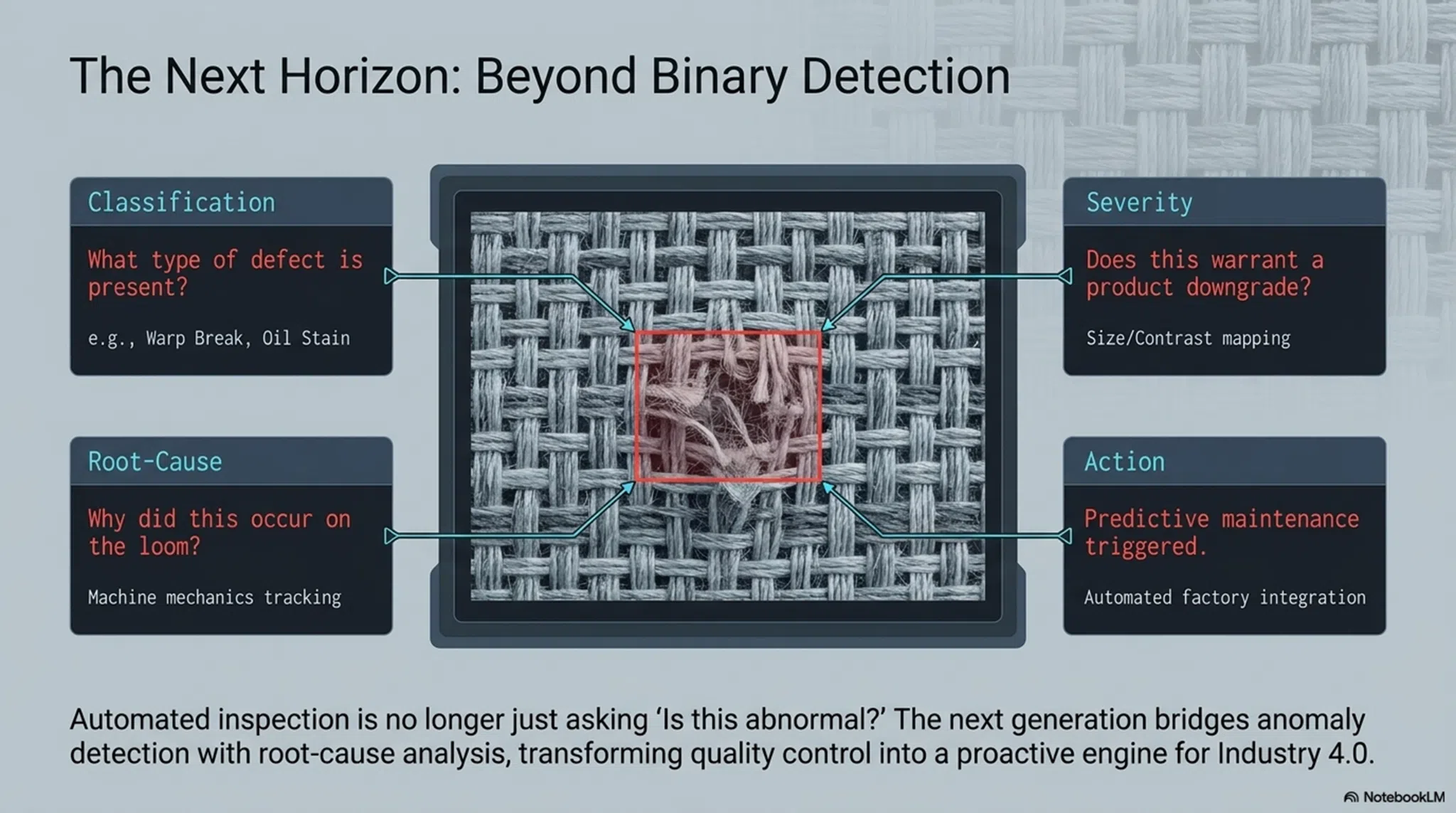
Finally, the next frontier may extend beyond anomaly detection itself.
Most current systems answer only one question: Is this region abnormal?
Future intelligent inspection systems are expected to answer additional questions, including what type of defect is present, how severe it is, why it occurred, and what corrective action should be taken. Integrating anomaly detection with defect classification, root-cause analysis, predictive maintenance, and manufacturing process optimization represents a natural evolution toward fully intelligent quality control.
10. Conclusion
Fabric defect detection has evolved from traditional image processing techniques into one of the most active research areas in industrial computer vision. This evolution has been driven by a practical manufacturing challenge: defects are rare, diverse, and expensive to annotate, making conventional supervised learning unsuitable for many real production environments.
This paper has presented the major research directions that have shaped modern anomaly detection systems for textile inspection. Feature-based methods established the one-class learning paradigm by learning compact representations of normality from defect-free samples. Teacher–student distillation reduced memory requirements through knowledge transfer, while Reverse Distillation further improved anomaly localization by deliberately restricting the reconstruction capability of the student network. Anomaly synthesis introduced artificial defect generation to overcome the scarcity of defective samples, gradually evolving from simple image manipulation to controllable feature-space synthesis and rapid transfer learning. Frequency-based approaches demonstrated that exploiting the inherent periodicity of textile structures provides a powerful complementary perspective that combines physical interpretability with modern deep learning. Finally, alternative approaches and comparative evaluations highlighted the importance of robustness, interpretability, and realistic industrial benchmarking.
Across these developments, one consistent trend emerges. The field has progressively shifted from pursuing maximum benchmark accuracy toward designing systems that satisfy the practical constraints of industrial deployment. Modern anomaly detection systems are expected not only to detect defects accurately, but also to operate in real time, adapt rapidly to new products, function reliably under changing environmental conditions, and execute efficiently on resource-constrained hardware.
Although no single approach currently satisfies all industrial requirements, the collective progress achieved over recent years has significantly narrowed the gap between academic research and practical manufacturing applications. Future advances will likely arise from combining the complementary strengths of multiple research directions rather than relying on any individual methodology.
As artificial intelligence continues to mature, automated fabric inspection is expected to become an integral component of smart manufacturing and Industry 4.0. By enabling earlier defect detection, reducing manual inspection effort, minimizing production waste, and improving overall product quality, intelligent anomaly detection systems have the potential to transform textile manufacturing into a more efficient, reliable, and sustainable industrial process.
Series Complete
This concludes the six-part AI-innovate publication of the original review paper. Together, the series traces the evolution of AI-based fabric defect detection from early feature representations through teacher–student learning, reverse distillation, anomaly synthesis, frequency-domain analysis, and the broader research landscape shaping future intelligent inspection systems.
Complete Series
Evolution of AI-Based Fabric Defect Detection
Continue reading all six parts of this research publication.