




Most vendors quote vague estimates for a vision system, and 68 percent of manufacturers report budget overruns on their first deployment as a result, primarily because integration complexity and ongoing operational costs get underestimated from the start. That is not a technology problem. It is a planning problem, and it is entirely avoidable once you know what questions to ask before you talk to a single vendor.
This guide is the starting point, not the deep dive. It answers the questions that come before camera specs and model architecture: what kind of vision system your use case actually needs, what realistic budget tiers look like, whether to build, buy, or bring in an integrator, and where deployments typically go wrong. Once you have those answers, this guide points you to the more technical resources on specific pieces, sensor selection, edge deployment, defect coverage, that go deeper on each decision.
Start With the Use Case, Not the Technology
The single most common mistake in vision system planning is starting with a technology preference, “we want 3D” or “we want AI,” before defining what the system actually needs to accomplish. Vision applications in manufacturing fall into a handful of distinct categories, and the category determines nearly every downstream decision.
- Inspection and defect detection. Identifying scratches, contamination, dimensional flaws, or missing components on a part. This is the most common application and the one most vendors default to discussing first.
- Measurement and dimensional verification. Confirming a part’s actual geometry matches its CAD specification, a fundamentally different problem from surface inspection that often requires 3D capture and CAD-referenced comparison.
- Guidance and robotics. Directing a robot to pick, place, or align a part, where vision serves motion rather than quality control.
- Identification and traceability. Reading barcodes, OCR text, or serial markings to track a part through production and support recall or warranty processes.
Getting this classification right before evaluating any vendor or technology saves real time and money, since a system built for defect inspection is often poorly suited to dimensional measurement, and vice versa.
What This Actually Costs: Budget Tiers for 2026
Realistic budget expectations, based on deployment data across hundreds of production facilities, fall into three broad tiers.
| Tier | Investment Range | What You Get |
|---|---|---|
| Entry-level, single-line | $3,000-$10,000 | Basic 2D cameras, standard software, limited integration, suited to simple defect detection on one line |
| Mid-range, production-ready | $50,000-$150,000 | Professional-grade cameras, custom AI models, full MES integration, multi-defect detection |
| High-end, enterprise | $150,000-$500,000+ | Multi-camera 3D arrays, advanced analytics, redundant systems, centralized management |
These figures represent total investment, including hardware, software, integration, and training, not just equipment purchase price. A per-line implementation, accounting for the full scope of a standardized deployment, typically lands between $110,000 and $200,000. Over five years, total cost of ownership for a mid-to-large deployment commonly reaches $600,000 to $1.5 million, with positive ROI generally achieved by year two on well-scoped projects.
Build, Buy, or Integrate? The Three Paths
Every manufacturer evaluating vision technology faces the same fork: build the system internally, hire a system integrator, or adopt an AI-first platform that runs on existing hardware. Each path fits a different situation.
DIY / Self-Integration
Manufacturers with strong internal technical capability can self-integrate using off-the-shelf smart cameras and no-code AI platforms, skipping a formal integrator entirely for simpler inspection tasks. This works well for a single-line, well-defined defect detection problem, but complex multi-camera lines or full automation cells generally still benefit from outside engineering expertise.
System Integrator
Integration firms range from vendor-agnostic specialists, who pick the best camera, lighting, and software for the specific problem at a higher upfront engineering cost, to ecosystem-locked partners tied to a single hardware brand, who typically deploy faster and cheaper at the cost of long-term flexibility. Machine vision integration project costs range from around $25,000 for a single-camera inspection station to $500,000 or more for a full multi-camera automation cell, with turnkey projects typically taking 8 to 16 weeks from design to production go-live. The right integrator type depends on project shape: a standalone inspection upgrade suits an independent vision specialist, while a new production line or full automation cell suits a firm that treats vision as one piece of a larger controls and robotics build.
AI-First Platform Providers
A distinct and increasingly common option separates the physical system from the intelligence running on top of it. An integrator or existing hardware installation handles cameras, lighting, and mounting, while an AI inspection platform provides the detection layer, often trainable on a small number of sample images and deployable on hardware a manufacturer already owns. This path suits manufacturers who already have camera infrastructure in place but need better detection accuracy than a rule-based system delivers, without a full hardware replacement.
A Realistic Deployment Timeline
Successful deployments follow a structured, phased approach rather than a single big-bang rollout.
- Assessment and pilot selection (roughly 1-2 months). Audit the production line, establish baseline defect and cost metrics, and prioritize which use case delivers the clearest ROI.
- Pilot deployment (roughly 2-3 months). Implement on a single line, install and calibrate hardware, train the initial model on real production data, and integrate with existing quality systems.
- Optimization (roughly 1-2 months). Refine the model based on pilot results, document the process, and build a repeatable deployment template for additional lines.
- Enterprise rollout (several months, scaled to plant count). Roll out the validated template across remaining lines, ideally with parallel implementation teams to accelerate the timeline.
- Continuous improvement (ongoing). Budget 15 to 30 percent of the initial investment annually for model retraining, performance monitoring, and capability expansion as new defect types and product variants appear.
The Decision Framework: Is This Actually Worth It for Your Line?
Vision systems become cost-effective at different scales depending on defect cost and production volume. As a rough guide, conservative viability starts around 500,000 units annually per line, optimal economics kick in above 1 million units annually, and high-value applications like semiconductors or other high-defect-cost industries can justify investment at volumes as low as 100,000 units annually. Before evaluating vendors, answer these questions honestly:
- What percentage of your product is currently manually inspected?
- What does a defect cost once it escapes to the customer, versus if caught at the line?
- How many defects per 1,000 units does your current process actually catch?
- What is your production line speed, and does a vision system need to keep pace with it?
- How many quality inspectors are currently on payroll for this line?
- What is your current annual scrap and rework cost?
The investment becomes justified when annual defect reduction savings plus labor savings exceed the annual cost of operating the system, not just the upfront purchase price.
Where Most Vision Projects Actually Fail
The same failure patterns show up across deployment data repeatedly, and nearly all of them are avoidable with upfront planning rather than technology fixes after the fact.
- Underestimated integration complexity. The majority of manufacturers report integration costs running two to three times their initial estimate; budgeting real contingency for this upfront prevents the most common budget blowout.
- Inadequate training and change management. Many teams see a real productivity dip for several weeks post-deployment when training budget is treated as an afterthought rather than a planned cost.
- Poor data quality. A majority of deployments need to expand their training dataset within the first few months, usually because initial data collection did not capture the full range of shifts, lighting conditions, and product variation the line actually produces.
- Ignored model drift. AI models degrade in accuracy as production conditions shift over time, and most teams underestimate the ongoing cost of retraining, which should be budgeted as a recurring, not one-time, expense.
- Inconsistent lighting. A large share of vision inspection failures trace back to lighting design rather than software or algorithm limitations, making it one of the most underestimated line items in a vision system budget.
Where to Go Deeper
This guide covers the decisions that come before technology selection. Once you have a defined use case and budget, these resources go deeper on the specific choices ahead:
- Choosing between 2D and 3D capture: 2D Vision vs 3D Vision Systems for Inspection
- Sizing and deploying compute at the edge: Edge AI Deployment for Inspection
- Understanding what defect types are realistically detectable: Defects Detected by AI Vision Systems
- Working through the specific system selection process: How to Choose the Right Visual Inspection System
- Calculating the return on a specific deployment: Automated Visual Inspection ROI: Cost vs Value
- Preparing your organization before adopting AI quality tools: A Checklist for Adopting AI QA Solutions
How AI-Innovate Fits Into Your Vision System Decision
Whichever path a manufacturer chooses, self-integration, a system integrator, or an existing hardware base, the detection accuracy that path actually delivers comes down to the intelligence layer running on top of the physical system, not just the camera and lighting hardware itself.
AIxEye: The Detection Layer That Adapts to Your Use Case
AIxEye provides real-time visual inspection tuned to the specific defect types, materials, and tolerances a line actually produces, whether that system was built in-house, installed by an integrator, or added onto existing camera hardware already on the floor.
AIxAm: 3D Surface and Geometry Inspection Where Dimensional Accuracy Matters
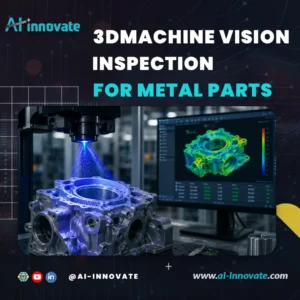
For the subset of use cases that fall under measurement and dimensional verification rather than surface inspection, AIxAm compares captured part geometry against CAD reference models, the capability a straightforward 2D defect detection setup was never built to provide.
AIxCore: Edge Processing That Keeps Detection Fast Enough to Matter
AIxCore handles on-site inference so inspection decisions happen at production speed rather than depending on a network round trip, a requirement that applies regardless of which budget tier or deployment path a manufacturer chooses.
Final Thoughts
The manufacturers who get real value from vision systems are not the ones who chase the most advanced technology first. They are the ones who define the actual use case before evaluating vendors, budget realistically using total cost of ownership rather than hardware price alone, and choose a build, buy, or integrate path that matches their internal technical capability and project scope.
Getting those decisions right before diving into camera specs, sensor types, and model architectures is what separates the 68 percent of manufacturers who overshoot their first vision system budget from the ones who deploy on plan and see positive ROI by year two. This guide is meant to get those foundational decisions right; the deeper technical guides linked above take you the rest of the way once they are.