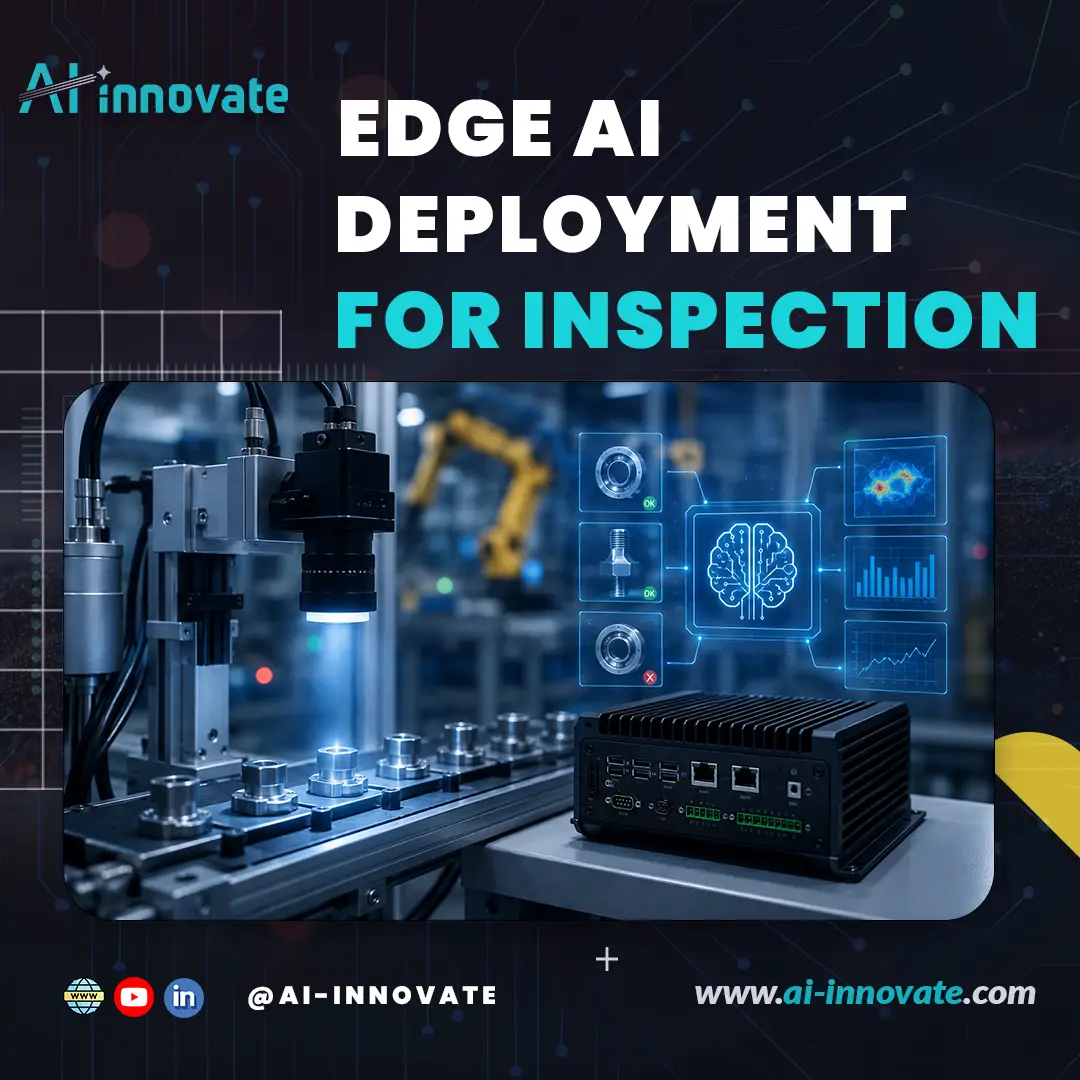





The days of manual inspection are far behind us. With the ever-increasing demand and customer expectation, good and consistent quality has become the bare minimum. Production lines move fast, product variations are frequent, and even small defects can lead to major recalls or safety issues, and that’s why manual inspection isn’t satisfactory anymore. With the emergence of AI as a befitting alternative, modern systems identify, classify, and locate objects or defects within images in real time.
In this blog, we’ll discuss the role of object detection for quality control and its core principles, how to choose the right imaging method and the most important applications of object detection in quality control.
Machine Vision Automated Inspection for Accuracy at Production Speed.
Modern machine vision systems combine high-resolution imaging with AI analytics to detect defects in real time. Learn how automated inspection improves consistency, reduces labor costs, and ensures reliable quality across high-volume manufacturing environments.

Breaking Down AI Object Detection in Manufacturing
Taking image analysis a step further, AI object detection not only determines whether something is wrong but also pinpoints where the issue is located within the frame.
How Object Detection Algorithms Work
Object detection algorithms combine computer vision and machine learning to analyze images and detect predefined objects or anomalies. Here’s how the process typically works:
- Image Acquisition: High resolution cameras capture images or video frames from the production line.
- Preprocessing: The system adjusts brightness, contrast, and noise levels to improve image clarity.
- Feature Extraction: Deep learning models analyze patterns such as edges, shapes, textures, and color differences.
- Bounding Box Prediction: The algorithm draws a bounding box around detected objects and assigns a confidence score.
- Classification: The system labels the object, such as scratch, crack, dent, missing part, or foreign object.
Popular deep learning architectures used in manufacturing include:
- YOLO for real time detection
- Faster R CNN for high accuracy detection
- SSD for balanced speed and performance
- Vision Transformers for complex pattern recognition
These models are trained on annotated datasets where defects or objects are labeled. The more diverse and accurate the training data, the better the system performs outside of the training ground.
- Read Also:
Core Technologies That Power Reliable Detection
Successful implementation of object detection systems involves hardware, software, and workflow integration. Core technologies include:
- High resolution industrial cameras for capturing detailed images
- Edge AI processors or GPUs for real time inference
- Deep learning frameworks for model training and deployment
- Industrial lighting systems to ensure consistent image quality
- Integration with PLC and MES systems for automated decision making
In simple terms, the steps to implementing object detection for quality control are:
- Define inspection goals and defect types
- Collect and annotate training data
- Train and validate the detection model
- Deploy the model on edge devices or industrial PCs
- Integrate with production line controls
- Continuously monitor and retrain for performance improvement
A strong feedback loop is essential. When new defect types appear, the dataset must be updated and the model retrained to maintain accuracy.
Choosing the Right Imaging Method for Foreign Object Detection
Foreign object detection requires selecting imaging technology based on material type, product characteristics, and defect visibility. Not all foreign objects are visible under standard lighting.
Here are key imaging methods and when to use them:
1.Standard RGB Cameras: They’re best for visible contaminants, packaging errors, and surface debris.
Advantages:
- Cost effective
- Easy to implement
- Suitable for high speed lines
Limitations:
- Cannot detect hidden or internal contaminants
2.X Ray Imaging: It’s suitable for detecting metal fragments inside food products, internal structural defects, and dense foreign objects.
Advantages:
- Detects hidden contaminants
- Works through packaging
Limitations:
- Higher cost
- Requires regulatory compliance
3.Hyperspectral Imaging: Works well with detecting chemical contamination, organic foreign materials, and subtle material differences.
Advantages:
- Detects defects invisible to human eyes
- Useful in food, pharmaceutical, and chemical industries
Limitations:
- Complex data processing
- Higher computational requirements
4.Infrared Imaging: This is best for detecting heat related defects, insulation flaws, and material inconsistencies.
Advantages:
- Identifies temperature anomalies
- Useful for predictive maintenance and quality validation
Selecting the right imaging method depends on product composition, production speed, regulatory requirements, and defect characteristics.
Real-World Applications Across Industries
Object detection is widely used across industries for improving inspection reliability and reducing waste, and so it’s used in a variety of industries for its benefits. Here is a list of real life use cases of object detection in quality control and what it’s used for.
Manufacturing:
- Detecting scratches, dents, and cracks on metal parts
- Identifying missing screws or misaligned components
- Verifying label placement and barcode accuracy
Food and Beverage:
- Detecting foreign objects in packaged food
- Inspecting seal integrity
- Verifying fill levels in bottles
Electronics:
- Checking solder joint quality
- Detecting missing or incorrectly placed components
- Inspecting micro cracks on circuit boards
Automotive:
- Verifying assembly sequence
- Inspecting weld seams
- Detecting paint defects and surface irregularities
Pharmaceuticals:
- Identifying defective pills
- Inspecting packaging for tampering
- Verifying correct labeling and batch codes
How AI-innovate Powers Intelligent Object Detection in Quality Control
As manufacturers move from manual inspection to AI-driven quality assurance, reliable object detection systems require more than just algorithms. They need scalable infrastructure, high-quality training data, and real-time processing at the edge. AI-innovate’s product ecosystem is built to support advanced object detection in modern production environments by helping with:
- AI-powered defect detection and object classification using AI2Eye, enabling real-time identification, localization, and labeling of scratches, cracks, foreign objects, assembly errors, and surface inconsistencies across high-speed production lines
- Synthetic data generation and validation through AI2Cam, reducing dependence on rare defect samples by creating controlled training datasets that improve detection accuracy and model robustness
- Edge deployment and industrial integration powered by AIxCore, an industrial AI edge compute unit built on NVIDIA Jetson Orin AGX, delivering real-time inference, robotics coordination, and seamless integration with PLC, MES, and existing inspection hardware
Whether manufacturers are implementing object detection for foreign object detection, assembly verification, or predictive quality control, AI-innovate provides the tools needed to transform inspection from reactive defect sorting to intelligent, data-driven prevention.
Final Thoughts: From Reactive Inspection to Intelligent Prevention
AI-powered object detection is transforming quality control from a reactive process of sorting out defects to a proactive process of ensuring quality. Rather than merely identifying defective products at the end of the production line, manufacturers can now detect issues earlier and adjust processes before defects become widespread.
I believe as production speeds increase and tolerance levels decrease, automated object detection will become a standard requirement rather than an optional upgrade. Those that adopt it strategically will enjoy greater reliability, lower costs and a competitive edge in an increasingly demanding market.
Sources
Ai-Innovate uses only high-quality sources, including peer-reviewed studies, to support the facts within our articles.
- ScienceDirect. (2022). Advances in Automated Visual Inspection and Quality Control.
A research article examining recent developments in visual inspection, pattern recognition, and machine learning techniques for quality assurance in industrial settings.
Retrieved from https://www.sciencedirect.com/science/article/pii/S2212827122015037 - Medium – API4AI. (2025). AI Object Detection API: Key to Automated Quality Control.
Explains how object detection APIs powered by AI can streamline automated quality checks, improve defect detection accuracy, and reduce manual inspection effort.
Retrieved from https://medium.com/@API4AI/ai-object-detection-api-key-to-automated-quality-control-a0ab2ebd3cdb - DAC Digital. (2025). Foreign Object Detection for Quality Control Solutions.
An overview of solutions that use machine vision and deep learning to identify foreign objects and anomalies in production environments.
Retrieved from https://dac.digital/deep-tech/our-solutions/quality-control-solutions/foreign-object-detection-for-quality-control-solutions/
FAQ
How often should models be retrained?
Models should be retrained whenever there are changes in the environment, such as new lighting, different background colors, or new types of product variations. Many manufacturers perform updates every few months to ensure accuracy remains high.
What are the main implementation challenges?
Variable lighting conditions and reflections off metallic or glass surfaces are the primary hurdles, often requiring custom strobes or polarized filters. Additionally, integrating the software with existing PLC hardware to trigger physical rejection arms in millisecond windows requires precise synchronization between the vision system and the assembly line.
How much data is needed?
You can start with as few as 30–50 images per defect class using transfer learning, though high-precision systems typically require hundreds or thousands. For rare defects, anomaly detection models can be trained solely on “good” parts to flag anything unusual, and synthetic data can fill gaps where real-world examples are missing.