




A machine fails, production stops, and teams rush to fix the issue. Maintenance used to be as such, a reactive process that would often end in great costs with each breakdown. With predictive maintenance, and most importantly with the addition of AI and machine learning models, organizations now use real-time data and advanced algorithms to anticipate issues before they disrupt operations. The result is fewer unplanned shutdowns, lower maintenance costs, and longer asset lifespans.
In this guide, we will walk through the practical first steps toward adopting predictive maintenance, explore common integration challenges, and outline actionable solutions that help ensure long-term success.
Predictive Maintenance with Machine Learning Protect Productivity.
Discover how to implement machine learning–powered predictive maintenance to monitor equipment health, forecast failures, and optimize maintenance schedules. Reduce unplanned downtime, lower costs, and extend asset life with data-driven maintenance strategies.

Where to Start: First Steps Towards Predictive Maintenance Adoption
Implementing predictive maintenance goes beyond a simple addition and requires an organizational shift. The following steps create a strong foundation for sustainable adoption.
- Evaluate Organizational Readiness: It’s essential to be in tune with your organization. Consider the following:
- Do leadership teams support data-driven decision-making?
- Is there alignment between operations, maintenance, and IT teams?
- Are maintenance processes standardized and documented?
- Is there a culture open to technological change?
- Build a Strong Change Management Framework: Introducing machine learning into maintenance workflows can create uncertainty among staff. Technicians may worry about job displacement or distrust automated recommendations. Predictive maintenance should be positioned as a support tool that enhances expertise, not replaces it. When employees understand how AI strengthens their work, adoption becomes smoother.
- Assess Your Existing Data Infrastructure: Machine learning is dependent on high-quality data. Without reliable and structured data, predictive models won’t be able to perform effectively. Evaluate your current infrastructure by asking:
- Are critical assets equipped with sensors?
- Is data collected consistently and stored securely?
- Are historical maintenance records digitized?
- Can systems integrate with existing ERP or CMMS platforms?
Many organizations discover gaps at this stage. You may need to install IoT sensors to capture vibration, temperature, pressure, or acoustic data. Data cleaning and standardization are also essential to ensure accurate model training.
- Identify the Right Technology Stack: Choosing the appropriate technology stack is a strategic decision. The goal isn’t to select the tools available that fit your operational needs.
A typical predictive maintenance stack includes:
- IoT sensors for real-time monitoring
- Edge or cloud data processing platforms
- Machine learning frameworks for model development
- Data visualization dashboards
- Integration with maintenance management systems
- Develop and Pilot Predictive Models: Instead of deploying predictive maintenance across all assets at once, begin with a pilot project focused on high-value or failure-prone equipment. Common machine learning techniques used are namely regression models, anomaly detection algorithms, and neural networks for time-series analysis. Once the pilot demonstrates measurable improvements such as lower downtime or maintenance cost savings, scaling gets easier and becomes more justified.

Predictive Maintenance Integration Challenges
Obstacles are inevitable when it comes to integrating predictive maintenance using machine learning into live operations. Common challenges include:
- Poor data quality or inconsistent sensor readings
- Limited historical failure data for training models
- Resistance from maintenance personnel
- Integration issues with legacy systems
- High upfront investment costs
- Overly complex models that are difficult to interpret
In some cases, predictive systems generate too many false positives. This can undermine trust in the technology and overwhelm maintenance teams with unnecessary alerts.
Another common issue is siloed data. Building accurate predictive models becomes more difficult when production data, maintenance logs, and operational metrics are stored in separate systems.
- Read Also:
Practical Solutions to Predictive Maintenance Challenges
While these challenges are unavoidable, they’re manageable with structured strategies.
Improve Data Quality and Governance
Clean, consistent data dramatically improves model accuracy. You need to:
- Standardize data collection processes
- Calibrate sensors regularly
- Implement centralized data storage
- Establish data governance policies
Start with Semi-Supervised or Anomaly Detection Models
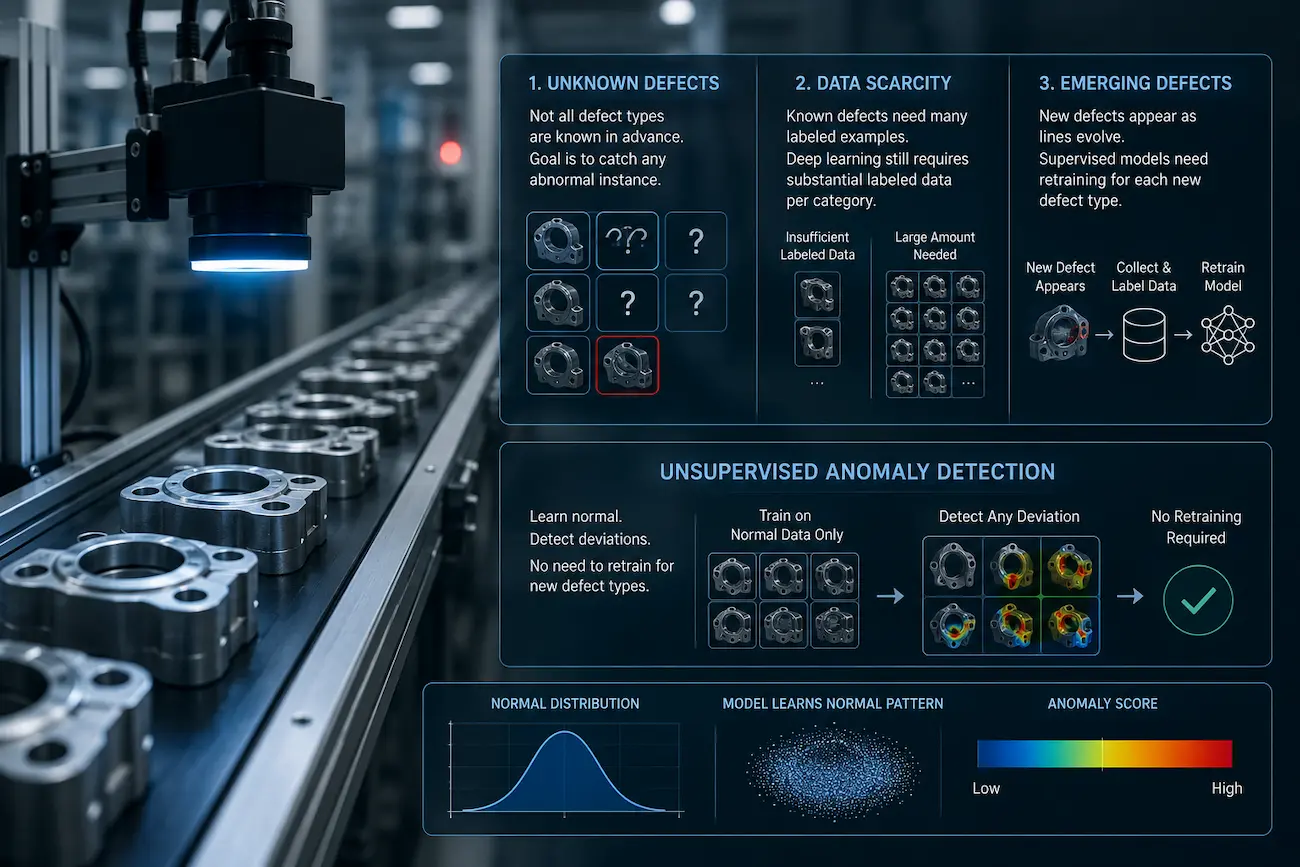
When failure data is limited, unsupervised or semi-supervised learning approaches can help. These models learn normal operating patterns and flag deviations without requiring extensive labeled failure examples.
Reduced Scrap and Rework
One of the most immediate sources of ROI is reduced scrap. When defects are detected early, faulty products don’t move further down the line where additional value has already been added. Early detection leads to:
- Lower material waste
- Fewer rework operations
- Reduced disposal and handling costs
Prioritize System Integration Early
Work closely with IT teams for guaranteed compatibility between predictive platforms and existing ERP, MES, or CMMS systems. APIs and middleware solutions can help bridge gaps between legacy and modern systems.
Focus on Model Interpretability
Choose models that provide explainable outputs. Maintenance teams need to understand why a prediction is made. Clear visualizations and root-cause indicators increase trust and usability.
Demonstrate Quick Wins
Early measurable improvements build confidence. Track key performance indicators such as:
- Reduction in unplanned downtime
- Decrease in maintenance costs
- Improvement in mean time between failures
- Increased equipment availability
Turn Predictive Maintenance into Measurable Operational Gains
Predictive maintenance only delivers value when it’s deployed with the right infrastructure, integration strategy, and AI capabilities. Moving from pilot projects to plant-wide reliability requires scalable edge processing, reliable data pipelines, and models that operate in real time, not just in dashboards.
At AI-innovate, we help manufacturers bridge the gap between machine learning theory and operational execution by providing:
- Edge AI infrastructure with AIxCore (powered by NVIDIA Jetson Orin AGX) for real-time vibration analysis, thermal monitoring, and multi-sensor data processing directly on the shop floor
- Intelligent visual inspection with AIxEye, enabling early detection of wear, surface degradation, and structural irregularities before they escalate into failures
- Synthetic data capabilities through AIxCam, helping teams strengthen predictive models when historical failure data is limited
Whether you’re starting with a single high-value asset or scaling predictive maintenance across multiple facilities, the key is combining robust data capture, explainable AI models, and industrial-grade deployment.
Conclusion
Implementing predictive maintenance using machine learning is more than just a technical project. Rather, it represents a fundamental shift in how organisations approach asset reliability. Proactively addressing integration challenges ensures smoother adoption and long-term sustainability.
When executed thoughtfully, we believe predictive maintenance shifts operations from reactive repairs to proactive optimisation. The result is greater equipment reliability, improved productivity and a manufacturing environment that is more resilient and ready to compete in an increasingly data-driven world.
Sources
Ai-Innovate uses only high-quality sources, including peer-reviewed studies, to support the facts within our articles.
- MDPI Electronics. (2023). AI-Driven Anomaly Detection in Industrial Systems.
A peer-reviewed study outlining advanced AI methods for detecting anomalies in industrial environments, including performance evaluation and implementation considerations.
Retrieved from https://www.mdpi.com/2079-9292/12/18/3971 - Groundlight AI Blog. (2025). Using AI Anomaly Detection in Industrial Manufacturing.
A practical discussion of how anomaly detection powered by AI enhances manufacturing quality control, reduces defects, and supports predictive maintenance.
Retrieved from https://www.groundlight.ai/blog/using-ai-anomaly-detection-in-industrial-manufacturing - arXiv Preprint. (2025). Foundations and Advances in Industrial Anomaly Detection.
A research preprint exploring state-of-the-art approaches for anomaly detection in industrial systems, including novel architectures and benchmark results.
Retrieved from https://arxiv.org/abs/2501.11310 - Quix Glossary. (2025). Anomaly Detection in Industrial Systems.
An introductory resource explaining key concepts, algorithms, and typical use cases for anomaly detection in industrial and IoT applications.
Retrieved from https://quix.io/glossary/anomaly-detection-in-industrial-systems
FAQ
How does machine learning work with predictive maintenance?
Machine learning analyzes historical and real-time data (e.g., vibration, temperature) to identify patterns that signal degradation or failure, enabling forecasts of equipment issues before they happen.
What industries benefit most from predictive maintenance?
Industries with high-value machines and critical uptime requirements — manufacturing, energy, transportation, oil & gas, and utilities — see significant advantages from ML-based predictive maintenance. This is because missed failures in these sectors are costly and disruptive.
What is Predictive Maintenance?
Predictive maintenance is a strategy that uses sensor and operational data to monitor equipment condition and detect anomalies, so maintenance can be planned before failures occur.
- Read Also: