Some yarn faults cannot be seen in the yarn or in raw white fabric, and only show up as a color change at a later processing stage [1]. A camera is the obvious tool for checking yarn, but it measures how the yarn looks, and it cannot see a change in fiber count that leaves the diameter unchanged.
A capacitive sensor measures something else again, the amount of fiber, so the same yarn can pass one check and fail another. Choosing the wrong method means steady, confident readings that miss the fault you care about, or paying for equipment you did not need.
This guide explains what cameras, optical sensors, laser sensors and capacitive sensors each measure, so you can tell whether a camera is enough for your yarn, and what to test before you decide.
How to Measure Yarn Diameter and Detect Yarn Faults: What Are You Measuring?
Four different things are often mixed up when people talk about yarn quality. Each needs a different measurement.
Appearance is how the yarn looks to the eye, for example on a yarn board or in knitted fabric. Optical methods have an advantage here, because a one-direction optical reading comes close to what the human eye sees [1].
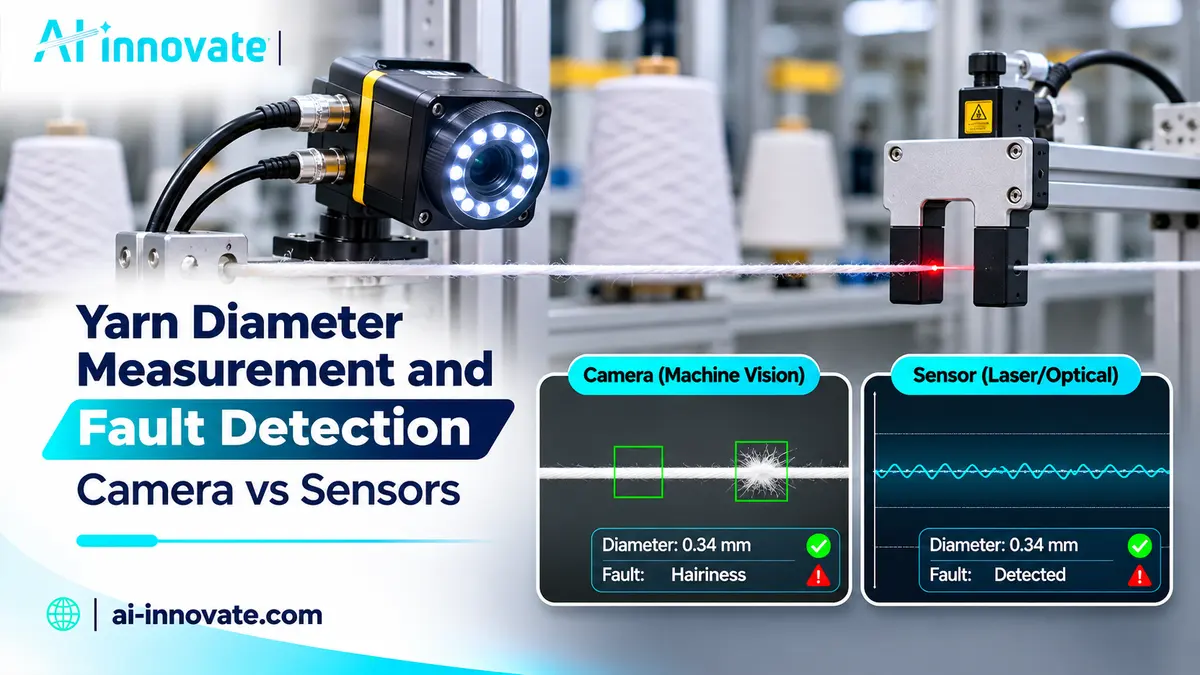
Diameter is how wide the yarn is at one point along its length. A camera or an optical sensor measures it from the yarn’s outline.
Hairiness is the loose fiber ends that stick out from the yarn surface. Hairs make the edge of the yarn fuzzy, so deciding where the yarn body ends and the hairs begin is a known difficulty in image-based measurement [3].
Thick and thin places from a change in mass are spots where the yarn holds more or less fiber than normal. This is a mass problem, and it is not the same as diameter. A capacitive sensor measures mass directly.
Key Insight
Diameter and mass can move apart. More fibers in the cross-section can, but do not have to, make the yarn wider. A narrower yarn with the same number of fibers points to a change in twist, not to a mass fault [1].
Before you choose a sensor, decide which of these four you need to control. It depends on whether your concern is how the yarn looks, how it runs in later processing, or how stable the spinning process is.
When Can a Camera Measure Yarn Diameter?
A camera finds the two edges of the yarn in the image, using edge detection, and converts the distance between them into a length. Five things decide how accurate that number is.
1. Clear edges. The yarn’s outline must be sharp against the background. A sharp edge lets the software place the boundary with confidence, while a soft edge leaves it uncertain.
2. Correct scale. The camera must be calibrated so that one pixel equals a known length, and yarn is thin, so pixel size matters. A patent filing from the yarn-clearing field describes a yarn about 250 µm across (Nm 40) and customary image sensors with 10 to 30 µm resolution. It reports diameter errors of up to ±6% to ±10% in earlier methods, against a requirement of under 1% for yarn clearing. Its worked example shows why: a yarn 6.5 pixels wide is read as 7 pixels when the partly covered edge pixels count as fully covered, an error of at least 8%. Counting those edge pixels in proportion, and calibrating against a known diameter, reduces the error [7].
3. Suitable lighting. Even, controlled light gives a clean edge. Illumination and lens quality have a strong effect on image quality in yarn imaging, and both back-lit (silhouette) and front-lit set-ups have been tested, each with advantages and disadvantages [3].
4. Precise focus. Yarn moves and vibrates. A limited depth of field is described as the most important restraint in yarn imaging, and yarn movement distorts line-scan images [3]. If the yarn leaves the sharp zone, the calibrated scale no longer holds. At high line speeds the camera also needs high-speed imaging, which is a separate topic from the measurement itself.
5. The amount of hairiness. Hairs blur the edge. Some systems report the width including hairs and others try to separate the yarn body from them, so a camera and a reference instrument can disagree just because they treat hairs differently. Decide which reading you need before you compare numbers.
Quick Tip
Before you compare a camera reading with a lab or reference instrument, write down how each one treats hairiness. Two systems that handle hairs differently can disagree on the same yarn even when both are working correctly.
A camera is a reasonable choice for diameter when the edges are sharp at your working resolution, the lighting is controlled, the yarn stays in focus and hairiness is handled in a known way. It is a weaker choice when the question is how much fiber is in the yarn.
Optical vs Capacitive vs Laser: What Does Each Sensor Measure?
These three names mix two ideas. Optical methods, including cameras and photodiode sensors, work with light and shadow, so they report the outline of the yarn. A laser is one kind of light source an optical sensor can use. Capacitive sensors work differently: the yarn passes between two plates and changes an electrical signal, which tracks the amount of fiber in the yarn [1]. Some research systems use both together to capture diameter, mass and hairiness [2].

| Method | What it measures | Limits | Test needed before choosing |
|---|---|---|---|
| Optical (camera or optical sensor) | The outline of the yarn: diameter, visible faults and hairiness | Needs sharp edges and steady focus. Does not see mass [3] | Run your yarn at line speed and compare the readings with a reference measurement of the same sample |
| Laser | The same as other optical methods: the width of the yarn's shadow. The laser is only the light source | Gives a sharper edge than an ordinary light [7], but adds a part to install and align, and still does not measure mass | Check first whether an ordinary light already gives a sharp enough edge on your yarn |
| Capacitive | Mass per unit length, meaning the amount of fiber in the yarn | Cannot measure diameter. Affected by humidity, temperature and conductive fibers [1] | Test at your standard climate and check the fiber blend for conductive fibers |
Swipe to see the full table
Is a laser necessary? No. A laser sensor is not necessary for every yarn or every production line. It helps only when the edge from an ordinary light is what limits your measurement. If a camera or optical sensor already gives a clean edge at the resolution you need, a laser is unlikely to change the result, and it still tells you nothing about mass.
When you need a capacitive sensor too. A capacitive sensor registers mass changes that leave the diameter unchanged, and an optical sensor cannot see those [1]. Industrial yarn clearers use both: the Uster Quantum 4.0 combines capacitive and optical sensors and checks one against the other [5]. If your decision depends on both appearance and process control, plan to measure both. Whether the added sensor pays for itself is a question of return on investment for the whole inspection setup.
Which Yarn Faults Need Imaging?
The right sensor depends on the fault. For each of the four below, the short answer comes first.
Foreign fibers: a camera or optical sensor, with one catch. Colored foreign fibers suit optical sensing. Uster describes a foreign-matter sensor with several light sources that detects colored fibers and separates them from vegetable matter that usually does no harm [8]. White and transparent polypropylene is harder. Loepfe, another yarn clearer maker, uses a separate triboelectric sensor for white polypropylene [6], which suggests that imaging alone may not be enough for that case. Color differences are a separate problem from foreign fibers and are part of color defect detection.
Fine fiber knots (neps): either one, and imaging helps identify them. Uster reports that a capacitive sensor registers neps, seed-coat fragments and trash particles as a short-wave increase in mass, and that an optical sensor can also detect short-wave variations [1]. A mass signal does not say what the object is. An image shows its shape and color, which helps tell a nep from a piece of trash.
Thick or thin places: it depends on the cause. A place that holds more or less fiber is a mass fault, and a capacitive sensor registers it. A thick place caused only by a rise in volume can usually be evened out in later processing, and a thin place with a smaller diameter but the same fiber count points to a twist variation [1]. A camera or optical sensor is the better fit when the concern is how these places will look in knitted fabric. A capacitive sensor is the better fit for controlling the spinning process.
Hairiness: a camera or optical sensor. Optical methods are the ones used to measure it. Most two-dimensional photoelectric systems tend to underestimate hairiness, because hairs are projected onto the yarn body or hidden behind it [4]. Check how any hairiness figure was measured before you compare it with another.
Is a camera enough? The table gathers the answers from the sections above, where the sources are cited.
| If your concern is | Is a camera enough? | What to add or check |
|---|---|---|
| Yarn diameter and appearance | Yes, when edges are sharp at your working resolution, light is controlled and focus is steady | Compare against a reference measurement of the same sample |
| Thick or thin places that affect how knitted fabric looks | Yes, optical diameter is the relevant measure | Nothing extra for appearance |
| Thick or thin places caused by a change in fiber mass | No, a camera sees diameter and not fiber count | A capacitive sensor |
| Fine fiber knots (neps) | Yes, optical sensors detect short-wave variations | A capacitive sensor if mass matters, because it registers them too |
| Hairiness | Yes, optical methods measure it, but two-dimensional systems tend to underestimate it | Check how any figure was measured before comparing |
| Colored foreign fibers | Yes, with an optical foreign-matter sensor | Test on your yarn color and blend |
| White or transparent polypropylene | Probably not on its own | A dedicated sensor, such as a triboelectric one |
Swipe to see the full table
No single answer fits every yarn. The result depends on the yarn type, the target fault and the conditions on your production line.
This guide covers sensing choices for the yarn itself. Defects in woven and knitted cloth belong to fabric defect detection, and color differences, print defects, line speed, camera count, upgrading older equipment and return on investment are separate questions that are not covered here.
How Should You Test Your Yarn Before Choosing a Method?
Published comparisons give direction, but the final choice comes from your own yarn and line. To choose the right method, check these seven things:
Material: fiber type and blend. Conductive fibers cause signal errors in capacitive sensing [1].
Color: it sets the contrast for imaging and affects foreign-fiber detection.
Diameter: it sets the pixel size and resolution you need.
Acceptable error: how far a reading can be off before it stops being useful.
Good and defective samples: real ones from your line, labeled by fault type.
Yarn speed: how fast the yarn moves past the sensor.
Lighting conditions: ambient light, dust and vibration for imaging, and humidity and temperature for capacitive sensing.
Run every candidate method on the same samples and compare each against a reference measurement. A method that works on one yarn can fail on another. Once you have chosen a method, the same sample set is the starting point for yarn and fiber inspection solutions built around your line.
Author's Suggestion
Build one labeled sample set before you talk to any vendor: good yarn, each fault you care about, and a reference measurement for every piece. Every candidate method can then be judged on the same evidence, and the sample set becomes the starting point for any system you install later.
Where Does AI Fit in Yarn Inspection?
Artificial intelligence is worth considering only for a fault that fixed rules cannot describe well, such as the look of a particular defect. It should be proposed for a given fault only after its performance has been tested on real samples of your yarn and confirmed. A model that works on one yarn does not carry over to another with a different color, twist or lighting. AI-Innovate‘s 2D automated visual inspection system, AIxEye, is built for visible defects on continuous material. Whether it suits a particular yarn is something to confirm on your own samples.
Share Your Yarn Details with AI-Innovate
Send a sample of your yarn, the fault you want to catch and the specifications of your production line, and AI-Innovate will review them with you before recommending a setup. No accuracy, speed or specific result is promised before testing.
Frequently Asked Questions
Can a camera replace a capacitive evenness tester?
Not for the same measurement. A capacitive sensor measures mass and a camera measures the yarn outline, so they answer different questions.
Does hairiness change the diameter reading?
It can. The reading depends on whether the system includes the hairs or separates them from the yarn body.
Is a laser sensor necessary for every yarn?
No. A laser changes the light source, not the type of measurement. Check whether an ordinary light already gives a sharp enough edge on your yarn.
Can one sensor catch every yarn fault?
Not in practice. Industrial yarn clearers combine capacitive and optical sensing with dedicated foreign-matter or polypropylene sensors for that reason.
References & Sources
- Uster Technologies AG. Comparison of the capacitive and optical measuring methods to determine evenness. USTER TESTER 5 Application Report SE 564, 2nd ed., July 2008. Report (PDF)
- Carvalho, V., Gonçalves, N., Soares, F., Vasconcelos, R., Belsley, M. Characterization of yarn mass parameters and production characteristics using optical sensors, capacitive sensors and image processing. International Journal of Sensors, Wireless Communications and Control, 2(3), 2012, pp. 145 to 156. doi:10.2174/2210327911202030002
- Özkaya, Y. A. Evaluation of yarn characteristics using computer vision and image processing. PhD thesis, Loughborough University, 2004. Thesis record
- 3D measurement of yarn hairiness via multi-perspective images. Proceedings of SPIE, vol. 10679, 2018. doi:10.1117/12.2307844
- Textile World. New Uster Quantum 4.0 yarn clearer offers spinners the best of both worlds. March 2021. Article
- Textotex. Loepfe ensures quality in yarn. March 2013. Article
- US Patent 6,242,755. Method and device for the contactless measuring of strand-like textile material. Patent text
- Textile World. Uster develops third-generation Uster Quantum clearer. September 2010. Article