AI in Quality Assurance for Software Testing

AI in Quality Assurance for Software Testing

The speed at which software comes out, gets updated, and then gets used has never been faster or more complicated. While this helps with new ideas, it makes things hard for quality teams. Old ways of testing software have a hard time keeping up with changes, more code, and what users want.

AI is changing how we do quality assurance. Instead of just doing separate checks on software, AI makes QA a process that keeps learning and getting better. Testing software is still important, but it’s now part of a bigger plan that uses AI to make sure things are good.

In this blog, we go over the effects of AI when it comes to QA in the case of software testing.

AI in Software QA Faster Testing Classification Better Quality.

Leverage AI-driven quality assurance to automate testing, detect defects early, and accelerate software delivery. Improve coverage, reduce manual effort, and ensure reliable, high-quality applications at scale.

Why Traditional Software QA Falls Short

In the past, software QA mainly tried to find mistakes after they happened. Things like manual testing, automated scripts, and regression tests have worked for a long time, but they don’t work as well with how we develop software today.

Manual testing takes a long time and the results can be different each time. Even the best testers might miss some problems, especially when they don’t have much time before release. Automated tests based on rules can be faster, but they’re also fragile. If something small changes in the design, process, or data, the tests can fail and need to be fixed all the time.

Also, it’s hard to see the big picture. Testing usually tells us if a test passed or not, but it doesn’t always explain what that means for how good the software is as a whole. QA teams end up fixing problems after they find them instead of preventing them. This means fixing things late, rushing releases, and making users unhappy.


How AI Transforms Software Quality Assurance

AI is changing quality assurance by moving the focus from just running tests to really understanding quality. Instead of just following the rules, AI systems learn from information like test results, past problems, code changes, how people use the software, and records of how the software is working.

By learning from patterns over time, AI-driven quality assurance systems can see where quality problems are likely to happen. This makes QA more proactive. Problems are spotted sooner, testing is focused on what’s most important, and decisions about quality are based on proof.

In software testing, this means AI isn’t only running tests faster. It’s choosing which tests are important, when to run them, and what the results tell us about the product.

Core AI Capabilities in Software QA

AI-driven quality assurance brings several capabilities that directly enhance software testing without replacing it.

AI-Driven Test Automation

Traditional automation executes predefined scripts. AI-driven automation goes further by learning which parts of the application are most risky.

AI can analyze historical defect data, recent code changes, and usage patterns to:

  • Generate test cases that target high-risk areas
  • Prioritize tests based on business impact
  • Reduce redundant or low-value test execution

Self-Healing QA Systems

Dealing with test maintenance is a pain in software testing. UI changes and workflow updates can cause many tests to fail fast.

Self-healing systems that use AI can spot these changes on their own. Instead of tests failing, the system changes by updating locators or suggesting fixes. This keeps tests reliable and reduces the work needed to maintain them.


Predictive Quality Analytics

AI can do a great job of predicting issues in quality control. By looking at past errors, code changes, and test outcomes, AI can find application areas likely to have problems before any tests are run.

This allows QA teams to:

  • Focus testing on high-risk features
  • Catch issues earlier in the development cycle
  • Reduce late-stage surprises

Natural Language and Requirement-Based Testing

AI can help line up what a business needs with how it’s tested. It uses language processing to turn what users want and need into real tests.

If a requirement is written simply, AI can turn it into automatic quality checks. This cuts down on confusion, gets teams on the same page, and makes sure everyone knows the quality standards are met.

AI-Driven QA in CI/CD and Continuous Quality Pipelines


In modern software development, quality assurance should be an ongoing effort, not just a final step.

AI-powered QA fits right into CI/CD processes, offering constant feedback as code is developed, tested, and released. Instead of waiting for long test periods, AI systems can examine results instantly.

This enables:

  • Faster feedback for developers
  • Early detection of quality regressions
  • Continuous validation without slowing delivery


Quality Improvements Enabled by AI in Software QA

AI can really help with software quality if it’s used the way it should be.

It makes finding problems easier since it spots patterns that people usually don’t see. Also, it cuts down on false alarms by focusing on the important tests first.

Teams can then feel more sure about their releases because they have a clearer understanding of any risks. Instead of just checking if all tests passed, they can use AI to see if the software is actually ready based on how it measures up.

With time, AI-based QA also gets better at keeping track of things. It uses data to connect what’s needed, the tests, any problems, and even issues that come up after release. This helps everyone see how quality changes over time.


Challenges of Using AI in Software Quality Assurance

Even with the pluses, using AI in QA has its issues.

AI systems rely on good data. If the data is bad, the results can be poor. If not watched, AI can make things worse.

It’s also important to know how AI makes its choices. QA people should know why AI sees a risk. Too much trust in AI can cause problems if the results aren’t checked.

Getting AI to work with what you already have can be hard. AI tools need to fit in with current testing and reporting. To make it work, you need a plan, training, and a slow start.

How QA Roles Evolve With AI-Driven Quality Assurance

AI won’t just take over the jobs of QA professionals; instead, it will change what they do.

As AI takes over checking repeatedly, QA engineers can focus on thinking, planning, and making things better. They can look at what AI finds, check if its guesses are right, and tell different teams how to make better quality decisions.

New skills become important, such as:

  • Understanding data and metrics
  • Evaluating AI outputs critically
  • Collaborating closely with developers and data teams
  • QA becomes less about executing tests and more about owning quality outcomes.

How AI-Innovate Supports AI-Driven Quality Assurance for Software Testing

AI-Innovate supports software teams adopting AI-driven quality assurance by providing products that help improve test reliability, decision-making, and continuous quality across modern development pipelines. Our product ecosystem helps with:

  • AI-driven quality monitoring and anomaly detection using AI2Eye, supporting intelligent analysis of test results, behavioral patterns, and quality signals beyond pass/fail outcomes
  • Data generation and validation through AI2Cam, helping teams simulate edge cases and expand test coverage when real-world failure data is limited
  • Scalable deployment and integration of AI workflows powered by AIxCore, enabling AI-based QA capabilities to integrate with existing testing tools, CI/CD pipelines, and reporting systems
  • Continuous quality insights and risk-based decision support, helping QA teams prioritize testing, detect regressions early, and maintain confidence in fast-paced release cycles

Whether teams are managing frequent releases, complex applications, or growing test suites, AI-Innovate’s products help apply AI in quality assurance for software testing with clarity, adaptability, and seamless integration into modern development workflows.


Conclusion

AI is changing software quality assurance. Instead of just doing manual tests and simple automation, AI helps with smarter testing, finding problems sooner, and making releases more reliable.

Testing software is still important, but it’s now part of a smart system that learns and gets better all the time. I believe when used well, AI in QA lets teams put out software faster without lowering the quality. This means the Software works better in real situations.

For groups that create complicated software quickly, AI is now key to QA. It’s a basic skill that shows how to keep software quality high over time.

Confused About Where to Start with AI?

Our specialists help you identify the right AI approach based on your process, data, and goals.

Ai-Innovate uses only high-quality sources, including peer-reviewed studies, to support the facts within our articles.

  1. Ideas2IT. (2025). AI Redefining QA & Software Testing. Explains how artificial intelligence is reshaping quality assurance in software development by automating test generation, predicting defects, and speeding up release cycles. Retrieved from https://www.ideas2it.com/blogs/ai-redefining-qa-software-testing ideas2it.com
  2. LinkedIn — Prodapt. (2025). How AI Is Transforming Quality Assurance in Software Development. Highlights AI’s shift of QA from reactive to proactive, with predictive defect detection and smarter testing workflows. Retrieved from https://www.linkedin.com/pulse/how-ai-transforming-quality-assurance-software-development-prodapt-nl3rc LinkedIn
  3. Effivity. (2024). AI in Quality Assurance: The Next Big Thing in Quality Management. Discusses how AI is improving accuracy and efficiency in quality management software, aiding compliance, inspection, and data-driven decision making. Retrieved from https://www.effivity.com/blog/ai-in-quality-assurance-the-next-big-thing-in-quality-management Effivity
  4. DeviQA Blog. (2025). How AI Changes Quality Assurance: 8 Industry Examples. Covers practical applications of AI in software QA, showing how companies improve productivity, reduce testing time, and enhance test coverage. Retrieved from https://www.deviqa.com/blog/how-ai-changes-quality-assurance-8-industry-examples/ deviqa.com

FAQ

Can AI handle edge cases?

Currently, AI still struggles with unpredictable edge cases and subjective “gray areas” that lack structured data. These scenarios still require human intuition to identify and resolve.

The first step is a diagnostic pilot project. Identify current bottlenecks—such as high script maintenance or slow regression cycles—and implement AI to solve that specific pain point before scaling.

Testers are shifting from execution-focused roles to Quality Strategists and Coaches. Key 2026 roles include AI Test Analysts who validate AI-driven products and Data Quality Engineers who ensure the integrity of datasets used for testing.
Automated Visual Inspection ROI

Automated Visual Inspection ROI: Cost vs Value

Manufacturing is nearly impossible without visual inspection, so it’s no question that a good visual inspection process is worth investing in. Customer expectations are ever-increasing, regulatory requirements are as tight as ever, and production lines have never been faster. That’s why many manufacturers are taking a closer look at automated visual inspection.

The big question isn’t whether the technology works, but whether the investment makes financial sense. So in this guide, we’ll break the discussion into what automated visual inspection brings, what it costs to implement, and how those costs translate into measurable returns.

Automated Visual Inspection ROI. Value That Pays Off.

Understand the true cost and value of automated visual inspection. Learn how AI-powered inspection delivers measurable ROI through reduced defects, lower labor costs, higher yield, and faster production.

Why Should You Invest in Automated Visual Inspection?

If the initial costs are high, what are you getting in return? The answer lies in all the differences an automated visual inspection process brings: decisions based on data, real-time inspection, AI defect detection and all the more.

One of the biggest advantages is inspection consistency. Manual inspection can vary from shift to shift or operator to operator. Automated systems apply the same rules every time, which leads to more stable quality outcomes.

There’s also a strong data advantage. Automated visual inspection systems record information about every unit produced. Over time, this data can be used to spot trends, recurring defects, and weak points in the process that are not always visible through manual inspection alone.

Other key benefits include:

  • Real-time defect detection without slowing down the line
  • Immediate feedback that allows issues to be addressed early
  • Reduced reliance on subjective human judgment
  • Continuous inspection instead of sample-based checks
Engineering documents, calculator, and precision metal parts on a worktable, with a blurred factory floor in the background, representing manufacturing planning and cost analysis.

Initial Costs of Integrating Automated Visual Inspection

If you want to invest in business process optimization tools, note that like any manufacturing technology, automated visual inspection requires an upfront investment. These costs are usually divided into visible upfront expenses and less obvious ongoing costs.

Upfront costs

The cost of automated visual inspection depends a lot on how complicated the application is. Here are some of the typical costs you will have to pay upfront:

  • Industrial cameras and lenses selected for resolution and speed
  • Lighting systems designed to create consistent image conditions
  • Computing hardware such as industrial PCs or edge AI devices
  • Visual inspection software or AI model licenses

As well as buying the equipment and software, it often costs a lot of money to combine all the different parts of the system. The inspection system must be connected to the production equipment, programmable logic controllers (PLCs), robots, or manufacturing execution systems that are already in place. This needs a lot of work and testing to make sure it works properly.

Customization can also add to upfront costs. Different products and defect types may need special inspection logic or training. If there’s more variety in products, more initial configuration is usually needed.

Training is also important. Operators, quality engineers, and maintenance teams need time to learn how the system works, how to understand the results, and how to respond when defects are detected.

Hidden costs

Some costs aren’t immediately noticeable when evaluating automated visual inspection ROI, but they still matter. Here are some common hidden or ongoing costs:

  • Periodic model updates as products or defect patterns change
  • Maintenance of cameras and lighting to preserve image quality
  • Software updates and cybersecurity management
  • System monitoring and performance validation

During the early stages, manufacturers may also do manual inspection as well as an automated one. This temporary overlap can increase short-term costs, but is often necessary to build confidence in the system. While these costs shouldn’t be ignored, they’re usually easy to predict and manage if you plan well.

The Real Value and ROI of Automated Visual Inspection

Looking beyond the numbers, the value of automated visual inspection becomes clear from the return. The ROI often comes from multiple areas working together rather than a single cost-saving metric.


Reduced Scrap and Rework

One of the most immediate sources of ROI is reduced scrap. When defects are detected early, faulty products don’t move further down the line where additional value has already been added. Early detection leads to:

  • Lower material waste
  • Fewer rework operations
  • Reduced disposal and handling costs

Labor Efficiency and Better Use of Skills

Automated visual inspection doesn’t eliminate labour, but gives it a new task. Instead of performing repetitive visual checks, skilled workers can focus on higher-value activities such as:

  • Root-cause analysis
  • Process optimization
  • Preventive quality planning

This shift improves overall productivity and addresses labor shortages, which are becoming more common across manufacturing sectors.

Downtime Reduction and Process Stability


Inspection systems highlight process drift on top of finding defects. Subtle changes in alignment, temperature, or material quality often show up in inspection data before a failure occurs.
Reducing even a small amount of downtime can have a major financial impact, especially in continuous or high-throughput operations.

By identifying these issues early, manufacturers can:

  • Prevent unplanned downtime
  • Avoid major equipment failures
  • Schedule maintenance more effectively


Compliance, Traceability, and Risk Reduction

In regulated industries, using cameras to check things visually can be very useful. This documentation helps to avoid problems and can be very useful if any problems do arise later on. Sometimes, avoiding one recall or customer complaint can make the whole investment worthwhile. Systems create reliable, time-stamped inspection records that support:

  • Customer audits
  • Regulatory compliance
  • Product traceability

Faster and More Confident Decision-Making

Automated visual inspection also helps you make decisions more quickly. Quality teams don’t need to wait for manual reports or subjective assessments. You can see the pass or fail results and all the supporting data right away.

This helps manufacturers to react faster, solve problems more quickly and make decisions based on facts instead of guesses.

This Topic might also interest you :

How AI-Innovate Supports Automated Visual Inspection ROI

AI-Innovate helps manufacturers maximize the return on automated visual inspection by providing AI-driven products designed to balance implementation cost with long-term value. Our product ecosystem supports ROI-focused inspection strategies by helping with:

  • AI-based visual inspection and defect detection using AI2Eye, enabling consistent, real-time quality decisions that reduce scrap, rework, and downstream costs
  • Data generation, simulation, and validation through AI2Cam, lowering model training costs and reducing dependence on large volumes of rare defect samples
  • Scalable deployment and system integration powered by AIxCore, allowing inspection systems to integrate smoothly with existing cameras, production lines, and manufacturing software
  • Actionable inspection data and traceability, supporting compliance, audit readiness, and faster decision-making across quality and operations teams

Whether manufacturers are evaluating the financial case for automated visual inspection or scaling existing systems across production lines, AI-Innovate’s products help turn inspection investments into measurable, long-term value across quality, efficiency, and operational stability.

Conclusion

When evaluating automated visual inspection ROI, it’s important to look beyond the initial equipment cost. While it is true that there are upfront costs involved, they’re only one side of the story. I think the long-term benefits come from better quality, less waste, more efficient use of workers, and lower risk of potential operational problems.

In the end, automated visual inspection doesn’t end with defect detection. The aim is to make manufacturing stronger, more efficient and competitive. The idea is that quality should be a benefit rather than a problem.

Confused About Where to Start with AI?

Our specialists help you identify the right AI approach based on your process, data, and goals.

Ai-Innovate uses only high-quality sources, including peer-reviewed studies, to support the facts within our articles.

  1. Averroes.ai. (2025). Visual Inspection System Cost Breakdown. Breaks down the key cost components of implementing visual inspection systems, including hardware, software, integration, and ongoing maintenance. Retrieved from https://averroes.ai/blog/visual-inspection-system-cost-breakdown
  2. Akridata.ai Blog. (2025). The ROI of Automated Inspection in Manufacturing. Explores how automated inspection systems deliver return on investment through reduced defects, improved throughput, and lower labor costs. Retrieved from https://akridata.ai/blog/the-roi-of-automated-inspection-in-manufacturing/
  3. Clarifai. (2025). How to Calculate the ROI of Automated Visual Inspection. Provides a practical framework for quantifying cost savings and efficiency gains from visual inspection automation. Retrieved from https://www.clarifai.com/blog/how-to-calculate-the-roi-of-automated-visual-inspection
  4. JLI Vision. (2025). The Cost and ROI of an Automated Surface Inspection System. Discusses typical investment costs, implementation factors, and financial benefits associated with deploying automated surface inspection technology. Retrieved from https://www.jlivision.com/blog/the-cost-and-roi-of-an-automated-surface-inspection-system

FAQ

What is the typical timeframe to see a return on investment (ROI) for automated inspection?

Most manufacturers achieve a full ROI within 12 to 24 months. In high-volume or high-risk sectors like steel or pharmaceuticals, some case studies report much faster paybacks, with one instance showing a 280% ROI in just over 4 months.

Yes. Modern AI-based AVI is specifically designed to handle “organic” variability. While traditional rule-based systems struggle with slight changes, AI models can be trained to recognize that a product is “good” even if components (like toppings on a pizza) are in slightly different spots, provided they meet quality standards.

Yes, but it is a common challenge. Integration often requires building custom APIs or middleware layers to bridge the gap between modern AI real-time workflows and older ERP or MES systems that may only process data in batches.

Not necessarily. In many 2026 deployments, AVI is used to augment rather than replace staff. It handles 100% of high-speed primary inspections, while human experts are reallocated to higher-value tasks, such as investigating the root causes of flagged defects or reviewing “borderline” cases to fine-tune the AI.


How to Choose the Right Visual Inspection System

How to Choose the Right Visual Inspection System

Visual inspection systems are very important in modern manufacturing and quality control. The right system can improve product consistency, reduce waste, and prevent costly failures. It can do so by detecting surface defects and verifying assembly accuracy. However, choosing an automated visual inspection system isn’t a one-size-fits-all decision.

Manufacturers often have to deal with a lot of different challenges. These include a wide range of camera technologies, multiple software approaches, varying lighting and optics requirements, and differences in vendor support and integration capabilities. This guide explains the most important things to think about when choosing a visual inspection system.

Edge AI in Smart Factories Faster Decisions, Faster Decisions.

Discover how Edge AI enables smart factories to process data instantly at the source. Reduce latency, improve responsiveness, and make faster, data-driven decisions that optimize production, quality, and efficiency.

Define Your Inspection Requirements

It’s very important to clearly define inspection requirements. This is the foundation of a successful visual inspection system. Many problems happen when expectations are unclear or not complete at the start.

First, you need to know what the system needs to inspect. This includes:

  • surface defect detections, like scratches, cracks, dents, or pits
  • Problems with the assembly, like parts not being there or not lined up right.
  • The dimensions and shapes must meet certain standards.
  • Text, labels, barcodes, or markings
  • There might be differences in color or how the surface looks.

There also some other important aspects to keep in mind:

  • The size of the defect and how easy it is to see it determine the camera resolution that is needed
  • The ability to inspect quickly and efficiently, especially in high-speed production environments
  • Factors in the production environment, such as dust, vibration, temperature changes, or reflective surfaces

Select the Appropriate Camera Technology

The camera is the most important part of any system that uses vision to inspect things. Choosing the right camera makes it easy to see, measure, and capture defects.

  • Key camera-related factors to evaluate include:
  • Resolution, which determines the smallest detectable defect
  • Frame rate, especially important for fast-moving production lines
  • Shutter type, with global shutters preferred to reduce motion blur

Sensor type, such as:

  1. Monochrome sensors for high-contrast defect detection
  2. Color sensors for label, packaging, or color verification tasks

The goal is to select a camera that meets inspection needs without creating unnecessary processing complexity.

Optimize Lighting and Optics

Lighting is one of the most important parts of a visual inspection system, but it’s often not given enough attention. Even the best camera can’t make up for poor lighting.

Effective lighting design focuses on:

  1. Highlighting defects or features of interest
  2. Reducing glare, shadows, and background noise
  3. Enhancing contrast between acceptable and defective areas

There are different types of lighting, such as ring lights, bar lights, dome lights, backlighting, and coaxial illumination. Each type of inspection is used for a specific purpose, depending on the part’s geometry, surface finish, and defect type.

Choosing the right optics is also important. The lens focal length, field of view, and depth of field must be carefully matched to the area being inspected.


Alt text: AI-powered robotic inspection system operating on an automated industrial production line.

Choose Between AI and Rule-Based Software

The software determines how inspection decisions are made, making this one of the most important choices in a visual inspection system. Many manufacturers use a mix of rule-based logic and AI detection to balance performance and transparency.

Rule-based inspection systems:

  • Use predefined thresholds, measurements, and logic
  • Work well for consistent, well-defined defects
  • Are easier to validate and explain
  • Typically require less training data

While AI-based inspection systems:

  • Use machine learning or deep learning models
  • Excel in complex or variable inspection scenarios
  • Adapt better to changes in texture, lighting, and surface appearance
  • Are ideal for coatings, natural materials, or complex assemblies

Evaluate Integration and Vendor Support

A visual inspection system doesn’t work on its own. It must work well with the equipment, control systems, and data infrastructure that are already in place.

First, you need to figure out how the system will communicate with other systems, like PLCs, robots, MES, or ERP. Real-time feedback may be needed to reject parts, adjust processes, or trigger alarms. It works with common communication protocols, which makes it easy to use and reduces times when it’s not operational.

Another important thing to consider is vendor support. Even the most advanced system will need to be set up, calibrated, maintained, and occasionally troubleshot. A good vendor should offer training, documents, and quick technical support.

It’s also important to think about how well the system can adapt to grow. As production volumes increase or inspection requirements change, the system should be able to adapt without needing to be replaced completely. This includes updates to the software, upgrades to the camera, and adding more inspection points.

Finally, check how much experience the vendor has in your industry. Suppliers who have successfully delivered similar systems in the past are more likely to provide a system that meets your needs.

AI Innovate: Flexible Visual Inspection Systems for Modern Manufacturing

AI Innovate helps manufacturers design and deploy visual inspection systems that match real-world production needs. Our AI-driven tools support both rule-based and advanced AI inspection, making it easier to detect defects, adapt to change, and scale over time. We assist with:

  • AI defect detection and quality monitoring using AI2Eye for complex surfaces, coatings, and variable parts
  • Visual data generation and validation with AI2Cam to support system training, testing, and performance optimization
  • Flexible inspection workflows built on the AIxCore platform that integrate with existing cameras, lighting, PLCs, and control systems
  • Scalable inspection solutions that adapt to new products, higher speeds, and evolving quality requirements

Whether you’re upgrading an existing inspection setup or building a new system from scratch, AI Innovate helps make visual inspection accurate, adaptable, and production-ready.

Conclusion


Choosing the right visual inspection system requires more than just picking a camera and software package. To do this, you need to understand your inspection goals, the environment where your products are made, and your long-term operational needs. I believe to build an inspection system that delivers consistent, accurate results, you need to clearly define requirements, select appropriate camera technology, optimize lighting and optics, choose the right software approach, and work with a reliable vendor.


Ai-Innovate uses only high-quality sources, including peer-reviewed studies, to support the facts within our articles.

  1. Visual Inspection System Patent Landscape Report 2025
    Globe Newswire — Analysis of over 5,400 patents highlighting key growth areas in visual inspection technologies such as AI-driven processing, 3D vision, and collaborative AI systems.
    https://www.globenewswire.com/news-release/2025/09/18/3152576/28124/en/Visual-Inspection-System-Patent-Landscape-Report-2025-Analysis-of-5-433-Patents-Key-Growth-Areas-Include-AI-driven-Processing-3D-Vision-and-Collaborative-AI-Systems.html
  2. Selecting the Correct Industrial Machine Vision Camera
    KEYENCE — Resource guide on choosing the right industrial machine vision camera based on application requirements, lighting, resolution, and more.
    https://www.keyence.com/products/vision/vision-sys/resources/vision-sys-resources/selecting-the-correct-industrial-machine-vision-camera.jsp
  3. AI Visual Inspection for Defect Detection Market Report
    HTF Market Insights — Market research report covering trends, drivers, and forecasts for AI-enabled visual inspection systems in defect detection applications.
    https://htfmarketinsights.com/report/4284385-ai-visual-inspection-for-defect-detection-market
  4. Machine Vision Technology Highlights at AUTOMATE 2025
    Vision Systems Design — Coverage of emerging machine vision demos and industrial automation trends showcased at the AUTOMATE 2025 event.
    https://www.vision-systems.com/cameras-accessories/article/55291757/automate-2025-machine-vision-technology-galore-in-demos-of-industrial-processes
  5.  

FAQ

What is the difference between AOI and AVI?

AOI (Automated Optical Inspection): A rule-based system that uses template matching to detect defects. It is highly effective for static, simple defects in structured environments but can struggle with natural variations, leading to higher false-positive rates.

AVI (Automated Visual Inspection): Powered by AI and machine learning, AVI learns “normal” patterns from image datasets. It is more flexible and accurate for complex, organic, or variable defects (like scratches on brushed metal) and generally requires less manual reprogramming.


False Rejects (Overkill): Setting tolerances too tight can cause the system to reject good parts, hurting yield.
Environmental Factors: Variations in ambient light, dust on lenses, or conveyor vibration can compromise accuracy.
Data Management: AI systems generate massive volumes of data that require structured handling for model retraining and audit trails.

Yes. Many 2026 software platforms are hardware-agnostic, allowing you to augment existing 2D/3D cameras with AI-driven software to reduce false positives and handle new defect types without replacing expensive hardware.

Part 6 - When Machines Learn to See

When Machines Learn to See: AI-Based Defect Detection in Modern Industry | Part 6

In Part 5, we compared classical image processing with learning-based methods and saw how data-driven approaches overcome many limitations of rule-based inspection. However, as industrial products become more complex and defect patterns more subtle, even traditional learning-based methods relying on hand-crafted features begin to fall short.

Deep Learning for Visual Defect Detection

This gap is where deep learning has fundamentally reshaped visual defect detection. By learning visual representations directly from raw images, deep learning enables inspection systems to detect defects that are difficult, ambiguous, or even impossible to describe explicitly with rules or engineered features.

In this section, we introduce deep learning-based defect detection, explain why it is different from earlier approaches, and outline its two main paradigms: supervised and unsupervised learning. This sets the conceptual foundation for a deeper exploration of unsupervised methods in Part 7.

Deep Learning for Visual Defect Detection. Precision at Scale.

Harness deep learning to identify complex visual defects with unmatched accuracy. Scale inspection across high-speed production lines while maintaining consistent quality, reducing false positives, and accelerating manufacturing excellence.

What Makes Deep Learning Different?

Deep learning refers to neural network models—most commonly convolutional neural networks (CNNs) that learn hierarchical representations of visual data.
Unlike classical or shallow learning approaches:

  • Features are not designed by engineers
  • Representations are learned automatically from data
  • Complex visual patterns can be modeled end-to-end

This ability to jointly learn features and decision logic is the key reason deep learning excels at defect detection tasks involving:

  • High intra-class variability
  • Subtle texture changes
  • Complex surface patterns
  • Non-linear defect appearances

Deep Learning as a Visual Representation Engine

At its core, deep learning transforms images into high-dimensional feature representations, often called embeddings.
These embeddings encode:

• Shape information

• Texture statistics

• Structural relationships

• Contextual visual cues

Defect detection then becomes a problem of identifying deviations in this learned representation space, rather than detecting defects through explicit visual rules.
This shift from rule-based reasoning to representation learning is what enables deep learning systems to generalize across variations that break traditional inspection pipelines.

This Topic might also interest you :


Supervised Deep Learning for Defect Detection

The Supervised Paradigm

In supervised deep learning, models are trained using labeled datasets, where each image (or region) is annotated as:

  • Normal
  • Defective
  • Or belonging to a specific defect class

The model learns to directly map images to labels, making defect detection a classification or segmentation problem.

Strengths of Supervised Approaches

Supervised deep learning can achieve:

  • Very high detection accuracy
  • Precise defect localization
  • Multi-class defect recognition

It is particularly effective when:

  • Defect types are known in advance
  • Large, well-annotated datasets are available
  • Defect appearance is relatively stable

In such settings, supervised models often outperform all other inspection methods.

Practical Limitations of Supervised Learning

Despite their power, supervised approaches face serious challenges in industrial defect detection:

  • Data annotation cost: Defect labeling requires expert knowledge and significant time
  • Class imbalance: Defects are rare by nature, leading to skewed datasets
  • Limited coverage: Models can only detect defect types seen during training
  • Poor adaptability: New defect types require dataset expansion and retraining

In many real-world manufacturing environments, collecting sufficient labeled defect data is impractical or impossible.

Why Industry Looks Beyond Supervised Learning

The limitations of supervised learning become especially pronounced in:

  • Early-stage production lines
  • High-mix, low-volume manufacturing
  • Processes where defects are unpredictable or evolving

In these cases, asking “Which defect class is this?” is less realistic than asking “Does this look normal?”
This shift in perspective naturally leads to unsupervised and weakly supervised approaches, where models learn primarily from normal (defect-free) data.

Unsupervised Deep Learning: Learning Normality

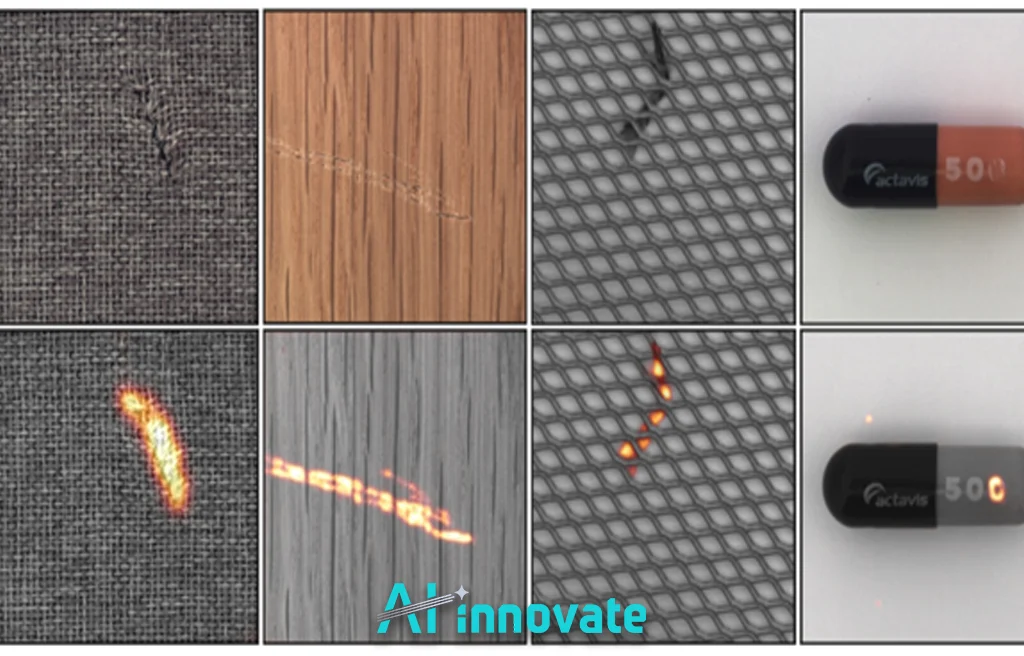
AI defect detection examples showing input images and heatmap overlays highlighting surface flaws across different materials and products.”

In unsupervised deep learning for defect detection, models are trained without explicit defect labels. Instead, they learn a representation of normal appearance.

Defects are then detected as:

  • Poor reconstructions
  • Outliers in feature space

Deviations from learned similarity patterns

This paradigm aligns naturally with industrial reality, where:

  • Normal samples are abundant
  • Defects are rare, diverse, and unpredictable

Why Unsupervised Methods Are a Natural Fit for Inspection

Unsupervised deep learning offers several conceptual advantages:

  • No need for defect annotation
  • Ability to detect previously unseen defects
  • Better scalability across products and lines

Rather than enumerating defect types, these methods model the manifold of normality and flag deviations as anomalies.
However, unsupervised approaches are not monolithic. In practice, they fall into distinct methodological families, each with different assumptions and trade-offs.

Two Fundamental Perspectives on Unsupervised Defect Detection

At a high level, unsupervised deep learning methods answer one of two questions:

  1. Can the system accurately reconstruct what it has learned as normal?
  2. How similar is a new sample to known normal representations?

These perspectives give rise to two major categories:

  • Reconstruction-based methods
  • Embedding similarity-based methods

Each category defines “anomaly” in a fundamentally different way and exhibits different strengths in industrial settings.

Why This Distinction Matters

Although both approaches are unsupervised, they:

  • Respond differently to subtle vs. structural defects
  • Scale differently with image resolution and complexity
  • Exhibit different failure modes

Understanding this distinction is critical for selecting the right defect detection strategy.

Bridging to the Next Section

Deep learning has transformed visual defect detection by enabling machines to learn rich representations directly from data. Within this paradigm, unsupervised learning plays a central role due to its alignment with real-world manufacturing constraints.
However, unsupervised methods themselves are not uniform. Their effectiveness depends strongly on how normality is modeled and how deviations are measured.

In Part 7, we will take a deeper dive into unsupervised defect detection by examining:

  • Reconstruction-based approaches (e.g., autoencoder-driven methods)
  • Embedding similarity-based approaches (e.g., feature-space comparison and nearest-neighbor methods)

By analyzing their assumptions, mechanisms, and practical behavior, we move one step closer to understanding how machines truly learn to recognize defects without being explicitly taught what defects look like.

Confused About Where to Start with AI?

Our specialists help you identify the right AI approach based on your process, data, and goals.

Part 5 - When Machines Learn to See

When Machines Learn to See: AI-Based Defect Detection in Modern Industry | Part 5

In Part 4, we focused on imaging as the foundation of machine vision systems how cameras, lenses, and lighting transform the physical world into digital images. Once this transformation is complete, the next critical question arises:

How should these images be interpreted to reliably detect defects?

Classical Image Processing vs. Learning-Based Methods

Historically, industrial inspection systems relied on classical image processing techniques to answer this question. More recently, learning-based methods have gained prominence, offering a fundamentally different way to extract meaning from visual data. This section explores both approaches, their underlying philosophies, and why industry has gradually shifted toward learning-based solutions.

Classical Vision vs AI Learning Choosing the Right Approach

Compare traditional image processing techniques with modern learning-based methods to understand their strengths, limitations, and best use cases. Learn how AI-driven vision delivers greater flexibility, accuracy, and scalability in complex inspection tasks.

Classical Image Processing: Rule-Based Visual Interpretation

Classical image processing refers to a family of techniques that rely on explicit, human-designed rules to analyze images. These methods dominated industrial vision systems for decades and remain widely used today in well-defined inspection tasks.

Core Characteristics of Classical Methods

Classical image processing typically involves:

  • Thresholding and binarization
  • Edge and contour detection
  • Morphological operations
  • Template matching
  • Hand-crafted feature extraction

In these systems, engineers explicitly define what constitutes a defect by encoding visual rules into the inspection pipeline.

Strengths of Classical Image Processing

Classical methods offer several advantages that made them attractive for early machine vision systems:

  • Deterministic behavior: Given the same input, the system always produces the same output
  • Interpretability: Engineers can easily understand why a defect was detected
  • Low data requirements: No large datasets are needed for deployment
  • Computational efficiency: Suitable for real-time inspection on limited hardware

For applications with stable products, low variability, and well-defined defect characteristics, classical image processing can be highly effectiv e.

Limitations of Classical Approaches

Despite their strengths, classical methods struggle as inspection problems become more complex.
Key limitations include:

  • Sensitivity to lighting and appearance variation
  • Fragility under small changes in product geometry or texture
  • Difficulty handling complex or ambiguous defects
  • Extensive manual tuning and maintenance

In practice, rule-based systems often require frequent parameter adjustments as production conditions evolve. This makes them difficult to scale across product variants or production lines.

Learning-Based Methods: Data-Driven Visual Understanding

Learning-based methods take a fundamentally different approach. Instead of encoding rules manually, these systems learn patterns directly from data.
At a high level, learning-based defect detection systems:

  • Use labeled or unlabeled image data
  • Learn statistical representations of normal and defective appearances
  • Generalize beyond explicitly programmed rules

This shift replaces manual rule design with model training, transferring much of the system complexity from engineering effort to data.

Advantages of Learning-Based Methods

Learning-based approaches address many of the structural weaknesses of classical image processing:

  • Robustness to variability: Better tolerance to changes in lighting, texture, and geometry
  • Reduced manual tuning: Fewer hand-crafted thresholds and parameters
  • Ability to model complex defects: Effective for subtle, non-linear visual patterns
  • Improved scalability: Easier adaptation to new products or defect types

These properties make learning-based methods particularly attractive in modern manufacturing environments with high product diversity.

New Challenges Introduced by Learning-Based Methods

However, learning-based approaches introduce their own challenges:

  • Dependence on data quality and quantity
  • Reduced interpretability compared to rule-based systems
  • Need for training, validation, and monitoring pipelines
  • Risk of overfitting or poor generalization

As a result, learning-based methods require a different mindset and infrastructure than classical inspection systems.

A Philosophical Difference: Rules vs. Representations

The distinction between classical and learning-based methods is not merely technical it is conceptual.

  • Classical image processing answers:

“How should a defect look?”

  • Learning-based methods answer:

“What patterns distinguish defects from normality?”

In classical systems, knowledge is encoded explicitly by engineers. In learning-based systems, knowledge is embedded implicitly within trained models.
This difference has profound implications for system design, maintenance, and scalability.

When Classical Methods Still Make Sense

Despite the rise of learning-based approaches, classical image processing remains valuable in certain contexts:

  • Simple, well-controlled inspection tasks
  • Applications requiring full explainability
  • Low-volume production with limited data
  • Environments with strict validation requirements

In many industrial systems, classical and learning-based methods are combined, leveraging the strengths of both.

Why Learning-Based Methods Set the Stage for Deep Learning

Learning-based inspection methods represent a stepping stone toward deep learning, but not all learning-based systems are deep learning systems.
Early learning-based approaches often relied on:

  • Hand-crafted features
  • Traditional machine learning classifiers
  • Statistical models of appearance

While powerful, these methods still depend on human feature design. Deep learning extends this idea further by learning both features and decision logic simultaneously.

Preparing the Transition to Deep Learning

As inspection problems grow more complex, the limitations of both classical image processing and shallow learning-based methods become apparent.
This naturally raises the next question:

Can systems learn directly from raw images, without relying on hand-crafted features?

This question leads directly to deep learning-based visual defect detection, which will be the focus of the next part.

What Comes Next

In Part 6: Deep Learning for Visual Defect Detection, we will focus specifically on:

  • Deep learning architectures for vision tasks
  • Supervised vs. unsupervised defect detection
  • The strengths and limitations of each paradigm
  • How deep learning reshapes inspection system design

By understanding classical and learning-based foundations, we are now ready to explore how machines truly learn to see.

Confused About Where to Start with AI?

Our specialists help you identify the right AI approach based on your process, data, and goals.

Part 4 - When Machines Learn to See

When Machines Learn to See: AI-Based Defect Detection in Modern Industry | Part 4

In Part 3, we discussed how industries transition from manual visual inspection to automated machine vision systems in order to eliminate human-related limitations such as fatigue, subjectivity, and poor repeatability.

Imaging System Components in Machine Vision

Why Imaging Becomes Critical After Automation

Once inspection logic becomes automated and decisions are formalized, a new reality emerges:

The performance of an automated inspection system is fundamentally limited by the quality of its visual input.
At this stage, inspection accuracy no longer depends on human perception it depends on how well the physical world is translated into digital images. This makes the imaging system comprising cameras, lenses, and lighting the most critical foundation of any machine vision-based defect detection solution.

Automation Needs Vision. Why Imaging Matters More Than Ever.

As manufacturing becomes increasingly automated, advanced imaging systems ensure quality, accuracy, and reliability. Discover why machine vision is essential for detecting defects, validating processes, and maintaining control in fully automated environments.

Imaging as the Foundation of Defect Detection

Before any algorithm can detect defects, those defects must be visually separable from their background. Imaging components are responsible for:

  • Capturing sufficient spatial detail
  • Preserving contrast and texture
  • Making defects consistently visible

In practice, many inspection failures attributed to “algorithm limitations” originate from suboptimal imaging design. For this reason, experienced machine vision engineers treat imaging not as a peripheral detail, but as a primary system design task.

Industrial Cameras: Capturing Visual Information

Industrial cameras act as the eyes of the machine vision system. Unlike consumer cameras, they are optimized for precision, stability, and integration with automation systems.

Area-Scan Cameras

Area-scan cameras capture two-dimensional images in a single exposure. They are the most widely used camera type in machine vision.

Typical applications include

Advantages

  • Simple system integration
  • Suitable for most general-purpose inspections
  • Flexible field of view

Example

Inspecting molded plastic parts for surface scratches or missing features as they pause briefly under the camera.

Line-Scan Cameras

Line-scan cameras capture images one line of pixels at a time. A complete image is built as the object moves relative to the camera.

Typical applications include

  • Continuous materials such as paper, textiles, metal sheets
  • High-speed production lines
  • Cylindrical or rotating objects

Advantages

  • Extremely high resolution in one dimension
  • Ideal for detecting fine, continuous defects
  • Excellent for uniform motion environments

Example

Detecting coating defects on steel strips or scratches on glass sheets moving at high speed.

The Role of Resolution and Sensor Choice

Regardless of camera type, defect detectability depends on:

  • Sensor resolution
  • Pixel size
  • Signal-to-noise ratio

A common design rule is that critical defects should span multiple pixels to ensure reliable detection. Over-specifying resolution increases cost and data load, while under-specifying risks missed defects.

Lenses: Shaping the Image

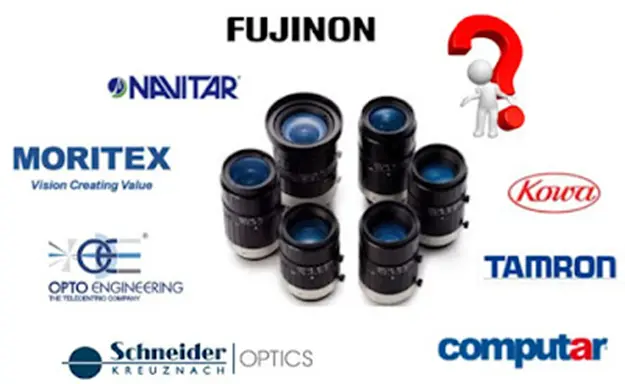
Selection of industrial machine vision lenses with logos of leading manufacturers used in imaging systems for automated inspection applications.
Various focal length machine vision camera lenses displayed on a white background, illustrating optical components for industrial imaging systems.

While cameras capture images, lenses determine how the scene is projected onto the sensor. Lens selection directly affects defect visibility and measurement accuracy.

Standard (Entocentric) Lenses

These lenses resemble conventional camera lenses and are used in most general-purpose applications.

Applications

  • Surface inspection
  • Presence/absence checks
  • Basic dimensional measurements

Limitations

  • Perspective distortion
  • Apparent size changes with object distance

Hypercentric Lensesf

Hypercentric lenses are a specialized class of machine vision optics designed to capture features that are not visible with conventional lenses, particularly surfaces and geometries that face away from the camera.
Unlike standard (entocentric) or telecentric lenses, hypercentric lenses have a virtual viewpoint located inside the object, which creates a unique imaging geometry where distant features appear larger than closer ones. This allows the camera to simultaneously observe:

  • The top surface of an object
  • Side walls
  • Underside edges

all within a single image.

Typical Applications of Hypercentric Lenses

Hypercentric optics are especially useful in inspection tasks where side or bottom features are critical, but physical access or multi-camera setups are impractical.
Common applications include:

  • Inspection of bottle necks, threads, and rims
  • Detection of defects on the inner walls of cylindrical parts
  • Verification of container sealing surfaces
  • Inspection of molded plastic caps and closures

Example

Inspecting the integrity of threads and sealing lips inside a bottle cap using a single top-mounted camera, without rotating the part or adding side cameras.

Macro and Specialized Lenses

For small objects or micro-defects, macro lenses or specialized optics are used to achieve high magnification and resolution.

Example

Inspecting solder joints or micro-cracks on electronic components.

Lighting: Making Defects Visible

Among all imaging components, lighting has the greatest influence on inspection performance. Defects are rarely objects themselves; they are variations in how a surface interacts with light.

Bright-Field Lighting

In bright-field illumination, light is directed toward the object and reflected back into the camera.

Best suited for

  • General surface inspection
  • Color and texture evaluation
  • Printing and labeling checks

Example

Inspecting printed labels for missing or blurred text.

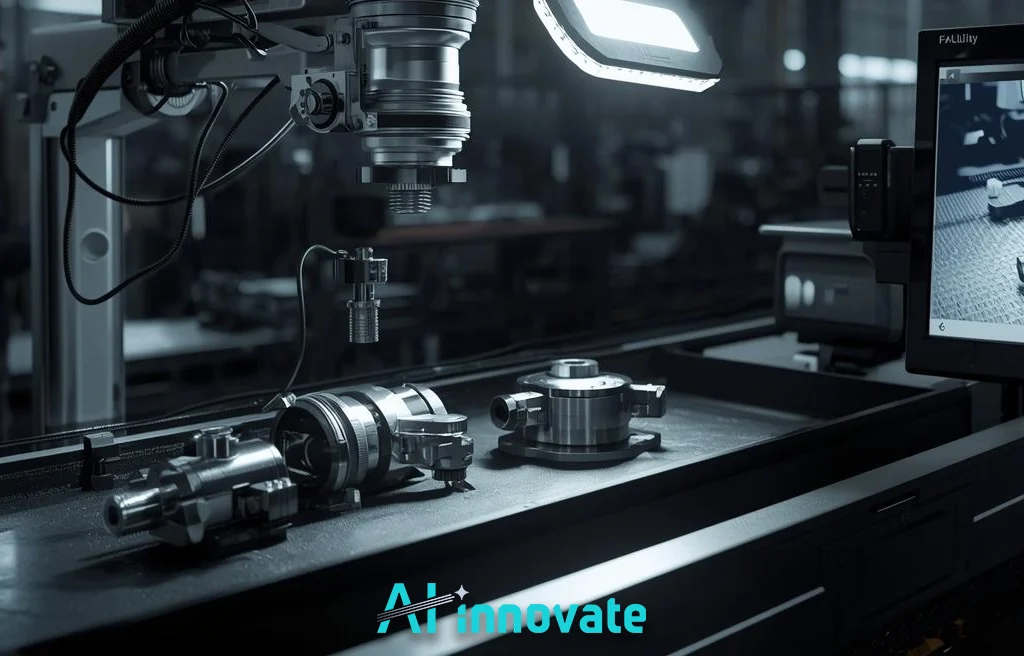
Industrial machine vision system with camera, lens, and LED lighting inspecting precision metal components for automated quality control.

Dark-Field Lighting

In dark-field illumination, light strikes the surface at a shallow angle. Only scattered light from surface irregularities reaches the camera.

Best suited for

  • Scratches and dents
  • Cracks and edge defects
  • Subtle surface anomalies

Example

Detecting fine scratches on polished metal or glass surfaces that are invisible under bright-field lighting.

Choosing the Right Lighting Strategy

Lighting is not selected based on brightness alone, but on how it interacts with defect geometry. Often, changing lighting geometry yields more improvement than changing cameras or algorithms.
Key considerations include:

In practice, successful systems often combine multiple lighting techniques to highlight different defect characteristics.

Imaging Stability and Repeatability

A core advantage of automated inspection over manual inspection is repeatability. Imaging systems must therefore be designed to:

  • Maintain stable illumination over time
  • Minimize sensitivity to ambient light
  • Ensure consistent object positioning

Without stability, even the best algorithms will struggle to produce reliable results.

Imaging as the Performance Ceiling

Once inspection decisions are automated, imaging quality defines the upper limit of what can be detected. If a defect is not visually separable in the image, no algorithm classical or AI-based can detect it reliably.
This is why imaging design precedes algorithm selection in professional machine vision projects.

Bridging to the Next Stage: From Images to Algorithms

Imaging systems convert physical reality into digital representations. The next question is how these images should be interpreted computationally.
In the next part of this series, we will explore:

  • Classical image processing methods for defect detection
  • Learning-based and AI-driven approaches
  • Their strengths, limitations, and appropriate use cases

Only once imaging is properly engineered does it make sense to ask how machines should learn to see defects.

AI in Automotive Manufacturing

AI in Automotive Manufacturing

The scale with which manufacturing operates today was nothing short of a dream around a decade ago. The key factor that played a central role in this achievement was automation. Automation technology continues to evolve, and its most recent addition is AI.

When industries like automotive vehicles become more complex and customer expectations continue to rise, manufacturers are under constant pressure to improve quality while controlling costs. This is where AI is playing an increasingly important role with introducing AI-driven quality control and inspection.

In this blog, we’ll explore the evolution of AI in the automotive manufacturing world.

AI in Automotive Manufacturing Driving Smarter Production.

From quality inspection to predictive maintenance, AI is transforming automotive manufacturing. Improve efficiency, ensure consistent quality, and accelerate innovation across every stage of vehicle production.

The Important Role of AI in Car Manufacturing

Automotive manufacturing is complicated in many ways. There are thousands of components that need metal defect detection, multiple production stages, and extremely tight tolerances.

The major role that AI plays in the manufacturing process itself is by continuously analyzing production data to detect patterns, anomalies, and inefficiencies through machine learning, computer vision, and advanced analytics.

Traditional automation methods faced difficulties because of the level of perception needed. AI has been a revolution in the industry. Key areas where AI is now central include:

  • AI-driven quality control across stamping, welding, painting, and final assembly, metal defect detection on body panels, frames, castings, and machined parts.
  • Enhancing safety with features like automatic emergency braking, lane-keeping assist, and adaptive cruise control.
  • Autonomous driving is mainly driven by AI, using machine learning and deep learning models to analyse live data from sensors and cameras.

Unlike traditional systems, AI adapts over time. The more data is collected, the more accurate the models become and the better they are at dealing with differences in materials, lighting and how the processes are carried out. This adaptability is especially important in car factories that make different models on the same production line.

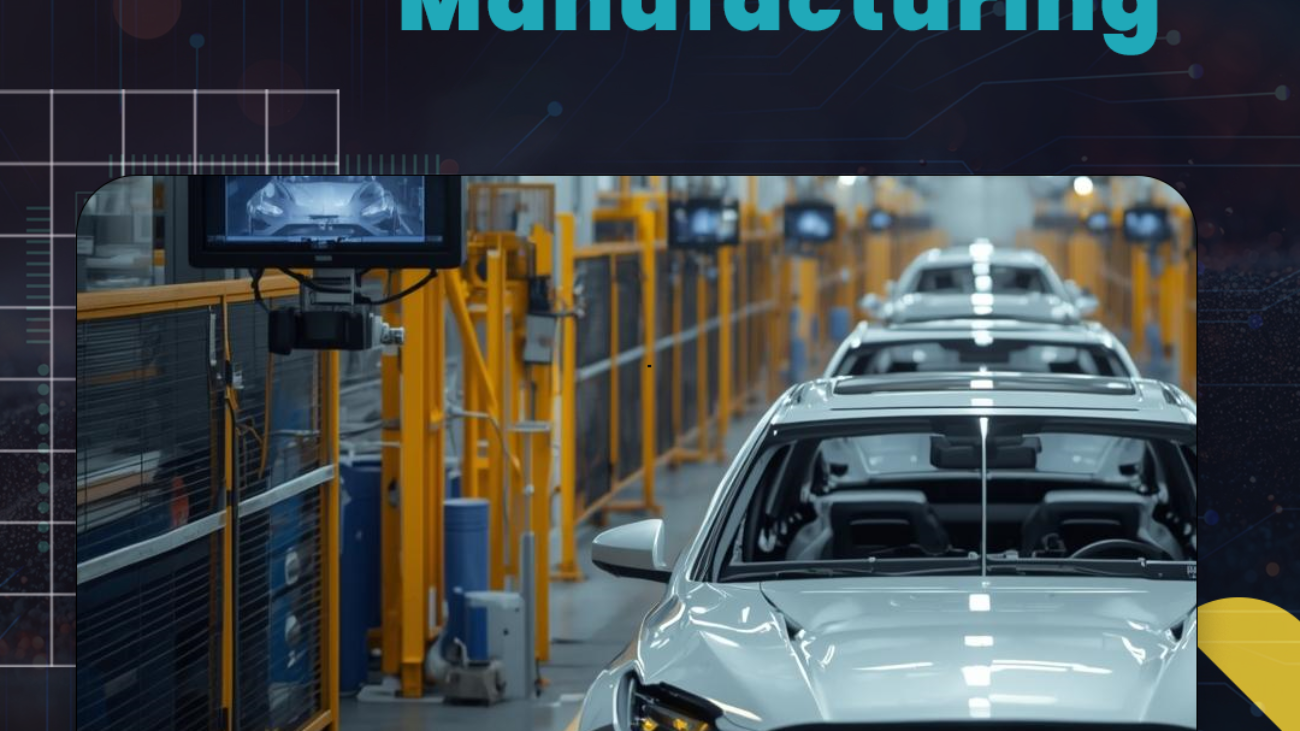
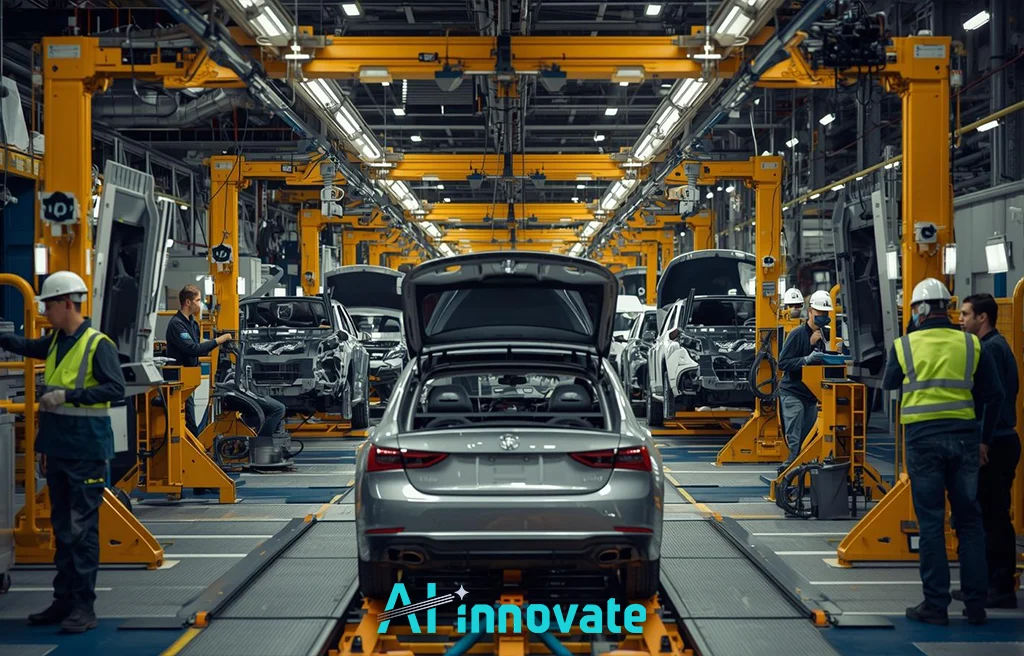
Automotive assembly line with unfinished cars moving through production, showcasing large-scale vehicle manufacturing and industrial automation

Beyond the Factory Floor: AI in the Vehicle

What might be noticeable the most to the drivers is the AI features added to vehicles beyond the manufacturing part:

  • Autonomous Driving: AI is the technology that makes self-driving cars work. It uses different types of sensors (cameras, LiDAR, radar) and learns how to understand the environment and plan the car’s route.
  • Advanced Driver-Assistance Systems (ADAS): AI is used in important safety features like automatic emergency braking, lane-keeping assist, and adaptive cruise control. These features help drivers avoid accidents and make driving safer.
  • Personalized In-Car Experience: AI-driven systems learn what drivers like and don’t like, so they can automatically change seat positions, climate control and infotainment settings to make driving easier and more comfortable.
  • Predictive Diagnostics: AI checks the health of vehicles as they drive, telling drivers when something might be wrong and helping them fix the vehicle quickly and save money.

How AI Is Changing the Automotive Industry

AI is reshaping the automotive industry beyond isolated inspection tasks. It’s driving a shift toward smarter factories with AI for industrial process control, more resilient operations, and data-driven decision-making across manufacturing, logistics, and retail.

Smart Factories and Production Lines

AI is a key part of making smart factories. Robots and automation systems driven by AI can make production faster and reduce human error on assembly lines. These systems can adapt to changes in models, components, or the amount of production.

Quality Control and Inspection

AI-driven quality control has seen one of the biggest changes. Computer vision systems that use AI can find very small defects that are hard or even impossible for a person to spot. By spotting problems on the surface, problems with how things are lined up, and differences in the materials early on, AI can make vehicles better overall and reduce the need for extra work and waste.

Predictive Maintenance

AI is also changing how equipment is maintained. Instead of relying on fixed maintenance schedules, AI models analyse machine data to predict failures before they happen.

This approach to maintenance means you won’t have any unexpected downtime, your equipment will last longer, and you’ll avoid costly production interruptions.

Generative Design and Engineering

In design and engineering, AI supports generative design by evaluating thousands of design variations based on safety, performance and efficiency requirements.

This helps car manufacturers make cars that are lighter, safer, and more efficient that take less time to make.

AI in Operations and Retail

In supply chains, AI keeps track of parts as they are being sent out, predicts how many will be needed, and spots problems before they cause delays.

This makes sure that customers get their orders more often, and it also means that the company doesn’t have to spend as much money on storing goods or on delivering them.

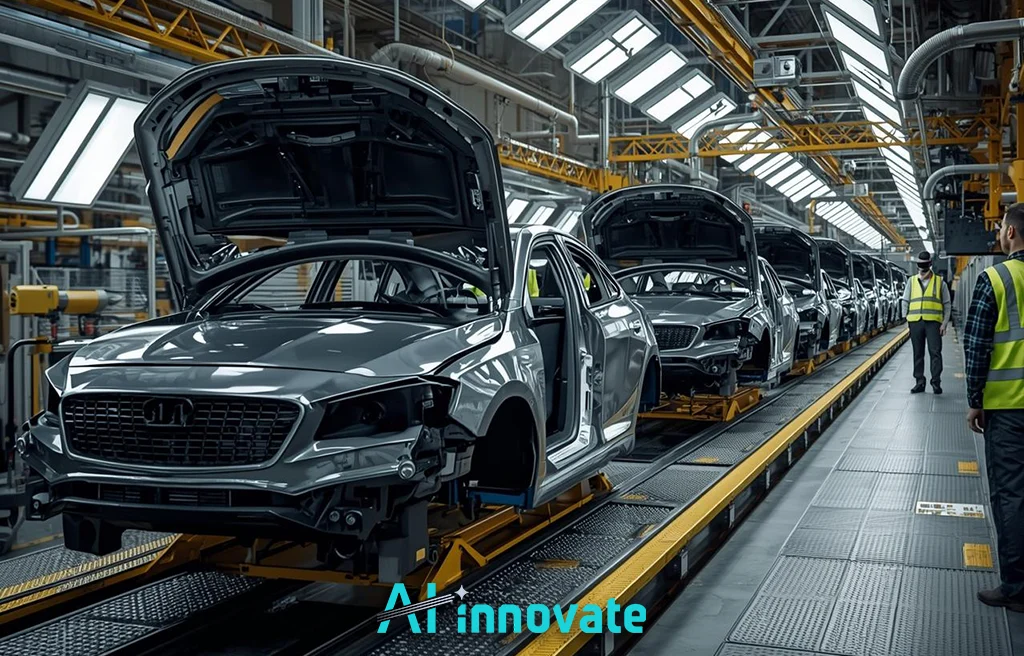
Car manufacturing plant interior with workers assembling vehicles on a production line, highlighting modern automotive production and quality control.

The Role of AI in the Automotive Industry: Trends, Benefits, and Use Cases in 2026

In 2026, AI is expected to be a core part of how cars are designed, built, and supported. Instead of being used only for inspection or automation, AI will connect engineering, manufacturing, and operations across the entire industry.

Key Trends to Watch

AI is becoming especially important in electric vehicles and advanced manufacturing. Some new trends include:

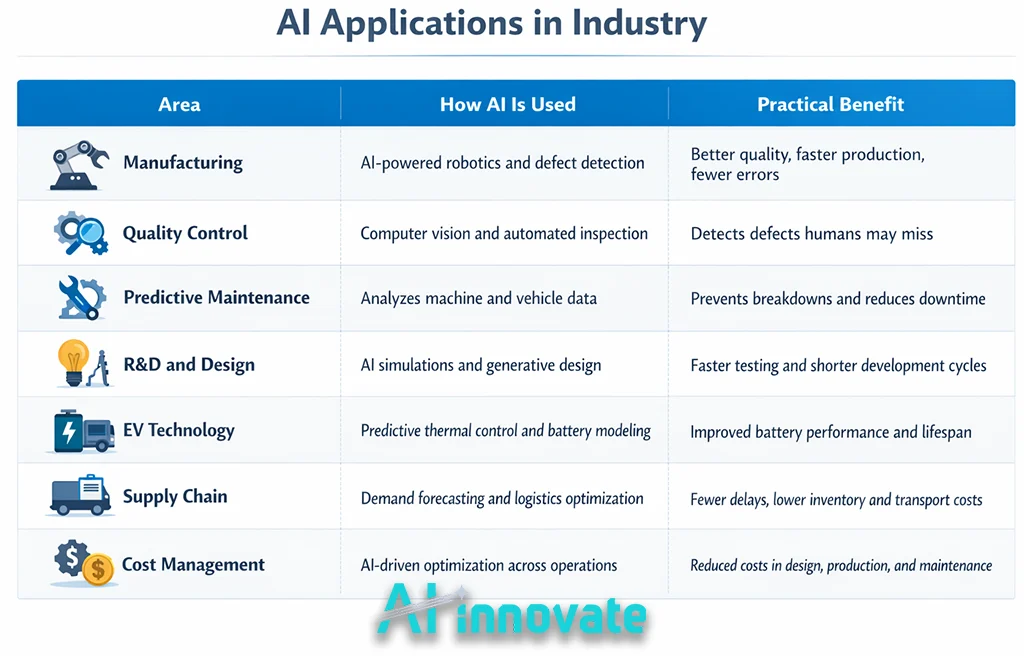
  • Predictive thermal control, which can manage heat in EV batteries and propulsion systems, improving performance and extending component life.
  • Battery design is sped up by AI-enabled platforms by running simulations that would normally take months.
  • AI-powered digital twins and generative simulations allow companies to test designs and production changes virtually before making physical adjustments.


How Companies Leverage AI in Automotive Manufacturing

When it comes to a good demonstration of how AI fits into automotive manufacturing, BMW and Toyota show how AI supports zero-defect manufacturing in real factories very well.

  • BMW uses AI-based visual inspection to spot surface and assembly defects early, which improves consistency and reduces manual checks.
  • Toyota applies AI for monitoring production processes, using machine learning to detect small deviations before they turn into larger quality issues.

Notice that in both cases, AI supports engineers and operators rather than replacing them.


Benefits of AI in Automotive Manufacturing

AI helps manufacturers work smarter at every stage, from design to production to maintenance.

Applications Table

How AI-innovate Supports AI in Automotive Manufacturing

AI-innovate supports automotive manufacturers across inspection, production, and quality control by providing AI-driven products designed for complex, high-volume manufacturing environments. Our product ecosystem helps with:

  • AI-powered visual inspection and defect detection using AI2Eye, enabling consistent quality control across stamping, welding, painting, and final assembly lines
  • Synthetic data generation, simulation, and validation through AI2Cam, supporting robust model training when real defect data is limited or production conditions vary
  • Scalable deployment and integration of AI workflows powered by AIxCore, allowing AI systems to connect with existing cameras, sensors, robotics, and production software
  • Real-time inspection feedback and process monitoring, helping automotive teams reduce rework, prevent downstream defects, and maintain stable production at scale

Whether manufacturers are managing multiple vehicle models on shared production lines, working toward zero-defect goals, or preparing for advanced EV and smart factory initiatives, AI-innovate’s products help apply AI in automotive manufacturing with flexibility, reliability, and seamless integration into existing operations.

Conclusion

Today, AI is a key part of modern automotive manufacturing. With AI driven quality control and metal defect detection, and real-time monitoring, its impact is already transforming how vehicles are built and inspected.

I believe as the industry moves, AI will play an even greater role in making manufacturing processes more efficient, helping to create smarter factories and more resilient production systems. In practice, the most successful ones combine advanced technology with strong process knowledge and human judgment.

Confused About Where to Start with AI?

Our specialists help you identify the right AI approach based on your process, data, and goals.

Ai-Innovate uses only high-quality sources, including peer-reviewed studies, to support the facts within our articles.

  1. AdvancedTech. (n.d.). AI in Automotive Manufacturing. Explores how artificial intelligence is being applied to streamline automotive production processes, improve quality control, and boost overall efficiency on the assembly line. Retrieved from https://www.advancedtech.com/blog/ai-in-automotive-manufacturing/
  2. Salesforce. (n.d.). AI in the Automotive Industry: Use Cases and Trends. Highlights key ways AI is reshaping automotive manufacturing, supply chain management, customer experience, and connected car technologies. Retrieved from https://www.salesforce.com/in/automotive/artificial-intelligence/guide/ (Salesforce)
  3. NeuralConcept. (2025). Artificial Intelligence in Car Manufacturing. Covers practical applications of AI across automotive design, production optimization, robotic automation, and defect detection. Retrieved from https://www.neuralconcept.com/post/artificial-intelligence-in-car-manufacturing (Neural Concept)
  4. IBM Think. (2025). AI in the Automotive Industry. Discusses how machine learning, computer vision, and generative AI are transforming vehicle design, production, predictive maintenance, and future software-defined vehicles. Retrieved from https://www.ibm.com/think/topics/ai-in-automotive-industry (IBM)
  5. S&P Global Automotive Insights. (2025). AI in the Automotive Industry: Trends, Benefits & Use Cases. Provides an industry perspective on AI adoption across design, manufacturing, autonomous systems, and operational efficiencies. Retrieved from https://www.spglobal.com/automotive-insights/en/blogs/2025/07/ai-in-automotive-industry (spglobal.com)
  6.  

FAQ

What is the primary role of AI in automotive manufacturing today?

AI is used to automate production processes with robotics, enhance quality control, and reduce human error. It shifts manufacturing from simple mechanical automation to cognitive automation, where plants act as self-optimizing ecosystems.

A digital twin is a virtual replica of a physical production line or vehicle. In 2026, these are used to run “what-if” simulations, testing process changes virtually to avoid expensive real-world mistakes.


The leading concerns in 2025 are cybersecurity (vulnerability to hacking) and data privacy regarding the massive amounts of sensor and driver data collected. There are also significant ethical and legal questions regarding accident liability when an autonomous system fails.


Costs vary significantly based on scope. Smaller, localized implementations may start at a few thousand dollars, while large-scale, factory-wide systems can cost millions of dollars.


How Smart Factories Use Edge AI for Faster Decisions

How Smart Factories Make Faster Decisions With Edge AI in Manufacturing

Building a data-driven culture has become something to strive for in the manufacturing world. There’s no doubt that this culture has changed manufacturing for the better, but with the addition of AI-driven quality control and AI defect detection, sometimes the amount of data is overwhelming to deal with. Sending all big data architecture to the cloud isn’t always practical. Machines generate massive amounts of information, and in many cases, decisions need to happen instantly. That’s where edge AI in manufacturing comes in. Keep reading for a better understanding of edge AI, how it’s used in manufacturing, and the tools that enable it, and where it stands regarding cloud AI.

Edge AI in Smart Factories Faster Decisions, Real-Time Control.

Discover how Edge AI enables smart factories to process data instantly at the source. Reduce latency, improve responsiveness, and make faster, data-driven decisions that optimize production, quality, and efficiency.

What Makes Edge AI Special?

You may be wondering how edge AI differs from “normal” AI. The difference lies in how they deal with data:

What Is Cloud AI?

normal” AI usually works like this:

  1. A device collects data (images, video, sensor readings, etc.)
  2. The data is sent over the internet to a cloud server
  3. The AI model processes the data
  4. Results are sent back to the device

This means it relies heavily on internet connectivity and centralized computing power.


What Is Edge AI?

With Edge AI, the AI model runs locally on:

  • Cameras
  • Smartphones
  • Drones
  • IoT sensors
  • Industrial machines
  • Embedded systems (like NVIDIA Jetson, Raspberry Pi, or smart chips)

The data is processed on the device itself, often in real time, without needing to leave the device.

How Edge AI Is Powering Smart Manufacturing

Edge AI is becoming a key part of smart factory solutions because it brings intelligence straight to the production line. Some of the most common applications include:

Real-Time Quality Inspection

Edge AI systems can analyze images or sensor data as products move down the line. Any problems are spotted right away, so faulty items can be taken out before they cause bigger problems.

Predictive Maintenance

By monitoring vibration, temperature, or sound data from machines, edge AI can spot early signs of wear or failure. This means that maintenance teams can fix problems before they happen, which means less downtime.

Process Optimization

Edge AI can adjust machine settings as and when they need to, based on the current situation. This helps make sure the quality stays the same and there’s less waste without human intervention.

Safety Monitoring

Cameras and sensors that use AI can spot dangerous situations. You can set up alerts to trigger instantly, which helps prevent accidents.

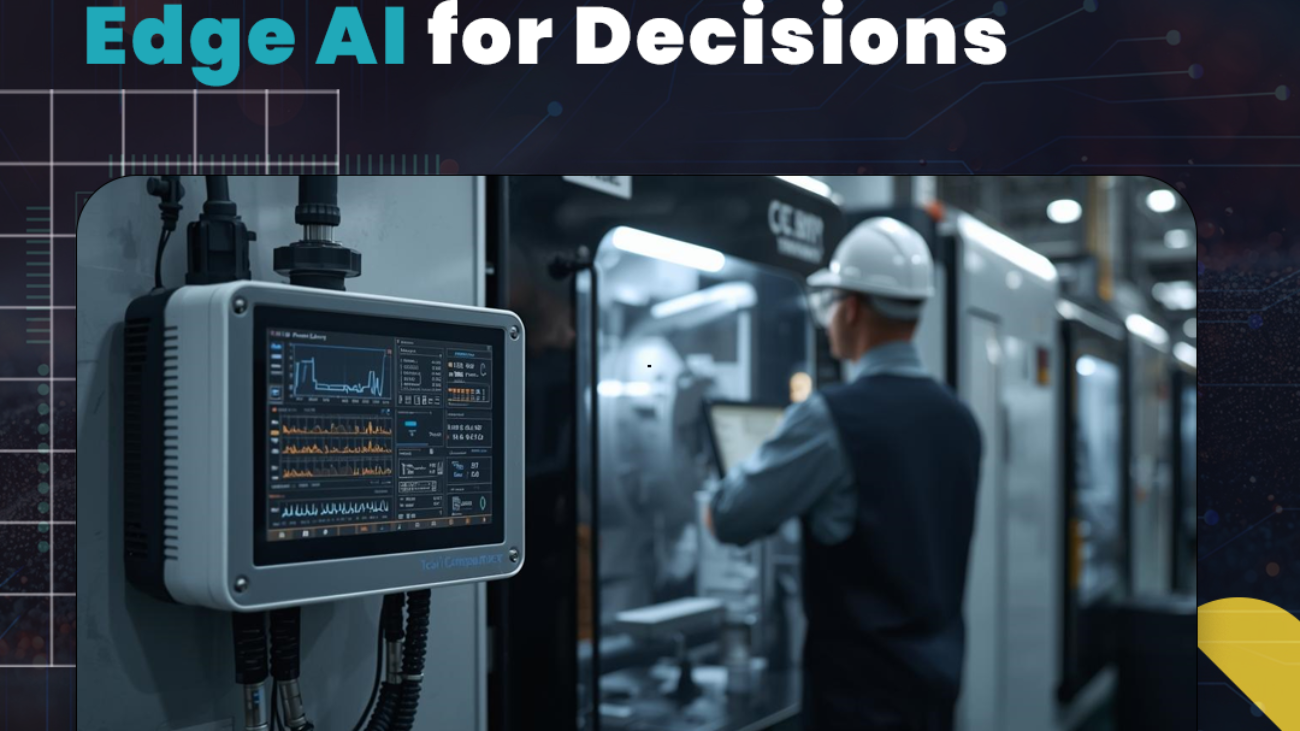
Engineer checking an edge AI monitoring screen on the factory floor for safety monitoring

Edge AI Platforms and Tools for Smart Manufacturing

Edge AI in manufacturing relies on a combination of hardware and software working together.

The hardware side includes:

  • Industrial PCs
  • Edge gateways
  • Embedded systems
  • AI-enabled cameras.

These devices are designed to operate in harsh environments and handle real-time data processing close to the source.

The software side includes:

  • Model deployment tools
  • Data pipelines
  • Monitoring systems.

These platforms allow AI models to run efficiently on limited hardware while still being updated and managed centrally.

Many modern platforms support a hybrid approach, where models are trained in the cloud and then deployed to edge devices. This setup combines the strengths of both environments and makes edge AI easier to scale across multiple production lines or facilities.

Where edge AI is used and where cloud AI is used in manufacturing

While edge AI and cloud AI may sound similar as concepts, their applications and where they’re leveraged in manufacturing is actually different.

Edge AI handles real-time, on-the-floor decisions where speed and reliability matter most:

  • Visual quality inspection: It enables defect detection for defects such as scratches, misalignments, or missing parts directly on production lines.
  • Robot guidance & control: Edge AI runs close to robots for instant path correction and object detection.
  • Predictive maintenance (local): It can monitor vibration, heat, sound, or pressure sensors to flag anomalies before failure.
  • Safety systems: Detects human presence near machines and triggers emergency stops instantly.
  • Offline operation: Since it doesn’t rely on internet connection to send data, it can keep the line running even if network connectivity drops.

Cloud AI can analyze, optimize and provide long-term intelligence across machines, lines and factories:

  • Model training & improvement: It can train large AI models by using historical production data.
  • Cross-factory optimization: Could AI is able to compare performance across multiple plants.
  • Trend & root-cause analysis: It’s particularly excellent at finding patterns that aren’t visible on a single machine.
  • Production forecasting & planning: Predicts output, downtime, and material needs.
  • Centralized reporting & dashboards: It gives managers and engineers a big-picture view of the overall condition of the processes.

How AI-innovate Supports Edge AI in Smart Manufacturing

AI-innovate supports manufacturers adopting edge AI in manufacturing by providing AI-driven products designed for real-time decision-making on the production floor. Our product ecosystem helps with:

  • Real-time defect analysis and visual inspection at the edge using AI2Eye, enabling fast, low-latency quality control directly on production lines
  • Data generation, simulation, and validation through AI2Cam, supporting reliable model training and testing before deployment to edge devices
  • Deployment and management of scalable edge AI workflows powered by AIxCore, allowing AI models to run on industrial PCs, edge gateways, and embedded systems while remaining centrally managed
  • Hybrid edge–cloud AI architectures, enabling manufacturers to process time-critical data locally while using the cloud for model training, optimization, and long-term analysis

Whether manufacturers are implementing real-time inspection, predictive maintenance, or safety monitoring, AI-innovate’s products help apply edge AI in manufacturing with speed, reliability, and seamless integration into existing smart factory environments.

Conclusion

Edge AI is changing how manufacturers work by making machines and processes more intelligent. By reducing delays and making things more reliable, edge AI in manufacturing helps to make decisions faster, improve quality control and create safer working environments.

I believe while cloud AI is still very important for large-scale analysis and coordination, edge AI is best for situations where speed and responsiveness are key. Together, these elements form the foundation of truly smart manufacturing systems that are built for efficiency, resilience, and real-world performance.

Confused About Where to Start with AI?

Our specialists help you identify the right AI approach based on your process, data, and goals.

Ai-Innovate uses only high-quality sources, including peer-reviewed studies, to support the facts within our articles.

  1. InGenerO Blog. (2025). Edge AI in Manufacturing. Explains how deploying AI at the edge (on devices and local controllers) enhances real-time decision-making, reduces latency, and improves quality control on the factory floor. Retrieved from https://ingenero.com/blog/edge-ai-in-manufacturing/
  2. Edge Impulse Blog. (2025). Revolutionizing Smart Manufacturing with Edge AI. Discusses how embedded AI models at the edge are transforming smart manufacturing use cases, including predictive maintenance, anomaly detection, and automated inspection. Retrieved from https://www.edgeimpulse.com/blog/revolutionizing-smart-manufacturing-with/
  3. ScienceDirect / Elsevier. (2023). Industrial Internet of Things and Edge Computing for Quality-Aware Manufacturing. Presents research on combining IIoT, edge computing, and AI to enable quality-aware manufacturing systems with low latency and high reliability. Retrieved from https://www.sciencedirect.com/science/article/pii/S0030399223013166 (scienceDirect.com)
  4. Springer — Cluster Computing. (2024). Optimizing Industrial Systems with Edge Intelligence: Architectures and Applications. Reviews state-of-the-art edge AI architectures in industrial environments, highlighting performance gains and use cases in smart factories. Retrieved from https://link.springer.com/article/10.1007/s10586-024-04686-y

FAQ

Can Edge AI work without an internet connection?

Yes. Once an AI model is deployed to an edge device, it can perform inference (analysis and decision-making) entirely offline. This ensures operational continuity even during network outages.

Yes. Manufacturers typically use middleware or custom interfaces to retrofit legacy machines. Adding external sensors and edge gateways allows older equipment to benefit from AI without a full “rip-and-replace”.

Challenges in Detecting Defects on Reflective Surfaces

Challenges in Detecting Defects on Reflective Surfaces

Reflective surfaces are used everywhere in our life if we pay attention. Polished metal panels, coated components, glass, and high-gloss finishes are all possible because of their performance and appearance. However, this reflectiveness causes trouble in defect detection in manufacturing. Detecting defects on reflective materials is far more complex than on matte surfaces, and without the right inspection approach, defects can be missed or misclassified. In this blog, we’ll explore the key challenges of surface defect detection of reflective surfaces and how to overcome them, the common defects, and the role of AI as a solution.

Catch Every Crack , & Deformation

High-speed detection of metal flaws in real-time.

Common Defects Found on Reflective Surfaces

Defects on reflective surfaces are often subtle and inconsistent in appearance. Some of them are harder to notice than others since they might only be visible when light hits the surface at a specific angle, or they might become invisible by blending with reflections. Some defects that commonly appear on reflective surfaces include:

  • Scratches and micro-scratches
  • Dents and surface distortionStains and residue
  • Uneven finishes
  • Discoloration
  • Bubbles
  • Peeling

Key Challenges in Inspection of Reflective Surfaces

The most central problem in inspecting reflective surfaces and metal defect detection is light. Reflections can hide real defects or create false indications that look like damage. Highly reflective materials tend to bounce light directly back toward cameras or inspectors, creating:

  • Glare
  • Hotspots
  • Mirror-like reflections

Another problem is inconsistency. A defect may be clearly visible from one angle but completely invisible from another. On busy production lines, there’s often not much time to take lots of images or change how things are checked.

The defects are also hard to spot because the defects and the surface around them have a similar colour. This makes it harder for traditional vision systems that use fixed thresholds or rules to spot the problems.

Environmental factors add to the problem. Small changes in lighting, vibration, dust, or temperature can affect inspection accuracy.

Best Solution to Challenges in Detecting Defects on Reflective Surfaces

To deal with these challenges, manufacturers usually start by improving the physical inspection setup. The lighting has been carefully designed to reduce glare and make it easier to see defects. You can use different types of lighting to help control reflections and reveal surface irregularities. These different types of lighting include diffuse, polarised and angled lighting.

Using advanced imaging techniques, like taking pictures from different angles, can make it even more reliable. But hardware alone is rarely enough. This is where AI-based inspection systems are very useful.

AI-driven quality control systems don’t just rely on fixed rules. Instead, they learn from large sets of real production images to understand what acceptable surfaces look like and how defects differ from normal reflections. Over time, these systems get better at spotting real defects and ignoring things that are just part of how the material looks, like how the light hits it or how it’s made. This makes AI especially good at automatically checking reflective materials at high speeds.

In general, the best solutions are:

  • AI defect detection and AI-driven quality control
  • Optimal setups
  • Using different lightings including diffuse, polarised and angled lighting
  • Advanced imaging techniques

Remaining Challenges Even With AI

Even though there have been improvements, AI isn’t a complete solution on its own. It’s very important to have good training data, and it can take a lot of time and be subjective to collect and label defect data on reflective surfaces. New materials, coatings, or finishes may need new models or training to keep things accurate.

Integration is another ongoing challenge. AI inspection systems must be able to work reliably with the production equipment, automation systems and workflows that are already in place. There’s also a balance to maintain between how accurate inspections are and how well they perform in real-time, particularly in environments where a lot of inspections are done quickly and delays aren’t acceptable.

High-intensity laser scanning a metal surface during automated inspection, highlighting precision defect detection in advanced industrial manufacturing

How AI-innovate Supports Defect Detection on Reflective Surfaces

AI-innovate supports manufacturers dealing with reflective materials by providing AI-driven inspection products designed to handle glare, variable reflections, and subtle surface defects. Our product ecosystem helps with:

  • AI-based defect detection on reflective and high-gloss surfaces using AI2Eye, which applies deep-learning vision models to distinguish true defects from lighting artifacts and reflections
  • Data generation, simulation, and validation through AI2Cam, enabling robust model training when collecting and labeling defect data on reflective surfaces is difficult
  • Scalable deployment and system integration powered by AIxCore, allowing AI inspection workflows to integrate with existing cameras, lighting setups, and production equipment
  • Real-time inspection feedback and quality monitoring, helping manufacturers maintain accuracy and consistency even at high production speeds

Whether you’re inspecting polished metals, coated components, glass, or other reflective materials, AI-innovate’s products help manufacturers apply AI defect detection with greater reliability, adaptability, and seamless integration into existing quality control processes.

Conclusion

Finding defects on reflective surfaces is still one of the most difficult problems in industrial quality control. It’s hard for human inspectors and traditional vision systems to see because of glare, low contrast and changing surface appearance.

While using AI for inspection has made things more consistent and adaptable, I believe the best results come from a balanced approach that includes proper lighting, good system design and well-trained models.

Ai-Innovate uses only high-quality sources, including peer-reviewed studies, to support the facts within our articles.

  1. ScienceDirect / Elsevier. (2025). Highly Reflective Metal Industrial Parts Surface Detection with Polarization Vision and Modified YOLO. Describes a vision system that uses polarization imaging and an enhanced YOLO model to improve defect detection accuracy on shiny, reflective metal parts—overcoming glare challenges common in industrial inspection. Retrieved from https://www.sciencedirect.com/science/article/abs/pii/S105120042500260X (scienceDirect.com)
  2. MDPI Photonics. (2023). Laser and Photonic Systems for Surface Inspection (Volume 12, Issue 4). Covers advances in optical technologies and photonics used for high-resolution surface inspection, including laser-based systems that can enhance subtle defect visibility in manufacturing contexts. Retrieved from https://www.mdpi.com/2304-6732/12/4/368
  3. Wiley Online Library. (2020). Real-Time Surface Inspection Using Vision Systems. Explores early foundational work on integrating vision systems in real-time surface inspection, highlighting algorithms that enable rapid detection of surface flaws on industrial products. Retrieved from https://onlinelibrary.wiley.com/doi/10.1155/2020/1837528
  4. PEKAT VISION. (2025). Defect Detection on Reflective Surfaces. Discusses the challenges of inspecting glossy and reflective materials in industrial settings and shows how patterned illumination combined with AI-driven vision software can significantly improve defect visibility. Retrieved from https://www.pekatvision.com/defect-detection-on-reflective-surfaces (pekatvision.com)
  5.  

FAQ

Why can’t standard industrial lighting detect defects on shiny parts?

Standard “flood” or uniform lighting reflects directly back into the camera, creating large saturated “white-out” areas (glare) that mask surface details. Because reflective surfaces act like mirrors, they also reflect the factory environment (overhead lights, cables, personnel), which machine vision algorithms may mistake for surface flaws.

Yes. Modern AI models are trained on diverse datasets that include “acceptable variations” like reflections and shadows. In 2025, systems often use multi-angle image fusion, where the AI compares several images of the same part taken from different lighting angles to “cancel out” moving reflections while keeping static defects visible.

Curvature is a “major challenge” because it constantly changes the angle of reflection across a single image. This requires sophisticated setups, such as robotic arms that move the camera/light in a synchronized path or dome lighting that provides 360-degree diffused illumination to minimize hot spots on uneven geometries.


Confused About Where to Start with AI?

Our specialists help you identify the right AI approach based on your process, data, and goals.

Common Challenges in AI Surface Defect Detection Systems

Common Challenges in AI Surface Defect Detection Systems


AI has recently become the hot topic of many discussions, and most of the time, the debate is centered around the advantages or disadvantages of it. The concern has found its way to the manufacturing world, and many seek to know what exactly AI brings to the table. When it comes to surface defect detection, the benefits are rather obvious and can be seen through real-time detection and faster processes, so the challenges might get overlooked. As with everything else, AI surface defect detection systems have their own limits, and acknowledging these limits opens the door to better integration. In this blog, we explore the most common challenges in AI surface defect detection systems for informed decision making and how to overcome them.

Smarter Surface Defect Detection Powered by AI

AI-driven vision systems detect scratches, dents, and surface irregularities with exceptional accuracy. Improve quality, reduce scrap, and ensure consistent manufacturing standards with intelligent surface defect detection.

Data & Training Challenges

Data is the backbone of any AI system. Without the correct data, AI surface defect detection systems will struggle to perform. This reliance causes issues such as:

  • Limited defect samples: Many manufacturing processes are designed to reduce defects, which is good for production but problematic for AI training. Rare defects may only appear sometimes, which makes it hard to collect enough examples for the model to learn from.
  • Highly imbalanced datasets: A typical dataset may contain thousands of images of acceptable surfaces for every image containing a defect. This imbalance can cause models to become biased toward predicting “no defect”.
  • Complex and subtle defect patterns: Surface defects can be different sizes, shapes, contrasts, and textures. Scratches, pits, stains, or micro-cracks may look different depending on the material and how it was processed.
  • Time-consuming data labeling: Labeling defect data requires knowledge of the subject. Quality engineers must tell the difference between defects and acceptable surface variation, which makes annotation slow and expensive.

Environmental & Hardware Issues

Even the best AI model can’t make up for poor image quality. It’s often just as important to make the imaging environment stable as it is to improve the algorithm itself.

Common Environmental Challenges

  • Lighting variability: Things like changes in the amount of light, reflections from shiny surfaces, or shadows can make defects in images look different.
  • Dust, oil, and contamination: The air in places like factories often contains tiny particles or other types of residue. These can make it hard to see small details on surfaces or can add noise to images.
  • Vibration and movement: If machines vibrate or parts move, it can cause blurry or misaligned images.
  • Temperature and humidity fluctuations: Things like changes to the environment can have an effect on camera sensors, lenses and lighting.


Hardware-Related Challenges

  • Insufficient camera resolution: Low-resolution cameras may not be able to see small surface defects, such as micro-cracks or subtle texture differences.
  • Inadequate lighting design: If the lighting isn’t positioned right or isn’t consistent, it can hide defects or create false patterns.
  • Hardware degradation over time: Cameras, lenses and lights can drift out of calibration or degrade over time.

Operational & Integration Hurdles


Poor integration results in inconsistent quality decisions on top of creating confusion among operators and slowing the production down. Using AI in the production process brings its own challenges, not just technical issues.

  • Legacy equipment compatibility: Many factories still use older machines that weren’t made to work with modern AI systems or data storage methods.
  • Complex system integration: AI inspection needs to communicate with other software systems, such as MES, QMS and production control software.
  • Unclear decision logic: Defining pass, fail, and review thresholds can be difficult, especially for borderline cases.
  • Scalability across lines and plants: A system that works well on one production line may not work the same way across multiple facilities with different conditions.
Industrial vision inspection camera analyzing metal surface defects on a production line with real-time data visualization on a monitoring screen.

Organizational & Human Factors

Outside of the systems, human and organizational readiness is essential for leveraging AI to its full potential. Even the most accurate AI system will fail if people don’t trust it or adopt it. To make this happen, you need to manage any changes, provide training, and be open about what you’re doing.

  • Black-box perception: Deep learning models can be tricky for teams to explain to auditors or customers, because they aren’t always clear how they work.
  • Insufficient training: Without proper training, staff may misuse the system or ignore its outputs altogether.
  • Resistance to workflow changes: AI inspection can change responsibilities and processes, which can lead to resistance if it’s not managed carefully.
  • Unclear ownership and accountability: It may be unclear whether AI systems fall under quality, engineering, or IT responsibility.

How Manufacturers Can Approach These Challenges Strategically

None of the above mentioned challenges in AI surface defect detection systems are impossible to solve. In fact, it’s fairly easy with the right strategy.

Challenge Area

Specific Challenge

Mitigation Strategy

Data & Training

Rare or insufficient defect samples

Use data augmentation, synthetic defect generation, and transfer learning

Data & Training

Imbalanced datasets

Apply weighted loss functions or anomaly detection trained on normal samples

Data & Training

Changing defect patterns

Implement continuous data collection and model retraining

Environment

Lighting and reflection variability

Use controlled, diffuse, or polarized lighting setups

Environment

Dust, vibration, and noise

Install protective enclosures and perform regular calibration

Hardware

Limited image resolution

Deploy high-resolution cameras or multi-sensor systems

Operations

Real-time speed vs accuracy

Use edge AI devices and optimized inference models

Integration

Legacy system compatibility

Introduce modular AI systems with standardized interfaces

Integration

Multi-site scalability

Centralize model management and deployment pipelines

Human Factors

Lack of trust in AI output

Use explainable AI to highlight defect regions and confidence scores

Human Factors

Operator skill gaps

Provide structured training and clear escalation workflows


How AI-innovate Supports Reliable AI Surface Defect Detection Systems

AI-innovate helps manufacturers address the technical, operational, and organizational challenges of AI surface defect detection by providing practical, production-ready inspection products. Our solutions support manufacturers with:

  • AI-based surface defect detection and decision support through AI2Eye, enabling consistent identification of defects despite data imbalance, environmental variation, and subtle surface patterns
  • Synthetic data generation and validation using AI2Cam, helping teams overcome limited defect samples and reduce the burden of manual data labeling
  • Scalable deployment and system integration powered by AIxCore, allowing AI inspection workflows to connect with existing cameras, production lines, and quality systems
  • Explainable and adaptable AI inspection workflows that improve trust, support operator training, and enable continuous model improvement across lines and facilities

Whether manufacturers are dealing with data scarcity, complex integration, or organizational adoption, AI-innovate’s products help turn common challenges in AI surface defect detection systems into manageable, long-term capabilities within modern manufacturing environments.

Conclusion

Despite everything, AI is still a great investment for surface defect detection in manufacturing. The benefits are numerous and the challenges can be overcome. In my opinion, the most successful AI inspection systems use AI to help make decisions, rather than replacing the need for engineering expertise. When problems are dealt with in a way that looks at the bigger picture and is done early, using technology like AI to spot problems on surfaces can become a reliable and manageable part of modern manufacturing.

If you think carefully about how to do this and keep making improvements, you can turn these problems into strengths that will last. This will show how good AI-powered quality control can be.

Ai-Innovate uses only high-quality sources, including peer-reviewed studies, to support the facts within our articles.


  1. Springer — AI Perspectives. (2023). AI-Driven Quality Control for Smart Manufacturing: Opportunities and Challenges. Explores how artificial intelligence is reshaping defect detection and quality assurance in smart manufacturing, including technical hurdles and integration pathways. Retrieved from https://link.springer.com/article/10.1007/s44248-023-00004-w
  2. TEKsystems. (2025). Overcoming AI Implementation Challenges. Discusses common roadblocks organizations face when integrating AI systems (such as data preparation, talent gaps, and change management) and offers practical strategies to address them. Retrieved from https://www.teksystems.com/en-jp/insights/article/overcoming-ai-implementation-challenges
  3. Dataspan AI Blog. (2025). Automated Defect Detection: How GenAI and Synthetic Data Are Transforming Visual Inspection in Manufacturing. Covers how generative AI and synthetic training data improve defect detection accuracy and accelerate machine vision deployment. Retrieved from https://www.dataspan.ai/blog/automated-defect-detection-how-genai-and-synthetic-data-are-transforming-visual-inspection-in-manufacturing
  4. Multishoring Blog. (2025). AI in Manufacturing Quality Control. Provides an overview of how AI tools are being applied to automate quality checks, reduce errors, and enhance production efficiency across manufacturing sectors. Retrieved from https://multishoring.com/blog/ai-in-manufacturing-quality-control

Confused About Where to Start with AI?

Our specialists help you identify the right AI approach based on your process, data, and goals.

FAQ

Can AI detect "unseen" or new types of defects?

Standard supervised models only recognize what they were trained on. However, unsupervised anomaly detection (using autoencoders or foundation models) can flag any deviation from “normal” patterns, allowing the system to identify novel defects it has never seen before.

Yes. Most modern solutions are modular and use standard APIs to connect with existing PLCs, SCADA, or Manufacturing Execution Systems (MES).

Modern systems detect a wide range of surface issues including scratches, cracks, dents, corrosion, discoloration, missing components, and micro-cracks as small as 0.1mm.