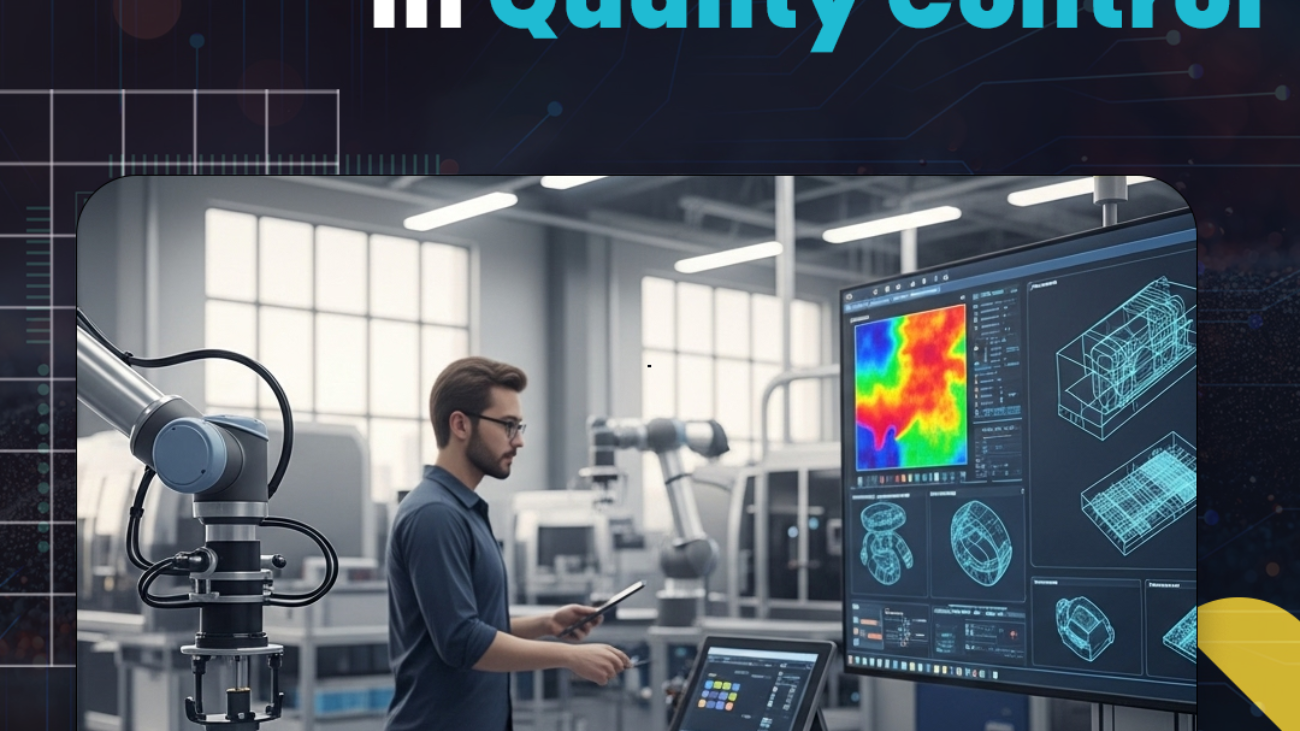
Applications of AI in Quality Control

Applications of AI in Quality Control: A Comprehensive Overview

In the competitive and ever-evolving world of industries, quality control plays a central role in meeting established standards and customer expectations. Initially, this process was done by trained inspectors, and although effective, it was prone to human error and lacked efficiency. Applying AI driven quality control has opened a new door for the manufacturing world, as it offers a solution for the problems of traditional methods. In this article, we’ll go into the details of what the application of AI in quality control means.

AI in Quality Control Smarter Inspections , Superior Products.

From predictive maintenance to quality optimization, machine learning is transforming manufacturing. Unlock real-time insights, improve efficiency, and drive continuous innovation across your production line.

AI and the New Era of Quality Control

Quality control is a systematic process in which products and services are checked to meet set standards for performance and quality. This step in manufacturing is crucial, as it leads to customer satisfaction and brand loyalty, and finally to increased profit. Ensuring that products meet consistent standards also reduces costs by minimizing waste and rework. It’s needless to say that investing in good quality control is essential. This is why AI in quality control is rising in popularity, as it achieves a smoother, more accurate, and efficient process by automated visual inspection. The application of AI in quality control means increased precision and allows for predictive maintenance to prevent issues before they occur.

Applications of AI in Quality Control Across Industries

AI in quality control is widely used in many fields and companies. Some use cases are:
  • Manufacturing: Industries like automotive and food and beverage use AI for visual inspections to detect defects and foreign objects. For example, BMW uses AI to inspect welds on car bodies, detecting even minor imperfections to meet safety standards.
  • Healthcare: AI aids in drug quality control by inspecting manufacturing processes for anomalies and ensuring compliance with safety regulations. For instance, Pfizer uses AI to automate the process of checking labels and packaging for accuracy, ensuring compliance and speeding up production.
  • Customer Service: AI analyzes customer interactions to identify gaps and provide insights for improving the customer experience. Big companies like Amazon and Google benefit from this.
  • Finance: AI is used for fraud detection and ensuring the quality of financial products and services. Companies like Morgan Stanley and Goldman Sachs use AI for quality control in finance.

How AI Enhances Quality Control

In general, AI systems use a combination of machine learning (ML), computer vision, natural language processing (NLP), and data analytics to monitor, inspect, and improve production and service quality. We can see this in effect in:
  1. Automated Detection and Inspection: AI systems can analyze thousands of product images or sensor readings per minute, identifying defects, inconsistencies, or contaminants faster and more accurately than humans.
  2. Predictive Quality Monitoring: AI predicts problems by analyzing production data (such as temperature, vibration, pressure, or speed) to identify patterns that indicate potential defects. This allows for predictive maintenance, enabling adjustments before issues arise.
  3. Real-Time Process Optimization: AI models optimize parameters and adjust them to maintain ideal performance. In processes like plastic molding or metal casting, AI can automatically fine-tune pressure and cooling times for consistent product quality.
  4. Intelligent Data Analysis and Reporting: AI automates the collection and analysis of quality data from various sources, generating instant reports and highlighting trends. It suggests corrective actions based on past performance and uses NLP tools to identify recurring issues in inspection reports and customer feedback.
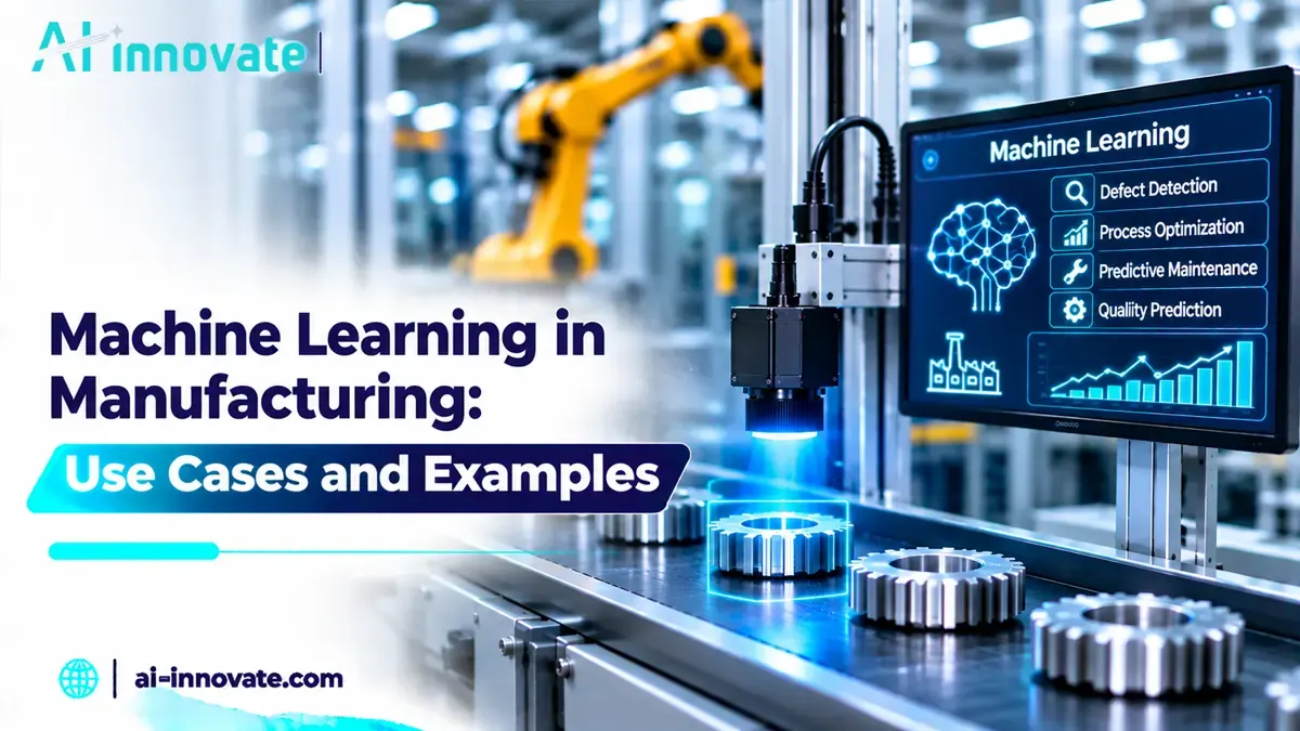
Our AI2Eye and AI2Cam At AI-innovate improve quality control in manufacturing. AI2Eye monitors production in real time, spotting defects early and ensuring product quality remains consistent. Meanwhile, AI2Cam allows teams to test and optimize camera setups before deployment, improving data collection and model accuracy.

Conclusion

AI is transforming quality control, assisting in detect defects, optimizing processes, and analyzing data in real time, which leads to consistent quality, reduced waste, and improved decision-making, enabling companies to deliver reliable products and services efficiently. In the future, AI is likely to become even more advanced, enabling fully automated quality systems that can learn and adapt continuously to new challenges and standards. Note: Some graphics and visuals in this post were produced using AI-generated content.

Ai-Innovate uses only high-quality sources, including peer-reviewed studies, to support the facts within our articles.

  1. Datategy. (2024). How AI Transforms Quality Control in Modern Manufacturing. Explores how AI and computer vision detect defects and reduce manual inspection. Retrieved from datategy.net

  2. Qualityze. (2024). AI in Quality: Revolutionizing QMS Industry. Details how AI enhances Quality Management Systems (QMS) in industrial settings. Retrieved from qualityze.com

  3. Körber Digital. (2024). How AI is Revolutionizing Quality Control in Manufacturing. Covers automation of inspections, predictive defect detection and data-driven quality insights. Retrieved from koerber-digital.com

  4. Miquido. (2025). AI for Manufacturing Quality Control. A case-driven overview of how AI detects defects in real time and improves product consistency. Retrieved from miquido.com

  5. Softude. (2025). How AI is Revolutionizing Quality Control and Quality Assurance in Manufacturing? Describes how AI transforms QC from reactive to predictive across manufacturing lines. Retrieved from softude.com

  6. Industrial Omron UK. (2025). Revolutionising Quality Control: AI and Data Capture Transform Manufacturing. Highlights how AI-vision systems lower false positives and adapt to product variations. Retrieved from industrial.omron.co.uk

  7.  

Confused About Where to Start with AI?

Our specialists help you identify the right AI approach based on your process, data, and goals.

FAQ

What is the application of AI in quality control?

 It leverages advanced algorithms and machine learning to inspect products, identify defects, and ensure compliance with quality standards.

AI-driven test case creation, automated visual inspections, self-healing test scripts, and predictive analytics for early defect detection.


By employing adaptive algorithms, AI can identify patterns, trends, and deviations that might be difficult for human operators to detect.

Machine learning in manufacturing: a robotic arm and vision camera on a production line with a dashboard for defect detection, process optimization and predictive maintenance

Machine Learning in Manufacturing: Use Cases, Examples and How to Get Started

Machine learning in manufacturing uses algorithms that learn from production data, such as sensor readings, images and quality records, to predict failures, detect defects, optimize process settings and forecast demand. Instead of following fixed rules, the models improve as they see more data, which helps factories reduce downtime, scrap and rework. This guide explains the main use cases, the types of machine learning involved, real examples and how to get started.

Key Takeaways

The most proven use cases are predictive maintenance, quality inspection and process optimization.

Supervised learning needs labeled examples; anomaly detection can start with data from normal production only.

Data quality and integration with existing systems decide most project outcomes, more than the choice of algorithm.

Start with one costly problem, run a pilot with clear KPIs, then scale what works.

What Is Machine Learning in Manufacturing?

Machine learning (ML) allows systems to learn from data and make predictions, detect patterns, or recommend actions. When applied to manufacturing, it uses algorithms and data-driven models to improve and automate various processes (Kusiak, 2018).

In short, machine learning helps manufacturing systems learn from data so they can predict outcomes, detect patterns and support or automate decisions.

Types of Machine Learning Used in Manufacturing

TypeHow it learnsTypical manufacturing use
Supervised learningFrom labeled examples, such as good and defective partsDefect classification, quality prediction, demand forecasting
Unsupervised learning and anomaly detectionFrom normal data, flagging anything unusualMachine health monitoring, rare or new defects
Deep learningNeural networks that learn features from images or signalsVisual inspection, sound and vibration analysis
Reinforcement learningFrom trial and feedback in a real or simulated processRobot control, process parameter tuning

The right type depends on the problem and on the data you already have; for inspection with few defect samples, see unsupervised anomaly detection.

Machine Learning Use Cases in Manufacturing

These are the most common applications of machine learning in manufacturing:

1. Predictive Maintenance

Models learn the normal vibration, temperature and current patterns of each machine and flag early signs of wear, so maintenance can be planned before a breakdown stops the line.

2. Quality Inspection and Defect Detection

Computer vision models inspect every product and detect scratches, cracks, missing parts or assembly errors, including surface defect detection on metal, textiles and other materials (Czimmermann et al., 2020). See how this works in machine vision inspection systems.

3. Predictive Quality

Models link process parameters with quality results to predict which batches are likely to fail, so settings can be corrected before defects appear.

4. Process Optimization

Machine learning finds the combination of machine settings that gives the best output, material usage and energy consumption for each product. The full method is explained in machine learning for manufacturing process optimization.

5. Yield Improvement

By connecting defect data with process and material data, machine learning shows which few causes drive most of the losses; see yield improvement in manufacturing.

6. Demand Forecasting and Planning

Models use order history, seasonality and market data to forecast demand, so production plans and inventory follow real needs.

7. Product Design and Development

Machine learning analyzes test, field and customer data to show which design features cause failures or matter most to users, which shortens development cycles.

8. Digital Twins and Simulation

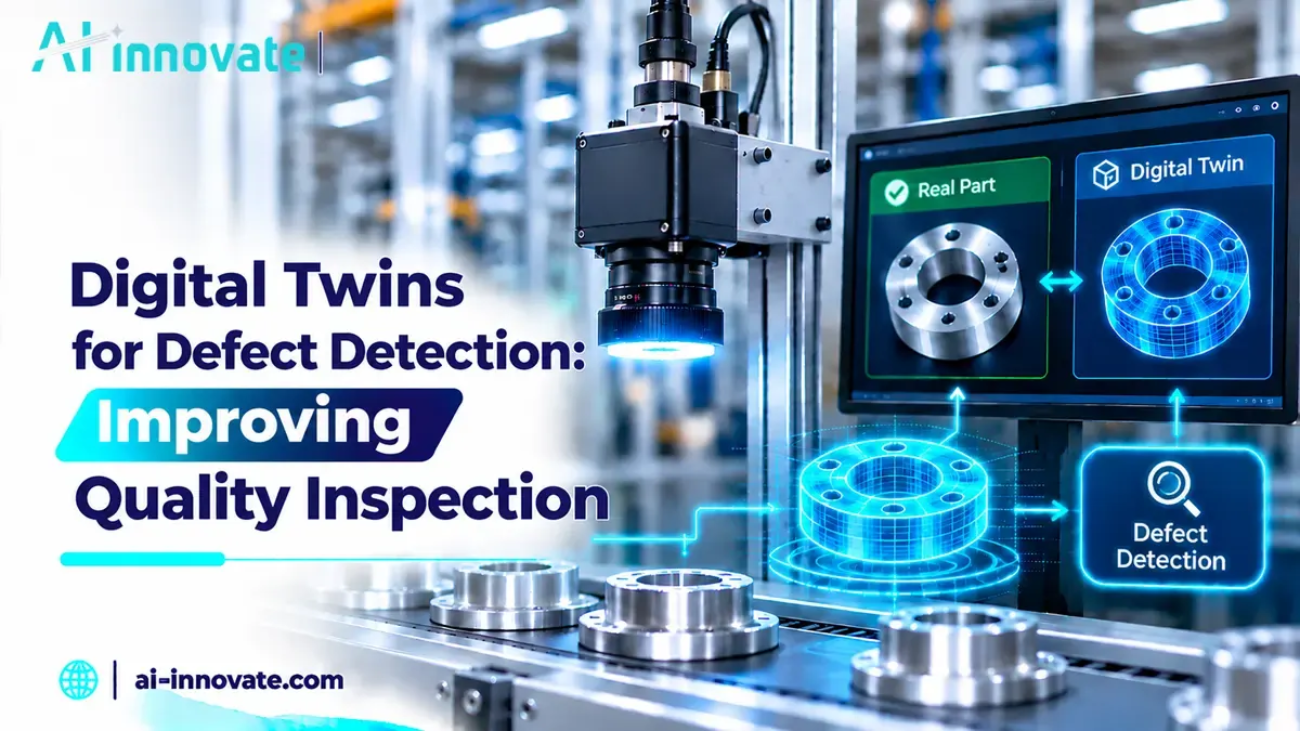
A digital twin combines a virtual model of a machine or line with real data, and machine learning helps it predict the effect of a change before it is made on the shop floor.

Machine Learning Examples by Industry

Machine learning is applied differently in each sector:

  • Food manufacturing: computer vision sorts and grades products by size, shape, color or ripeness, and detects foreign objects before packaging.
  • Automotive manufacturing: machine learning inspects paint, welds and assemblies, and predicts failures on robots and presses in body and assembly shops.
  • Semiconductors and electronics: machine learning classifies wafer and board defects and links them to process steps to speed up yield learning.
  • Plastic Products Manufacturing: ML sorts recyclable plastics automatically based on type and color and predicts the ideal molding parameters (temperature, pressure, and cycle time) to minimize defects and material waste.
  • Textiles: inline vision systems detect weaving and surface defects on moving fabric; see the textile defect detection case study below.

Machine Learning Technologies Used in Manufacturing

Machine learning is usually delivered through three groups of technologies:

  • Predictive Analytics: Predictive analytics use data, statistical algorithms, and ML to forecast future outcomes based on historical and real-time information.
  • Intelligent Process Automation (IPA): IPA combines Robotic Process Automation (RPA) with AI and ML to automate complex tasks. Unlike traditional automation, IPA can adapt and make decisions based on data.
  • Computer Vision (CV): CV is a branch of AI that allows computers and machines to see, interpret, and make decisions based on visual data.

Pros and Cons

As with everything, leveraging ML in manufacturing comes with many benefits and potential limitations. To see the bigger picture better, let’s go through the advantages and disadvantages.

Pros

Some of the benefits of integrating machine learning in manufacturing are:

  • Improved Decision Making: Using ML makes it easier to make decisions by using data. The real-time gathering and processing of data makes it all the more convenient.
  • Energy Efficiency: ML predicts energy needs and optimizes machine operation times to lower peak energy usage, which reduces energy consumption and environmental impact.
  • Cost Reduction: Using ML means reduced waste, rework, and downtime. By using predictive analytics, better material usage and maintenance is achieved.
  • Quality Assurance: ML applies the same criteria to every product and reduces the variation of manual inspection, which improves overall product quality.

At AI-innovate, we apply machine learning to visual inspection. AIxEye inspects products on the line in real time, detecting defects early and keeping quality consistent, and AIxCore runs the models at the edge, next to the machines.

Cons

Using ML in manufacturing may come with some challenges (Wuest et al., 2016):

  • Data Requirements: ML needs large amounts of high-quality data to operate effectively. Incomplete, inconsistent, or poor-quality data can lead to unreliable predictions and outcomes.
  • Data Security and Privacy Risks: Increased connectivity of devices and networks may lead to more cyber-attack opportunities in ML-based manufacturing systems.
  • Unclear ROI (Return on Investment): Benefits of ML may take time to show. Companies may struggle to measure immediate returns compared to costs.
  • Integration Challenges: Combining ML systems with existing equipment or production software can be complicated.

How to Implement Machine Learning in Manufacturing

  1. Choose one costly problem, such as a recurring defect or a critical machine, and define the KPI you want to improve.
  2. Check the data: what is already collected, at what frequency and quality, and what is missing.
  3. Collect and label data, adding sensors or cameras where needed.
  4. Build and validate a model on data it has not seen, with operators and engineers reviewing the results.
  5. Run a pilot on the line and compare the KPI with the baseline.
  6. Integrate the model with PLC, MES or maintenance systems and plan regular retraining.
  7. Scale to similar lines and products once the pilot result is proven.

Real Examples of Machine Learning in Manufacturing

Machine learning is already used in daily production. The example below comes from an AI-innovate project:

AI-innovate: Inline Defect Detection in Textiles

In a project with a continuous textile manufacturer, an AIxEye-based machine learning system inspected textured fabric inline with 100% automated coverage and reduced the QC staff requirement by 50%. The defect data was linked with suppliers, raw materials and seasonal conditions to find the sources of recurring defects.

Conclusion

Machine learning is becoming an essential part of modern manufacturing. It helps factories use data effectively to predict maintenance needs, improve quality, and optimize production.

As production systems become more complex, the ability to learn from data is moving from an advantage to a necessity for manufacturers that want to stay efficient and adaptable. The most successful projects start small, prove the result on one line and then scale.

Pick a first project where the data already exists and the result is easy to measure, such as unplanned stops on one machine or the defect rate on one line. A clear before-and-after comparison makes it easier to win support for the next project.

Note: Some graphics and visuals in this post were produced using AI-generated content.

This article draws on the following sources:

  • Wuest, T., Weimer, D., Irgens, C. and Thoben, K.-D. (2016). Machine learning in manufacturing: advantages, challenges, and applications. Production & Manufacturing Research, 4(1), 23-45. doi.org/10.1080/21693277.2016.1192517
  • Kusiak, A. (2018). Smart manufacturing. International Journal of Production Research, 56(1-2), 508-517. doi.org/10.1080/00207543.2017.1351644
  • Czimmermann, T. et al. (2020). Visual-Based Defect Detection and Classification Approaches for Industrial Applications: A Survey. Sensors, 20(5), 1459. doi.org/10.3390/s20051459

Confused About Where to Start with AI?

Our specialists help you identify the right AI approach based on your process, data, and goals.

Frequently Asked Questions

How is machine learning used in manufacturing?

Manufacturers use machine learning to analyze production data, such as sensor readings, images and quality records, to predict machine failures, detect defects, optimize process settings and forecast demand.

Machine learning connects to existing systems through PLCs, sensors, MES and ERP software, usually via standard industrial interfaces. Edge devices often run the models next to the machines, while results are shared with plant systems and dashboards.

Machine learning forecasts demand, optimizes inventory levels, and improves logistics efficiency. It can predict delays, recommend alternative suppliers, and identify risks early.

It depends on the use case: images of good and defective parts for inspection, sensor time series for maintenance, and process parameters linked to quality results for predictive quality. Data must be consistent, correctly time-stamped and representative of real production.

AI is the broad field of systems that perform tasks requiring intelligence, while machine learning is the part of AI that learns from data. Most AI applications in factories today, such as visual inspection and predictive maintenance, are built with machine learning.

Common examples are vibration models that predict motor failures, vision systems that detect defects on metal parts or moving fabric, models that predict which batches will fail quality checks, and demand forecasts that set production plans.

Detecting Color Defects with Machine Vision AI

Detecting Color Defects with Machine Vision AI

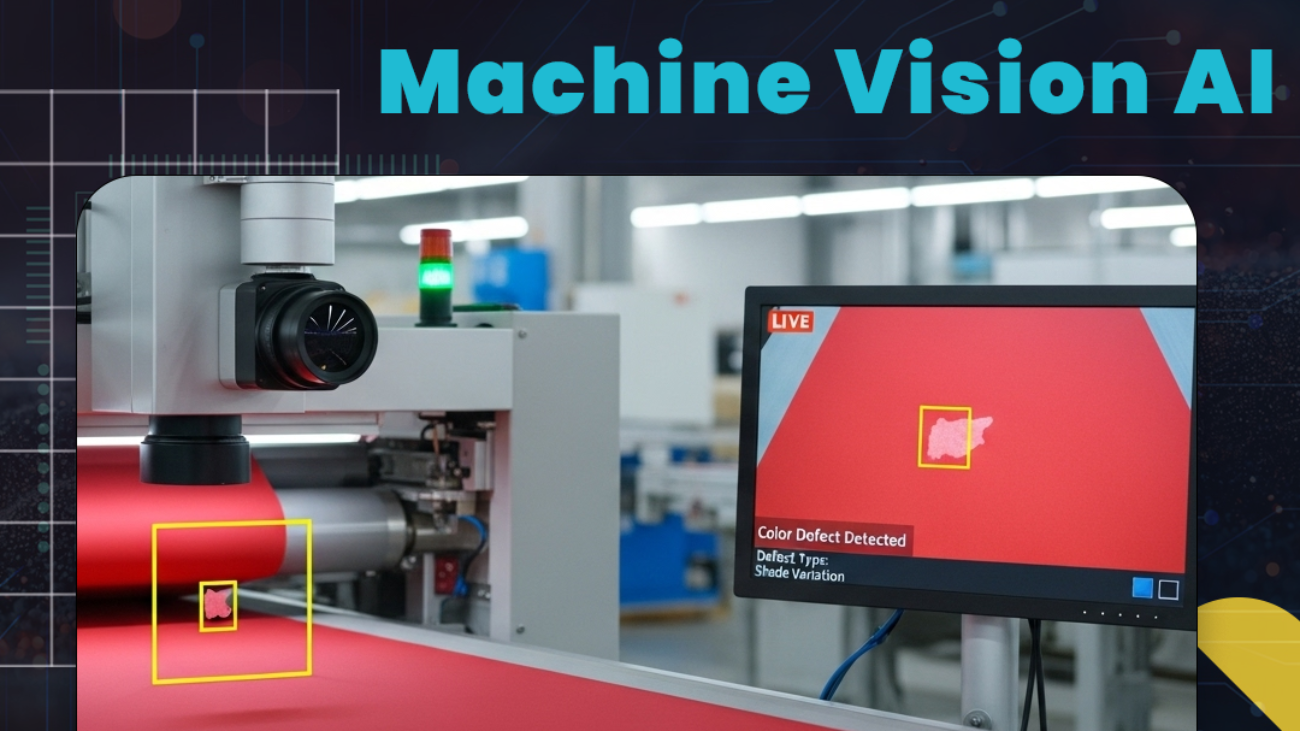
Color consistency is often one of the first qualities customers notice in textiles, packaging, automotive parts, and printed materials. Even if the product functions perfectly, a slight variation in shade or tone can signal poor quality. However, detecting subtle color deviations is not always easy.

Human inspectors may have difficulty with lighting changes, fatigue, and subjective perception, which can lead to inconsistent results. In high-speed production environments, minor inconsistencies can result in large batches of defective output. Machine vision AI offers a more objective and scalable solution. It combines advanced imaging systems with intelligent algorithms to analyze color data with precision and consistency across materials and lighting conditions.

This article will explain how machine vision detects color defects, the challenges manufacturers face, and how AI-powered inspection improves reliability, accuracy, and production efficiency.

Color Perfection with Machine Vision AI.

AI-powered vision systems detect color inconsistencies, shade variations, and printing defects in real time. Ensure flawless color accuracy, consistent branding, and superior product quality across every production run.

What Color Defect Detection With Machine Vision AI Means

Detecting color defects using machine vision AI is a process in which AI and computer vision technologies are used to identify color-related imperfections in objects, products, or materials. This is specifically important where appearance, consistency, and quality matter, like in manufacturing, agriculture, food processing, textiles, and ai-driven quality control processes.

The way machine vision does this is through computers or cameras equipped with vision sensors that “see” products like a human eye, but with higher precision and consistency. AI algorithms then analyze the visual data to detect patterns, compare colors, and identify defects.

Color defects refer to unwanted variations in color, such as:

  • Fading, discoloration, or inconsistent pigmentation
  • Stains, spots, or blemishes
  • Uneven ripening in fruits or vegetables
  • Miscolored parts in textiles or paints

How Machine Vision AI Works in Color Defect Detection

Machine vision AI combines advanced imaging technology and intelligent algorithms to detect color inconsistencies. This process usually consists of some key steps:

  1. Image Capture: High-resolution cameras capture detailed images of the target object under controlled lighting conditions. Proper lighting is essential to avoid shadows, glare, or reflections that could affect color perception. Systems may use visible light, infrared, or multispectral cameras to capture accurate color information.
  2. Preprocessing: The captured images are processed to prepare for analysis by noise removal, lighting normalization, and color calibration. This way, it’s ensured that AI systems analyze the product rather than lighting distortions or camera errors.
  3. Feature Extraction: AI extracts color-related features like color values in different color spaces (e.g., RGB, HSV, Lab), texture or pattern associated with color, or color uniformity across surfaces. With these features, AI understands the color, how it’s distributed, and whether it’s natural or defective.
  4. Defect Detection: Based on predefined standards or trained examples, AI models classify features as “defective” or “acceptable” based on color deviations.
  5. Action: Once a defect is detected, the system triggers the appropriate response:
    • Flagging defective items for manual review.
    • Automated sorting to remove or redirect defective products.
    • Data reporting for quality tracking and process optimization.

Real-Life Applications of Machine Vision AI in Color Defect Detection

When it comes to color defect detection using machine vision AI, we can see that it’s widely used in various industries, and it has unique use cases for each. Listed below are a few industries that leverage it and how they do it:

  • Food Industry: One possible application of machine vision AI in this industry is detecting rotten or under-ripe fruits based on color differences. It ensures consistent color and ripeness in fruits, vegetables, and grains, detects bruises, rot, or disease early to reduce waste, and maintains quality standards for retail and export.
  • Textile & Garments: Machine vision AI can be used to identify slight shade differences between fabric rolls that should appear identical. Detecting color mismatches in fabrics means uniform coloration and fewer rejections.
  • Automotive Manufacturing: Machine vision AI may be used to ensure that all panels of a car have the same paint tone without visible variation. It can also detect surface discoloration, oxidation, or coating defects.
  • Packaging & Printing: Verifying color accuracy in printed labels, logos, and packaging manufacturing, detecting misprints, fading, or ink contamination, can all be taken care of by machine vision AI, which protects brand identity and reduces customer complaints.

Proven Benefits and Potential Disadvantages

As mentioned above, many different industries benefit from integrating machine vision AI. The advantages of doing so include, but are not limited to:
Advantages of Machine Vision AI in Color Defect Detection

  • Better Accuracy: They maintain consistent performance over long production periods with no fatigue or bias.
  • Increased Speed: They can inspect thousands of items per minute, far faster than manual inspection, and real-time detection allows immediate correction or sorting.
  • Reduced Costs: It lowers labor costs and material waste by catching defects early.
  • Traceability: The system can store inspection data for analysis, helping improve processes and identify the root causes of color defects.

At AI-innovate, AIxEye and AIxCam have been adapted for color defect detection. AIxEye monitors products in real time, identifying color variations to help maintain consistent quality. AIxCam provides a way to simulate and adjust camera setups efficiently before deployment. Together, they support more accurate and streamlined color defect detection in manufacturing processes.
Disadvantages of Machine Vision AI in Color Defect Detection

It’s also worth noting that there might be downsides to using machine vision AI as well. Such as:

  • High data requirements: Training AI models effectively needs a large amount of well-labeled, high-quality data. Collecting and preparing these datasets can be both time-consuming and expensive.
  • Significant computational power: Machine vision AI systems require strong processing capabilities to analyze complex images. This often means using specialized hardware like GPUs to keep performance fast and reliable.
  • Environmental sensitivity: Factors such as lighting changes, vibrations, or dust can easily affect the system’s accuracy. To ensure consistent results, inspections often need to take place in controlled environments, which can add to overall costs.
  • Difficulty with complex materials: Transparent, shiny, or reflective materials can be difficult to inspect accurately because reflections and refractions can confuse even advanced imaging systems.

Conclusion

Machine vision AI enables manufacturers to detect color defects with a level of consistency and objectivity that manual inspection cannot match. Companies can monitor color quality in real time, reduce waste, and prevent costly rework by combining controlled imaging environments with intelligent algorithms. This approach strengthens brand reputation and ensures that every product meets defined visual standards.

In my time working with AI-driven inspection systems, I have found that color detection is often underestimated in its impact. Even minor inconsistencies can erode customer confidence. As AI and imaging technologies advance, I believe that color inspection will be fully integrated into automated quality control systems, giving manufacturers greater control and long-term reliability across production lines.

Note: Some graphics and visuals in this post were produced using AI-generated content.

Ai-Innovate uses only high-quality sources, including peer-reviewed studies, to support the facts within our articles.

  1. IQS Directory. (2024). Understanding Defect Detection Using Machine Vision Systems. Provides an overview of machine‐vision system types, components and industrial applications. Retrieved from https://www.iqsdirectory.com/articles/machine-vision-system.html

  2. UnitX Labs. (2025). Understanding Defect Detection Using Machine Vision Systems. Explores how automated vision and AI systems achieve high accuracy in defect detection and process optimisation. Retrieved from https://www.unitxlabs.com/resources/defect-detection-machine-vision-systems-3/

  3. Ultralytics. (2025). Leveraging Color Detection in Computer Vision Applications. Explains how colour detection techniques (RGB, HSV) support computer vision in tasks like sorting, inspections and automation. Retrieved from https://www.ultralytics.com/blog/leveraging-color-detection-in-computer-vision-applications

  4. Intelgic. (n.d.). Detecting Color Defects Using Machine Vision AI. Discusses how machine-vision AI detects colour‐based defects that might escape human inspection. Retrieved from https://intelgic.com/detecting-color-defects-using-machine-vision-ai

  5.  

Confused About Where to Start with AI?

Our specialists help you identify the right AI approach based on your process, data, and goals.

FAQ

What is color defect detection in manufacturing?

Color defect detection is the process of identifying unwanted color variations, stains, fading, discoloration, or inconsistent pigmentation in manufactured products. AI-powered machine vision systems automate this process using cameras and intelligent image analysis to ensure consistent product quality.

AI improves quality control by learning from production data and adapting to complex color patterns over time. Many manufacturers integrate machine vision with broader AI for Quality Assurance systems to achieve faster inspections, reduced waste, and more reliable defect detection.

Machine vision AI uses high-resolution cameras, controlled lighting, and deep learning algorithms to analyze product colors in real time. The system compares captured images against predefined quality standards and automatically identifies abnormal color variations or surface inconsistencies.

AI-powered inspection systems provide consistent and objective analysis without fatigue or human bias. Unlike manual inspectors, machine vision systems can detect microscopic color differences continuously at high production speeds, improving both accuracy and reliability.

Machine vision AI is widely used in:

  • Textile and garment manufacturing
  • Automotive paint inspection
  • Food processing
  • Packaging and printing
  • Electronics manufacturing
  • Pharmaceutical production

These industries rely on accurate color consistency to maintain product quality and brand standards.

Common causes include:

  • Inconsistent raw materials
  • Incorrect pigment mixing
  • Lighting variations
  • Temperature fluctuations
  • Printing errors
  • Coating inconsistencies
  • Equipment calibration issues

AI systems help manufacturers identify these issues early before they affect large production batches.

Key benefits include:

  • Higher inspection accuracy
  • Faster production line inspections
  • Reduced waste and rework
  • Lower labor costs
  • Improved product consistency
  • Real-time defect detection
  • Better traceability and reporting

These advantages help manufacturers maintain high visual quality standards while improving operational efficiency.

Yes. Machine vision AI is a core technology in modern automated inspection systems, including Automated Optical Inspection Machines, where AI analyzes products continuously during production to identify visual defects instantly.

AI for Defect Control in Piping

AI for Defect Control in Piping: What it does & How it Works

Pipelines and industrial piping systems are often hidden behind walls, buried underground, or embedded within complex facilities. Yet these systems play a critical role in ensuring safety, improving efficiency, and ensuring long-term reliability. If they go unnoticed, small defects such as micro-cracks, corrosion spots, weld flaws, or coating damage can quietly develop into major failures.

Traditional inspection methods rely heavily on periodic manual checks and specialised testing, which can be time-consuming and difficult to scale up. As infrastructure networks expand and operational demands increase, these limitations become more apparent. Artificial intelligence is now transforming the way piping systems are monitored and maintained. By combining machine vision, sensor data, and intelligent analytics, AI enables continuous, objective defect monitoring.

This article will explain how AI can support piping inspections, where it can deliver the most value, the challenges it can address, and how organisations can use it to improve safety, compliance and operational performance.


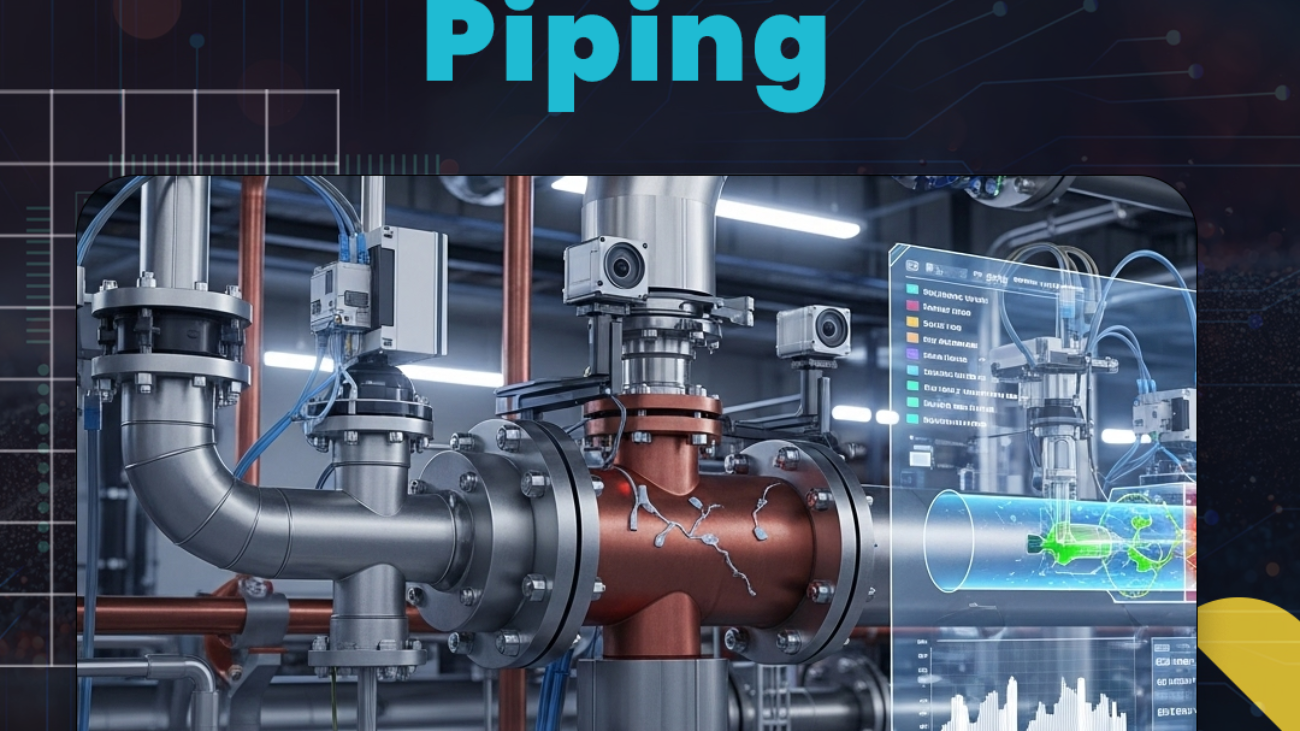
AI Defect Control for Piping Detect, Protect.

AI-powered inspection systems identify cracks, corrosion, and weld defects in piping with unmatched accuracy. Discover how intelligent analytics enhance safety, reduce downtime, and ensure reliable pipeline performance.

How AI Enhances Defect Detection and Monitoring in Piping

Pipe defect detection is the process of identifying flaws, damages, or irregularities in pipelines that transport water, oil, gas, or other substances, using inspection methods and AI-based technologies. A defect or anomaly refers to any deviation from the pipeline’s original condition, such as a reduction in wall thickness from metal loss, a deformation in the pipe wall, or the presence of a crack.

How AI is Applied to Defect Detection in Piping

AI is applied in pipeline defect control to automate inspections, enhance accuracy, and enable predictive maintenance. By using technologies like machine learning, AI can analyze inspection footage, non-destructive testing results, or radiographic images to detect and classify defects. These applications not only accelerate the inspection process and minimize manual labor but also monitor long-term pipeline degradation, facilitating proactive maintenance planning.

  • Visual Inspection: AI analyzes CCTV or drone footage to detect and categorize defects in pipelines automatically. This process is often combined with human review to verify findings and ensure accuracy.
  • Non-destructive Testing (NDT): AI algorithms process data from techniques such as ultrasonic testing or acoustic emission, interpreting signals to identify anomalies. This reduces the reliance on manual analysis while supporting accurate assessment of pipeline conditions.
  • Radiographic and Weld Inspection: AI models examine radiographic images to detect weld defects quickly and precisely, improving the efficiency of inspections while maintaining safety standards.
  • Manufacturing: AI can predict and optimize production parameters during pipe manufacturing, helping to reduce the occurrence of defects and produce higher-quality output.

Defecting problems in piping

How AI Works in Defect Control in Piping

AI follows a process in defect detection. Here’s the simplified steps to the process:

  1. Data Collection: AI needs data to detect defects. This data comes from various inspection sources, such as cameras mounted on robots, drones, or crawlers, capturing images and videos inside pipes.
  2. Data Preprocessing: Raw data can be messy, so it needs cleaning before AI can analyze it. Defect analysis techniques are in various forms, it could includes removing noise like blurry frames or flickering light, enhancing images for better visibility, labeling defect regions, and normalizing data across sensors or inspection sessions.
  3. AI Model Training: Cleaned data is used to train deep learning models. Common approaches include CNNs for image recognition, YOLO or Faster R-CNN for real-time video detection, U-Net or SegNet for pixel-level defect segmentation, and LSTM or Transformer models for analyzing time-series sensor data like pressure or acoustic signals.
  4. Real-Time Detection: Once trained, AI models can be deployed on inspection devices or cloud servers to analyze data in real time defect analysis during inspections.
  5. Predictive Analytics: AI can also predict future failures by analyzing trends in defect growth, pressure changes, or corrosion rates. This supports predictive maintenance, allowing issues to be addressed before they cause a failure.
  6. Visualization and Reporting: The results are presented in intuitive dashboards, making it easy to track defects and maintenance priorities.

Benefits and Limitations of AI for Defect Control in Piping

AI has become a game-changer in many fields, and defect detection is no exception. Here are a few ways AI enhances this process:

Proven Benefits

  • Increased Speed: AI can analyze large volumes of data much faster than manual inspection.
  • Improved Accuracy: AI is able to detect subtle defects that humans might miss.
  • Predictive Maintenance: By analyzing historical data, AI can predict future pipe degradation and potential failure points, leading to better strategic maintenance planning.
  • Reduced Costs: AI decreases the labor required for manual inspection and reduces waste in the manufacturing process.

At AI-innovate, we’ve created AI2Eye and AI2Cam to enhance manufacturing efficiency. AI2Eye uses AI for real-time defect detection and process optimization, while AI2Cam emulates GigE Vision cameras for cost-effective testing and development. Together, they simplify workflows and accelerate innovation.

Possible Limitations

  • Limited Data: The effectiveness of AI depends on the quality and quantity of training data. Getting large, diverse, and labeled datasets of pipe defects is difficult.
  • Poor Generalization: AI models trained on one specific pipeline system may not work on another.
  • False Positives and False Negatives: AI may falsely detect defects (false positives) or miss subtle ones (false negatives). Both of which lead to unnecessary maintenance or missed failures.
  • Limited Detection of Certain Defect Types: Subsurface or micro-defects may not show up in camera data. AI relying only on vision may lead to missing internal corrosion, unless combined with active sensing.

Conclusion

AI-driven quality control is transforming the way industries manage the integrity of piping systems. By automating inspection analysis and integrating real-time monitoring, organisations can gain earlier visibility of developing risks and achieve greater consistency in quality assessment. These capabilities help to reduce unplanned downtime, extend asset life and strengthen regulatory compliance. When combined with modern sensing technologies, AI can transform inspections from periodic tasks into continuous safety and performance functions.

From my experience of working with industrial inspection and automation systems, I would say that the greatest value of AI in piping control lies in prevention. When teams can detect problems before they escalate, they can transition from reactive maintenance to strategic asset management. As infrastructure networks become increasingly complex, AI-based inspection will be essential for ensuring reliable and resilient operations.

Note: Some graphics and visuals in this post were produced using AI-generated content.

Ai-Innovate uses only high-quality sources, including peer-reviewed studies, to support the facts within our articles.

Confused About Where to Start with AI?

Our specialists help you identify the right AI approach based on your process, data, and goals.

FAQ

What Hardware is Required in AI-enhanced Defect Detection in Piping?

Typically, Industrial cameras, edge devices (like an NVIDIA Jetson), and network access.

  • Systems can integrate via digital I/O, OPC-UA, or by connecting to MES/SCADA systems, with modern solutions often designed as drop-in upgrades.


Accuracy largely depends on the quality and volume of training data. Early-stage AI systems may need inspection footage covering millions of feet to achieve reliable results.

Yes, even a single AI defect detection system can reduce rework and improve traceability.

Ai-Innovate uses only high-quality sources, including peer-reviewed studies, to support the facts within our articles.

  1. Numalis. (2024). AI for Smarter Pipeline Management in Oil and Gas Industry.
    A practical industry article explaining how artificial intelligence and machine learning are used in pipeline operation, monitoring, inspection, and predictive maintenance to improve integrity and detect defects.
    Retrieved from https://numalis.com/ai-pipeline-management-in-oil-and-gas-industry/
  2. ScienceDirect. (2025). Artificial Intelligence in Energy Pipelines: Opportunities and Challenges.
    A research overview of how AI is applied across energy pipeline life cycles, including construction quality assurance, defect detection, and maintenance optimization.
    Retrieved from https://www.sciencedirect.com/science/article/pii/S2095809925005508
  3. Edge Impulse Blog. (2024). Piping Up to Detect Defects.
    A technical blog explaining how edge AI and embedded machine learning support real-time defect detection using sensor data and intelligent analytics.
    Retrieved from https://www.dgeimpulse.com/blog/piping-up-to-detect-defects/
AI in Steel manufacturing

AI in Steel manufacturing

The steel industry is a massive, trillion-dollar pillar of the global economy. For decades, it has relied on established processes. But today, it stands at a turning point. Artificial intelligence is here to redefine efficiency and quality. This isn’t about futuristic concepts; it’s about practical tools that solve real problems. At AI-innovate, we create these intelligent solutions. Our focus is on bringing AI from the lab to your production line. This article explores how AI is revolutionizing Steel manufacturing, turning data into your most valuable asset.

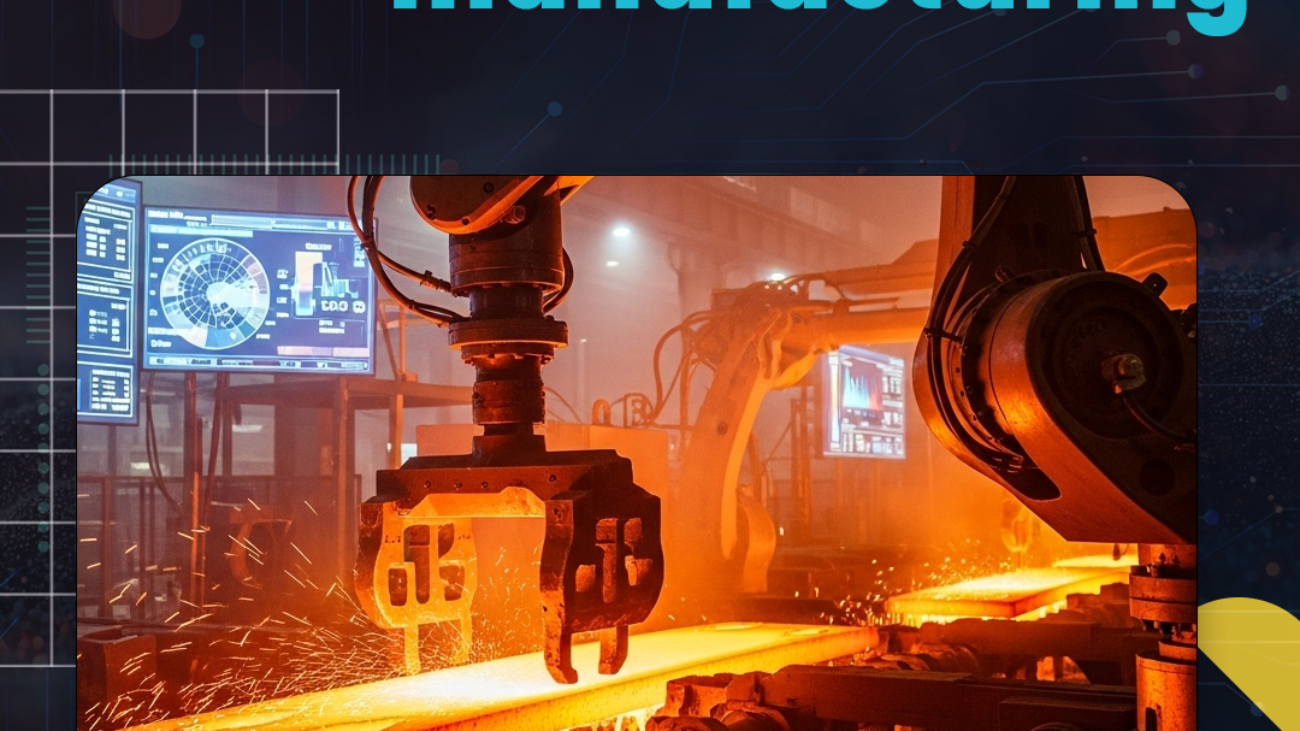
AI in Steel Production Smarter Production Smarter Production

Integrate AI into every stage of steel manufacturing  from quality inspection to process optimization. Detect defects early, improve yield, and achieve consistent, high-grade steel with intelligent automation.

The New Face of Steel: How Artificial Intelligence Is Transforming an Old Industry

Artificial intelligence is breathing new life into the steel sector. It moves operations from reactive fixes to proactive control. AI algorithms analyze real-time data from countless sensors on the production line. They monitor temperature, pressure, and chemical composition with incredible precision.

This allows for instant adjustments that enhance quality and efficiency. Leading companies are already seeing impressive results. For instance, ArcelorMittal successfully reduced product defects in its automotive steel by 15% using an AI-powered system. This technology is not just an upgrade; it’s a necessary evolution.

The Need for Accurate and Relevant Data

AI’s power is directly tied to the quality of its data. To be effective, machine learning models need a constant stream of high-quality information. In steel production, this means capturing every detail. Data from furnaces, rolling mills, and cooling systems all contribute to a complete picture. Without this detailed data, an AI system cannot learn to distinguish a minor hiccup from a critical flaw. Many plants install modern IoT sensors on older equipment for this reason. A robust data infrastructure is the true foundation for a successful digital transformation in the industry.

Read Also : Machine Learning in Production–From Models to Real Impact

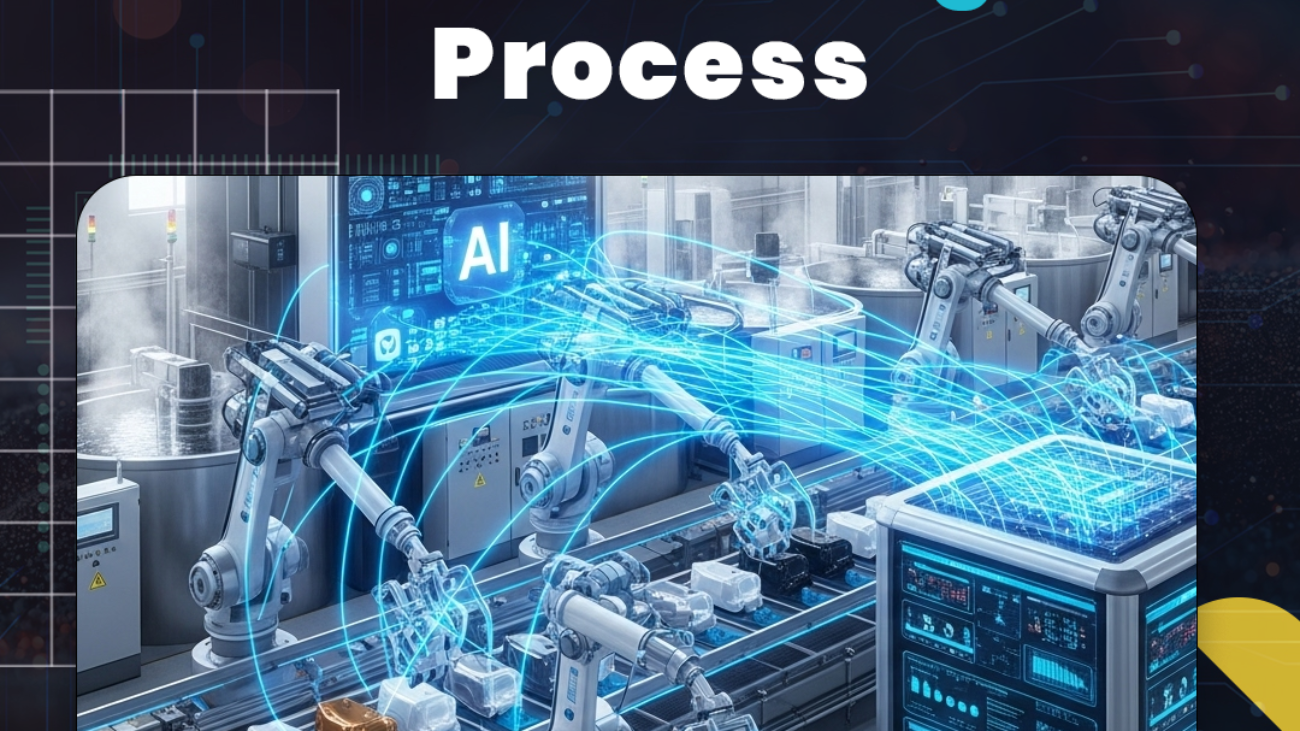
AI-monitored hot steel rolling line with robots in a steel plant

Applications of AI in Steel Manufacturing

With a solid data foundation, AI’s applications become transformative. The impact is felt directly on the factory floor in several key areas. These are practical benefits that redefine what is possible in modern Steel manufacturing. Here’s a closer look at where the technology makes a real difference.

Preventing Errors Before They Occur

The best way to manage defects is to prevent them entirely. AI makes this possible through real-time AI-driven quality control. AI-powered computer vision systems act as tireless inspectors. They can spot microscopic cracks and surface flaws with over 95% accuracy.
This is a task no human team could ever match. Our system, AI2Eye, was designed for this exact purpose. It brings cutting-edge defect detection directly to your production line. Catching issues instantly means less waste, fewer slowdowns, and a stronger bottom line. In fact, some plants have cut quality-related complaints by nearly 40% with this approach.

Improved Product Quality

Consistency is the hallmark of quality steel. AI ensures every batch meets exact specifications. The system analyzes thousands of data points to predict the final properties of the steel. It then makes subtle adjustments to the production process automatically.

This data-driven approach removes guesswork and human error. Voestalpine, another industry leader, managed to reduce its final product defect rate by more than 20% by using AI-driven computer vision. The result is a more reliable and valuable product for the end customer.

Cost Reduction and Energy Efficiency

Operational costs are a major concern in Steel manufacturing. AI tackles this challenge head-on. Predictive maintenance algorithms can forecast equipment failures. This reduces unplanned downtime by as much as 30%, saving significant repair costs.

AI also optimizes energy consumption. By fine-tuning furnace operations and material mixtures, plants can lower their energy bills substantially. Major producers have reported energy savings between 5% and 7% by using AI to guide their smelting processes. These small percentages translate into millions of dollars in annual savings.

Data-Driven Insight

Beyond immediate process control, AI delivers invaluable long-term insights. It transforms raw production data into clear, actionable intelligence. These insights can reveal hidden bottlenecks in the supply chain or improve demand forecasting by up to 10%.

This empowers managers to make smarter, data-backed decisions. For the technical teams pioneering these new solutions, tools that accelerate the development cycle are crucial. That’s why we developed AI2Cam. It’s a virtual camera emulator that allows developers to test machine vision applications without needing physical hardware, saving time and resources.

Conclusion

The evolution of steel production is no longer just about stronger alloys. It is about smarter processes built on intelligent data. By embracing AI, companies can achieve remarkable gains in quality, efficiency, and sustainability. The tools to begin this transformation are available now. This new chapter in Steel manufacturing is not a future possibility; it is a present reality.


FAQ

How is AI used in steel manufacturing processes?

AI is used to monitor production lines, optimize furnace operations, predict equipment failures, and inspect steel surfaces for defects using computer vision systems.

Yes, AI analyzes operational data to optimize temperature control, fuel usage, and production schedules, helping steel manufacturers lower energy costs and reduce emissions.

AI improves quality by detecting defects early, maintaining consistent processing conditions, and predicting quality issues before they affect final products.

AI in packaging manufactoring

AI is Transforming Packaging Manufacturing

The packaging sector is evolving faster than ever. Once defined by mechanical efficiency, it now faces demands for greater intelligence, sustainability, and precision. Artificial intelligence is the critical technology meeting this challenge. It moves operations beyond simple automation to create truly responsive systems. AI is Transforming Packaging Manufacturing, turning data into a powerful asset for quality and efficiency. At AI-innovate, we develop practical AI tools to solve these real-world industrial challenges. This article provides a clear guide to understanding AI’s powerful impact on the packaging industry.

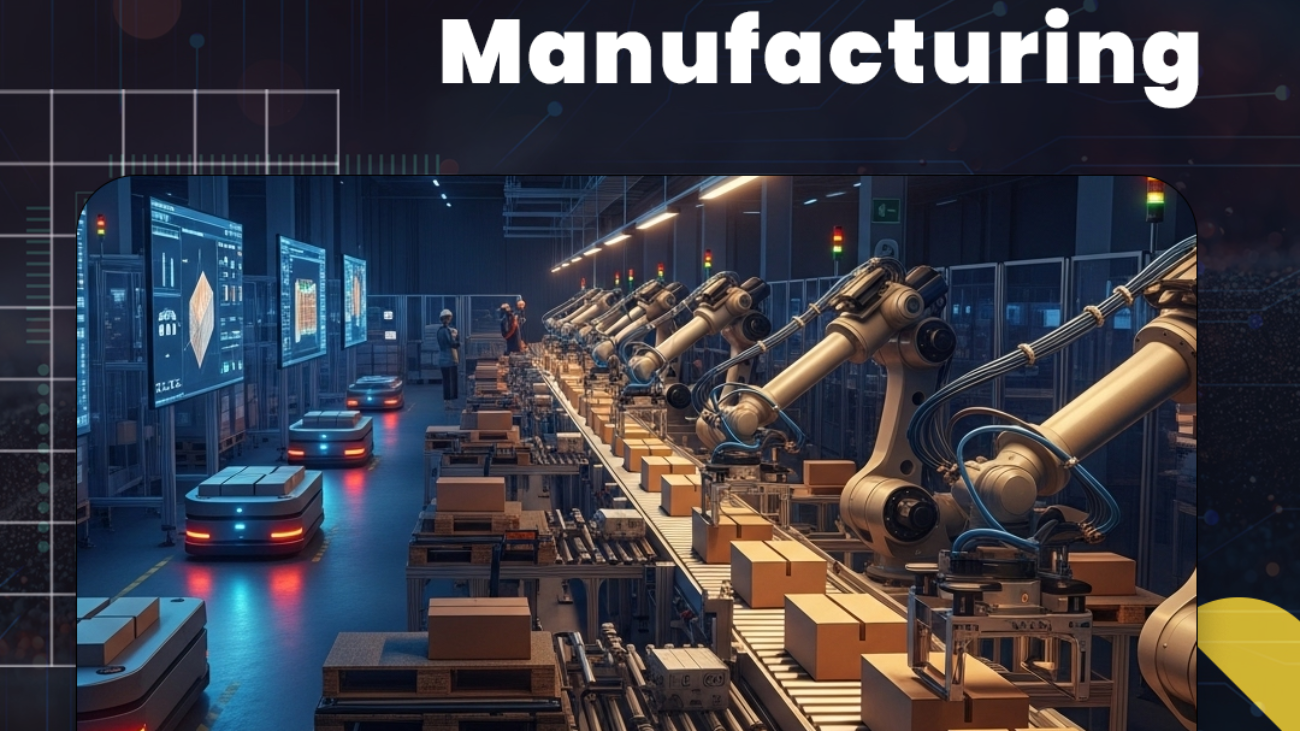
AI in Packaging Smarter Production Flawless Results.

From defect detection to material optimization, AI is revolutionizing packaging manufacturing. Boost efficiency, reduce waste, and deliver perfect packaging every time with intelligent automation.

AI in Packaging?

When we discuss AI in packaging, we’re talking about a fundamental shift from automated repetition to intelligent adaptation. AI systems learn from production data, enabling them to make predictive and optimized decisions that were previously impossible. This integration delivers significant and measurable returns for manufacturers. To better understand its impact, consider these core benefits:

  • Drastic Waste Reduction: AI-powered quality control catches defects in real-time. This minimizes scrap material and faulty products. Some applications have reduced packaging material use by up to 30%.
  • Enhanced Operational Efficiency: AI optimizes production schedules and automates complex tasks. This leads to faster throughput and streamlined processes, increasing overall output.
  • Predictive Maintenance: Smart sensors integrated with AI can predict machinery failures before they happen. This proactive approach avoids costly downtime and extends the life of valuable equipment.
  • Guaranteed Quality and Consistency: AI vision systems inspect products with a level of precision that humans cannot sustain. This ensures a higher standard of quality, which strengthens brand reputation.

AI improving packaging Design

The influence of AI begins long before the production line starts. It is a powerful partner in the design phase, where smart algorithms help create better packaging from the ground up. By analyzing factors like material strength, weight, and consumer trends, AI can generate design options that are both structurally sound and appealing to the market.

This data-first approach shows how AI is Transforming Packaging Manufacturing from the very first step. A key challenge, however, is testing how these new designs will perform in automated systems.

For developers creating these machine vision applications, our AI2Cam software provides a vital solution. It is a virtual camera emulator that allows engineers to prototype and test their software without needing physical hardware. This accelerates innovation, reduces development costs, and allows teams to collaborate remotely and efficiently.

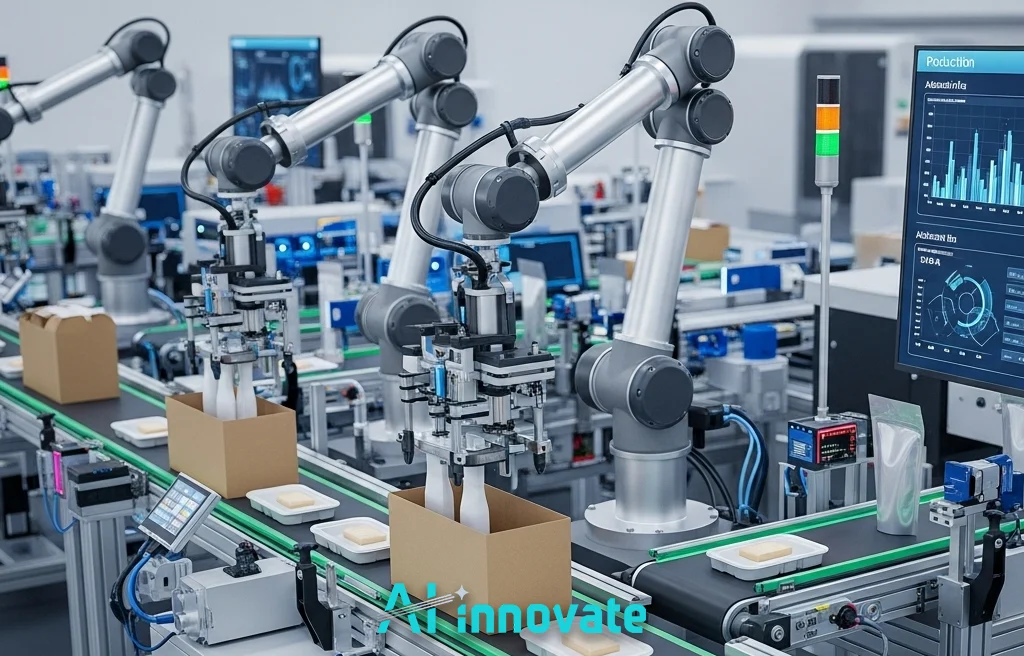
Automated factory production line with multiple silver robotic arms placing products into cardboard boxes on a conveyor belt, next to a monitor displaying AI production data and graphs.

Speed and precision with AI

On the factory floor, the combination of speed and precision is essential. This is where AI-powered machine vision systems excel. They can inspect thousands of units per minute, identifying microscopic defects like cracks in bottle caps or tiny misalignments in labeling that are invisible to the naked eye.

This capability goes far beyond human inspection, ensuring every product meets exact quality standards without slowing down production. Solutions like our ai2eye system are a clear example of how AI is Transforming Packaging Manufacturing.
Our AI2Eye system integrates directly into the manufacturing line, acting as a set of super-powered eyes. It performs real-time defect detection and also analyzes the entire process to identify hidden bottlenecks.
By providing data-driven insights, AI2Eye helps operators make adjustments that boost efficiency, reduce waste, and guarantee a higher-quality final product for industries from polymers to packaging.

Read Also : AI Defect Detection Solutions

Optimising Distribution and Sustainability

AI’s impact extends far beyond the factory, reshaping logistics and advancing sustainability goals. In distribution, intelligent algorithms analyze variables like traffic, weather, and fuel costs to optimize delivery routes.
This doesn’t just speed up delivery; it can cut logistics costs by up to 25%. At the same time, AI is a crucial tool for sustainability. For example, Lenovo used an AI system to reduce its packaging materials by 35% and cut its carbon emissions by 50,000 kg.

AI also helps create a circular economy by improving waste-sorting technologies and helping designers select eco-friendly, recyclable materials. Navigating these opportunities requires expertise. We encourage you to reach out to our team to discuss how AI can optimize your specific operations.

AI reshaping the packaging industry

The evidence points to a clear and exciting future. From designing sustainable materials to ensuring flawless quality control and optimizing global supply chains, artificial intelligence is no longer a theoretical concept. It is a practical, powerful, and essential tool for modern industry. The journey shows that AI is Transforming Packaging Manufacturing for the better, making it smarter, faster, and more responsible. This intelligent revolution is creating new opportunities for growth and innovation across the entire sector.

Note: Some graphics and visuals in this post were produced using AI-generated content.

AI in the Aluminum Anodizing Process

How AI Improves Aluminum Anodizing

With the aluminum anodizing market set to exceed $3.5 billion by 2025, AI is transforming the way manufacturers optimize their anodizing processes. Traditional anodizing methods may be inefficient, inconsistent, and can be dependent on manual monitoring. In industries where aluminum anodizing is crucial, AI refines this process by reducing waste, improving precision, and enhancing cost-efficiency. In this guide, we’ll discuss the real-world use cases and the benefits of integrating AI into the aluminum anodizing process in greater detail.

AI in Aluminum Anodizing Perfect Finish Every Time

Harness AI to monitor and optimize the anodizing process  from surface preparation to color consistency. Detect defects early, ensure flawless coating quality, and achieve unmatched precision in aluminum finishing.

AI in the Aluminum Anodizing Process

When exposed to the environment, aluminum forms a thin aluminum oxide layer, which erodes over time. Anodizing is an electrochemical process that forms a protective oxide layer on aluminum, increasing corrosion resistance, durability, and aesthetic qualities.

Anodized aluminum is widely used everywhere, which means optimized production is essential to meet the market demand. Implementing AI into the process is a good solution to this problem, as it transforms how we work with aluminum anodizing. AI spots patterns using smart algorithms to find bottlenecks in the process. This makes inspection faster and more precise, leading to better quality as the outcome.

How AI Optimizes the Aluminum Anodizing Process

AI is becoming an important part of modern aluminum anodizing, helping manufacturers run more efficient and consistent operations. Some of the key ways AI is improving the anodizing process is mentioned below.

  1. Predictive Maintenance: AI provides predictive insights. It can identify potential defects or equipment issues before they occur, allowing operators to take corrective action proactively.
  2. Data Collection: AI systems draw data from sensors that track factors such as voltage, temperature, and chemical concentrations
  3. Visual Inspection: High-resolution cameras capture surface images, detecting any inconsistencies in the anodized aluminum as they appear.
  4. Instant Alerts and Corrections: The system then sends alerts for quick corrective action.
  5. Real-Time Adjustments: AI can automatically adjust process settings in real time to maintain optimal conditions. This helps keep production on schedule, improve throughput, and reduce variability between batches.
  6. Process Optimization: AI and machine learning are applied to enhance the aluminum anodizing process by improving control, consistency, and overall efficiency.

By analyzing data and monitoring the process in real time, AI can detect issues early, make automatic adjustments, and keep production running smoothly. It supports better quality control, reduces waste, and helps teams make faster, more informed decisions.

Where AI-optimized Aluminum Anodizing is Used

  • Automotive and Aerospace: Anodized components need to meet tight standards for durability and consistency. AI-driven process control certifies that every batch maintains the same hardness and corrosion resistance.
  • Industrial Anodizing Plants: AI systems track current draw patterns and bath conductivity trends. This lets operators spot early signs of wear in rectifiers or electrode plates and schedule maintenance.
  • Architectural Applications: In architectural anodizing, where large volumes of aluminum are treated for building materials, AI monitoring minimizes chemical waste by predicting the ideal time to refresh acid baths.
  • Consumer Electronics: AI-powered visual inspection tools can check millions of anodized units, ensuring perfectly uniform tones across entire product lines while reducing the need for manual quality checks.
  • Marine and Aerospace Engineering: AI simulates how anodized coatings will hold up under harsh conditions like salt spray and temperature cycling. This helps engineers choose the best treatment process early on.

Benefits and Limitations of AI-Enhanced Aluminum Anodizing

Although AI brings huge advantages to the aluminum anodizing process, there are some notable downsides to it as well. To get a clearer picture, take both into consideration.
Benefits of AI in Aluminum Anodizing

  • Increased Efficiency: AI streamlines the anodizing process by analyzing data and adjusting parameters. It reduces downtime and minimizes manual intervention.
  • Improved Quality: With AI monitoring every step, consistency becomes the new standard. This leads to higher-quality finishes, fewer rejects, and greater customer satisfaction.
  • Cost Reduction: Fewer defects mean less rework while predictive maintenance prevents costly equipment failures. Over time, these improvements lower overall operating costs.
  • Sustainability: AI reduces waste and chemical consumption. Smarter energy management further cuts emissions, helping anodizing plants meet sustainability targets.

Our AI2Eye software is an example of an AI tool providing real-time defect detection and process optimization. Our AI2Cam also advances inspection and design capabilities by enhancing machine vision development and inspection.

Limitations of AI-improved Aluminum Anodizing

  • Data Quality: AI is only as good as the data it receives. Inconsistent sensor readings or poorly calibrated equipment can lead to inaccurate predictions or false defect detections.
  • Complexity and Skill Gaps: Operators may need additional training to understand how AI decisions are made or how to interpret its recommendations.
  • Continuous Training: AI models need continuous updates to adapt to new materials. If AI models aren’t retrained regularly with new data, their accuracy can decline.
  • Overreliance on Automation: Skilled operators often catch context-specific issues that automated systems might misinterpret. Depending too heavily on AI increases the chance of such misinterpretations.

Conclusion

AI is changing the ways of aluminum anodizing by making processes faster, more precise, and more cost-effective. With AI, manufacturers can produce high-quality products while reducing waste and unnecessary cost. As AI continues to improve, companies that adopt these technologies will be better positioned to keep up with the ever-increasing demand.

FAQ

What role does AI play in optimizing this process?

AI makes aluminum anodizing more precise, efficient, and sustainable, while reducing defects, downtime, and costs.

AI improves consistency, reduces defects, and optimizes overall efficiency.

  1. Using data-driven algorithms to forecast how the anodizing process will behave under different conditions.
  1. It makes anodizing more consistent, more sustainable, saves time, reduces costs, and maintains competitive quality standards.

It leverages algorithms and machine learning to regulate the anodizing process. It gathers data from sensors and PLCs, analyzes it in real time, and adjusts process parameters.

Depending on the complexity of the anodizing operation, the type of equipment, and the level of AI integration, it may take from weeks to a few months.

AI for Thermal Quality Inspections

AI for Thermal Quality Inspections

Key Takeaways

Seeing beyond human limits:

AI-powered thermal vision reveals what traditional inspection often overlooks. It uncovers hidden cracks, overheating components, and subtle defects, helping manufacturers achieve unmatched precision and product reliability.

Turning heat into insight:

By transforming raw thermal data into real-time intelligence, AI predicts equipment stress, identifies early warning signs, and prevents costly downtime before production is affected.

Innovation that drives performance:

With advanced tools like AI2Eye and AI2Cam, manufacturers gain smarter oversight, faster decision-making, and a safer, more efficient production environment built on data-driven intelligence.

What if you could predict a system failure weeks in advance or eliminate an entire class of product defects permanently? These outcomes are no longer theoretical. The limitations of manual inspection have historically capped operational efficiency, but a smarter approach is now available. Strategic implementation of AI to Thermal Quality Inspections directly addresses these challenges by automating oversight and catching anomalies the human eye misses. At AI-innovate, our mission is to deliver these tangible results, boosting your ROI through intelligent, proactive quality assurance.

AI-Powered Thermal Inspection See Beyond the Surface.

Leverage AI with thermal imaging to detect hidden defects, temperature anomalies, and process irregularities instantly. Enhance quality control, prevent failures, and ensure every product meets the highest thermal performance standards.

What human eye can’t see?

The human eye is remarkable, but it is not engineered for industrial quality control. Manual inspection is inherently limited by factors that technology can easily overcome. Inspectors face fatigue, which leads to inconsistent results and subjective judgments.

Most importantly, our eyes can only perceive a fraction of the electromagnetic spectrum. We cannot see the subtle thermal variations that often serve as the earliest indicators of a problem. These limitations lead to critical failures in quality inspection. For instance:

  • Microscopic Defects: Cracks or weaknesses in materials may not be visible but often create distinct heat patterns under stress.
  • Electrical Faults: Overheating components are a primary sign of malfunction, a phenomenon entirely invisible to the naked eye. Such issues are significant, with electrical failures accounting for roughly 24% of all industrial fires.
  • Inconsistent Seals: Improperly sealed packages can have temperature variations that reveal leaks or contamination risks.

It’s time to go thermal

To see these hidden issues, industries must look beyond visible light. This is the role of thermal imaging. Thermal cameras capture infrared radiation, which all objects emit, and convert it into a visual heat map. Suddenly, a component on the verge of failure glows brightly. A faulty seal on a product appears as a cool spot. This technology provides an entirely new layer of information. Switching to thermal inspection is no longer a niche choice but a strategic necessity.

By monitoring these heat signatures, manufacturers can address problems proactively. Systems that apply AI to Thermal Quality Inspections automate this entire process. Instead of having an operator interpret complex thermographic images, intelligent algorithms analyze the data in real-time, identifying anomalies with superhuman speed and precision.

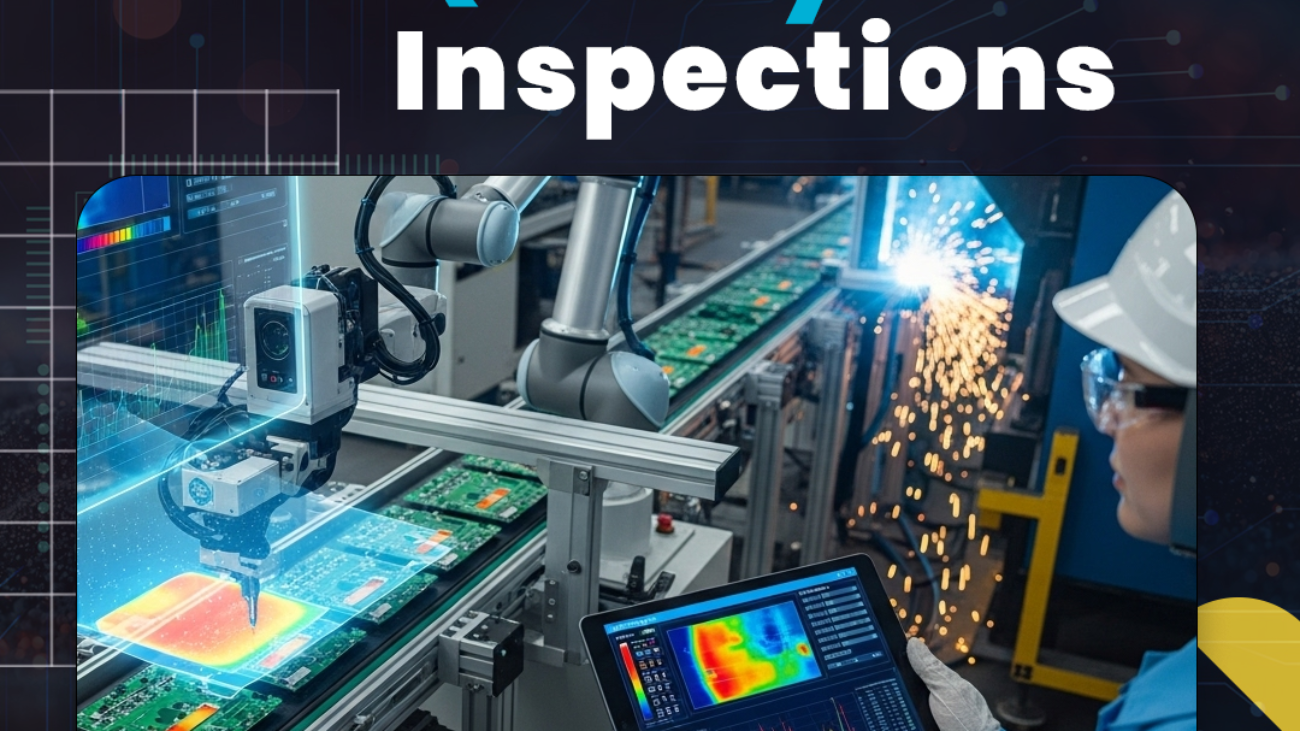
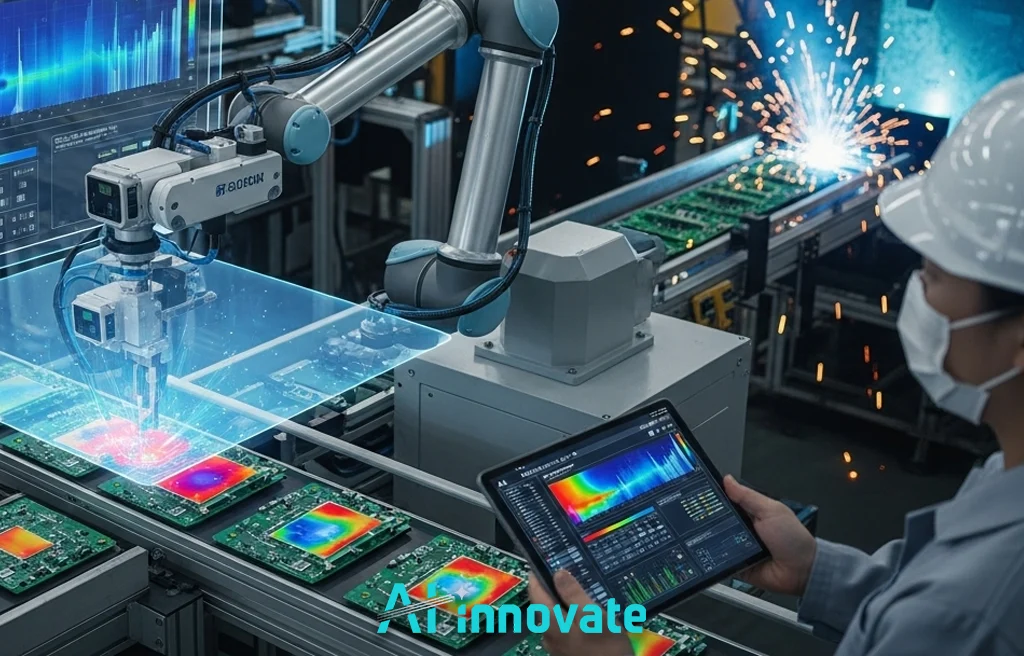
Worker using AI for Thermal Quality Inspections in a production line of pcb boards.

AI enhancing Thermal inspection

A thermal camera provides raw data; artificial intelligence provides the meaning. AI algorithms are trained on vast datasets of thermal images, learning to distinguish between normal operational heat patterns and the signatures of specific defects. This elevates thermal inspection from a simple monitoring tool to an intelligent diagnostic system. For example, deep learning models can achieve up to 98% accuracy in identifying different materials based solely on their thermal properties.

This is precisely where our AI2Eye system excels. It integrates directly into the production line, acting as an tireless inspector that never loses focus. AI2Eye analyzes every product’s thermal signature, catching surface defects and process inefficiencies that would otherwise go unnoticed. This constant, automated vigilance empowers manufacturers to make smarter, faster, and more efficient operational decisions.

Benefits of thermal inspection

The advantages of integrating AI with thermal imaging are tangible and deliver a clear return on investment. As this technology matures, its applications are creating transformative results across multiple industries. Below, we explore some of the most impactful benefits that our partners and clients experience.

Data-Driven Insights

AI transforms raw temperature readings into actionable business intelligence. It identifies recurring patterns, correlates thermal data with production outcomes, and pinpoints hidden bottlenecks. This allows managers to move from reactive fixes to proactive process optimization based on empirical evidence, not guesswork.

Predictive Maintenance

Predictive maintenance is one of the most powerful applications of this technology. By detecting early signs of mechanical wear or electrical stress, systems can forecast equipment failures before they happen. This approach has been shown to reduce maintenance costs by up to 30% and eliminate as much as 75% of unplanned downtime.

Early Defect Detection

Many defects are invisible until the final stages of production, leading to significant waste. Thermal inspection catches flaws at their source. In complex processes like welding, AI-powered thermographic analysis can identify faulty welds with nearly 99% accuracy, ensuring structural integrity and product safety from the start.

Enhanced Safety

Automated thermal monitoring creates a safer working environment. AI systems can provide 24/7 surveillance of critical infrastructure to prevent fires. Furthermore, specialized models trained on over 21,000 images can now detect thermal threats to workers, such as proximity to hot surfaces, with over 99% precision.

Integrating AI into Thermal Monitoring: From Sensors to Insights

The journey from a sensor to a valuable insight is a seamless process with modern AI tools. First, high-resolution thermal cameras capture data from the production line. This data is fed into an AI model that processes the images in real-time. The model then identifies and flags any deviations from the established quality standards. This is the foundational workflow that enables effective AI to Thermal Quality Inspections.

To accelerate this integration, we developed AI2Cam. This powerful camera emulator allows engineers and R&D specialists to develop and test their machine vision applications without needing physical hardware. Teams can simulate various camera models and conditions, speeding up prototyping and reducing development costs. Explore how your development team can accelerate innovation with our virtual tools.

Confused About Where to Start with AI?

Our specialists help you identify the right AI approach based on your process, data, and goals.

Conclusion

Moving beyond the limitations of human vision is no longer a futuristic concept but a present-day competitive advantage. By leveraging thermal data, we uncover a world of insights that were previously invisible. When enhanced with artificial intelligence, this information drives unprecedented improvements in efficiency, quality, and safety. The future of industrial excellence is being built with AI to Thermal Quality Inspections, ensuring every product meets the highest possible standard.

Note: Some graphics and visuals in this post were produced using AI-generated content.

Ai-Innovate uses only high-quality sources, including peer-reviewed studies, to support the facts within our articles.

  1. Eigen Innovations. (2024). Smarter thermal: Adding AI to thermal quality inspections in manufacturing. Eigen Blog.
    Available at: https://eigen.io/blog/smarter-thermal-adding-ai-to-thermal-quality-inspections-in-manufacturing/
  2. DAC Digital. (2024). Thermal inspection: Examples where AI helps. DAC Digital Insights.
    Available at: https://dac.digital/thermal-inspection-examples-where-ai-helps/
  3. Nilg.ai. (2020). Thermal imaging in AI: How machine learning enhances temperature-based inspection. Nilg AI Blog.
    Available at: https://nilg.ai/202004/thermal-imaging-in-ai/
  4. Scylla AI. (2024). How AI helps monitor thermal anomalies in industrial settings. Scylla Blog.
    Available at: https://www.scylla.ai/how-ai-helps-monitor-thermal-anomalies-in-industrial-settings/
  5. 0hm.hu. (2024). Predictive maintenance with AI and thermal imaging: A General Electric case study. 0hm Projects.
    Available at: https://0hm.hu/en/projects/predictive-maintenance-with-ai-and-thermal-imaging-a-general-electric-case-study/
  6. Oxmaint. (2023). Thermal imaging for predictive maintenance in industry. Oxmaint Blog.
    Available at: https://oxmaint.com/blog/post/thermal-imaging-predictive-maintenance
  7. REVA University RACE Lab. (2023). Thermal image-based fault detection using machine learning and deep learning in industrial machines: Issues, challenges, and emerging trends.
    Available at: https://race.reva.edu.in/race-lab/thermal-image-based-fault-detection-using-machine-learning-and-deep-learning-in-industrial-machines%3A-issues-challenges-and-emerging-trends
  8. ASME Digital Collection. (2024). Machine learning approaches for heat treatment in manufacturing: A review. Journal of Heat Transfer, 148(1), 010801.
    Available at: https://asmedigitalcollection.asme.org/heattransfer/article-abstract/148/1/010801/1219913
  9. MDPI Applied Sciences. (2024). AI-based thermal monitoring systems for industrial quality inspection. Applied Sciences, 14(19), 8878.
    Available at: https://www.mdpi.com/2076-3417/14/19/8878

FAQ

What industries benefit most from AI-based thermal inspections?

Industries such as manufacturing, energy, construction, automotive, and electronics benefit greatly, as thermal inspections help identify overheating equipment, faulty wiring, and material defects.

Yes, AI can identify subtle temperature variations and hidden defects that are difficult for humans to notice, especially in complex systems or large facilities.

Yes, AI systems can process thermal data in real time, allowing companies to monitor equipment continuously and respond quickly to potential failures.

AI in Production Monitoring Systems for Smart Manufacturing

AI in Production Monitoring Systems for Smart Manufacturing

In a smart factory, every machine, sensor, and workstation contributes to a continuous stream of operational data. However, without proper analysis, this information can quickly become overwhelming rather than useful. Many manufacturers still rely on fragmented monitoring tools that provide delayed or incomplete insights into production performance.

This makes it difficult to identify inefficiencies, quality risks, or emerging equipment issues before they escalate. Artificial intelligence (AI) is transforming production monitoring by turning raw data into meaningful, real-time insights. Through pattern recognition and adaptive learning, AI systems help organizations understand how their processes behave under different conditions.

This article will explain how AI-driven monitoring systems work in smart manufacturing environments, the problems they solve, and how they enable manufacturers to maintain stability, improve productivity, and build more resilient operations.

Smart Manufacturing Smarter Monitoring with AI

Harness the power of AI to anticipate and prevent production defects before they occur. Boost efficiency, ensure consistent quality, and transform your manufacturing process from reactive to predictive.

AI Technologies in Real-Time Data Monitoring

Artificial intelligence is not a single entity but a suite of powerful technologies working in concert to interpret the complex language of your production line. These tools analyze vast amounts of data from sensors, cameras, and machinery in milliseconds, providing insights that were previously impossible to capture. To fully appreciate this transformation, let’s explore the core technologies driving this shift and the immediate operational advantages they provide.

Real-Time Visibility into Operations

At its core, AI-powered monitoring grants unprecedented, real-time visibility. By deploying advanced models like You Only Look Once (YOLO) for object detection and sophisticated tracking algorithms, our systems create a dynamic, digital twin of your production environment.
This means every component, process, and station is monitored continuously. You are no longer managing based on yesterday’s reports but on live, actionable intelligence, turning raw data into a clear view of your operations as they happen.

Operational Efficiency Through Streamlined Processes

Visibility naturally leads to efficiency. AI systems excel at identifying patterns and anomalies that signal production bottlenecks or inefficiencies. For example, by analyzing cycle times and material flow, the system can pinpoint the exact stage where delays occur, allowing for targeted process improvements.
This data-driven approach removes guesswork, helping you streamline workflows, balance production loads, and maximize the output of every single machine and operator on the floor.

Eliminating Manual Reporting

Manual data collection and reporting are notoriously time-consuming and prone to human error. AI systems automate this entire process. Key Performance Indicators (KPIs) like production counts, cycle times, and defect rates are generated automatically and with complete accuracy.
This frees your team from tedious administrative tasks, reduces the risk of inaccurate data influencing decisions, and ensures that everyone from the operations director to the QA manager has access to a single, reliable source of truth.

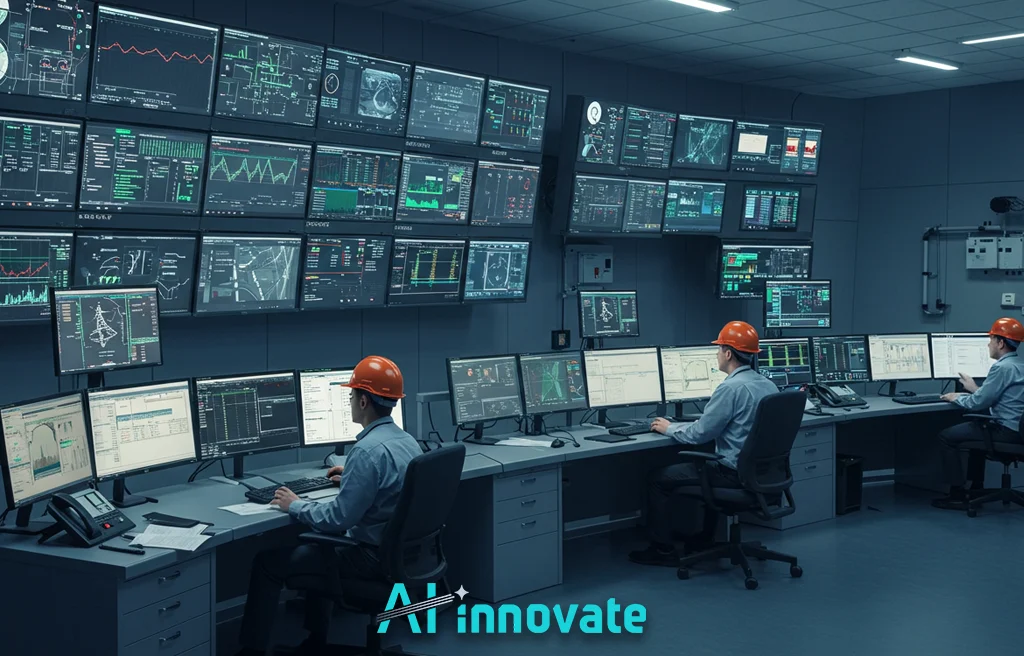
Operators in a dark command center monitoring data. Three workers in orange hard hats sit at a long desk, looking at multiple computer monitors displaying complex control charts, sensor data, and flow diagrams, beneath a wall of dozens of monitoring screens. The text "AI innovate" is at the bottom.

Benefits of Real-Time AI Monitoring in Manufacturing

Understanding the technology is one thing; witnessing its tangible impact on your bottom line is another. Implementing AI for Proactive Defect Prediction moves beyond theoretical gains and delivers measurable improvements in quality, speed, and reliability.
These benefits create a powerful ripple effect across the entire manufacturing value chain. Let’s delve into three of the most significant advantages that real-time AI monitoring brings to the factory floor.

Read Also : Real-time Defect Analysis – Precision at Production Speed

Quality inspection and error detection

Even the most skilled human inspector can experience fatigue or miss microscopic defects. Our ai2eye system acts as a super-powered, vigilant set of eyes on your production line, using advanced computer vision to inspect every single product in real-time.
It can detect subtle surface imperfections, assembly errors, or material inconsistencies with a level of precision that is simply superhuman. By catching these defects the moment they occur, you drastically reduce waste, minimize rework, and ensure only the highest quality products reach your customers.

Optimizing Operations Through Smarter Production Planning

Beyond simple defect detection, AI analyzes production data to enable smarter, more agile planning. By understanding the intricate relationships between different machines and processes, these systems help optimize scheduling and resource allocation.
For example, the industrial solutions provider Grundfos reduced its energy consumption by 15% by using AI to control and monitor its systems. This same principle applies to managing inventory, anticipating demand shifts, and ensuring a smoother, more cost-effective production cycle.

Intelligent Maintenance and Automated System Recovery

Unexpected equipment failure is one of the costliest disruptions in manufacturing. AI-powered intelligent maintenance shifts the paradigm from reactive repairs to predictive intervention.
By analyzing sensor data like temperature and vibration, algorithms can predict when a machine is likely to fail and schedule maintenance before a breakdown occurs. Some studies show this approach can reduce production downtime by as much as 70%, maximizing the lifespan and reliability of your critical assets.

Implementation Strategies

Adopting these powerful systems requires a clear and phased strategy to ensure a successful integration with your existing workflows. The goal is to build a solution that solves specific challenges and delivers a clear return on investment.
With the right approach, implementing a system for AI for Proactive Defect Prediction becomes a manageable and highly rewarding process. We guide our clients through a few essential steps.

Define Clear Objectives

We begin by identifying your most critical pain points. Is it reducing a specific type of defect? Or perhaps minimizing downtime on a key production line? A focused goal ensures the AI solution is tailored to deliver measurable results.
Establish a Robust Data Infrastructure: High-quality data is the lifeblood of any AI system. This involves ensuring your sensors and Industrial Internet of Things (IoT) devices are capturing clean, relevant information for the AI models to analyze.

Leverage Agile Development and Prototyping

The development and testing phase can often be slowed by hardware dependencies. To solve this, our ai2cam virtual camera emulator allows your engineers to rapidly prototype and validate machine vision applications without needing a single piece of physical camera hardware. This accelerates innovation, reduces upfront costs, and allows for extensive testing in a flexible, virtual environment.

Start with a Pilot and Scale

We recommend launching a pilot project on a single line or process. This allows your team to validate the technology, measure its impact, and build confidence before scaling the solution across your entire facility.

Engineers monitoring a factory control room with large screens. Two workers in hard hats stand before multi-panel displays showing live video feeds of machinery, industrial data, and analytics graphs. The text "AI innovate" is at the bottom.

Real-Life Applications

The power of these systems is best seen in action, where AI for Proactive Defect Prediction is already revolutionizing diverse industries. It is not a future-facing technology but a proven solution delivering value today. Here are just a few examples of how it’s being applied:

In the Textile Industry

automated visual inspection systems scan fabrics at high speeds to detect weaving defects, color inconsistencies, and other flaws that are nearly impossible to spot with the naked eye.

For Metal Fabrication

AI algorithms analyze images to identify microscopic cracks or surface blemishes on components, ensuring structural integrity and safety in critical applications like automotive and aerospace.

Read Also : Metal Defect Detection – Smart Systems for Zero Defects

In Packaging and Bottling

systems monitor filling lines to verify correct liquid levels, ensure proper cap sealing, and check for label accuracy and placement, all at a rate of hundreds of units per minute.

Manufacturing Industry Outlook and Impacts

The integration of AI is not a passing trend but a fundamental shift redefining the competitive landscape of manufacturing. The numbers tell a compelling story: the market for AI-powered machine vision is projected to grow from $4.1 billion in 2020 to $15.2 billion by 2025.

Furthermore, Gartner predicts that over 50% of large manufacturing enterprises will be using AI platforms for operational optimization by 2027. This rapid adoption signals that AI is becoming a baseline competency, empowering companies to achieve unparalleled levels of efficiency, quality, and innovation.

Conclusion

AI-powered production monitoring systems are becoming a central pillar of smart manufacturing. These platforms convert real-time data into predictive and prescriptive insights, helping manufacturers improve process stability, reduce waste, and enhance operational performance. Their ability to continuously learn enables them to adapt as conditions change, supporting long-term reliability and scalability.

In my view, the greatest advantage of AI monitoring is situational awareness. When teams understand how their operations behave at every stage, they can proactively optimize rather than react defensively. As smart factories evolve, AI-driven monitoring will play a pivotal role in creating efficient, transparent, and self-improving production environments.

Note: Some graphics and visuals in this post were produced using AI-generated content.

FAQ

How does AI improve production monitoring systems?

AI analyzes real-time data from machines, sensors, and workflows to detect inefficiencies, predict downtime, and optimize production performance automatically.

AI uses data such as machine speed, temperature, vibration, output rates, defect rates, and maintenance logs to evaluate system performance and identify potential issues.

Yes, AI enables predictive maintenance by identifying early warning signs of equipment failure, allowing maintenance teams to take action before breakdowns occur.

Yes, many AI solutions are scalable and cloud-based, making them affordable and practical for small and medium manufacturers as well as large industrial plants.

Ai-Innovate uses only high-quality sources, including peer-reviewed studies, to support the facts within our articles.

  1. Nature Scientific Reports. (2025). AI Strategies for Smart Production Monitoring and System Optimization.
    A peer-reviewed research article examining how artificial intelligence enhances production monitoring, supports real-time decision making, and improves operational performance in smart manufacturing environments.
    Retrieved from https://www.nature.com/articles/s41598-025-25413-6

  2. Datategy. (2024). How AI Transforms Production Lines into Smart Manufacturing Systems.
    An industry article explaining how AI technologies are applied across production environments to improve monitoring, automation, and overall system intelligence.
    Retrieved from https://www.datategy.net/2024/12/17/how-ai-transforms-production-lines-into-smart-manufacturing-systems/

  3. Flowdit. (n.d.). AI in Manufacturing.
    A practical overview describing how artificial intelligence is integrated into manufacturing operations, including production monitoring, defect detection, and process improvement.
    Retrieved from https://flowdit.com/ai-in-manufacturing/

Digital twin for defect detection: an inspection camera comparing a real metal part with its digital twin to find defects

Digital Twins for Defect Detection: How Digital Twins and Computer Vision Improve Quality Inspection

A digital twin for defect detection is a virtual model of a product or process that is continuously updated with real production data. Inspection systems, such as cameras and sensors, compare what is actually produced with what the twin expects, so deviations are found and traced back to the process step that caused them. Digital twins also generate simulated images and synthetic defects for training computer vision models before a line is running.

Imagine being able to test, monitor and improve a production line without stopping a machine or risking a batch of material. That is what digital twins offer manufacturing. As production becomes faster and more complex, manual checks, delayed feedback and fragmented data leave manufacturers reacting to defects instead of preventing them. Digital twins, combined with AI-powered inspection, connect physical processes with virtual models that predict and explain quality problems. This article explains what digital twin inspection is, how digital twins work with computer vision, what research shows, and where the technology adds value today.

Key Takeaways

A true digital twin exchanges data with the real process in both directions; a one-way copy is only a digital shadow.

Computer vision supplies the twin with real measurements, and the twin supplies vision with expected geometry and context.

Digital twins can generate synthetic defect images, which helps when real defect samples are rare.

The value depends on model accuracy and data quality, so twins are usually built step by step, starting from one process.

Understanding Defect Detection

Defect detection is the process of identifying product imperfections that do not meet design or quality standards. When it is done manually by inspectors, it is affected by fatigue and inconsistency, and defects are often found late, which leads to waste and rework.

The field is moving to automated, AI-driven inspection. Machine vision systems inspect continuously, detect defects in real time and connect them with process data to find root causes. See defect detection in manufacturing for an overview.

What Is Digital Twin Inspection?

Digital twin inspection means inspecting a product or process against its digital twin instead of against a fixed specification only. Measurements from cameras, laser profilers and sensors are mapped onto the virtual model, so each deviation is seen in context: where it is on the part, which process step created it and how it compares with earlier units.

Role of Digital Twins in Defect Detection

A digital twin is not a static 3D model. It is a virtual representation of a physical object or process that is synchronized with data from the real system. Research distinguishes three levels: a digital model has no automatic data link, a digital shadow is updated automatically from the physical system, and a digital twin exchanges data in both directions, so the virtual model can also influence the real process (Kritzinger et al., 2018).

This continuous data flow lets the model simulate outcomes, predict behavior and analyze performance. In defect detection, the role of a digital twin is to move quality control from reaction to prediction: simulations on the virtual model show which process conditions are likely to create defects before they appear on real products.

By combining historical and live data, a digital twin can recognize small deviations from optimal process parameters, so a developing problem can be flagged before it becomes a defect or a failure.

Engineer monitoring a digital twin dashboard for defect detection in a smart factory

Core Mechanisms of Digital Twin–Based Defect Detection

A digital twin for defect detection works as a feedback loop between the factory floor and its virtual counterpart, in four stages:

  • Data Acquisition: The process originates with information. IoT sensors, industrial cameras, and laser profilometers are situated on the production line to gather a continuous flow of data. This includes vital metrics such as temperature, vibration patterns, component dimensions, and detailed images collected from the physical asset.
  • Virtual modeling: the data updates the digital twin so that it reflects the current state of the real product or process. The model also holds the design and the expected condition, which serve as the reference for comparison.
  • AI-Powered Analysis: Here, intelligence comes into play. Machine learning algorithms perform a continuous comparison between the live data stream and the virtual model’s ideal parameters. The system is trained to identify complex patterns and anomalies that indicate specific defect types, from hairline surface cracks to minute printing irregularities.
  • Real-time Feedback: Upon detecting a significant deviation, the system immediately flags the potential issue. It can also initiate automated corrective measures or alert operators for manual intervention, effectively closing the quality control loop.

Digital Twins and Computer Vision for Quality Inspection

Computer vision and digital twins complement each other. Vision systems give the twin real measurements of every part: images, dimensions, surface condition and defects. The twin gives the vision system context: the expected geometry from CAD, the process conditions when the part was made and the history of similar parts.

  • Model-based comparison: 3D scans or images are compared with the CAD-based twin to find shape deviations and missing features.
  • Defect localization: each defect found by the camera is placed on the virtual part and linked to the machine and process step that made it.
  • Simulated inspection: camera positions, lighting and field of view are tested in the virtual environment before hardware is installed.
  • Closed-loop correction: recurring defects trigger changes to process settings, which the twin can test virtually first.

What Research Shows

Reviews of digital twin research list prognostics and health management, including fault detection and diagnosis, as one of the main industrial applications of digital twins, alongside product design and production (Tao et al., 2019). A categorical review found that most published work describes digital models or digital shadows, while full digital twins are still scarce, and it names data connectivity and the lack of practical case studies as open issues (Kritzinger et al., 2018).

Read Also: Real-time Defect Analysis – Precision at Production Speed

Synthetic Defect Data and Simulation

Building and training defect detection models takes time, and testing with physical equipment is slow and expensive. Digital twins help in two ways. First, cameras, lighting and production scenarios can be simulated, so inspection setups are tested before hardware is installed. Second, 3D models of the product can be used to generate synthetic defect images, such as scratches, dents or missing features placed on reconstructed 3D objects, which helps train computer vision models for rare defects that are difficult to collect on a real line.

Use Cases Across Industries

Digital twins are already used in quality assurance, with different levels of maturity in different industries:

  • Discrete manufacturing: digital twins trace product defects back to the station and process step on the assembly line where they originate, helping engineers correct systematic process errors.
  • Automotive production: digital twins of body and assembly processes are used to check geometry and fit virtually and to find the causes of dimensional deviations.
  • Energy Sector: For offshore wind turbines, digital twins actively monitor the structural health and condition of components like blades. These systems can identify developing problems before they become critical failures, preventing expensive outages and improving operational safety.
  • 3D printing: in fused deposition modeling (FDM), a digital twin can compare the printed structure with the 3D design layer by layer and detect flaws such as over-extrusion as they occur.

Read Also: Digital Twins and 3D Printing AI

Industrial robot and process plant monitored by a digital twin for defect detection

Real Example: Linking Defects to Their Causes in an AI-innovate Project

In an AI-innovate project with a continuous textile manufacturer, an AIxEye-based system moved inspection to 100% automated coverage and reduced the QC staff requirement by 50%. Defect data was linked to suppliers, raw materials and seasonal conditions, the kind of process context a digital twin builds on. Read the textile defect detection case study.

Benefits of Using Digital Twins in Defect Detection

Digital twins turn quality control from a cost into a source of process knowledge. The main benefits go beyond finding defects:

  • Significant Waste Reduction: Identifying flaws at their earliest stage allows manufacturers to decrease the volume of scrap material and rejected products, fostering more sustainable and financially sound operations.
  • Enhanced Predictive Maintenance: The digital twin monitors both the product and the machinery. By assessing equipment performance, it anticipates potential failures, thereby minimizing unplanned downtime.
  • Improved product quality and consistency: continuous, data-based monitoring keeps products within specification and makes quality more consistent between batches.
  • Accelerated Development Cycles: Through virtual prototyping and simulation, the time needed to design, validate, and launch new products or production lines is considerably reduced.

Limits of Digital Twins for Defect Detection

  • Model accuracy: a twin is only as good as its model; if it does not reflect real process behavior, its predictions are wrong.
  • Data integration: data from machines, cameras and quality systems must be connected and synchronized, which is often the hardest part.
  • Cost and effort: building a full twin of a complex process takes time, so most projects start with one machine or one process step.
  • Validation: models must be checked regularly against real results, especially after process or product changes.

Future Outlook

Digital twins are moving toward more autonomy. Beyond finding a potential problem, future systems will adjust machine settings to prevent it, with edge and cloud computing making analysis faster and closer to the line.

Validating the accuracy of digital models will become essential, so that these systems can be trusted for automatic decisions.

Conclusion

Digital twins change defect detection from a reactive task into a continuous, predictive process. By connecting production systems with virtual models, manufacturers see quality risks, process variation and performance gaps earlier. Combined with AI vision and edge processing, digital twins support faster decisions and more consistent quality. AI-innovate helps manufacturers build the inspection data foundation that digital twins depend on.

As the technology matures, digital twins are likely to become a standard foundation for quality assurance, moving manufacturers from isolated inspections to connected, self-improving production.

Before building a full twin, check whether the data it needs is already captured reliably. A digital twin is only as accurate as the sensor and inspection data feeding it, so gaps in that data are the first thing to fix.

Note: Some graphics and visuals in this post were produced using AI-generated content.

This article draws on the following sources:

  • Tao, F., Zhang, H., Liu, A. and Nee, A. Y. C. (2019). Digital Twin in Industry: State-of-the-Art. IEEE Transactions on Industrial Informatics, 15(4), 2405-2415. doi.org/10.1109/TII.2018.2873186
  • Kritzinger, W., Karner, M., Traar, G., Henjes, J. and Sihn, W. (2018). Digital Twin in manufacturing: A categorical literature review and classification. IFAC-PapersOnLine, 51(11), 1016-1022. doi.org/10.1016/j.ifacol.2018.08.474

Frequently Asked Questions

How do digital twins help improve defect detection accuracy?

Digital twins compare real production data with ideal performance models, allowing manufacturers to spot deviations, predict failures, and detect quality issues early.

Implementation depends on data availability and system integration, but many modern platforms are designed to connect with existing machines and sensors with minimal disruption.

A digital shadow is updated automatically from the physical system but does not send data back. A digital twin exchanges data in both directions, so it can also adjust the real process.

Cameras and 3D scanners supply real measurements, the twin supplies the expected geometry and process context, and the comparison shows deviations, their location and their likely cause. Twins are also used to simulate camera setups and generate synthetic defect images.

Digital twin inspection means inspecting a product or process against its digital twin instead of a fixed specification only. Camera and sensor measurements are mapped onto the virtual model, so each deviation is seen with its location, the process step that created it and earlier results.

Yes. 3D models of the product can be used to create synthetic defect images, such as scratches, dents or missing features. This helps train computer vision models for rare defects that are hard to collect on a real line.